第23章恒星の死The Death of Stars
Supernova 1987A超新星1987A
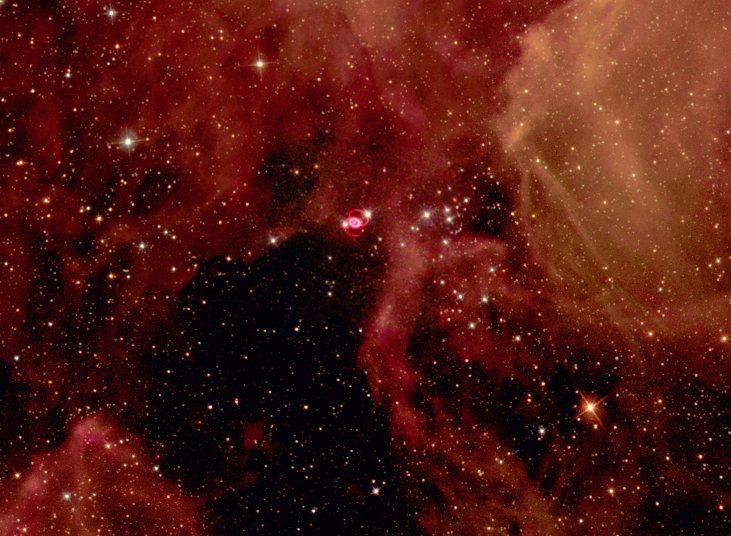
Our most detailed information about what happens when a type II supernova occurs comes from an event that was observed in 1987. Before dawn on February 24, Ian Shelton, a Canadian astronomer working at an observatory in Chile, pulled a photographic plate from the developer. Two nights earlier, he had begun a survey of the Large Magellanic Cloud, a small galaxy that is one of the Milky Way’s nearest neighbors in space. Where he expected to see only faint stars, he saw a large bright spot. Concerned that his photograph was flawed, Shelton went outside to look at the Large Magellanic Cloud . . . and saw that a new object had indeed appeared in the sky (see Figure 23.11). He soon realized that he had discovered a supernova, one that could be seen with the unaided eye even though it was about 160,000 light-years away.
英語のヒント
II型超新星が起こるときに何が生じるか、その最も詳しい情報は、1987年に観測された出来事から得られた。2月24日の夜明け前、チリの天文台で働くカナダ人天文学者イアン・シェルトンは、現像液から写真乾板を取り出した。二晩前から、大マゼラン雲の調査を始めていた。これは、天の川銀河に最も近い宇宙の隣人の一つである、小さな銀河だ。暗い星だけが写っているはずの場所に、大きく明るい点が見えた。写真に欠陥があるのではと心配したシェルトンは、外へ出て大マゼラン雲を見上げた。すると、本当に新しい天体が空に現れていた(図23.11)。彼はすぐに、超新星を発見したのだと気づいた。約16万光年も離れているのに、肉眼で見える超新星だった。
Hubble Space Telescope Image of SN 1987A.ハッブル宇宙望遠鏡によるSN 1987Aの画像。
credit: modification of work by the Hubble Heritage Team (AURA/STScI/NASA/ESA) · CC BY 4.0
Figure 23.11 The supernova remnant with its inner and outer red rings of material is located in the Large Magellanic Cloud. This image is a composite of several images taken in 1994, 1996, and 1997—about a decade after supernova 1987A was first observed. (credit: modification of work by the Hubble Heritage Team (AURA/STScI/NASA/ESA))
図23.11 内側と外側に赤い物質の輪を持つ超新星残骸は、大マゼラン雲にある。この画像は、超新星1987Aが初めて観測されてから約10年後の、1994年、1996年、1997年に撮った複数の画像を合成したもの。(出典:Hubble Heritage Team〈AURA/STScI/NASA/ESA〉の作品を改変)
Now known as SN 1987A, since it was the first supernova discovered in 1987, this brilliant newcomer to the southern sky gave astronomers their first opportunity to study the death of a relatively nearby star with modern instruments. It was also the first time astronomers had observed a star before it became a supernova. The star that blew up had been included in earlier surveys of the Large Magellanic Cloud, and as a result, we know the star was a blue supergiant just before the explosion.
英語のヒント
1987年に初めて発見された超新星だったことから、現在SN 1987Aと呼ばれる。この南の空の輝かしい新顔は、比較的近くの星の死を近代的な装置で調べる、初めての機会を天文学者に与えた。また、超新星になる前の星が観測されていた、初めての例でもあった。爆発した星は、それ以前の大マゼラン雲の調査に写っていた。そのため、爆発の直前には青色超巨星だったことがわかっている。
By combining theory and observations at many different wavelengths, astronomers have reconstructed the life story of the star that became SN 1987A. Formed about 10 million years ago, it originally had a mass of about 20 MSun. For 90% of its life, it lived quietly on the main sequence, converting hydrogen into helium. At this time, its luminosity was about 60,000 times that of the Sun (LSun), and its spectral type was O. When the hydrogen in the center of the star was exhausted, the core contracted and ultimately became hot enough to fuse helium. By this time, the star was a red supergiant, emitting about 100,000 times more energy than the Sun. While in this stage, the star lost some of its mass.
英語のヒント
天文学者は、理論と多くの異なる波長の観測を組み合わせ、SN 1987Aになった星の一生を復元した。約1000万年前に生まれ、初めの質量は約20 MSunだった。一生の90%を主系列で静かに過ごし、水素をヘリウムへ変えていた。この時期の光度は太陽の光度〈LSun〉の約6万倍で、スペクトル型はO型だった。中心の水素を使い果たすと中心核が収縮し、やがてヘリウムを融合できるほど高温になった。このころには赤色超巨星となり、太陽の約10万倍のエネルギーを放射していた。この段階で、星は質量の一部を失った。
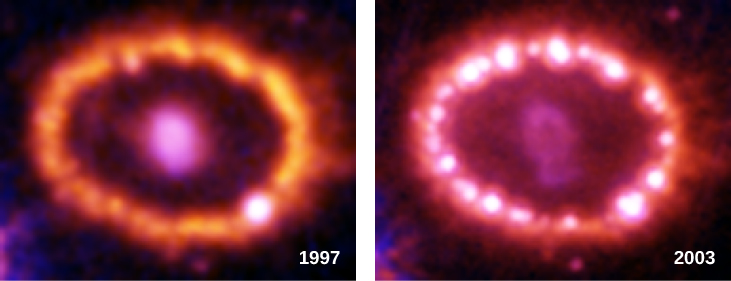
This lost material has actually been detected by observations with the Hubble Space Telescope (Figure 23.12). The gas driven out into space by the subsequent supernova explosion is currently colliding with the material the star left behind when it was a red giant. As the two collide, we see a glowing ring.
英語のヒント
この失われた物質は、実際にハッブル宇宙望遠鏡の観測で見つかっている(図23.12)。その後の超新星爆発で宇宙へ押し出されたガスが、星が赤色巨星だったころに残した物質と、今、衝突している。両者がぶつかることで、光る輪が見えるのである。
Ring around Supernova 1987A.超新星1987Aを囲む輪。
credit: modification of work by NASA, P. Challis, R. Kirshner (Harvard-Smithsonian Center for Astrophysics) and B. Sugerman (STScI) · CC BY 4.0
Figure 23.12 These two images show a ring of gas expelled by a red giant star about 30,000 years before the star exploded and was observed as Supernova 1987A. The supernova, which has been artificially dimmed, is located at the center of the ring. The left-hand image was taken in 1997 and the right-hand image in 2003. Note that the number of bright spots has increased from 1 to more than 15 over this time interval. These spots occur where high-speed gas ejected by the supernova and moving at millions of miles per hour has reached the ring and blasted into it. The collision has heated the gas in the ring and caused it to glow more brightly. The fact that we see individual spots suggests that material ejected by the supernova is first hitting narrow, inward-projecting columns of gas in the clumpy ring. The hot spots are the first signs of a dramatic and violent collision between the new and old material that will continue over the next few years. By studying these bright spots, astronomers can determine the composition of the ring and hence learn about the nuclear processes that build heavy elements inside massive stars. (credit: modification of work by NASA, P. Challis, R. Kirshner (Harvard-Smithsonian Center for Astrophysics) and B. Sugerman (STScI))
図23.12 この2枚の画像は、星が爆発して超新星1987Aとして観測される約3万年前に、赤色巨星が放出したガスの輪を示す。輪の中心にある超新星は、画像処理で暗くしてある。左は1997年、右は2003年の画像。この間に、明るい点が1個から15個以上に増えたことに注目してほしい。これらの点は、超新星が放出し、毎時数百万マイルで進む高速のガスが、輪に到達して激突した場所に生じている。衝突で輪のガスが加熱され、さらに明るく光るようになった。点が個々に分かれて見えることから、超新星の放出物はまず、塊の多い輪から内向きに突き出た、細いガスの柱に当たっていると考えられる。高温の明るい点は、新旧の物質の劇的で激しい衝突が始まった最初の兆候であり、衝突はこの後も数年間続く。明るい点を調べることで、天文学者は輪の組成を定め、大質量星の内部で重い元素を作る核過程を知ることができる。(出典:NASA、P. Challis、R. Kirshner〈ハーバード・スミソニアン天体物理学センター〉、B. Sugerman〈STScI〉の作品を改変)
Helium fusion lasted only about 1 million years. When the helium was exhausted at the center of the star, the core contracted again, the radius of the surface also decreased, and the star became a blue supergiant with a luminosity still about equal to 100,000 LSun. This is what it still looked like on the outside when, after brief periods of further fusion, it reached the iron crisis we discussed earlier and exploded.
英語のヒント
ヘリウムの核融合が続いたのは、わずか約100万年だった。中心のヘリウムが尽きると、中心核は再び収縮し、表面までの半径も小さくなった。そして星は、光度をなお約10万 LSunに保ちながら、青色超巨星となった。その後、短い期間の核融合がさらに続き、先に述べた鉄の危機に達して爆発するまで、外から見た姿はこのままだった。
Some key stages of evolution of the star that became SN 1987A, including the ones following helium exhaustion, are listed in Table 23.2. While we don’t expect you to remember these numbers, note the patterns in the table: each stage of evolution happens more quickly than the preceding one, the temperature and pressure in the core increase, and progressively heavier elements are the source of fusion energy. Once iron was created, the collapse began. It was a catastrophic collapse, lasting only a few tenths of a second; the speed of infall in the outer portion of the iron core reached 70,000 kilometers per second, about one-fourth the speed of light.
英語のヒント
SN 1987Aになった星の進化の主要な段階を、ヘリウムが尽きた後のものも含めて、表23.2に示す。数値を覚える必要はないが、表に見られる傾向に注目してほしい。一つひとつの進化段階は前の段階より速く進み、中心核の温度と圧力は高くなり、核融合のエネルギー源になる元素も、順に重くなる。鉄が作られると、崩壊が始まった。わずか0.数秒しか続かない、破局的な崩壊だった。鉄の中心核の外側の部分では、落下速度が毎秒7万キロメートル、光速のおよそ4分の1に達した。
Evolution of the Star That Exploded as SN 1987A SN 1987Aとして爆発した星の進化 |
|||
|---|---|---|---|
Phase 段階 |
Central Temperature (K) 中心温度〈K〉 |
Central Density (g/cm3) 中心密度〈g/cm3〉 |
Time Spent in This Phase この段階で過ごす時間 |
Hydrogen fusion 水素核融合 |
5 | years 年 |
|
Helium fusion ヘリウム核融合 |
970 | 106 years 106年 |
|
Carbon fusion 炭素核融合 |
170,000 | 2000 years 2000年 |
|
Neon fusion ネオン核融合 |
6 months 6か月 |
||
Oxygen fusion 酸素核融合 |
1 year 1年 |
||
Silicon fusion ケイ素核融合 |
Days 数日 |
||
Core collapse 中心核の崩壊 |
Tenths of a second 0.数秒 |
||
In the meantime, as the core was experiencing its last catastrophe, the outer shells of neon, oxygen, carbon, helium, and hydrogen in the star did not yet know about the collapse. Information about the physical movement of different layers travels through a star at the speed of sound and cannot reach the surface in the few tenths of a second required for the core collapse to occur. Thus, the surface layers of our star hung briefly suspended, much like a cartoon character who dashes off the edge of a cliff and hangs momentarily in space before realizing that he is no longer held up by anything.
英語のヒント
その間、中心核が最後の破局に見舞われていても、外側にあるネオン、酸素、炭素、ヘリウム、水素の殻は、まだ崩壊が起きたことを知らなかった。各層が物理的に動いたという情報は、星の中を音速で伝わるため、中心核が崩壊するのに要する0.数秒の間には、表面まで届かない。そのため、星の表面の層は、ほんの少しの間、宙づりの状態になった。崖の端から走り出し、何にも支えられていないことに気づくまで、一瞬だけ空中に浮かんでいる漫画の登場人物のようである。
The collapse of the core continued until the densities rose to several times that of an atomic nucleus. The resistance to further collapse then became so great that the core rebounded. Infalling material ran into the “brick wall” of the rebounding core and was thrown outward with a great shock wave. Neutrinos poured out of the core, helping the shock wave blow the star apart. The shock reached the surface of the star a few hours later, and the star began to brighten into the supernova Ian Shelton observed in 1987.
英語のヒント
中心核の崩壊は、密度が原子核の数倍になるまで続いた。すると、それ以上の崩壊への抵抗が非常に大きくなり、中心核は跳ね返った。落ち込んできた物質は、跳ね返る中心核という『れんがの壁』にぶつかり、大きな衝撃波とともに外へ放り出された。中心核からはニュートリノがあふれ出し、衝撃波が星を吹き飛ばすのを助けた。数時間後に衝撃が表面へ達すると、星は明るくなり始め、イアン・シェルトンが1987年に観測した超新星となった。