第23章恒星の死The Death of Stars
Networking to Catch More Bursts連携してさらに多くのバーストを捉える
After initial observations showed that the precise locations and afterglows of gamma-ray bursts could be found, astronomers set up a system to catch and pinpoint bursts on a regular basis. But to respond as quickly as needed to obtain usable results, astronomers realized that they needed to rely on automated systems rather than human observers happening to be in the right place at the right time.
英語のヒント
初期の観測によって、ガンマ線バーストの正確な位置と残光を見つけられるとわかると、天文学者は、継続的にバーストを捉えて位置を定める仕組みを整えた。しかし、役立つ結果を得るのに必要な速さで対応するには、人間の観測者がたまたま適切な時と場所にいることを当てにせず、自動化した仕組みに頼る必要があると気づいた。
Now, when an orbiting high-energy telescope discovers a burst, its rough location is immediately transmitted to a Gamma-Ray Coordinates Network based at NASA’s Goddard Space Flight Center, alerting observers on the ground within a few seconds to look for the visible-light afterglow.
英語のヒント
今では、軌道上の高エネルギー望遠鏡がバーストを発見すると、おおよその位置が、NASAゴダード宇宙飛行センターに置かれたガンマ線座標ネットワークへ直ちに送られる。そして数秒以内に地上の観測者へ通知し、可視光の残光を探せるようにする。
The first major success with this system was achieved by a team of astronomers from the University of Michigan, Lawrence Livermore National Laboratory, and Los Alamos National Laboratories, who designed an automated device they called the Robotic Optical Transient Search Experiment (ROTSE), which detected a very bright visible-light counterpart in 1999. At peak, the burst was almost as bright as Neptune—despite a distance (measured later by spectra from larger telescopes) of 9 billion light-years.
英語のヒント
この仕組みで最初の大きな成功を収めたのは、ミシガン大学、ローレンス・リバモア国立研究所、ロスアラモス国立研究所の天文学者のチームだった。チームは、ロボット光学突発天体探索実験〈ROTSE〉と名付けた自動装置を設計し、1999年に非常に明るい可視光の対応天体を検出した。最大時には、バーストは海王星とほぼ同じ明るさだった。後に大型望遠鏡のスペクトルで測った距離が90億光年もあったにもかかわらず、である。
More recently, astronomers have been able to take this a step further, using wide-field-of-view telescopes to stare at large fractions of the sky in the hope that a gamma-ray burst will occur at the right place and time, and be recorded by the telescope’s camera. These wide-field telescopes are not sensitive to faint sources, but ROTSE showed that gamma-ray burst afterglows could sometimes be very bright.
英語のヒント
最近では、天文学者はさらに一歩進め、広い視野の望遠鏡で空の大きな部分を見続けるようになった。ガンマ線バーストがちょうどよい場所と時刻に起き、カメラに記録されることを期待している。この広視野望遠鏡は暗い天体には敏感でないが、ROTSEは、残光がときには非常に明るくなると示していた。
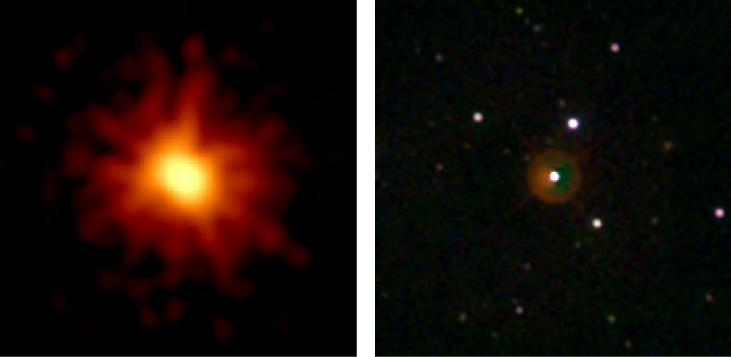
Astronomers’ hopes were vindicated in March 2008, when an extremely bright gamma-ray burst occurred and its light was captured by two wide-field camera systems in Chile: the Polish “Pi of the Sky” and the Russian-Italian TORTORA [Telescopio Ottimizzato per la Ricerca dei Transienti Ottici Rapidi (Italian for Telescope Optimized for the Research of Rapid Optical Transients)] (see Figure 23.21). According to the data taken by these telescopes, for a period of about 30 seconds, the light from the gamma-ray burst was bright enough that it could have been seen by the unaided eye had a person been looking in the right place at the right time. Adding to our amazement, later observations by larger telescopes demonstrated that the burst occurred at a distance of 8 billion light-years from Earth!
英語のヒント
2008年3月、その期待が実を結んだ。極めて明るいガンマ線バーストが起き、その光を、チリの二つの広視野カメラが捉えた。ポーランドの『Pi of the Sky』と、ロシア・イタリアのTORTORAである。TORTORAはTelescopio Ottimizzato per la Ricerca dei Transienti Ottici Rapidiの略で、イタリア語で『高速の光学突発現象の研究に最適化した望遠鏡』を意味する(図23.21)。これらの望遠鏡のデータによれば、約30秒間、バーストの光は、適切な時刻に適切な場所を見ている人がいたなら、肉眼でも見えたほど明るかった。さらに驚くことに、その後の大型望遠鏡の観測によって、地球から80億光年離れた場所で起きたとわかったのである。
Gamma-Ray Burst Observed in March 2008.2008年3月に観測されたガンマ線バースト。
credit: modification of work by NASA/Swift/Stefan Immler, et al. · NASA media use guidelines
Figure 23.21 The extremely luminous afterglow of GRB 080319B was imaged by the Swift Observatory in X-rays (left) and visible light/ultraviolet (right). (credit: modification of work by NASA/Swift/Stefan Immler, et al.)
図23.21 GRB 080319Bの極めて明るい残光を、スウィフト観測衛星がX線〈左〉と可視光・紫外線〈右〉で撮影した。(出典:NASA/Swift/Stefan Immlerほかの作品を改変)
To Beam or Not to Beamビームなのか、そうでないのか
The enormous distances to these events meant they had to have been astoundingly energetic to appear as bright as they were across such an enormous distance. In fact, they required so much energy that it posed a problem for gamma-ray burst models: if the source was radiating energy in all directions, then the energy released in gamma rays alone during a bright burst (such as the 1999 or 2008 events) would have been equivalent to the energy produced if the entire mass of a Sun-like star were suddenly converted into pure radiation.
英語のヒント
これほど遠い距離で観測どおりの明るさに見えるには、これらの現象は、驚異的に高エネルギーだったはずである。実際、必要なエネルギーがあまりに大きく、モデルにとって問題になった。もし発生源が全方向に放射するなら、1999年や2008年のような明るいバーストでは、ガンマ線だけで放出するエネルギーが、太陽のような星の全質量を突然、純粋な放射へ変えた場合に相当してしまうのである。
For a source to produce this much energy this quickly (in a burst) is a real challenge. Even if the star producing the gamma-ray burst was much more massive than the Sun (as is probably the case), there is no known means of converting so much mass into radiation within a matter of seconds. However, there is one way to reduce the power required of the “mechanism” that makes gamma-ray bursts. So far, our discussion has assumed that the source of the gamma rays gives off the same amount of energy in all directions, like an incandescent light bulb.
英語のヒント
これほどのエネルギーを、バーストという短時間で生み出すのは、実に難しい。発生させる星が、おそらく実際そうであるように、太陽よりはるかに重かったとしても、数秒でそれほどの質量を放射へ変える既知の方法はない。しかし、バーストを生む『装置』に求められるパワーを減らす方法が一つある。ここまでは、白熱電球のように、発生源があらゆる方向へ等量のエネルギーを出すと仮定していた。
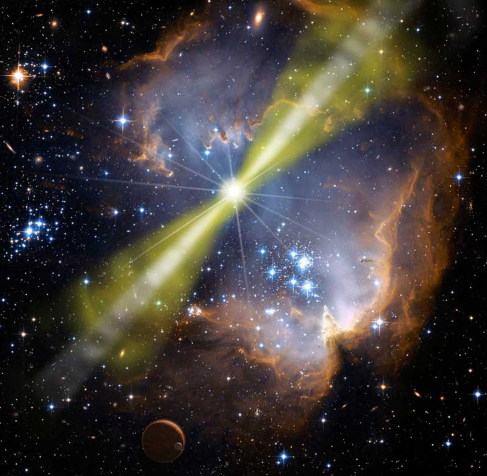
But as we discuss in Pulsars and the Discovery of Neutron Stars, not all sources of radiation in the universe are like this. Some produce thin beams of radiation that are concentrated into only one or two directions. A laser pointer and a lighthouse on the ocean are examples of such beamed sources on Earth (Figure 23.22). If, when a burst occurs, the gamma rays come out in only one or two narrow beams, then our estimates of the luminosity of the source can be reduced, and the bursts may be easier to explain. In that case, however, the beam has to point toward Earth for us to be able to see the burst. This, in turn, would imply that for every burst we see from Earth, there are probably many others that we never detect because their beams point in other directions.
英語のヒント
しかし、「パルサーと中性子星の発見」で述べたように、宇宙の放射源がすべてそうとは限らない。一つか二つの方向だけに集中した、細い放射のビームを作るものもある。地上の例なら、レーザーポインターや海の灯台である(図23.22)。バーストの際、ガンマ線が一つか二つの細いビームだけに出るなら、発生源の光度の推定を下げられ、説明がしやすくなるだろう。ただし、その場合、私たちがバーストを見るには、ビームが地球を向く必要がある。ということは、地球から見える一つのバーストに対し、ほかの方向を向くために検出できないものが、おそらく数多くあるはずである。
Burst That Is Beamed.ビームで放射するバースト。
credit: NASA/Swift/Mary Pat Hrybyk-Keith and John Jones · NASA media use guidelines
Figure 23.22 This artist’s conception shows an illustration of one kind of gamma-ray burst. The collapse of the core of a massive star into a black hole has produced two bright beams of light originating from the star’s poles, which an observer pointed along one of these axes would see as a gamma-ray burst. The hot blue stars and gas clouds in the vicinity are meant to show that the event happened in an active star-forming region. (credit: NASA/Swift/Mary Pat Hrybyk-Keith and John Jones)
図23.22 ある種類のガンマ線バーストの想像図。大質量星の中心核がブラックホールへ崩壊し、星の両極から明るいビームを二つ生んだ。一方の軸の方向にいる観測者には、ガンマ線バーストとして見える。周囲の高温の青い星やガス雲は、活発な星形成領域で起きたことを表す。(出典:NASA/Swift/Mary Pat Hrybyk-Keith、John Jones)
Long-Duration Gamma-Ray Bursts: Exploding Stars長いガンマ線バースト――爆発する星
After identifying and following large numbers of gamma-ray bursts, astronomers began to piece together clues about what kind of event is thought to be responsible for producing the gamma-ray burst. Or, rather, what kind of events, because there are at least two distinct types of gamma-ray bursts. The two—like the different types of supernovae—are produced in completely different ways.
英語のヒント
多数のガンマ線バーストを特定して追跡した結果、天文学者は、どんな現象がそれを生むと考えられるか、手掛かりをつなぎ合わせ始めた。いや、『現象』は複数形にすべきだろう。バーストには、少なくとも二種類あるからだ。異なる型の超新星と同じように、この二つはまったく別の仕組みで作られる。
Observationally, the crucial distinction is how long the burst lasts. Astronomers now divide gamma-ray bursts into two categories: short-duration ones (defined as lasting less than 2 seconds, but typically a fraction of a second) and long-duration ones (defined as lasting more than 2 seconds, but typically about a minute).Just to keep you up-to-date, we should report that in July of 2025, astronomers discovered a gamma-ray burst that lasted an astonishing 7 hours! Several groups of scientists are studying all the data from the burst, and its even longer afterglow, to figure out how it fits (or doesn’t fit) with the ideas we discuss in this chapter.
英語のヒント
観測上の決定的な違いは、持続時間である。現在は二つに分け、短いものは2秒未満、典型的には1秒未満、長いものは2秒超、典型的には約1分と定義する。新しい情報も伝えておくと、2025年7月には、驚くことに7時間も続くガンマ線バーストが発見された。複数の研究グループが、バーストと、それよりさらに長く続く残光の全データを調べ、この章で述べる考え方にどう当てはまるのか、あるいは当てはまらないのかを探っている。
All of the examples we have discussed so far concern the long-duration gamma-ray bursts. These constitute most of the gamma-ray bursts that our satellites detect, and they are also brighter and easier to pinpoint. Many hundreds of long-duration gamma-ray bursts, and the properties of the galaxies in which they occurred, have now been studied in detail. Long-duration gamma-ray bursts are universally observed to come from distant galaxies that are still actively making stars. They are usually found to be located in regions of the galaxy with strong star-formation activity (such as spiral arms). Recall that the more massive a star is, the less time it spends in each stage of its life. This suggests that the bursts come from a young and short-lived, and therefore massive type of star.
英語のヒント
ここまでの例は、すべて長いガンマ線バーストである。衛星が検出するバーストの大半を占め、明るく、位置も特定しやすい。今では何百もの長いバーストと、その母銀河の性質が詳しく調べられている。いずれも、今なお活発に星を作る遠方の銀河から来ると観測される。通常、渦状腕のような、強い星形成活動のある領域に位置する。質量が大きい星ほど、一生の各段階で過ごす時間は短いことを思い出そう。したがって、発生源は若く短命な、ゆえに大質量の星だと考えられる。
Furthermore, in several cases when a burst has occurred in a galaxy relatively close to Earth (within a few billion light-years), it has been possible to search for a supernova at the same position—and in nearly all of these cases, astronomers have found evidence of a supernova of type Ic going off. A type Ic is a particular type of supernova, which we did not discuss in the earlier parts of this chapter; these are produced by a massive star that has been stripped of its outer hydrogen layer. However, only a tiny fraction of type Ic supernovae produce gamma-ray bursts.
英語のヒント
さらに、地球から比較的近い、数十億光年以内の銀河で起きた数例では、同じ位置で超新星を探すことができた。そして、ほぼすべての場合に、Ic型超新星が爆発した証拠が見つかった。Ic型は、この章の前の部分では扱わなかった特定の種類で、外側の水素の層を失った大質量星から生じる。ただし、Ic型超新星のうち、ガンマ線バーストを作るのは、ごく一部だけである。
Why would a massive star with its outer layers missing sometimes produce a gamma-ray burst at the same time that it explodes as a supernova? The explanation astronomers have in mind for the extra energy is the collapse of the star’s core to form a spinning, magnetic black hole or neutron star. Because the star corpse is both magnetic and spinning rapidly, its sudden collapse is complex and can produce swirling jets of particles and powerful beams of radiation—just like in a quasar or active galactic nucleus (objects you will learn about Active Galaxies, Quasars, and Supermassive Black Holes), but on a much faster timescale. A small amount of the infalling mass is ejected in a narrow beam, moving at speeds close to that of light. Collisions among the particles in the beam can produce intense bursts of energy that we see as a gamma-ray burst.
英語のヒント
なぜ外層を失った大質量星は、ときに、超新星爆発と同時にガンマ線バーストを起こすのだろうか。追加のエネルギーを説明するために天文学者が考えているのは、中心核が崩壊し、回転と磁場を持つブラックホールまたは中性子星を作る、という仕組みである。星の残骸は、磁場を持つうえ高速で回転するので、その突然の崩壊は複雑になり、渦巻く粒子のジェットや強力な放射ビームを作り得る。「活動銀河・クエーサー・超大質量ブラックホール」で学ぶクエーサーや活動銀河核と同じようなものだが、ずっと短い時間スケールで起きる。落下する質量の一部が細いビームとして噴き出し、光速に近い速さで動く。その中で粒子同士が衝突すると、私たちがガンマ線バーストとして見る、強烈なエネルギー放出が生じ得る。
Within a few minutes, the expanding blast from the fireball plows into the interstellar matter in the dying star’s neighborhood. This matter might have been ejected from the star itself at earlier stages in its evolution. Alternatively, it could be the gas out of which the massive star and its neighbors formed.
英語のヒント
数分以内に、火の玉から広がる爆風は、死にゆく星の近隣の星間物質へ突っ込む。この物質は、進化のもっと早い段階で星自体が放出したものかもしれない。あるいは、大質量星とその近隣の星々を作った、もとのガスかもしれない。
As the high-speed particles from the blast are slowed, they transfer their energy to the surrounding matter in the form of a shock wave. That shocked material emits radiation at longer wavelengths. This accounts for the afterglow of X-rays, visible light, and radio waves—the glow comes at longer and longer wavelengths as the blast continues to lose energy.
英語のヒント
爆発から来る高速の粒子は、減速すると、そのエネルギーを衝撃波の形で周囲の物質へ渡す。衝撃を受けた物質は、より長い波長の放射を出す。これがX線、可視光、電波の残光を説明する。爆発がエネルギーを失い続けるにつれ、残光の波長はますます長くなる。