第23章恒星の死The Death of Stars
Collapse and Explosion崩壊と爆発
When the collapse of a high-mass star’s core is stopped by degenerate neutrons, the core is saved from further destruction, but it turns out that the rest of the star is literally blown apart. Here’s how it happens.
英語のヒント
大質量星の中心核の崩壊が、縮退した中性子によって止まると、中心核はそれ以上の破壊を免れる。しかし、星の残りの部分は、文字どおり吹き飛ばされてしまう。どうしてそうなるのかを見ていこう。
The collapse that takes place when electrons are absorbed into the nuclei is very rapid. In less than a second, a core with a mass of about 1 MSun, which originally was approximately the size of Earth, collapses to a diameter of less than 20 kilometers. The speed with which material falls inward reaches one-fourth the speed of light. The collapse halts only when the density of the core exceeds the density of an atomic nucleus (which is the densest form of matter we know). A typical neutron star is so compressed that to duplicate its density, we would have to squeeze all the people in the world into a single sugar cube! This would give us one sugar cube’s worth (one cubic centimeter’s worth) of a neutron star.
英語のヒント
電子が原子核へ取り込まれるときの崩壊は、非常に速い。もとは地球ほどの大きさがあった、質量約1 MSunの中心核が、1秒にも満たない間に、直径20キロメートル未満まで崩壊する。物質が内側へ落ち込む速さは、光速の4分の1に達する。崩壊が止まるのは、中心核の密度が、私たちの知る最も高密度の物質である原子核の密度を超えたときだけである。典型的な中性子星は、世界中のすべての人を角砂糖一つに押し込まなければ同じ密度にならないほど、圧縮されている。これでようやく、中性子星の角砂糖一個分、つまり1立方センチメートル分になる。
The neutron degenerate core strongly resists further compression, abruptly halting the collapse. The shock of the sudden jolt initiates a shock wave that starts to propagate outward. However, this shock alone is not enough to create a star explosion. The energy produced by the outflowing matter is quickly absorbed by atomic nuclei in the dense, overlying layers of gas, where it breaks up the nuclei into individual neutrons and protons.
英語のヒント
中性子が縮退した中心核は、それ以上の圧縮に強く抵抗し、崩壊を急停止させる。この突然の激しい衝撃によって、外へ伝わり始める衝撃波が生じる。しかし、この衝撃だけでは、星を爆発させるには足りない。外へ流れる物質が生むエネルギーは、上に重なる高密度のガス層の原子核にすぐ吸収され、原子核を個々の中性子と陽子へ分解するのに使われる。
Our understanding of nuclear processes indicates (as we mentioned above) that each time an electron and a proton in the star’s core merge to make a neutron, the merger releases a neutrino. These ghostly subatomic particles, introduced in The Sun: A Nuclear Powerhouse, carry away some of the nuclear energy. It is their presence that launches the final disastrous explosion of the star. The total energy contained in the neutrinos is huge. In the initial second of the star’s explosion, the power carried by the neutrinos (1046 watts) is greater than the power put out by all the stars in over a billion galaxies.
英語のヒント
核過程の理解からわかるように、先ほど述べた、中心核の電子と陽子が合体して中性子になる反応では、そのたびにニュートリノが放出される。「太陽――核エネルギーの源」で紹介した、この幽霊のような素粒子は、核エネルギーの一部を持ち去る。そして、これらが存在することが、最後の壊滅的な星の爆発を引き起こす。ニュートリノに含まれる総エネルギーは巨大である。爆発が始まって最初の1秒には、ニュートリノが運ぶパワーは1046ワットに達し、10億個を超える銀河の、すべての恒星が出すパワーより大きくなる。
While neutrinos ordinarily do not interact very much with ordinary matter (we earlier accused them of being downright antisocial), matter near the center of a collapsing star is so dense that the neutrinos do interact with it to some degree. They deposit some of this energy in the layers of the star just outside the core. This huge, sudden input of energy reverses the infall of these layers and drives them explosively outward. Most of the mass of the star (apart from that which went into the neutron star in the core) is then ejected outward into space. As we saw earlier, such an explosion requires a star of at least 8 MSun, and the neutron star can have a mass of at most 3 MSun. Consequently, at least five times the mass of our Sun is ejected into space in each such explosive event!
英語のヒント
ニュートリノは、ふだんは普通の物質とあまり相互作用しない。以前には、まったく非社交的だと評したほどである。しかし、崩壊する星の中心近くでは物質の密度が非常に高いため、ニュートリノも、ある程度は物質と相互作用する。ニュートリノはエネルギーの一部を、中心核のすぐ外の層へ渡す。この巨大で突然のエネルギー供給が、それらの層の内向きの落下を逆転させ、爆発的に外へ押し出す。すると、中心核の中性子星に取り込まれた分を除き、星の質量の大部分が宇宙へ放出される。先に見たように、この爆発が起こるには少なくとも8 MSunの星が必要であり、中性子星の質量は最大でも3 MSun.である。したがって、この種の爆発が起こるたびに、太陽の少なくとも5倍の質量が宇宙へ放出されることになる。
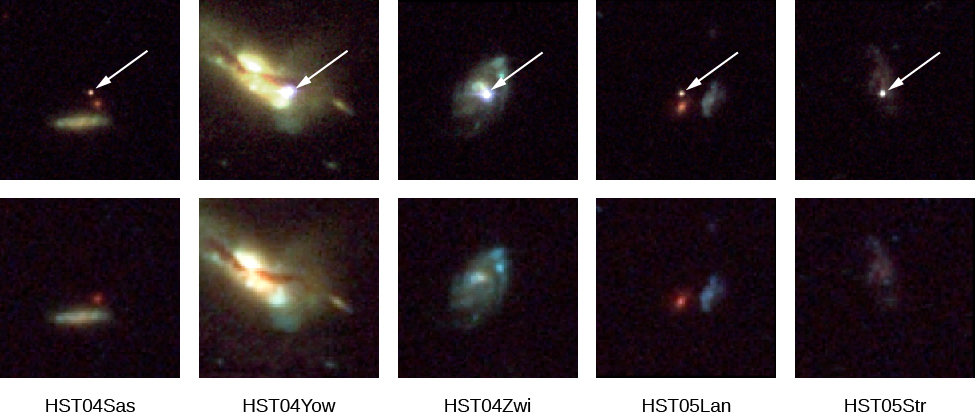
The resulting explosion is called a supernova (Figure 23.7). When these explosions happen close by, they can be among the most spectacular celestial events, as we will discuss in the next section. (Actually, there are at least two different types of supernova explosions: the kind we have been describing, which is the collapse of a massive star, is called, for historical reasons, a type II supernova. We will describe how the types differ later in this chapter).
英語のヒント
こうして起こる爆発を超新星という(図23.7)。近くで起きた場合には、次の節で述べるように、天体現象の中でも最も壮観なものの一つとなり得る。実際には、超新星爆発には少なくとも二つの異なる種類がある。ここまで説明してきた、大質量星の崩壊によるものは、歴史的な理由からII型超新星と呼ばれる。それぞれの型の違いは、この章の後半で説明する。
Five Supernova Explosions in Other Galaxies.ほかの銀河で起きた五つの超新星爆発。
credit: modification of work by NASA, ESA, and A. Riess (STScI) · CC BY 4.0
Figure 23.7 The arrows in the top row of images point to the supernovae. The bottom row shows the host galaxies before or after the stars exploded. Each of these supernovae exploded between 3.5 and 10 billion years ago. Note that the supernovae when they first explode can be as bright as an entire galaxy. (credit: modification of work by NASA, ESA, and A. Riess (STScI))
図23.7 上段の矢印が超新星を示す。下段は、その星が爆発する前、または爆発した後の母銀河の姿。それぞれの超新星は、35億~100億年前に爆発した。爆発直後の超新星は、銀河全体に匹敵するほど明るくなることがある。(出典:NASA、ESA、A. Riess〈STScI〉の作品を改変)
Table 23.1 summarizes the discussion so far about what happens to stars and substellar objects of different initial masses at the ends of their lives. Like so much of our scientific understanding, this list represents a progress report: it is the best we can do with our present models and observations. The mass limits corresponding to various outcomes may change somewhat as models are improved. There is much we do not yet understand about the details of what happens when stars die.
英語のヒント
表23.1に、さまざまな初期質量を持つ恒星と、恒星より軽い天体が、一生の終わりにどうなるかについて、ここまでの話をまとめた。科学の理解の多くと同じく、これは研究の途中経過を示す表であり、現在のモデルと観測から得られる最善のまとめである。モデルの改良に伴って、結末を分ける質量の境界は、多少変わる可能性がある。星が死ぬときに何が起こるか、その詳細には、まだ理解していないことが多く残っている。
The Ultimate Fate of Stars and Substellar Objects with Different Masses 質量の異なる恒星と恒星より軽い天体の、究極の運命 |
|
|---|---|
Initial Mass (Mass of Sun = 1)Stars in the mass ranges 0.25–8 and 8–10 may later produce a type of supernova different from the one we have discussed so far. These are discussed in The Evolution of Binary Star Systems. 初期質量〈太陽の質量=1〉質量が0.25~8および8~10の範囲の星は、後に、ここまで説明したものとは異なる種類の超新星を起こすことがある。「連星系の進化」で取り上げる。 |
Final State at the End of Its Life 一生の終わりの最終状態 |
< 0.01 0.01未満 |
Planet 惑星 |
0.01 to 0.08 0.01~0.08 |
Brown dwarf 褐色矮星 |
0.08 to 0.25 0.08~0.25 |
White dwarf made mostly of helium 主にヘリウムからできた白色矮星 |
0.25 to 8 0.25~8 |
White dwarf made mostly of carbon and oxygen 主に炭素と酸素からできた白色矮星 |
8 to 10 8~10 |
White dwarf made of oxygen, neon, and magnesium 酸素、ネオン、マグネシウムからできた白色矮星 |
10 to 40 10~40 |
Supernova explosion that leaves a neutron star 超新星爆発を起こし、中性子星を残す |
> 40 40超 |
Supernova explosion that leaves a black hole 超新星爆発を起こし、ブラックホールを残す |
The Supernova Giveth and the Supernova Taketh Away超新星は与え、超新星は奪う
After the supernova explosion, the life of a massive star comes to an end. But the death of each massive star is an important event in the history of its galaxy. The elements built up by fusion during the star’s life are now “recycled” into space by the explosion, making them available to enrich the gas and dust that form new stars and planets. Because these heavy elements ejected by supernovae are critical for the formation of planets and the origin of life, it’s fair to say that without mass loss from supernovae and planetary nebulae, neither the authors nor the readers of this book would exist.To tell the full story, there is another way to make and recycle these heavier elements which we will discuss in The Milky Way Galaxy. That is the merger of two neutron stars, which also causes a huge explosion.
英語のヒント
超新星爆発によって、大質量星の一生は終わる。しかし、一つひとつの大質量星の死は、その銀河の歴史にとって重要な出来事である。星の一生の間に核融合で作られた元素は、爆発によって宇宙へ『再利用』される。それらは、新しい星や惑星を作るガスや塵に取り込まれ、重い元素を豊かにする。超新星が放出する重い元素は、惑星の形成や生命の起源に不可欠である。そのため、超新星や惑星状星雲による質量の放出がなければ、この本の著者も読者も存在しないだろう、と言ってよい。話を完全にするために付け加えると、重い元素を作って再利用する方法は、もう一つある。「天の川銀河」で述べる、二つの中性子星の合体である。この合体も巨大な爆発を引き起こす。
But the supernova explosion has one more creative contribution to make, one we alluded to in Stars from Adolescence to Old Age when we asked where the atoms in your jewelry came from. The supernova explosion produces a flood of energetic neutrons that barrel through the expanding material. These neutrons can be absorbed by iron and other nuclei where they can turn into protons. Thus, they can build up elements that are more massive than iron, possibly including such terrestrial favorites as gold, silver and uranium. Supernovae (and, as we will shortly see, the explosive mergers of neutron stars) are the only candidates we have for places where such heavier atoms can be made. Next time you wear some gold jewelry (or give some to your sweetheart), bear in mind that those gold atoms were forged long ago in these kinds of celestial explosions!
英語のヒント
しかし、超新星爆発には、何かを生み出す働きがもう一つある。「恒星の青年期から老年期まで」で、宝飾品の原子はどこから来たのかと尋ねたときに、それをほのめかした。超新星爆発は、高エネルギーの中性子を大量に作り、それらが膨張する物質の中を勢いよく突き進む。中性子は鉄などの原子核に取り込まれ、その中で陽子へ変わることがある。こうして、鉄より重い元素を作れる。地上で珍重される金、銀、ウランも、そこに含まれる可能性がある。このような重い原子を作る場所の候補として私たちが持っているのは、超新星と、まもなく見る中性子星の爆発的な合体だけである。次に金の宝飾品を身に着けるとき、あるいは大切な相手に贈るときには、その金の原子が、はるか昔にこのような天体の爆発で作られたことを思い出してほしい。
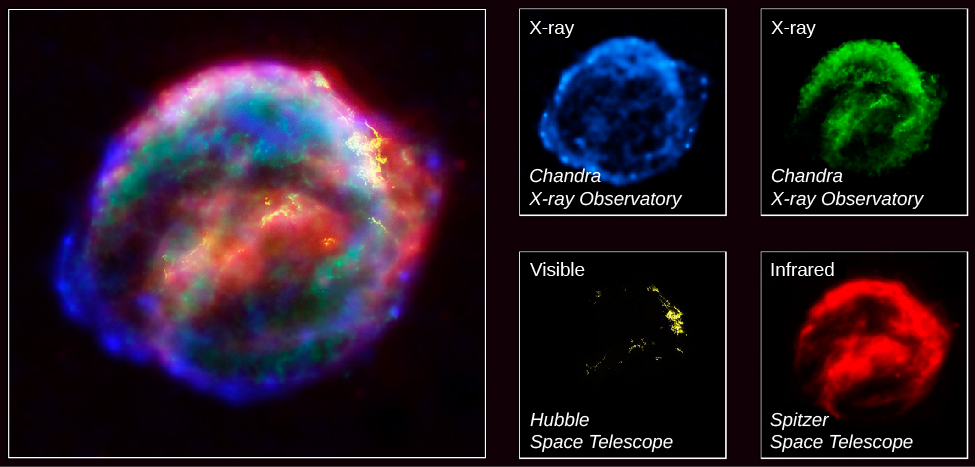
When supernovae explode, these elements (as well as the ones the star made during more stable times) are ejected into the existing gas between the stars and mixed with it. Thus, supernovae play a crucial role in enriching their galaxy with heavier elements, allowing, among other things, the chemical elements that make up earthlike planets and the building blocks of life to become more common as time goes on (Figure 23.8).
英語のヒント
超新星が爆発すると、これらの元素は、星がもっと安定していた時期に作った元素とともに、もともと星と星の間にあるガスへ放出され、混ざり合う。このように超新星は、銀河に重い元素を増やす重要な役割を果たす。その結果、地球のような惑星を作る元素や、生命の材料となる元素などが、時代とともにより多く存在するようになる(図23.8)。
Kepler Supernova Remnant.ケプラーの超新星残骸。
credit: modification of work by NASA, ESA, R. Sankrit and W. Blair (Johns Hopkins University) · NASA media use guidelines
Figure 23.8 This image shows the expanding remains of a supernova explosion, which was first seen about 400 years ago by sky watchers, including the famous astronomer Johannes Kepler. The bubble-shaped shroud of gas and dust is now 14 light-years wide and is expanding at 2,000 kilometers per second (4 million miles per hour). The remnant emits energy at wavelengths from X-rays (shown in blue and green) to visible light (yellow) and into the infrared (red). The expanding shell is rich in iron, which was produced in the star that exploded. The main image combines the individual single-color images seen at the bottom into one multi-wavelength picture. (credit: modification of work by NASA, ESA, R. Sankrit and W. Blair (Johns Hopkins University))
図23.8 約400年前、著名な天文学者ヨハネス・ケプラーを含む空の観測者たちが初めて目にした、超新星爆発の広がる残骸。泡のように包むガスと塵は、現在、幅14光年に広がり、毎秒2000キロメートル〈毎時400万マイル〉で膨張している。残骸は、X線〈青と緑〉から可視光〈黄色〉、赤外線〈赤〉まで、幅広い波長でエネルギーを放つ。広がる殻には、爆発した星の内部で作られた鉄が豊富に含まれている。上の大きな画像は、下の単色の画像を一つに合わせた、複数の波長の合成画像である。(出典:NASA、ESA、R. Sankrit、W. Blair〈ジョンズ・ホプキンス大学〉の作品を改変)
Supernovae are also thought to be the source of many of the high-energy cosmic ray particles discussed in Cosmic Rays. Trapped by the magnetic field of the Galaxy, the particles from exploded stars continue to circulate around the vast spiral of the Milky Way. Scientists speculate that high-speed cosmic rays hitting the genetic material of Earth organisms over billions of years may have contributed to the steady mutations—subtle changes in the genetic code—that drive the evolution of life on our planet. In all the ways we have mentioned, supernovae have played a part in the development of new generations of stars, planets, and life.
英語のヒント
超新星は、「宇宙線」で述べた高エネルギーの宇宙線粒子の、多くの発生源でもあると考えられている。爆発した星から来た粒子は、銀河の磁場に捕らえられ、天の川銀河の巨大な渦巻きの中を回り続ける。科学者たちは、高速の宇宙線が何十億年もの間、地球の生物の遺伝物質に当たり続けたことが、絶えず起こる突然変異に寄与したのではないかと推測している。突然変異とは遺伝情報の微妙な変化であり、地球上の生命の進化を進めるものである。ここまで述べたさまざまな形で、超新星は、新しい世代の星、惑星、生命が生まれ発展する過程の一端を担ってきた。
But supernovae also have a dark side. Suppose a life form has the misfortune to develop around a star that happens to lie near a massive star destined to become a supernova. Such life forms may find themselves snuffed out when the harsh radiation and high-energy particles from the neighboring star’s explosion reach their world. If, as some astronomers speculate, life can develop on many planets around long-lived (lower-mass) stars, then the suitability of that life’s own star and planet may not be all that matters for its long-term evolution and survival. Life may well have formed around a number of pleasantly stable stars only to be wiped out because a massive nearby star suddenly went supernova.
英語のヒント
しかし、超新星には暗い側面もある。超新星になる運命の大質量星の近くに、たまたま別の星があり、その周りで不運にも生命が発達したとしよう。隣の星の爆発から来る強烈な放射と高エネルギー粒子がその世界に届くと、その生命は消し去られるかもしれない。一部の天文学者が推測するように、寿命の長い低質量星の周りの多くの惑星に生命が発達できるとしても、その生命自身の主星と惑星が適しているというだけでは、長期的な進化と生存に必要な条件をすべて満たすとは限らない。快適で安定したいくつもの星の周りに生命が生まれながらも、近くの大質量星が突然超新星となったために、滅ぼされてしまったことは、十分あり得る。
What is a safe distance to be from a supernova explosion? A lot depends on the violence of the particular explosion, what type of supernova it is (see The Evolution of Binary Star Systems), and what level of destruction we are willing to accept. Calculations suggest that a supernova less than 50 light-years away from us would certainly end all life on Earth, and that even one 100 light-years away would have drastic consequences for the radiation levels here. One minor extinction of sea creatures about 2 million years ago on Earth may actually have been caused by a supernova at a distance of about 120 light-years.
英語のヒント
超新星爆発から、どれほど離れていれば安全なのだろうか。その答えは、個々の爆発の激しさ、超新星の種類(「連星系の進化」参照)、そしてどの程度の被害なら受け入れられるかによって大きく変わる。計算によれば、私たちから50光年未満の超新星は、地球上のあらゆる生命を確実に終わらせ、100光年離れていても、地球に届く放射の強さに深刻な影響を及ぼすという。地球で約200万年前に起きた、海の生物の小規模な絶滅の一つは、実際には約120光年先の超新星が原因だった可能性がある。
The good news is that there are at present no massive stars that promise to become supernovae within 50 light-years of the Sun. (This is in part because the kinds of massive stars that become supernovae are overall quite rare.) The massive star closest to us, Spica (in the constellation of Virgo), is about 260 light-years away, probably a safe distance, even if it were to explode as a supernova in the near future.
英語のヒント
よい知らせは、太陽から50光年以内には、今のところ超新星になりそうな大質量星がないことである。これは一つには、超新星になるような大質量星が、全体としてかなりまれだからだ。私たちに最も近い大質量星は、おとめ座のスピカで、約260光年離れている。近い将来に超新星として爆発したとしても、おそらく安全な距離である。
Extreme Gravity極端な重力
In this section, you were introduced to some very dense objects. How would those objects’ gravity affect you? Recall that the force of gravity, F, between two bodies is calculated as
この節では、非常に高密度の天体をいくつか見てきた。それらの重力は、あなたにどのような影響を与えるだろうか。二つの物体の間の重力Fは、次の式で求められることを思い出そう。
where G is the gravitational constant, are the masses of the two bodies, and R is their separation. Also, from Newton’s second law,
ここで、Gは万有引力定数、は二つの物体の質量、Rはその間の距離である。また、ニュートンの第2法則から、
where a is the acceleration of a body with mass M.
となる。aは、質量Mの物体の加速度である。
So let’s consider the situation of a mass—say, you—standing on a body, such as Earth or a white dwarf (where we assume you will be wearing a heat-proof space suit). You are M1 and the body you are standing on is M2. The distance between you and the center of gravity of the body on which you stand is its radius, R. The force exerted on you is
そこで、ある質量を持つもの、たとえばあなたが、地球や白色矮星のような天体の上に立っている状況を考えよう。白色矮星では、耐熱の宇宙服を着ていると仮定する。あなたの質量をM1、立っている天体の質量をM2とする。あなたと、その天体の重心との距離は、天体の半径Rである。あなたに働く力は、
Solving for a, the acceleration of gravity on that world, we get
となる。この世界の重力加速度aについて解くと、
Note that we have replaced the general symbol for acceleration, a, with the symbol scientists use for the acceleration of gravity, g.
となる。加速度を表す一般的な記号aを、重力加速度に使う記号gに置き換えていることに注意しよう。
Say that a particular white dwarf has the mass of the Sun but the radius of Earth . What is the acceleration of gravity at the surface of the white dwarf?
ある白色矮星が、太陽と同じ質量と、地球と同じ半径を持つとしよう。その表面の重力加速度はいくらになるだろうか。
Solution解き方
The acceleration of gravity at the surface of the white dwarf is
白色矮星の表面での重力加速度は、
Compare this to g on the surface of Earth, which is 9.8 m/s2.
となる。地球の表面でのg、9.8 m/s2と比べてみよう。
Check Your Learning理解を確かめよう
What is the acceleration of gravity at the surface if the white dwarf has the twice the mass of the Sun and is only half the radius of Earth?
白色矮星の質量が太陽の2倍で、半径が地球の半分しかない場合、表面の重力加速度はいくらになるだろうか。