第23章恒星の死The Death of Stars
23.5 The Evolution of Binary Star Systems23.5 連星系の進化
Learning Objectives学習の目標
By the end of this section, you will be able to:
この節を学ぶと、次のことができるようになる。
Describe the kind of binary star system that leads to a nova event
新星を起こす連星系がどのようなものか説明する。
Describe the type of binary star system that leads to a type Ia supernovae event
Ia型超新星を起こす連星系がどのようなものか説明する。
Indicate how type Ia supernovae differ from type II supernovae
Ia型超新星とII型超新星の違いを示す。
The discussion of the life stories of stars presented so far has suffered from a bias—what we might call “single-star chauvinism.” Because the human race developed around a star that goes through life alone, we tend to think of most stars in isolation. But as we saw in The Stars: A Celestial Census, it now appears that as many as half of all stars may develop in binary systems—those in which two stars are born in each other’s gravitational embrace and go through life orbiting a common center of mass.
英語のヒント
ここまでの星の一生の説明には、偏りがあった。いわば『単独星びいき』である。人類は、一生を一人で過ごす星の周りで発達したので、ほかの星も大半が単独だと考えがちだ。しかし「恒星――星の世界の実態を調べる」で見たように、今では全恒星の半数ほどが、連星系で成長する可能性があると考えられている。二つの星が互いの重力に抱かれるように生まれ、共通の重心を回りながら一生を過ごす系である。
For these stars, the presence of a close-by companion can have a profound influence on their evolution. Under the right circumstances, stars can exchange material, especially during the stages when one of them swells up into a giant or supergiant, or has a strong wind. When this happens and the companion stars are sufficiently close, material can flow from one star to another, decreasing the mass of the donor and increasing the mass of the recipient. Such mass transfer can be especially dramatic when the recipient is a stellar remnant such as a white dwarf or a neutron star. While the detailed story of how such binary stars evolve is beyond the scope of our book, we do want to mention a few examples of how the stages of evolution described in this chapter may change when there are two stars in a system.
英語のヒント
こうした星では、近くに伴星があることが、進化に大きな影響を及ぼし得る。条件が整うと、星同士で物質をやり取りできる。特に、一方が巨星や超巨星へ膨張する段階や、強い恒星風を持つ場合がそうである。そのとき二つの星が十分近ければ、物質が一方から他方へ流れ、与える側の質量を減らし、受け取る側の質量を増やす。受け取る側が白色矮星や中性子星のような星の残骸なら、この質量移動は特に劇的なものになり得る。このような連星の進化の詳細は本書の範囲を超えるが、星が二つある場合、この章で述べた進化の段階がどう変わるか、いくつかの例には触れておきたい。
White Dwarf Explosions: The Mild Kind白色矮星の爆発――穏やかな場合
Let’s consider the following system of two stars: one has become a white dwarf and the other is gradually transferring material onto it. As fresh hydrogen from the outer layers of its companion accumulates on the surface of the hot white dwarf, it begins to build up a layer of hydrogen. As more and more hydrogen accumulates and heats up on the surface of the degenerate star, the new layer eventually reaches a temperature that causes fusion to begin in a sudden, explosive way, blasting much of the new material away.
英語のヒント
一方が白色矮星になり、もう一方がそこへ少しずつ物質を渡している、二つの星の系を考えよう。伴星の外層から来た新しい水素が、高温の白色矮星の表面にたまり、水素の層を作り始める。縮退した星の表面にさらに水素がたまって熱くなると、やがて新しい層は、核融合が突然、爆発的に始まる温度に達し、新たに積もった物質の多くを吹き飛ばす。
In this way, the white dwarf quickly (but only briefly) becomes quite bright, hundreds or thousands of times its previous luminosity. To observers before the invention of the telescope, it seemed that a new star suddenly appeared, and they called it a nova.We now know that this historical terminology is quite misleading since novae do not originate from new stars. In fact, quite to the contrary, novae originate from white dwarfs, which are actually the endpoint of stellar evolution for low-mass stars. But since the system of two stars was too faint to be visible to the naked eye, it did seem to people, before telescopes were invented, that a star had appeared where nothing had been visible. Novae fade away in a few months to a few years.
英語のヒント
こうして白色矮星は、短い間だけだが、急速に非常に明るくなり、もとの光度の数百~数千倍に達する。望遠鏡の発明前の観測者には、新しい星が突然現れたように見えたため、新星〈nova〉と名付けた。今では、この歴史的な呼び名が大きな誤解を招くことを知っている。新星は、新しい星から生じるのではない。むしろ逆に、低質量星の進化の終点である白色矮星から生じる。もとの連星系が肉眼では見えないほど暗かったため、望遠鏡ができる前には、何も見えていなかった場所に星が現れたように感じられたのである。新星は数か月から数年で暗くなっていく。
Hundreds of novae have been observed, each occurring in a binary star system and each later showing a shell of expelled material. A number of stars have more than one nova episode, as more material from its neighboring star accumulates on the white dwarf and the whole process repeats. As long as the episodes do not increase the mass of the white dwarf beyond the Chandrasekhar limit (by transferring too much mass too quickly), the dense white dwarf itself remains pretty much unaffected by the explosions on its surface.
英語のヒント
これまでに数百の新星が観測され、どれも連星系で起こり、その後、放出された物質の殻が見られている。新星を何度も起こす星もある。隣の星からさらに物質が白色矮星へたまり、過程全体が繰り返されるからだ。あまりに多くの質量が急速に移って、白色矮星がチャンドラセカール限界を超えさえしなければ、高密度の白色矮星自体は、表面の爆発によってほとんど影響を受けない。
White Dwarf Explosions: The Violent Kind白色矮星の爆発――激しい場合
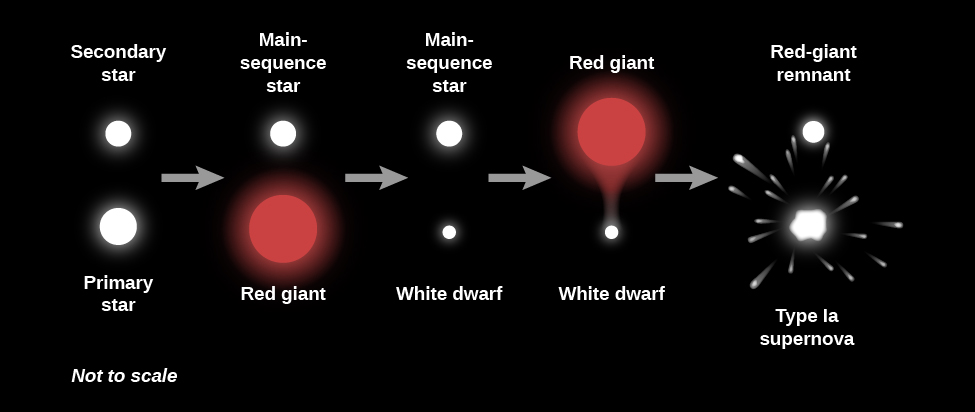
If a white dwarf accumulates matter from a companion star at a much faster rate, it can be pushed over the Chandrasekhar limit. The evolution of such a binary system is shown in Figure 23.18. When its mass approaches the Chandrasekhar mass limit (exceeds 1.4 MSun), such an object can no longer support itself as a white dwarf, and it begins to contract. As it does so, it heats up, and new nuclear reactions can begin in the degenerate core. The star “simmers” for the next century or so, building up internal temperature. This simmering phase ends in less than a second, when an enormous amount of fusion (especially of carbon) takes place all at once, resulting in an explosion. The fusion energy produced during the final explosion is so great that it completely destroys the white dwarf. Gases are blown out into space at velocities of about 10,000 kilometers per second, and afterward, no trace of the white dwarf remains.
英語のヒント
白色矮星が伴星から、もっと速いペースで物質を集めると、チャンドラセカール限界を超えることがある。このような連星系の進化を図23.18に示す。質量が限界に近づき、1.4 MSunを超えると、もはや白色矮星として自らを支えられず、収縮し始める。収縮で温度が上がり、縮退した中心核で新しい核反応が始まることがある。星は、それから100年ほど、内部の温度を高めながら『弱火で煮える』。このゆっくりした段階は、大量の核融合、特に炭素の核融合が一斉に起きると、1秒にも満たない時間で終わり、爆発に至る。最後の爆発で生じる核融合エネルギーは非常に大きく、白色矮星を完全に破壊する。ガスは毎秒約1万キロメートルで宇宙へ吹き出し、あとには白色矮星の痕跡は残らない。
Evolution of a Binary System.連星系の進化。
OpenStax / Rice University · CC BY 4.0
Figure 23.18 The more massive star evolves first to become a red giant and then a white dwarf. The white dwarf then begins to attract material from its companion, which in turn evolves to become a red giant. Eventually, the white dwarf acquires so much mass that it is pushed over the Chandrasekhar limit and becomes a type Ia supernova.
図23.18 質量の大きい星が先に進化し、赤色巨星を経て白色矮星になる。その後、伴星も赤色巨星へ進化すると、白色矮星はその物質を引き寄せ始める。やがて十分な質量を得てチャンドラセカール限界を超え、Ia型超新星となる。
Such an explosion is also called a supernova, since, like the destruction of a high-mass star, it produces a huge amount of energy in a very short time. However, unlike the explosion of a high-mass star, which can leave behind a neutron star or black hole remnant, the white dwarf is completely destroyed in the process, leaving behind no remnant. We call these white dwarf explosions type Ia supernovae.
英語のヒント
この爆発も、大質量星の破壊と同様、短時間に巨大なエネルギーを生み出すので、超新星と呼ばれる。しかし、中性子星やブラックホールを残し得る大質量星の爆発とは異なり、この過程では白色矮星が完全に壊れ、残骸となる星は残らない。このような白色矮星の爆発を、Ia型超新星と呼ぶ。
We distinguish type I supernovae from those of supernovae of type II originating from the death of massive stars discussed earlier by the absence of hydrogen in their observed spectra. Hydrogen is the most common element in the universe and is a major component of massive, evolved stars. However, as we learned earlier, hydrogen is absent from the white dwarf remnant, which is primarily composed of carbon and oxygen for masses comparable to the Chandrasekhar mass limit.
英語のヒント
I型超新星は、観測されるスペクトルに水素がないことによって、先に述べた大質量星の死によるII型超新星と区別する。水素は宇宙で最もありふれた元素であり、進化した大質量星の主要な成分でもある。しかし、すでに学んだように、白色矮星の残骸には水素がない。チャンドラセカール限界に近い質量では、主に炭素と酸素からできている。
The “a” subdesignation of type Ia supernovae further refers to the presence of strong silicon absorption lines, which are absent from supernovae originating from the collapse of massive stars. Silicon is one of the products that results from the fusion of carbon and oxygen, which bears out the scenario we described above—that there is a sudden onset of the fusion of the carbon (and oxygen) of which the white dwarf was made.
英語のヒント
Ia型の小分類『a』は、さらに、強いケイ素の吸収線があることを示す。この線は、大質量星の崩壊による超新星にはない。ケイ素は、炭素と酸素の核融合で生じる生成物の一つであり、先に述べた筋書きを裏付ける。つまり、白色矮星を作っていた炭素や酸素の核融合が、突然始まるということである。
Observational evidence now strongly indicates that SN 1006, Tycho’s Supernova, and Kepler’s Supernova (see Supernovae in History) were all type Ia supernovae. For instance, in contrast to the case of SN 1054, which yielded the spinning pulsar in the Crab Nebula, none of these historical supernovae shows any evidence of stellar remnants that have survived their explosions. Perhaps even more puzzling is that, so far, astronomers have not been able to identify the companion star feeding the white dwarf in any of these historical supernovae.
英語のヒント
今では観測上の証拠から、SN 1006、ティコの超新星、ケプラーの超新星は、いずれもIa型超新星だったと強く示されている(「歴史の中の超新星」参照)。たとえば、かに星雲に回転するパルサーを残したSN 1054とは異なり、これらの歴史上の超新星には、爆発を生き延びた星の残骸の証拠がない。さらに不可解かもしれないのは、これらのどの例でも、白色矮星に物質を供給していた伴星を、今のところ天文学者が特定できていないことである。
Consequently, in order to address the mystery of the absent companion stars and other outstanding puzzles, astronomers have recently begun to investigate alternative mechanisms of generating type Ia supernovae. All proposed mechanisms rely upon white dwarfs composed of carbon and oxygen, which are needed to meet the observed absence of hydrogen in the type Ia spectrum. And because any isolated white dwarf below the Chandrasekhar mass is stable, all proposed mechanisms invoke a binary companion to explode the white dwarf. The leading alternative mechanism scientists believe creates a type Ia supernova is the merger of two white dwarf stars in a binary system. The two white dwarfs may have unstable orbits, such that over time, they would slowly move closer together until they merge. If their combined mass is greater than the Chandrasekhar limit, the result could also be a type Ia supernova explosion.
英語のヒント
そこで天文学者は、見つからない伴星や、ほかの未解決の謎を説明するため、近年、Ia型超新星を作る別の仕組みを調べ始めた。提案された仕組みは、すべて炭素と酸素からなる白色矮星に基づく。Ia型のスペクトルに水素が見られないという観測を満たすためには、これが必要である。また、チャンドラセカール限界より軽い孤立した白色矮星は安定なので、どの仕組みでも、爆発させるために連星の相手を持ち出す。科学者が有力だと考える別の仕組みは、連星系の二つの白色矮星の合体である。二つの軌道が不安定なら、時間とともにゆっくり近づき、ついに合体する可能性がある。合計の質量がチャンドラセカール限界より大きければ、その結果もIa型超新星爆発になり得る。
Type Ia supernovae are of great interest to astronomers in other areas of research. This type of supernova is brighter than supernovae produced by the collapse of a massive star. Thus, type Ia supernovae can be seen at very large distances, and they are found in all types of galaxies. The energy output from most type Ia supernovae is consistent, with little variation in their maximum luminosities, or in how their light output initially increases and then slowly decreases over time. These properties make type Ia supernovae extremely valuable “standard bulbs” for astronomers looking out at great distances—well beyond the limits of our own Galaxy. You’ll learn more about their use in measuring distances to other galaxies in The Big Bang.
英語のヒント
Ia型超新星は、ほかの分野を研究する天文学者にも、大きな関心を持たれている。大質量星の崩壊による超新星より明るいため、非常に遠くからも見え、しかもあらゆる種類の銀河で見つかる。多くのIa型超新星のエネルギー出力はよく揃っており、最大光度にも、初めに明るくなってからゆっくり暗くなる変化の仕方にも、ばらつきが小さい。そのためIa型超新星は、私たちの銀河のはるか外、非常に遠くを調べる天文学者にとって、きわめて有用な『標準電球』となる。ほかの銀河までの距離の測定に使う方法は、「ビッグバン」でさらに学ぶ。
In contrast, type II supernovae are about 5 times less luminous than type Ia supernovae and are only seen in galaxies that have recent, massive star formation. Type II supernovae are also less consistent in their energy output during the explosion and can have a range a peak luminosity values.
英語のヒント
対照的に、II型超新星の光度はIa型の約5分の1で、最近、大質量星が形成された銀河でしか見られない。また、爆発中のエネルギー出力もIa型ほど揃っておらず、最大光度にはさまざまな値がある。