第23章恒星の死The Death of Stars
23.2 Evolution of Massive Stars: An Explosive Finish23.2 大質量星の進化――爆発による最期
Learning Objectives学習の目標
By the end of this section, you will be able to:
この節を学ぶと、次のことができるようになる。
Describe the interior of a massive star before a supernova
超新星になる前の大質量星の内部を説明する。
Explain the steps of a core collapse and explosion
中心核の崩壊と爆発の段階を説明する。
List the hazards associated with nearby supernovae
近くの超新星によって生じる危険を挙げる。
Thanks to mass loss, then, stars with starting masses of at least 8 MSun (and perhaps even more) probably end their lives as white dwarfs. But we know stars can have masses as large as 150 (or more) MSun. They have a different kind of death in store for them. As we will see, these stars die with a bang.
英語のヒント
このように質量を失うおかげで、生まれたときの質量が少なくとも8 MSunに達する星でも、もしかするとそれ以上の星でも、おそらく白色矮星として一生を終えられる。しかし、150 MSun、あるいはそれ以上もの質量を持つ星があることもわかっている。こうした星には、別の死に方が待っている。これから見るように、これらの星は派手な爆発で死ぬのである。
Nuclear Fusion of Heavy Elements重い元素の核融合
After the helium in its core is exhausted (see The Evolution of More Massive Stars), the evolution of a massive star takes a significantly different course from that of lower-mass stars. In a massive star, the weight of the outer layers is sufficient to force the carbon core to contract until it becomes hot enough to fuse carbon into oxygen, neon, and magnesium. This cycle of contraction, heating, and the ignition of another nuclear fuel repeats several more times. After each of the possible nuclear fuels is exhausted, the core contracts again until it reaches a new temperature high enough to fuse still-heavier nuclei. The products of carbon fusion can be further converted into silicon, sulfur, calcium, and argon. And these elements, when heated to a still-higher temperature, can combine to produce iron. Massive stars go through these stages very, very quickly. In really massive stars, some fusion stages toward the very end can take only months or even days! This is a far cry from the millions of years they spend in the main-sequence stage.
英語のヒント
中心核のヘリウムを使い果たすと、大質量星の進化は、低質量星とは大きく異なる道筋をたどる(「より大質量の星の進化」参照)。大質量星では外層の重さが十分大きく、炭素の中心核は押されて収縮し、炭素を酸素、ネオン、マグネシウムへと融合させられるほど高温になる。この、収縮、加熱、次の核燃料への点火という一巡が、さらに何度か繰り返される。使える核燃料が一つ尽きるたびに、中心核は再び収縮し、さらに重い原子核を融合させられる新たな高温に達する。炭素の核融合でできた生成物は、さらにケイ素、硫黄、カルシウム、アルゴンへ変えられる。そして、それらの元素もいっそう高温になると結合し、鉄を作る。大質量星は、これらの段階を非常に速く通り過ぎる。本当に質量の大きい星では、最期に近い核融合の一段階が、わずか数か月、あるいは数日で終わることさえある。主系列の段階で過ごす数百万年とは、まるで違う。
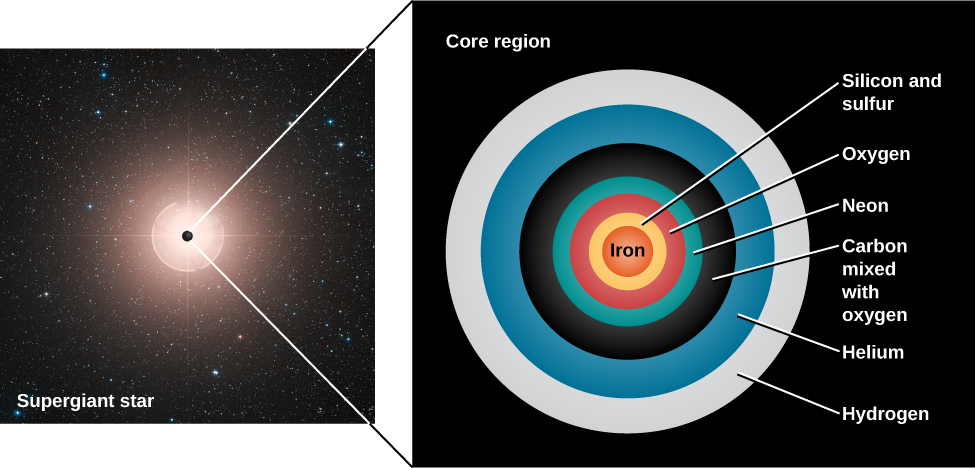
At this stage of its evolution, a massive star resembles an onion with an iron core. As we get farther from the center, we find shells of decreasing temperature in which nuclear reactions involve nuclei of progressively lower mass—silicon and sulfur, oxygen, neon, carbon, helium, and finally, hydrogen (Figure 23.6).
英語のヒント
この進化の段階に達した大質量星は、鉄の中心核を持つタマネギに似ている。中心から遠ざかるにつれて、温度の低い殻が順に現れ、それぞれの殻で核反応に関わる原子核も次第に軽くなる。ケイ素と硫黄、酸素、ネオン、炭素、ヘリウム、そして最後に水素である(図23.6)。
Structure of an Old Massive Star.老いた大質量星の構造。
credit: modification of work by ESO, Digitized Sky Survey · CC BY 4.0
Figure 23.6 Just before its final gravitational collapse, the core of a massive star resembles an onion. The iron core is surrounded by layers of silicon and sulfur, oxygen, neon, carbon mixed with some oxygen, helium, and finally hydrogen. Outside the core, the composition is mainly hydrogen and helium. (Note that this diagram is not precisely to scale but is just meant to convey the general idea of what such a star would be like.) (credit: modification of work by ESO, Digitized Sky Survey)
図23.6 最後の重力崩壊の直前、大質量星の中心部はタマネギに似た構造をしている。鉄の中心核の周囲に、ケイ素と硫黄、酸素、ネオン、少量の酸素が混じった炭素、ヘリウム、最後に水素の層が重なる。中心部の外側の主な成分は、水素とヘリウムである。(この図は正確な縮尺ではなく、こうした星がどのような構造かという全体像を伝えるためのものである。)(出典:ESO、Digitized Sky Surveyの作品を改変)
But there is a limit to how long this process of building up elements by fusion can go on. The fusion of silicon into iron turns out to be the last step in the sequence of nonexplosive element production. Up to this point, each fusion reaction has produced energy because the nucleus of each fusion product has been a bit more stable than the nuclei that formed it. As discussed in The Sun: A Nuclear Powerhouse, light nuclei give up some of their binding energy in the process of fusing into more tightly bound, heavier nuclei. It is this released energy that maintains the outward pressure in the core so that the star does not collapse. But of all the nuclei known, iron is the most tightly bound and thus the most stable.
英語のヒント
しかし、核融合で元素を積み上げるこの過程も、いつまでも続くわけではない。ケイ素から鉄への核融合が、爆発を伴わない元素生成の最後の段階となる。ここまでは、核融合でできた原子核のほうが、その材料となった原子核より少し安定なので、どの反応もエネルギーを生み出していた。「太陽――核エネルギーの源」で説明したように、軽い原子核が、より強く結び付いた重い原子核へ融合する過程では、結合エネルギーの一部が放出される。この放出されたエネルギーが、中心核の外向きの圧力を維持し、星の崩壊を防いでいる。しかし、知られている原子核のうちで、鉄は最も強く結び付いており、そのため最も安定している。
You might think of the situation like this: all smaller nuclei want to “grow up” to be like iron, and they are willing to pay (produce energy) to move toward that goal. But iron is a mature nucleus with good self-esteem, perfectly content being iron; it requires payment (must absorb energy) to change its stable nuclear structure. This is the exact opposite of what has happened in each nuclear reaction so far: instead of providing energy to balance the inward pull of gravity, any nuclear reactions involving iron would remove some energy from the core of the star.
英語のヒント
こんなたとえで考えてみよう。小さな原子核はみな、鉄のように『大人になる』ことを望んでおり、その目標へ進むためなら代金を払う、つまりエネルギーを出す。しかし鉄は、十分な自尊心を備えた成熟した原子核であり、鉄でいることにすっかり満足している。安定した原子核の構造を変えるには、代金を受け取る、つまりエネルギーを吸収しなければならない。これは、それまでの核反応で起きていたこととは正反対である。鉄が関わる核反応は、内向きの重力を支えるエネルギーを供給するどころか、中心核からエネルギーの一部を奪ってしまう。
Unable to generate energy, the star now faces catastrophe.
英語のヒント
エネルギーを生み出せなくなった星は、いよいよ破局を迎える。
Collapse into a Ball of Neutrons崩壊して中性子の球になる
When nuclear reactions stop, the core of a massive star is supported by degenerate electrons, just as a white dwarf is. For stars that begin their evolution with masses of at least 10 MSun, this core is likely made mainly of iron. (For stars with initial masses in the range 8 to 10 MSun, the core is likely made of oxygen, neon, and magnesium, because the star never gets hot enough to form elements as heavy as iron. The exact composition of the cores of stars in this mass range is very difficult to determine because of the complex physical characteristics in the cores, particularly at the very high densities and temperatures involved.) We will focus on the more massive iron cores in our discussion.
英語のヒント
核反応が止まると、大質量星の中心核は、白色矮星と同じように、縮退した電子によって支えられる。少なくとも10 MSunの質量で進化を始めた星では、その中心核の主成分は鉄と考えられる。初期質量が8~10 MSunの星では、中心核の主成分は酸素、ネオン、マグネシウムだろう。鉄ほど重い元素を作れるほどの高温にはならないからだ。この質量範囲の星の中心核の組成を正確に定めるのは、非常に難しい。中心核の物理的な性質は複雑であり、とりわけ、非常に高い密度と温度のもとでは扱いが難しいためである。ここからは、より大質量の鉄の中心核に注目して話を進める。
While no energy is being generated within the white dwarf core of the star, fusion still occurs in the shells that surround the core. As the shells finish their fusion reactions and stop producing energy, the ashes of the last reaction fall onto the white dwarf core, increasing its mass. As Figure 23.2 shows, a higher mass means a smaller core. The core can contract because even a degenerate gas is still mostly empty space. Electrons and atomic nuclei are, after all, extremely small. The electrons and nuclei in a stellar core may be crowded compared to the air in your room, but there is still lots of space between them.
英語のヒント
星の白色矮星状の中心核の内部ではエネルギーは作られないが、その周囲の殻では核融合が続いている。殻が核融合を終え、エネルギーを作らなくなると、最後の反応の『灰』が白色矮星状の中心核へ落ち込み、その質量を増やす。図23.2で見たように、質量が増すほど中心核は小さくなる。縮退した気体でも、そのほとんどは空間なので、中心核は収縮できる。結局のところ、電子も原子核も極めて小さい。星の中心核の電子と原子核は、部屋の空気に比べれば混み合っているかもしれないが、それでも間には多くの空間がある。
The electrons at first resist being crowded closer together, and so the core shrinks only a small amount. Ultimately, however, the iron core reaches a mass so large that even degenerate electrons can no longer support it. When the density reaches 4 × 10¹¹ g/cm3 (400 billion times the density of water), some electrons are actually squeezed into the atomic nuclei, where they combine with protons to form neutrons and neutrinos. This transformation is not something that is familiar from everyday life, but becomes very important as such a massive star core collapses.
英語のヒント
初めは電子が、さらに近くへ押し込められることに抵抗するので、中心核は少ししか縮まない。しかし、ついには鉄の中心核の質量が、縮退した電子でも支えられないほど大きくなる。密度が4 × 10¹¹ g/cm3、水の密度の4000億倍に達すると、電子の一部は実際に原子核の中へ押し込まれ、陽子と結合して、中性子とニュートリノを作る。この変化は日常生活ではなじみのないものだが、このような大質量の星の中心核が崩壊するときには、非常に重要になる。
Some of the electrons are now gone, so the core can no longer resist the crushing mass of the star’s overlying layers. The core begins to shrink rapidly. More and more electrons are now pushed into the atomic nuclei, which ultimately become so saturated with neutrons that they cannot hold onto them.
英語のヒント
電子の一部が消えたため、中心核はもう、上に重なる層の押しつぶすような重さに耐えられない。中心核は急速に縮み始める。さらに多くの電子が原子核へ押し込まれ、ついには原子核が中性子でいっぱいになり、抱えきれなくなる。
At this point, the neutrons are squeezed out of the nuclei and can exert a new force. As is true for electrons, it turns out that the neutrons strongly resist being in the same place and moving in the same way. The force that can be exerted by such degenerate neutrons is much greater than that produced by degenerate electrons, so unless the core is too massive, they can ultimately stop the collapse.
英語のヒント
この段階で、中性子は原子核から押し出され、新たな力を及ぼせるようになる。電子と同じく、中性子も同じ場所で同じように動くことに強く抵抗する。このような縮退した中性子が生む力は、縮退した電子の力よりはるかに大きい。そのため、中心核の質量が大きすぎなければ、中性子はついに崩壊を止められる。
This means the collapsing core can reach a stable state as a crushed ball made mainly of neutrons, which astronomers call a neutron star. We don’t have an exact number (a “Chandrasekhar limit”) for the maximum mass of a neutron star, but calculations tell us that the upper mass limit of a body made of neutrons might only be about 3 MSun. So if the mass of the core were greater than this, then even neutron degeneracy would not be able to stop the core from collapsing further. The dying star must end up as something even more extremely compressed, which until recently was believed to be only one possible type of object—the state of ultimate compaction known as a black hole (which is the subject of our next chapter). This is because no force was believed to exist that could stop a collapse beyond the neutron star stage.
英語のヒント
つまり、崩壊する中心核は、主に中性子からできた、押しつぶされた球として安定した状態に達し得る。天文学者はこれを中性子星と呼ぶ。中性子星の最大質量について、チャンドラセカール限界に相当する正確な値はまだない。しかし計算によれば、中性子からできた天体の質量の上限は、わずか約3 MSunかもしれない。中心核の質量がそれより大きければ、中性子の縮退でも、それ以上の崩壊を止められないだろう。死にゆく星は、さらに極端に圧縮された何かになるはずである。最近まで、その可能性は一種類だけと考えられていた。次の章で扱うブラックホール、究極まで圧縮された状態である。中性子星の段階を超えて崩壊するのを止められる力は、存在しないと考えられていたからだ。