第23章恒星の死The Death of Stars
23.4 Pulsars and the Discovery of Neutron Stars23.4 パルサーと中性子星の発見
Learning Objectives学習の目標
By the end of this section, you will be able to:
この節を学ぶと、次のことができるようになる。
Explain the research method that led to the discovery of neutron stars, located hundreds or thousands of light-years away
数百~数千光年離れた中性子星の発見につながった研究方法を説明する。
Describe the features of a neutron star that allow it to be detected as a pulsar
中性子星をパルサーとして検出できるようにする特徴を述べる。
List the observational evidence that links pulsars and neutron stars to supernovae
パルサーや中性子星と超新星を結び付ける、観測上の証拠を挙げる。
After a type II supernova explosion fades away, all that is left behind is either a neutron star or something even more strange, a black hole. We will describe the properties of black holes in Black Holes and Curved Spacetime, but for now, we want to examine how the neutron stars we discussed earlier might become observable.
英語のヒント
II型超新星の爆発の光が弱まったあとに残るのは、中性子星か、それよりさらに奇妙なブラックホールである。ブラックホールの性質は「ブラックホールと曲がった時空」で説明する。まずは、先ほど述べた中性子星が、どうすれば観測可能になるかを調べよう。
Neutron stars are the densest objects in the universe; the force of gravity at their surface is 1011 times greater than what we experience at Earth’s surface. The interior of a neutron star is composed of about 95% neutrons, with a small number of protons and electrons mixed in. In effect, a neutron star is a giant atomic nucleus, with a mass about 1057 times the mass of a proton. Its diameter is more like the size of a small town or an asteroid than a star. (Table 23.3 compares the properties of neutron stars and white dwarfs.) Because it is so small, a neutron star probably strikes you as the object least likely to be observed from thousands of light-years away. Yet neutron stars do manage to signal their presence across vast gulfs of space.
英語のヒント
中性子星は宇宙で最も高密度の天体であり、その表面の重力は、地表で経験するものの1011倍も大きい。内部は約95%が中性子で、少数の陽子と電子が混じっている。実質的に、中性子星は陽子の約1057倍の質量を持つ、巨大な原子核である。直径は星というより、小さな町や小惑星ほどの大きさだ。(表23.3で、中性子星と白色矮星の性質を比較している。)あまりに小さいので、数千光年も離れた場所から観測するには、およそ向かない天体だと感じるかもしれない。それでも中性子星は、宇宙の巨大な隔たりを越えて、自分の存在を知らせることができる。
Properties of a Typical White Dwarf and a Neutron Star 典型的な白色矮星と中性子星の性質 |
||
|---|---|---|
Property 性質 |
White Dwarf 白色矮星 |
Neutron Star 中性子星 |
Mass (Sun = 1) 質量〈太陽=1〉 |
0.6 (always <1.4) 0.6〈常に1.4未満〉 |
Always >1.4 and <3 常に1.4超、3未満 |
Radius 半径 |
7000 km | 10 km |
Density 密度 |
g/cm3 | 1014 g/cm3 |
The Discovery of Neutron Stars中性子星の発見
In 1967, Jocelyn Bell, a research student at Cambridge University, was studying distant radio sources with a special detector that had been designed and built by her advisor Antony Hewish to find rapid variations in radio signals. In those days, the project computers spewed out reams of paper showing where the telescope had surveyed the sky, and it was the job of Hewish’s graduate students to go through it all, searching for interesting phenomena. In September 1967, Bell discovered what she called “a bit of scruff”—a strange radio signal unlike anything seen before.
英語のヒント
1967年、ケンブリッジ大学の研究学生ジョスリン・ベルは、特別な検出器を使って遠方の電波源を調べていた。この検出器は、指導教員のアントニー・ヒューイッシュが、電波信号の素早い変化を見つけるために設計・製作したものだった。当時、研究用のコンピューターは、望遠鏡が空のどこを調べたかを示す紙を大量に吐き出していた。そのすべてに目を通し、興味深い現象を探すのが、ヒューイッシュの大学院生たちの仕事だった。1967年9月、ベルは、それまで見たどんなものとも違う奇妙な電波信号を見つけた。彼女が『ちょっとした乱れ』と呼んだものだった。
What Bell had found, in the constellation of Vulpecula, was a source of rapid, sharp, intense, and extremely regular pulses of radio radiation. Like the regular ticking of a clock, the pulses arrived precisely every 1.33728 seconds. Such exactness first led the scientists to speculate that perhaps they had found signals from an intelligent civilization. Radio astronomers even half-jokingly dubbed the source “LGM” for “little green men.” Soon, however, three similar sources were discovered in widely separated directions in the sky.
英語のヒント
ベルがこぎつね座で見つけたのは、短く鋭く強い電波のパルスを、きわめて規則正しく出す天体だった。時計の正確な刻みのように、パルスはちょうど1.33728秒ごとに届いた。初め、この精密さから、科学者たちは、もしかしたら知的文明からの信号を見つけたのではないかと考えた。電波天文学者は半ば冗談で、その電波源を『小さな緑色の人々』〈little green men〉の頭文字からLGMと呼びさえした。しかし、まもなく、空の大きく離れた方向に、似た電波源がさらに三つ見つかった。
When it became apparent that this type of radio source was fairly common, astronomers concluded that they were highly unlikely to be signals from other civilizations. By today, over 4000 such sources have been discovered; they are now called pulsars, short for “pulsating radio sources.”
英語のヒント
この種の電波源がかなりありふれたものだとわかると、天文学者は、ほかの文明からの信号である可能性は非常に低いと結論した。現在までに4000個を超える同種の電波源が発見されており、脈動する電波源〈pulsating radio sources〉を短くした『パルサー』と呼ばれている。
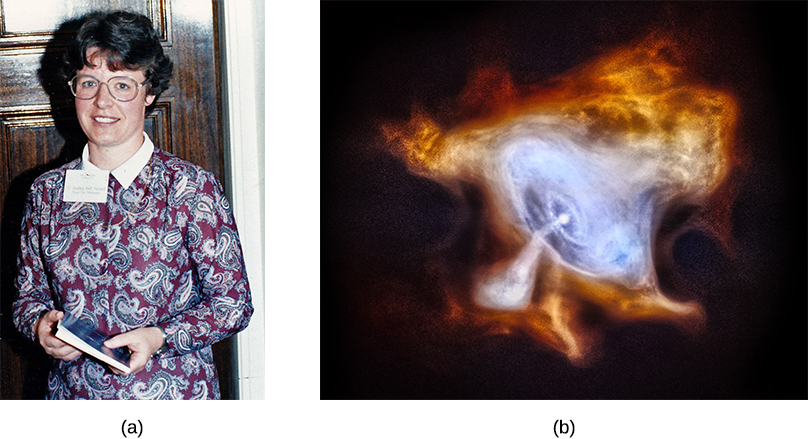
The pulse periods of different pulsars range from a little longer than 1/1000 of a second to nearly 10 seconds. At first, the pulsars seemed particularly mysterious because nothing could be seen at their location on visible-light photographs. But then a pulsar was discovered right in the center of the Crab Nebula, a cloud of gas produced by SN 1054, a supernova that was recorded by the Chinese in 1054 (Figure 23.14). The energy from the Crab Nebula pulsar arrives in sharp bursts that occur 30 times each second—with a regularity that would be the envy of a Swiss watchmaker. In addition to pulses of radio energy, we can observe pulses of visible light and X-rays from the Crab Nebula. The fact that the pulsar was just in the region of the supernova remnant where we expect the leftover neutron star to be immediately alerted astronomers that pulsars might be connected with these elusive “corpses” of massive stars.
英語のヒント
パルサーのパルス周期は、1000分の1秒を少し超えるものから、10秒近いものまである。初めは、可視光写真でその位置に何も見えないため、パルサーはいっそう謎めいていた。しかしその後、かに星雲のまさに中心で、パルサーが発見された。かに星雲は、1054年に中国で記録された超新星SN 1054が作ったガスの雲である(図23.14)。かに星雲のパルサーからのエネルギーは、毎秒30回の鋭いパルスとなって届く。その規則正しさは、スイスの時計職人もうらやむほどだ。電波のパルスだけでなく、可視光とX線のパルスも観測できる。超新星残骸の中でも、残された中性子星があるはずの場所に、ちょうどパルサーがあった。この事実から、天文学者はすぐに、パルサーが、なかなか捉えられない大質量星の『亡骸』と関係しているかもしれないと気づいた。
Jocelyn Bell and the Crab Nebula.ジョスリン・ベルとかに星雲。
credit a: work by A. Fraknoi; credit b: modification of work by NASA/CXC/SAO · CC BY 4.0
Figure 23.14 (a) Jocelyn Bell in 1979. Bell discovered pulsars in 1967 as a graduate student. (b) This image shows X-ray emissions from the Crab Nebula, which is about 6500 light-years away. The pulsar is the bright spot at the center of the concentric rings. Data taken over about a year show that particles stream away from the inner ring at about half the speed of light. The jet that is perpendicular to this ring is a stream of matter and antimatter electrons also moving at half the speed of light. (credit a: work by A. Fraknoi; credit b: modification of work by NASA/CXC/SAO)
図23.14 〈a〉1979年のジョスリン・ベル。1967年、大学院生のときにパルサーを発見した。〈b〉約6500光年離れたかに星雲のX線画像。パルサーは、同心円状の輪の中央の明るい点である。約1年間のデータから、内側の輪から粒子が光速の約半分で流れ出していることがわかる。この輪に垂直なジェットは、物質である電子と、その反物質である陽電子の流れで、やはり光速の半分で動いている。(出典a:A. Fraknoiの作品。出典b:NASA/CXC/SAOの作品を改変)
The Crab Nebula is a fascinating object. The whole nebula glows with radiation at many wavelengths, and its overall energy output is more than 100,000 times that of the Sun—not a bad trick for the remnant of a supernova that exploded almost a thousand years ago. Astronomers soon began to look for a connection between the pulsar and the large energy output of the surrounding nebula.
英語のヒント
かに星雲は魅力的な天体である。星雲全体が多くの波長で輝き、総エネルギー出力は太陽の10万倍を超える。1000年近く前に爆発した超新星の残骸としては、なかなか大した芸当だ。天文学者はすぐに、パルサーと、それを取り巻く星雲の大きなエネルギー出力とのつながりを探り始めた。