第23章恒星の死The Death of Stars
23.6 The Mystery of the Gamma-Ray Bursts23.6 ガンマ線バーストの謎
Learning Objectives学習の目標
By the end of this section, you will be able to:
この節を学ぶと、次のことができるようになる。
Give a brief history of how gamma-ray bursts were discovered and what instruments made the discovery possible
ガンマ線バーストがどのように発見されたか、その略史と、発見を可能にした装置を説明する。
Explain why astronomers think that gamma-ray bursts beam their energy rather than it radiating uniformly in all directions
ガンマ線バーストが、あらゆる方向に一様に放射するのでなく、ビームとしてエネルギーを出すと天文学者が考える理由を説明する。
Describe how the radiation from a gamma-ray burst and its afterglow is produced
ガンマ線バーストと、その残光の放射が生じる仕組みを述べる。
Explain how short-duration gamma-ray bursts differ from longer ones, and describe the process that makes short-duration gamma-ray bursts
短いガンマ線バーストと長いものの違いを説明し、短いバーストを作る過程を述べる。
Explain why gamma-ray bursts may help us understand the early universe
ガンマ線バーストが、初期宇宙の理解に役立ち得る理由を説明する。
Everybody loves a good mystery, and astronomers are no exception. The mystery we will discuss in this section was first discovered in the mid-1960s, not via astronomical research, but as a result of a search for the tell-tale signs of nuclear weapon explosions. The US Defense Department launched a series of Vela satellites to make sure that no country was violating a treaty that banned the detonation of nuclear weapons in space.
英語のヒント
人はみな、よい謎解きが好きで、天文学者も例外ではない。この節で扱う謎が初めて見つかったのは、1960年代半ばだった。天文学の研究ではなく、核兵器の爆発を示す証拠を探す過程での発見である。アメリカ国防総省は、宇宙での核兵器の爆発を禁じた条約に違反する国がないか確かめるため、一連のヴェラ衛星を打ち上げた。
Since nuclear explosions produce the most energetic form of electromagnetic waves called gamma rays (see Radiation and Spectra), the Vela satellites contained detectors to search for this type of radiation. The satellites did not detect any confirmed events from human activities, but they did—to everyone’s surprise—detect short bursts of gamma rays coming from random directions in the sky. News of the discovery was first published in 1973; however, the origin of the bursts remained a mystery. No one knew what produced the brief flashes of gamma rays or how far away the sources were.
英語のヒント
核爆発は、最も高エネルギーの電磁波であるガンマ線を生むため、ヴェラ衛星には、その放射を探す検出器が搭載されていた(「放射とスペクトル」参照)。衛星は、人間の活動と確認された現象を検出しなかった。しかし、誰もが驚いたことに、空の不規則な方向から来る短いガンマ線バーストを検出した。この発見が初めて公表されたのは1973年だが、バーストの起源は謎のままだった。短いガンマ線の閃光を何が生むのか、発生源がどれほど遠いのか、誰も知らなかった。
From a Few Bursts to Thousands数例から数千例へ
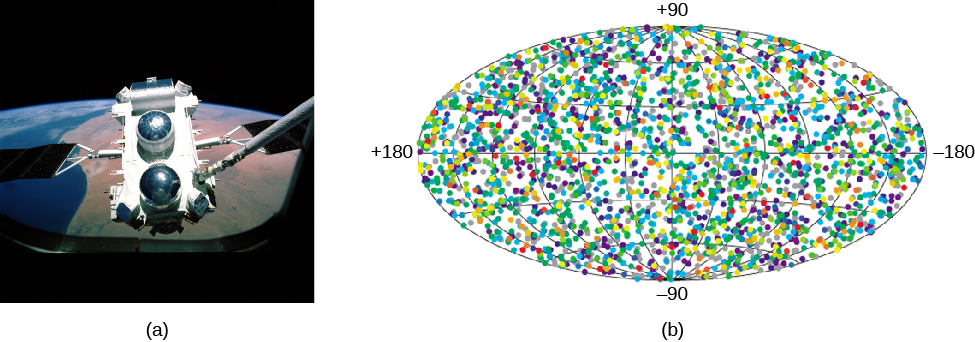
With the launch of the Compton Gamma-Ray Observatory by NASA in 1991, astronomers began to identify many more bursts and to learn more about them (Figure 23.19). Approximately once per day, the NASA satellite detected a flash of gamma rays somewhere in the sky that lasted from a fraction of a second to several hundred seconds. Before the Compton measurements, astronomers had expected that the most likely place for the bursts to come from was the main disk of our own (pancake-shaped) Galaxy. If this had been the case, however, more bursts would have been seen in the crowded plane of the Milky Way than above or below it. Instead, the sources of the bursts were distributed isotropically; that is, they could appear anywhere in the sky with no preference for one region over another. Almost never did a second burst come from the same location.
英語のヒント
1991年にNASAがコンプトン・ガンマ線観測衛星を打ち上げると、天文学者ははるかに多くのバーストを見つけ、詳しく知るようになった(図23.19)。衛星はおよそ1日に一度、空のどこかで、1秒未満から数百秒続くガンマ線の閃光を検出した。コンプトンの測定以前には、天文学者は、発生場所として最もありそうなのは、私たちのパンケーキ形の銀河の主要な円盤部分だと予想していた。しかしそれなら、天の川の混み合った平面に、その上や下より多くのバーストが見えるはずだった。実際には、発生源は等方的に分布していた。つまり空のどこにでも現れ得て、特定の領域を好む偏りがなかった。同じ場所で2度目のバーストが起きることも、ほとんどなかった。
Compton Detects Gamma-Ray Bursts.コンプトンによるガンマ線バーストの検出。
credit a: modification of work by NASA; credit b: modification of work by NASA/GSFC · NASA media use guidelines
Figure 23.19 (a) In 1991, the Compton Gamma-Ray Observatory was deployed by the Space Shuttle Atlantis. Weighing more than 16 tons, it was one of the largest scientific payloads ever launched into space. (b) This map of gamma-ray burst positions measured by the Compton Gamma-Ray Observatory shows the isotropic (same in all directions), uniform distribution of bursts on the sky. The map is oriented so that the disk of the Milky Way would stretch across the center line (or equator) of the oval. Note that the bursts show no preference at all for the plane of the Milky Way, as many other types of objects in the sky do. Colors indicate the total energy in the burst: red dots indicate long-duration, bright bursts; blue and purple dots show short, weaker bursts. (credit a: modification of work by NASA; credit b: modification of work by NASA/GSFC)
図23.19 〈a〉1991年、コンプトン・ガンマ線観測衛星が、スペースシャトル・アトランティスから放出された。質量は16トンを超え、宇宙へ打ち上げられた科学観測用機器としては、最大級のものだった。〈b〉コンプトンが測ったバーストの位置の地図は、空での等方的〈全方向で同じ〉で一様な分布を示す。楕円の中央線、つまり赤道に沿って天の川の円盤が伸びる向きに描かれている。空のほかの多くの天体とは異なり、バーストは天の川の平面を好む偏りをまったく示さない。色はバーストの総エネルギーを表す。赤い点は長く明るいバースト、青や紫の点は短く弱いバーストである。(出典a:NASAの作品を改変。出典b:NASA/GSFCの作品を改変)
For several years, astronomers actively debated whether the burst sources were relatively nearby or very far away—the two possibilities for bursts that are isotropically distributed. Nearby locations might include the cloud of comets that surrounds the solar system or the halo of our Galaxy, which is large and spherical, and also surrounds us in all directions. If, on the other hand, the bursts occurred at very large distances, they could come from faraway galaxies, which are also distributed uniformly in all directions.
英語のヒント
数年間にわたり、天文学者は、バーストの発生源が比較的近いのか、それとも非常に遠いのかを盛んに議論した。等方的な分布には、この二つの可能性がある。近い場所なら、太陽系を取り巻く彗星の雲や、銀河のハローが候補になる。ハローは大きな球形で、やはり私たちを全方向から取り囲む。反対に、非常に遠くで起きているなら、遠方の銀河から来ている可能性がある。それらも、あらゆる方向に一様に分布しているからだ。
Both the very local and the very distant hypotheses required something strange to be going on. If the bursts were coming from the cold outer reaches of our own solar system or from the halo of our Galaxy, then astronomers had to hypothesize some new kind of physical process that could produce unpredictable flashes of high-energy gamma rays in these otherwise-quiet regions of space. And if the bursts came from galaxies millions or billions of light-years away, then they must be extremely powerful to be observable at such large distances; indeed they had to be the among the biggest explosions in the universe.
英語のヒント
非常に近いという仮説も、非常に遠いという仮説も、何か奇妙なことが起きていると考える必要があった。太陽系の冷たい外縁や銀河のハローから来るなら、それ以外は静かな宇宙の領域で、予測できない高エネルギーのガンマ線閃光を作れる、新種の物理過程を想定しなければならない。何百万、何十億光年も離れた銀河から来るなら、その距離で観測できるほど、極めて強力なはずである。実際、宇宙で最大級の爆発でなければならなかった。
The First Afterglows初めて見つかった残光
The problem with trying to figure out the source of the gamma-ray bursts was that our instruments for detecting gamma rays could not pinpoint the exact place in the sky where the burst was happening. Early gamma-ray telescopes did not have sufficient resolution. This was frustrating because astronomers suspected that if they could pinpoint the exact position of one of these rapid bursts, then they would be able to identify a counterpart (such as a star or galaxy) at other wavelengths and learn much more about the burst, including where it came from. This would, however, require either major improvements in gamma-ray detector technology to provide better resolution or detection of the burst at some other wavelength. In the end, both techniques played a role.
英語のヒント
ガンマ線バーストの発生源を突き止めようとするときの問題は、ガンマ線を検出する装置では、空のどこで起きたかを正確に特定できないことだった。初期のガンマ線望遠鏡には、十分な分解能がなかった。これはもどかしいことだった。短いバーストの正確な位置さえわかれば、星や銀河など、ほかの波長で対応する天体を見つけ、どこから来たかも含めて、はるかに詳しく知れるはずだと考えられたからである。そのためには、分解能を高める大幅なガンマ線検出技術の改良か、別の波長でのバーストの検出が必要だった。結局、両方の方法が役割を果たした。
The breakthrough came with the launch of the Italian Dutch BeppoSAX satellite in 1996. BeppoSAX included a new type of gamma-ray telescope capable of identifying the position of a source much more accurately than previous instruments, to within a few minutes of arc on the sky. By itself, however, it was still not sophisticated enough to determine the exact source of the gamma-ray burst. After all, a box a few minutes of arc on a side could still contain many stars or other celestial objects.
英語のヒント
突破口となったのは、1996年に打ち上げられた、イタリアとオランダのベッポサックス衛星だった。新しい種類のガンマ線望遠鏡を備え、従来よりはるかに正確に、空で数分角以内の範囲へ発生源を絞り込めた。しかし、これだけでは、バーストの天体を正確に特定できるほどの性能には、まだ達していなかった。何しろ、一辺数分角の枠内にも、星などの天体が多数含まれ得る。
However, the angular resolution of BeppoSAX was good enough to tell astronomers where to point other, more precise telescopes in the hopes of detecting longer-lived electromagnetic emission from the bursts at other wavelengths. Detection of a burst at visible-light or radio wavelengths could provide a position accurate to a few seconds of arc and allow the position to be pinpointed to an individual star or galaxy. BeppoSAX carried its own X-ray telescope onboard the spacecraft to look for such a counterpart, and astronomers using visible-light and radio facilities on the ground were eager to search those wavelengths as well.
英語のヒント
それでもベッポサックスの角分解能は、ほかのもっと精密な望遠鏡をどこへ向ければよいか知らせるには十分だった。バーストからの、より長く続く電磁波放射を、ほかの波長で検出しようというのである。可視光や電波で検出できれば、位置を数秒角の精度で定め、一つの星や銀河に絞り込める。ベッポサックスは、対応する天体を探すため、自身のX線望遠鏡も搭載していた。地上の可視光や電波の施設を使う天文学者も、それぞれの波長で探そうと意欲を燃やしていた。
Two crucial BeppoSAX burst observations in 1997 helped to resolve the mystery of the gamma-ray bursts. The first burst came in February from the direction of the constellation Orion. Within 8 hours, astronomers working with the satellite had identified the position of the burst, and reoriented the spacecraft to focus BeppoSAX’s X-ray detector on the source. To their excitement, they detected a slowly fading X-ray source 8 hours after the event—the first successful detection of an afterglow from a gamma-ray burst. This provided an even-better location of the burst (accurate to about 40 seconds of arc), which was then distributed to astronomers across the world to try to detect it at even longer wavelengths.
英語のヒント
1997年の、ベッポサックスによる二つの重要なバースト観測が、謎を解く助けとなった。最初のバーストは2月、おりおん座の方向から来た。衛星を運用する天文学者は、8時間以内にその位置を特定し、機体の向きを変えてX線検出器を発生源へ向けた。胸を躍らせることに、現象から8時間後、ゆっくり暗くなるX線源を検出した。ガンマ線バーストの残光の検出に初めて成功したのである。これで位置は約40秒角の精度へ、さらに絞り込まれた。より長い波長で検出するため、この位置は世界中の天文学者へ伝えられた。
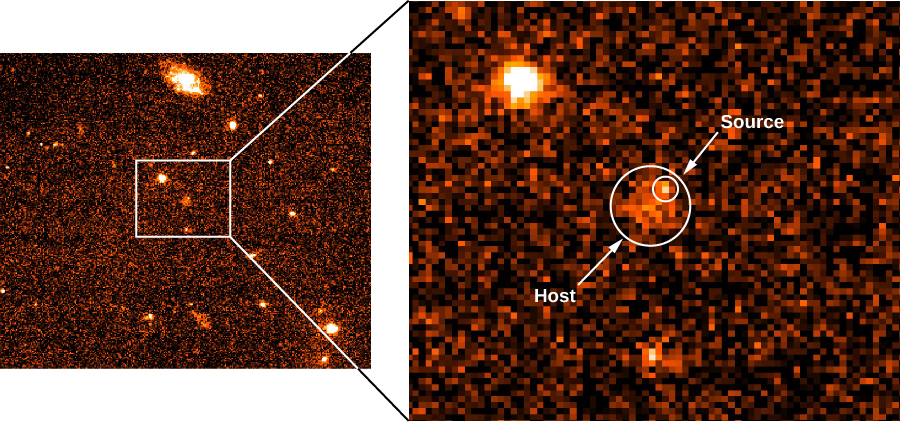
That very night, the 4.2-meter William Herschel Telescope on the Canary Islands found a fading visible-light source at the same position as the X-ray afterglow, confirming that such an afterglow could be detected in visible light as well. Eventually, the afterglow faded away, but left behind at the location of the original gamma-ray burst was a faint, fuzzy source right where the fading point of light had been—a distant galaxy (Figure 23.20). This was the first piece of evidence that gamma-ray bursts were indeed very energetic objects from very far away. However, it also remained possible that the burst source was much closer to us and just happened to align with a more distant galaxy, so this one observation alone was not a conclusive demonstration of the extragalactic origin of gamma-ray bursts.
英語のヒント
その夜のうちに、カナリア諸島の口径4.2メートルのウィリアム・ハーシェル望遠鏡が、X線残光と同じ位置で、暗くなりつつある可視光源を見つけた。残光を可視光でも検出できると確かめられたのである。やがて残光は消えたが、もとのバーストの位置、光の点が消えたまさにその場所には、暗くぼやけた天体が残った。遠方の銀河だった(図23.20)。これは、ガンマ線バーストが本当に非常に遠くの高エネルギー天体である、最初の証拠だった。しかし、発生源はもっと近くにあり、たまたま遠い銀河と同じ方向に重なっただけという可能性も残った。そのため、この一観測だけでは、銀河系外起源の決定的な証明にはならなかった。
Gamma-Ray Burst.ガンマ線バースト。
credit: modification of work by Andrew Fruchter (STScI), Elena Pian (ITSRE-CNR), and NASA, ESA · CC BY 4.0
Figure 23.20 This false-color Hubble Space Telescope image, taken in September 1997, shows the fading afterglow of the gamma-ray burst of February 28, 1997 and the host galaxy in which the burst originated. The left view shows the region of the burst. The enlargement shows the burst source and what appears to be its host galaxy. Note that the gamma-ray source is not in the center of the galaxy. (credit: modification of work by Andrew Fruchter (STScI), Elena Pian (ITSRE-CNR), and NASA, ESA)
図23.20 1997年9月のハッブル宇宙望遠鏡の擬似カラー画像。1997年2月28日のガンマ線バーストの、暗くなりつつある残光と、その母銀河を示す。左はバーストの周辺領域。拡大図には、発生源と、母銀河と思われる天体が見える。ガンマ線源は銀河の中心にはないことに注意しよう。(出典:Andrew Fruchter〈STScI〉、Elena Pian〈ITSRE-CNR〉、NASA、ESAの作品を改変)
On May 8 of the same year, a burst came from the direction of the constellation Camelopardalis. In a coordinated international effort, BeppoSAX again fixed a reasonably precise position, and almost immediately a telescope on Kitt Peak in Arizona was able to catch the visible-light afterglow. Within 2 days, the largest telescope in the world (the Keck in Hawaii) collected enough light to record a spectrum of the burst. The May gamma-ray burst afterglow spectrum showed absorption features from a fuzzy object that was 4 billion light-years from the Sun, meaning that the location of the burst had to be at least this far away—and possibly even farther. (How astronomers can get the distance of such an object from the Doppler shift in the spectrum is something we will discuss in Galaxies.) What that spectrum showed was clear evidence that the gamma-ray burst had taken place in a distant galaxy.
英語のヒント
同じ年の5月8日、きりん座の方向からバーストが来た。国際的な連携によって、ベッポサックスは再びかなり正確な位置を定め、アリゾナ州キットピークの望遠鏡が、ほとんど直後に可視光の残光を捉えた。2日以内に、世界最大の望遠鏡であるハワイのケックが、スペクトルを記録するのに十分な光を集めた。5月のバーストの残光スペクトルには、太陽から40億光年離れた、ぼんやりした天体による吸収の特徴があった。これは、バーストが少なくともそこまで遠く、場合によってはさらに遠方にあることを意味する。(スペクトルのドップラー偏移からその距離を求める方法は、「銀河」で説明する。)そのスペクトルは、バーストが遠方の銀河で起きた明確な証拠を示していた。