第23章恒星の死The Death of Stars
The Synthesis of Heavy Elements重い元素の合成
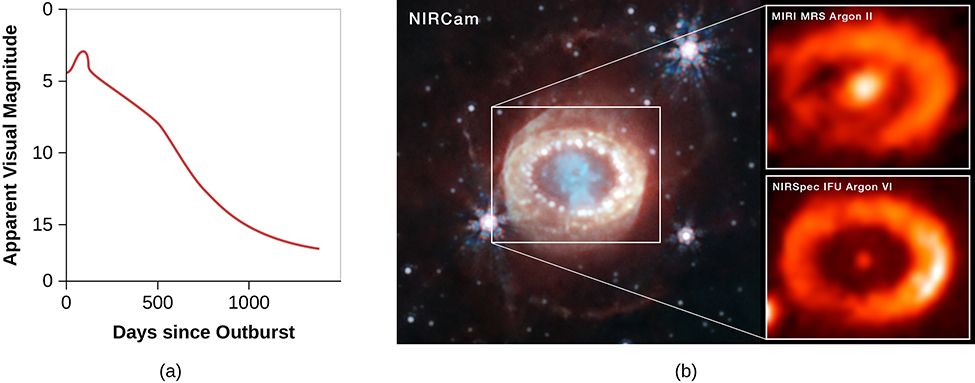
The variations in the brightness of SN 1987A in the days and months after its discovery, which are shown in Figure 23.13, helped confirm our ideas about heavy element production. In a single day, the star soared in brightness by a factor of about 1000 and became just visible without a telescope. The star then continued to increase slowly in brightness until it was about the same apparent brightness as the stars in the Little Dipper. Up until about day 40 after the outburst, the energy being radiated away was produced by the explosion itself. But then SN 1987A did not continue to fade away, as we might have expected the light from the explosion to do. Instead, SN 1987A remained bright as energy from newly created radioactive elements came into play.
英語のヒント
発見から数日、数か月にわたるSN 1987Aの明るさの変化は、重い元素が作られる仕組みについての考えを確かめる助けとなった。その変化を図23.13に示す。星はたった1日で約1000倍に明るくなり、望遠鏡なしでもかろうじて見えるようになった。その後もゆっくり明るさを増し、こぐま座の小びしゃくを形作る星々と同程度の見かけの明るさになった。爆発から約40日目までは、放射されるエネルギーは爆発そのものによって生じたものだった。しかしその後、SN 1987Aは、爆発の光ならそうなると予想されるようには、暗くなり続けなかった。新たに作られた放射性元素のエネルギーが働き始め、明るさを保ったのである。
Change in the Brightness of SN 1987A over Time and Supernova 1987A Observed with the James Webb Space Telescope.SN 1987Aの明るさの時間変化と、ジェイムズ・ウェッブ宇宙望遠鏡による観測。
credit b: modification of work "Argon emission in SN1987A" by NASA, ESA, CSA, STScI, and C. Fransson (Stockholm University), M. Matsuura (Cardiff University), M. J. Barlow (University College London), P. J. Kavanagh (Maynooth University), J. Larsson (KTH Royal Institute of Technology)/ESA, CC BY 4.0 · CC BY 4.0
Figure 23.13 (a) Note how the rate of decline of the supernova’s light slowed between days 40 and 500. During this time, the brightness was mainly due to the energy emitted by newly formed (and quickly decaying) radioactive elements. Remember that magnitudes are a backward measure of brightness: the larger the magnitude, the dimmer the object looks. (b) At the left we see an image of the supernova in 2023, seen with the telescope’s near-infrared camera. You can see ring of material from earlier in the life of the star with which the particles from the explosion are now colliding. It’s an infrared version of Figure 23.12. At the bottom right, you see an image in the infrared light of highly ionized argon atoms. You can see a strong signal from the object in the center, which indicates that it is a neutron star, giving off energetic radiation. (credit b: modification of work "Argon emission in SN1987A" by NASA, ESA, CSA, STScI, and C. Fransson (Stockholm University), M. Matsuura (Cardiff University), M. J. Barlow (University College London), P. J. Kavanagh (Maynooth University), J. Larsson (KTH Royal Institute of Technology)/ESA, CC BY 4.0)
図23.13 〈a〉40日目から500日目まで、超新星の光の弱まる速さが遅くなったことに注目しよう。この間の明るさは、主に新しく作られ、急速に崩壊する放射性元素の放つエネルギーによるものだった。等級は、明るさと逆向きの尺度である。等級の数値が大きいほど、天体は暗く見える。〈b〉左は、望遠鏡の近赤外線カメラで見た、2023年の超新星の姿。星の一生のもっと早い時期に放出された物質の輪が見え、爆発で飛び出した粒子が今、その輪に衝突している。図23.12の赤外線版である。右下は、強く電離したアルゴン原子の赤外線による画像。中心の天体から強い信号が見られ、高エネルギーの放射を出す中性子星であることを示している。(出典b:NASA、ESA、CSA、STScI、C. Fransson〈ストックホルム大学〉、M. Matsuura〈カーディフ大学〉、M. J. Barlow〈ユニヴァーシティ・カレッジ・ロンドン〉、P. J. Kavanagh〈メイヌース大学〉、J. Larsson〈スウェーデン王立工科大学〉/ESAの『Argon emission in SN1987A』を改変。CC BY 4.0)
One of the elements formed in a supernova explosion is radioactive nickel, with an atomic mass of 56 (that is, the total number of protons plus neutrons in its nucleus is 56). Nickel-56 is unstable and changes spontaneously (with a half-life of about 6 days) to cobalt-56. (Recall that a half-life is the time it takes for half the nuclei in a sample to undergo radioactive decay.) Cobalt-56 in turn decays with a half-life of about 77 days to iron-56, which is stable. Energetic gamma rays are emitted when these radioactive nuclei decay. Those gamma rays then serve as a new source of energy for the expanding layers of the supernova. The gamma rays are absorbed in the overlying gas and re-emitted at visible wavelengths, keeping the remains of the star bright.
英語のヒント
超新星爆発で作られる元素の一つに、原子の質量数が56の放射性ニッケルがある。原子核中の陽子と中性子の合計が56という意味である。ニッケル56は不安定で、約6日の半減期で、自発的にコバルト56へ変わる。半減期とは、試料中の原子核の半分が放射性崩壊するまでの時間である。次にコバルト56が、約77日の半減期で、安定した鉄56へ崩壊する。これらの放射性原子核が崩壊すると、高エネルギーのガンマ線が放出される。ガンマ線は、膨張する超新星の層にとって新しいエネルギー源となる。上に重なるガスに吸収され、可視光の波長で再放射されることで、星の残骸を明るく保つのである。
As you can see in Figure 23.13, astronomers did observe brightening due to radioactive nuclei in the first few months following the supernova’s outburst and then saw the extra light die away as more and more of the radioactive nuclei decayed to stable iron. The gamma-ray heating was responsible for virtually all of the radiation detected from SN 1987A after day 40. Some gamma rays also escaped directly without being absorbed. These were detected by Earth-orbiting telescopes at the wavelengths expected for the decay of radioactive nickel and cobalt, clearly confirming our understanding that new elements were indeed formed in the crucible of the supernova.
英語のヒント
図23.13のように、天文学者は実際に、爆発後の最初の数か月に、放射性原子核による増光を観測した。その後、さらに多くの原子核が安定した鉄へ崩壊するにつれ、付け加わっていた光が消えていくのも見た。40日目以降にSN 1987Aから検出された放射は、ほぼすべてガンマ線による加熱が源だった。ガンマ線の一部は、吸収されずにそのまま外へ逃げ出した。地球を周回する望遠鏡が、それを放射性ニッケルとコバルトの崩壊から予想される波長で検出した。新しい元素が本当に超新星というるつぼの中で作られた、という理解が、こうして明確に確かめられた。
Neutrinos from SN 1987ASN 1987Aからのニュートリノ
If there had been any human observers in the Large Magellanic Cloud about 160,000 years ago, the explosion we call SN 1987A would have been a brilliant spectacle in their skies. Yet we know that less than 1/10 of 1% of the energy of the explosion appeared as visible light. About 1% of the energy was required to destroy the star, and the rest was carried away by neutrinos (as discussed in Evolution of Massive Stars: An Explosive Finish). The overall energy in these neutrinos was truly astounding. In the initial second of the event, as we noted earlier in our general discussion of supernovae, their total luminosity exceeded the luminosity of all the stars in over a billion galaxies. And the supernova generated this energy in a volume less than 50 kilometers in diameter! Supernovae are one of the most violent events in the universe, and their light turns out to be only the tip of the iceberg in revealing how much energy they produce.
英語のヒント
約16万年前の大マゼラン雲に人間の観測者がいたなら、私たちがSN 1987Aと呼ぶ爆発は、その空で輝かしい光景となっただろう。しかし、可視光になったのは、爆発のエネルギーの0.1%にも満たないことがわかっている。約1%が星を破壊するのに使われ、残りはニュートリノが持ち去った(「大質量星の進化――爆発による最期」参照)。ニュートリノに含まれるエネルギーの総量は、実に驚くべきものだった。先に超新星を一般的に説明した際にも述べたように、最初の1秒間には、その総光度は10億個を超える銀河の全恒星の光度を上回った。しかも、超新星は直径50キロメートル未満の領域で、このエネルギーを生み出したのである。超新星は宇宙で最も激しい現象の一つであり、その光が明らかにしてくれるエネルギー量は、氷山の一角にすぎない。
In 1987, the neutrinos from SN 1987A were detected by two instruments—which might be called “neutrino telescopes”—almost a full day before Shelton’s observations. (This is because the neutrinos get out of the exploding star more easily than light does, and also because you don’t need to wait until nightfall to catch a “glimpse” of them.) Both neutrino telescopes, one in a deep mine in Japan and the other under Lake Erie, consist of several thousand tons of purified water surrounded by several hundred light-sensitive detectors. Incoming neutrinos interact with the water to produce positrons and electrons, which move rapidly through the water and emit deep blue light.
英語のヒント
1987年、SN 1987Aのニュートリノは、シェルトンの観測よりほぼ丸1日早く、『ニュートリノ望遠鏡』と呼べる二つの装置で検出された。ニュートリノのほうが光より容易に爆発する星から抜け出せるうえ、ニュートリノを『垣間見る』には日暮れを待つ必要もないからである。一つは日本の深い鉱山内、もう一つはエリー湖の下にあり、いずれも数千トンの純水を数百個の光検出器で囲んだものだった。入ってきたニュートリノが水と相互作用すると、陽電子や電子が生じる。それらは水の中を高速で移動し、濃い青色の光を放つ。
Altogether, 19 neutrinos were detected. Since the neutrino telescopes were in the Northern Hemisphere and the supernova occurred in the Southern Hemisphere, the detected neutrinos had already passed through Earth and were on their way back out into space when they were captured.
英語のヒント
合計19個のニュートリノが検出された。ニュートリノ望遠鏡は北半球にあり、超新星は南半球側の空で起きた。そのため、検出されたニュートリノは、すでに地球を通り抜け、再び宇宙へ出ていく途中で捕らえられたものだった。
Only a few neutrinos were detected because the probability that they will interact with ordinary matter is very, very low. It is estimated that the supernova actually released 1058 neutrinos. A tiny fraction of these, about 30 billion, eventually passed through each square centimeter of Earth’s surface. About a million people actually experienced a neutrino interaction within their bodies as a result of the supernova. This interaction happened to only a single nucleus in each person and thus had absolutely no biological effect; it went completely unnoticed by everyone concerned.
英語のヒント
ニュートリノが普通の物質と相互作用する確率は非常に低いため、検出されたのはわずかな数だった。超新星が実際に放出したニュートリノは、1058個と推定される。そのごく一部、約300億個ずつが、やがて地球表面の1平方センチメートルごとを通過した。超新星の結果、約100万人は実際に、体内でニュートリノとの相互作用を経験した。ただし、一人につき原子核一つで起きただけなので、生物学的な影響はまったくなく、当人たちは誰も気づかなかった。
Since the neutrinos come directly from the heart of the supernova, their energies provided a measure of the temperature of the core as the star was exploding. The central temperature was about 200 billion K, a stunning figure to which no earthly analog can bring much meaning. With neutrino telescopes, we are peering into the final moment in the life stories of massive stars and observing conditions beyond all human experience. Yet we are also seeing the unmistakable hints of our own origins.
英語のヒント
ニュートリノは超新星の中心から直接来るので、そのエネルギーは、星が爆発するときの中心核の温度を測る手掛かりとなった。中心温度は約2000億K。地上の何にたとえても、その大きさを十分に実感できないほど驚くべき数値である。私たちはニュートリノ望遠鏡で、大質量星の一生の最後の瞬間をのぞき込み、人間のあらゆる経験を超えた状態を観測している。同時に、私たち自身の起源の確かな手掛かりも見ているのである。