第12章環・衛星・冥王星Rings, Moons, and Pluto
12.2 The Galilean Moons of Jupiter12.2 木星のガリレオ衛星
Learning Objectives学習の目標
By the end of this section, you will be able to:
この節を学び終えると、次のことができるようになる。
Describe the major features we can observe about Callisto and what we can deduce from them
カリストで観測できる主な特徴と、そこから推測できることを説明する。
Explain the evidence for tectonic and volcanic activity on Ganymede
ガニメデの地殻変動と火山活動の証拠を説明する。
Explain what may be responsible for the unusual features on the icy surface of Europa
エウロパの氷の表面にある特異な特徴の原因として考えられるものを説明する。
Describe the major distinguishing characteristic of Io
イオを際立たせる主な特徴を説明する。
Explain how tidal forces generate the geological activity we see on Europa and Io
エウロパとイオで見られる地質活動を潮汐力がどのように引き起こすかを説明する。
From 1996 to 1999, the Galileo spacecraft careered through the jovian system on a complex but carefully planned trajectory that provided repeated close encounters with the large Galilean moons. More recently, the Juno spacecraft, also a Jupiter orbiter, has provided a few close looks at Ganymede and Europa. (Beginning in 2004, we received an even greater bonanza of information about Titan, obtained from the Cassini spacecraft and its Huygens probe, which landed on its surface. We include Titan, Saturn’s one big moon, here for comparison.) Table 12.1 summarizes some basic facts about these large moons (plus our own Moon for comparison).
英語のヒント
1996~1999年、ガリレオ探査機は、複雑だが慎重に計画された軌道をたどって木星系を飛び回り、大きなガリレオ衛星に繰り返し接近した。さらに最近では、同じく木星周回機であるジュノーが、ガニメデとエウロパの近接観測をいくつか行った。2004年からは、カッシーニ探査機と、タイタン表面に着陸したホイヘンス・プローブによって、タイタンについてさらに豊富な情報が得られた。ここでは比較のため、土星でひときわ大きな衛星であるタイタンも含める。表12.1に、これらの大きな衛星の基本的な情報をまとめる。比較のため、地球の月も載せてある。
The Largest Moons 最も大きな衛星 |
||||
|---|---|---|---|---|
Name 名称 |
Diameter 直径(km) |
Mass 質量(地球の月=1) |
Density 密度(g/cm³) |
Reflectivity 反射率(%) |
Moon 月 |
3476 | 1.0 | 3.3 | 12 |
Callisto カリスト |
4820 | 1.5 | 1.8 | 20 |
Ganymede ガニメデ |
5270 | 2.0 | 1.9 | 40 |
Europa エウロパ |
3130 | 0.7 | 3.0 | 70 |
Io イオ |
3640 | 1.2 | 3.5 | 60 |
Titan タイタン |
5150 | 1.9 | 1.9 | 20 |
Callisto: An Ancient, Primitive Worldカリスト――太古の原始的な世界
We begin our discussion of the Galilean moons with the outermost one, Callisto, not because it is remarkable but because it is not. This makes it a convenient object with which other, more active, worlds can be compared. Its distance from Jupiter is about 2 million kilometers, and it orbits the planet in 17 days. Like our own Moon, Callisto rotates in the same period as it revolves, so it always keeps the same face toward Jupiter. Callisto’s day thus equals its month: 17 days. Its noontime surface temperature is only 130 K (about 140 °C below freezing), so that water ice is stable (it never evaporates) on its surface year round.
英語のヒント
ガリレオ衛星の話を、最も外側のカリストから始めよう。それは特別に目立つ存在だからではなく、むしろそうではないからである。そのため、ほかのもっと活発な世界と比較するのに便利な対象になる。木星からの距離は約200万キロメートルで、17日で一周する。地球の月と同様、自転周期と公転周期が同じなので、いつも同じ面を木星に向けている。したがってカリストでは、1日が1か月に等しく、どちらも17日である。正午の地表温度はわずか130 K、氷点下約140℃なので、表面の水の氷は一年中安定しており、蒸発することがない。
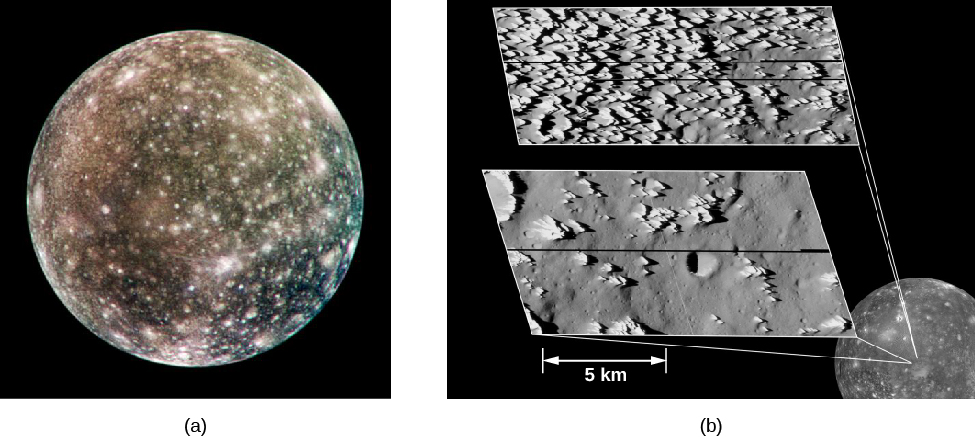
Callisto has a diameter of 4820 kilometers, almost the same as the planet Mercury (Figure 12.3). Yet its mass is only one-third as great, which means its density (the mass divided by the volume) must be only one-third as great as well. This tells us that Callisto has far less of the rocky and metallic materials found in the inner planets and must instead be an icy body through much of its interior. Callisto can show us how the geology of an icy object compares with those made primarily of rock.
英語のヒント
カリストの直径は4820キロメートルで、水星とほぼ同じである(図12.3)。それでも質量は水星の3分の1しかないため、密度、すなわち質量を体積で割った値も3分の1しかないことになる。このことから、カリストでは内惑星に見られる岩石や金属の物質がはるかに少なく、代わりに内部の大部分が氷に富むはずだとわかる。カリストを調べれば、氷の天体の地質が、主として岩石からできた天体とどう違うかを知ることができる。
Unlike the worlds we have studied so far, Callisto has not fully differentiated (separated into layers of different density materials). We can tell that it lacks a dense core from the details of its gravitational pull on the Galileo spacecraft. This surprised scientists, who expected that all the big icy moons would be differentiated. It should be easier for an icy body to differentiate than for a rocky one because the melting temperature of ice is so low. Only a little heating will soften the ice and get the process started, allowing the rock and metal to sink to the center while the slushy ice floats to the surface. Yet Callisto seems to have frozen solid before the process of differentiation was complete.
英語のヒント
ここまでに調べた世界と違い、カリストは完全には分化していない。密度の異なる物質の層へ完全に分かれていないのである。ガリレオ探査機に及ぼす重力の引き方の詳細から、高密度の核がないとわかる。大きな氷衛星はすべて分化しているはずだと考えていた科学者たちは、この結果に驚いた。氷の融解温度は非常に低いため、岩石の天体よりも、氷の天体の方が分化しやすいはずである。少し熱すれば氷が軟らかくなって過程が始まり、岩石と金属は中心へ沈み、半分溶けた氷は表面へ浮き上がれる。しかしカリストは、分化が完了する前に固く凍ってしまったように見える。
The surface of Callisto is covered with impact craters, like the lunar highlands. The survival of these craters tells us that an icy object can retain impact craters on its surface. Callisto is unique among the planet-sized objects of the solar system in the apparent absence of interior forces to drive geological change. You might say that this moon was stillborn, and it has remained geologically dead for more than 4 billion years (Figure 12.3).
英語のヒント
カリストの表面は、月の高地のように衝突クレーターで覆われている。これらのクレーターが残っていることは、氷の天体でも表面に衝突クレーターを保持できると教えてくれる。地質の変化を駆動する内部の力がないように見える点で、カリストは太陽系の惑星ほどの大きさの天体の中でも独特である。この衛星は死んだ状態で生まれ、40億年以上にわたって地質学的に死んだままだった、と言えるかもしれない(図12.3)。
Callisto.カリスト。
credit a: modification of work by NASA/JPL/DLR; credit b: modification of work by NASA/JPL/Arizona State University, Academic Research Lab · JPL image use policy
Figure 12.3 (a) Jupiter’s outermost large moon shows a heavily cratered surface. Astronomers believe that the bright areas are mostly ice, while the darker areas are more eroded, ice-poor material. (b) These high-resolution images, taken by NASA’s Galileo spacecraft in May 2001, show the icy spires (top) on Callisto’s surface, with darker dust that has slid down as the ice erodes, collecting in the low-lying areas. The spires are about 80 to 100 meters tall. As the surface erodes even further, the icy spires eventually disappear, leaving impact craters exposed, as shown in the lower image. (credit a: modification of work by NASA/JPL/DLR; credit b: modification of work by NASA/JPL/Arizona State University, Academic Research Lab)
図12.3 (a)木星の最も外側の大衛星には、クレーターが密集した表面が見える。天文学者は、明るい領域の大半は氷で、暗い領域はより浸食され、氷が少なくなった物質だと考えている。(b)NASAのガリレオ探査機が2001年5月に撮影した高解像度画像。上の画像はカリスト表面の氷の尖塔を示す。氷が浸食されるにつれて滑り落ちた暗いちりが、低い場所にたまっている。尖塔の高さは約80~100メートルである。浸食がさらに進むと、氷の尖塔はやがて消え、下の画像のように衝突クレーターが露出する。(クレジットa:NASA/JPL/DLRの作品を改変。b:NASA/JPL/Arizona State University, Academic Research Labの作品を改変)
In thinking about ice so far from the Sun, we must take care not to judge its behavior from the much warmer ice we know and love on Earth. At the temperatures of the outer solar system, ice on the surface is nearly as hard as rock, and it behaves similarly. Ice on Callisto does not deform or flow like ice in glaciers on Earth.
英語のヒント
太陽からこれほど遠い場所の氷を考えるときには、地球上で私たちが親しんでいる、ずっと温かい氷から、その振る舞いを判断しないよう注意しなければならない。外側の太陽系の温度では、表面の氷は岩石とほぼ同じくらい硬く、振る舞いも似ている。カリストの氷は、地球の氷河の氷のように変形したり流れたりしない。
Ganymede, the Largest Moon最大の衛星、ガニメデ
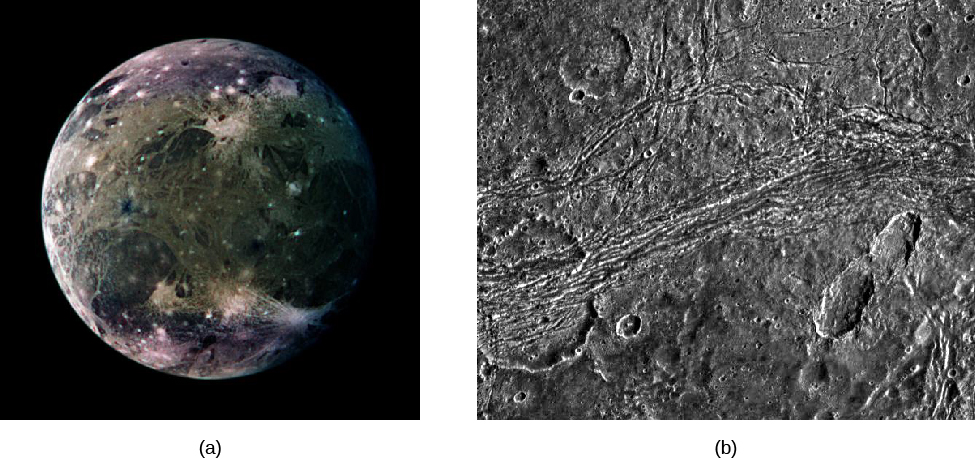
Ganymede, the largest moon in the solar system, also shows a great deal of cratering (Figure 12.4). Recall from Other Worlds: An Introduction to the Solar System that we can use crater counts on solid worlds to estimate the age of the surface. The more craters, the longer the surface has been exposed to battering from space, and the older it must therefore be. About one-quarter of Ganymede’s surface seems to be as old and heavily cratered as that of Callisto; the rest formed more recently, as we can tell by the sparse covering of impact craters as well as the relative freshness of those craters. If we judge from crater counts, this fresher terrain on Ganymede is somewhat younger than the lunar maria or the martian volcanic plains, perhaps 2 to 3 billion years old.
英語のヒント
太陽系最大の衛星ガニメデにも、多数のクレーターが見られる(図12.4)。「ほかの世界――太陽系入門」の章で、固体の世界ではクレーターを数えて表面の年代を推定できると学んだことを思い出そう。クレーターが多いほど、表面は宇宙からの衝突に長くさらされており、それだけ古いはずである。ガニメデ表面の約4分の1は、カリストと同じくらい古く、クレーターも密集しているように見える。残りはもっと最近できた。衝突クレーターがまばらで、個々のクレーターも比較的新鮮なことから、それがわかる。クレーター数から判断すると、このガニメデの比較的新しい地形は、月の海や火星の火山平原よりいくらか若く、おそらく20~30億年前のものである。
The differences between Ganymede and Callisto are more than skin deep. Ganymede is a differentiated world, like the terrestrial planets. Measurements of its gravity field tell us that the rock sank to form a core about the size of our Moon, with a mantle and crust of ice “floating” above it. In addition, the Galileo spacecraft discovered that Ganymede has a magnetic field, the sure signature of a partially molten interior. There is very likely liquid water trapped within the interior. Thus, Ganymede is not a dead world but rather a place of intermittent geological activity powered by an internal heat source. Some surface features could be as young as the surface of Venus (a few hundred million years).
英語のヒント
ガニメデとカリストの違いは、表面だけではない。ガニメデは地球型惑星と同じく、分化した世界である。重力場の測定から、岩石が沈んで地球の月ほどの核を作り、その上に氷のマントルと地殻が「浮かんでいる」とわかる。さらに、ガリレオ探査機はガニメデに磁場があることを発見した。これは内部が部分的に溶けている確かな証拠である。内部には液体の水が閉じ込められている可能性が非常に高い。したがってガニメデは死んだ世界ではなく、内部の熱源によって断続的な地質活動が起こる場所である。表面の一部の特徴は、金星の表面と同じくらい新しく、数億年前のものかもしれない。
The younger terrain was formed by tectonic and volcanic forces (Figure 12.4). In some places, the crust apparently cracked, flooding many of the craters with water from the interior. Extensive mountain ranges were formed from compression of the crust, forming long ridges with parallel valleys spaced a few kilometers apart. In some areas, older impact craters were split and pulled apart. There are even indications of large-scale crustal movements that are similar to the plate tectonics of Earth.
英語のヒント
新しい地形は、地殻変動と火山活動によって作られた(図12.4)。場所によっては地殻が割れ、内部からの水が多くのクレーターを満たしたように見える。地殻の圧縮から広大な山脈ができ、数キロメートル間隔の平行な谷を伴う、長い尾根が形成された。いくつかの領域では、古い衝突クレーターが割れて引き離された。地球のプレートテクトニクスに似た、大規模な地殻運動の兆候さえある。
Ganymede.ガニメデ。
credit a: modification of work by NASA/JPL/DLR; credit b: modification of work by NASA/JPL/Brown University · JPL image use policy
Figure 12.4 (a) This global view of Ganymede, the largest moon in the solar system, was taken by Voyager 2. The colors are enhanced to make spotting differences easier. Darker places are older, more heavily cratered regions; the lighter areas are younger (the reverse of our Moon). The brightest spots are sites of geologically recent impacts. (b) This close-up of Nicholson Regio on Ganymede shows an old impact crater (on the lower left-hand side) that has been split and pulled apart by tectonic forces. Against Ganymede’s dark terrain, a line of grooves and ridges appears to cut through the crater, deforming its circular shape. (credit a: modification of work by NASA/JPL/DLR; credit b: modification of work by NASA/JPL/Brown University)
図12.4 (a)ボイジャー2号が撮影した、太陽系最大の衛星ガニメデの全球像。違いを見分けやすくするため、色を強調している。暗い場所は古く、クレーターがより多い領域であり、明るい領域は若い。これは地球の月とは逆である。最も明るい点は、地質学的に最近起きた衝突の場所を示す。(b)ガニメデのニコルソン地域の接近画像。左下の古い衝突クレーターは、地殻変動の力によって割れ、引き離されている。暗い地形の中で、溝と尾根の列がクレーターを横切り、その円形を変形させているように見える。(クレジットa:NASA/JPL/DLRの作品を改変。b:NASA/JPL/Brown Universityの作品を改変)
Why is Ganymede so different from Callisto? Possibly the small difference in size and internal heating between the two led to this divergence in their evolution. But more likely the gravity of Jupiter is to blame for Ganymede’s continuing geological activity. Ganymede is close enough to Jupiter that tidal forces from the giant planet may have episodically heated its interior and triggered major convulsions on its crust.
英語のヒント
なぜガニメデはカリストとこれほど違うのだろうか。両者の大きさと内部の加熱のわずかな違いが、進化の道筋を分けたのかもしれない。しかし、ガニメデの地質活動が続く原因としてもっとありそうなのは、木星の重力である。ガニメデは木星に十分近いため、この巨大惑星からの潮汐力が、時折その内部を加熱し、地殻の大変動を引き起こした可能性がある。
A tidal force results from the unequal gravitational pull on two sides of a body. In a complex kind of modern dance, the large moons of Jupiter are caught in the varying gravity grip of both the giant planet and each other. This leads to gravitational flexing or kneading in their centers, which can heat them—an effect called tidal heating. (A fuller explanation is given in the section on Io.) We will see as we move inward to Europa and Io that the role of jovian tides becomes more important for moons close to the planet.
英語のヒント
潮汐力は、天体の両側に働く重力の引き方が等しくないことから生じる。複雑なモダンダンスのように、木星の大きな衛星は、巨大惑星自身と互いの衛星の、変化する重力に捉えられている。そのため、中心部は重力によってたわめられたり、こねられたりし、加熱されることがある。この効果を潮汐加熱という。より詳しい説明はイオの節で行う。内側のエウロパやイオへ進むにつれて、木星の潮汐の役割は、惑星に近い衛星ほど重要になることがわかるだろう。