第12章環・衛星・冥王星Rings, Moons, and Pluto
12.4 Pluto and Charon12.4 冥王星とカロン
Learning Objectives学習の目標
By the end of this section, you will be able to:
この節を学び終えると、次のことができるようになる。
Compare the orbital characteristics of Pluto with those of the planets
冥王星の軌道の特徴を、惑星のものと比較する。
Describe information about Pluto’s surface deduced from the New Horizons images
ニュー・ホライズンズの画像から推定された、冥王星表面の情報を説明する。
Note some distinguishing characteristics of Pluto’s large moon Charon
冥王星の大衛星カロンを特徴づける性質をいくつか挙げる。
Pluto is not a moon, but we discuss it here because its size and composition are similar to many moons in the outer solar system. Our understanding of Pluto (and its large moon Charon) have changed dramatically as a result of the New Horizons flyby in 2015.
英語のヒント
冥王星は衛星ではないが、大きさや組成が、外側の太陽系の多くの衛星と似ているため、ここで取り上げる。冥王星とその大衛星カロンについての理解は、2015年のニュー・ホライズンズのフライバイによって大きく変わった。
Is Pluto a Planet?冥王星は惑星か
Pluto was discovered through a careful, systematic search, unlike Neptune, whose position was calculated from gravitational theory. Nevertheless, the history of the search for Pluto began with indications that Uranus had slight departures from its predicted orbit, departures that could be due to the gravitation of an undiscovered “Planet X.” Early in the twentieth century, several astronomers, most notably Percival Lowell, then at the peak of his fame as an advocate of intelligent life on Mars, became interested in searching for this ninth planet.
英語のヒント
重力理論から位置が計算された海王星とは違い、冥王星は入念で系統的な探索によって発見された。それでも、冥王星探しの歴史は、天王星の軌道に予測からのわずかなずれがあるという兆候から始まった。そのずれは、まだ発見されていない「惑星X」の重力によるものかもしれなかった。20世紀初め、何人もの天文学者が、この第9惑星の探索に関心を持った。特に有名なのがパーシヴァル・ローウェルである。当時、彼は火星の知的生命の存在を主張する人物として、名声の絶頂にあった。
Lowell and his contemporaries based their calculations primarily on tiny unexplained irregularities in the motion of Uranus. Lowell’s computations indicated two possible locations for a perturbing Planet X; the more likely of the two was in the constellation Gemini. He predicted a mass for the planet intermediate between the masses of Earth and Neptune (his calculations gave about 6 Earth masses). Other astronomers, however, obtained other solutions from the tiny orbital irregularities, even including one model that indicated two planets beyond Neptune.
英語のヒント
ローウェルと同時代の人々は、主として天王星の運動にある、説明できない微小な不規則性をもとに計算した。ローウェルの計算は、摂動を起こす惑星Xの候補位置を二つ示した。より有望な方は、ふたご座の中にあった。彼は惑星の質量を、地球と海王星の中間と予測した。計算値は地球の約6倍だった。しかし、ほかの天文学者は小さな軌道の乱れから別の解を得ており、海王星の外側に2つの惑星を示すモデルさえあった。
At his Arizona observatory, Lowell searched without success for the unknown planet from 1906 until his death in 1916, and the search was not renewed until 1929. In February 1930, a young observing assistant named Clyde Tombaugh (see the Clyde Tombaugh: From the Farm to Fame feature box), comparing photographs he made on January 23 and 29 of that year, found a faint object whose motion appeared to be about right for a planet far beyond the orbit of Neptune (Figure 12.17). The new planet was named for Pluto, the Roman god of the underworld, who dwelt in remote darkness, just like the new planet. The choice of this name, among hundreds suggested, was helped by the fact that the first two letters were Percival Lowell’s initials.
英語のヒント
ローウェルはアリゾナの自分の天文台で、1906年から1916年に亡くなるまで未知の惑星を探したが、見つからなかった。探索が再開されたのは1929年だった。1930年2月、クライド・トンボーという若い観測助手(囲み記事「クライド・トンボー――農場から名声へ」参照)が、その年の1月23日と29日に自分で撮影した写真を比べ、淡い天体を見つけた。その動きは、海王星軌道のはるか向こうの惑星として、おおむね適切に見えた(図12.17)。新惑星は、ローマ神話の冥界の神プルートにちなんで名づけられた。この神は、新しい惑星と同じように、遠い暗闇に住んでいた。何百という候補の中からこの名が選ばれる助けになったのは、最初の2文字がパーシヴァル・ローウェルの頭文字でもあったことだ。
Pluto’s Motion.冥王星の動き。
Figure 12.17 Portions of the two photographs by which Clyde Tombaugh discovered Pluto in 1930. The left one was taken on January 23 and the right on January 29. Note that Pluto, indicated by an arrow, has moved among the stars during those six nights. If we hadn’t put an arrow next to it, though, you probably would never have spotted the dot that moved. (credit: modification of work by the Lowell Observatory Archives)
図12.17 クライド・トンボーが1930年に冥王星を発見した2枚の写真の一部。左は1月23日、右は1月29日に撮影された。矢印で示した冥王星が、その6晩の間に星々の中を動いたことに注目しよう。ただし、矢印を付けていなければ、動いた点を見つけることは、おそらくできなかっただろう。(クレジット:Lowell Observatory Archivesの作品を改変)
Although the discovery of Pluto appeared initially to be a vindication of gravitational theory similar to the earlier triumph of Adams and Le Verrier in predicting the position of Neptune, we now know that Lowell’s calculations were wrong. When its mass and size were finally measured, it was found that Pluto could not possibly have exerted any measurable pull on either Uranus or Neptune. Astronomers are now convinced that the reported small anomalies in the motions of Uranus are not, and never were, real.
英語のヒント
冥王星の発見は当初、アダムズとルヴェリエが海王星の位置を予測した以前の成功と同じように、重力理論の正しさを示すものに見えた。しかし、ローウェルの計算は誤っていたと今ではわかっている。質量と大きさがようやく測定されると、冥王星が天王星や海王星に、測定可能な引力を及ぼせるはずがないとわかった。天文学者は現在、報告された天王星の運動の小さな異常は実在せず、最初から実在していなかったと確信している。
From the time of its discovery, it was clear that Pluto was not a giant like the other four outer solar system planets. For a long time, it was thought that the mass of Pluto was similar to that of Earth, so that it was classed as a fifth terrestrial planet, somehow misplaced in the far outer reaches of the solar system. There were other anomalies, however, as Pluto’s orbit was more eccentric and inclined to the plane of our solar system than that of any other planet. Only after the discovery of its moon Charon in 1978 could the mass of Pluto be measured, and it turned out to be far less than the mass of Earth.
英語のヒント
発見当初から、冥王星が太陽系の外側のほかの4惑星のような巨人ではないことは明らかだった。長い間、質量は地球に近いと考えられていたため、何らかの理由で太陽系の遠い外縁へ置き違えられた、第5の地球型惑星として分類されていた。しかし、ほかにも異常な点があった。冥王星の軌道は、ほかのどの惑星よりも離心率が大きく、太陽系の面に対して大きく傾いていたのである。1978年に衛星カロンが発見されて初めて、冥王星の質量を測定できた。その値は地球の質量よりはるかに小さかった。
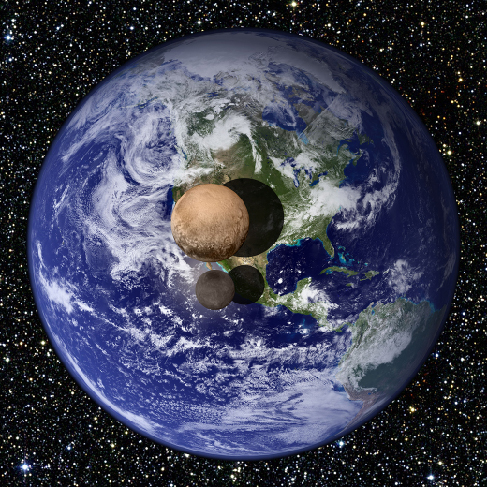
In addition to Charon, Pluto has four much smaller moons. Subsequent observations of Charon showed that this moon is in a retrograde orbit and has a diameter of about 1200 kilometers, more than half the size of Pluto itself (Figure 12.18). This makes Charon the moon whose size is the largest fraction of its parent planet. We could even think of Pluto and Charon as a double world. Seen from Pluto, Charon would be as large as eight full moons on Earth.
英語のヒント
冥王星にはカロンに加えて、ずっと小さな衛星が4つある。後の観測で、カロンは逆行軌道にあり、直径は約1200キロメートルで、冥王星本体の半分を超える大きさだとわかった(図12.18)。このためカロンは、親惑星の大きさに対する割合が最も大きい衛星になる。冥王星とカロンを二重の世界と考えることさえできる。冥王星から見たカロンは、地球から見た満月8個分ほどの大きさに見えるだろう。
Comparison of the Sizes of Pluto and Its Moon Charon with Earth.冥王星とその衛星カロンの大きさを地球と比較する。
credit: modification of work by NASA · NASA media use guidelines
Figure 12.18 This graphic vividly shows how tiny Pluto is relative to a terrestrial planet like Earth. That is the primary justification for putting Pluto in the class of dwarf planets rather than terrestrial planets. (credit: modification of work by NASA)
図12.18 この図は、地球のような地球型惑星に対して冥王星がいかに小さいかを鮮明に示している。これが、冥王星を地球型惑星ではなく準惑星の分類に入れる主な理由である。(クレジット:NASAの作品を改変)
To many astronomers, Pluto seemed like the odd cousin that everyone hopes will not show up at the next family reunion. Neither its path around the Sun nor its size resembles either the giant planets or the terrestrial planets. In the 1990s, astronomers began to discover additional small objects in the far outer solar system, showing that Pluto was not unique. We will discuss these trans-neptunian objects later with other small bodies, in the chapter on Comets and Asteroids: Debris of the Solar System. One of them (called Eris) is nearly the same size as Pluto, and another (Makemake) is substantially smaller. It became clear to astronomers that Pluto was so different from the other planets that it needed a new classification. Therefore, it was called a dwarf planet, meaning a planet much smaller than the terrestrial planets. We now know of many small objects in the vicinity of Pluto and we have classified several as dwarf planets.
英語のヒント
多くの天文学者にとって、冥王星は、次の親戚の集まりには来ないでほしいと誰もが願う、風変わりないとこのように見えた。太陽の周りの軌道も大きさも、巨大惑星にも地球型惑星にも似ていない。1990年代、天文学者は太陽系の遠い外側で、さらに小さな天体を発見し始め、冥王星が唯一の存在ではないことがわかった。これらの海王星以遠天体は、後の「彗星と小惑星――太陽系に残されたかけら」の章で、ほかの小天体とともに取り上げる。その一つのエリスは冥王星とほぼ同じ大きさであり、別のマケマケはかなり小さい。冥王星はほかの惑星とあまりにも違い、新しい分類が必要だと天文学者には明らかになった。そこで準惑星と呼ばれることになった。これは、地球型惑星よりずっと小さい惑星という意味である。現在、冥王星付近には数多くの小天体が知られ、そのうちいくつかは準惑星に分類されている。
A similar history was associated with the discovery of the asteroids. When the first asteroid (Ceres) was discovered at the beginning of the nineteenth century, it was hailed as a new planet. In the following years, however, other objects were found with similar orbits to Ceres. Astronomers decided that these should not all be considered planets, so they invented a new class of objects, called minor planets or asteroids. Today, Ceres is also called a dwarf planet. Both minor planets and dwarf planets are part of a whole belt or zones of similar objects (as we will discuss in Comets and Asteroids: Debris of the Solar System).
英語のヒント
小惑星の発見にも、似た歴史があった。19世紀初めに最初の小惑星ケレスが発見されると、新しい惑星として歓迎された。ところが、その後の数年間に、ケレスと似た軌道を持つ天体がほかにも見つかった。天文学者は、それらをすべて惑星とみなすべきではないと判断し、「小惑星」という新しい分類を作った。今日ではケレスも準惑星と呼ばれる。小惑星も準惑星も、似た天体が集まる帯や領域の一部である。このことは「彗星と小惑星――太陽系に残されたかけら」の章で扱う。
So, is Pluto a planet? Our answer is yes, but it is a dwarf planet, clearly not in the same league with the eight major planets (four giants and four terrestrials). While some people were upset when Pluto was reclassified, we might point out that a dwarf tree is still a type of tree and (as we shall see) a dwarf galaxy is still a type of galaxy.
英語のヒント
では、冥王星は惑星なのだろうか。私たちの答えは、そうだ、というものである。ただし、それは準惑星であり、4つの巨大惑星と4つの地球型惑星という8つの主要惑星とは、明らかに同じ部類ではない。冥王星の分類変更に動揺した人もいたが、矮性の木も木の一種であり、後に見る矮小銀河も銀河の一種だということを指摘してもよいだろう。