第12章環・衛星・冥王星Rings, Moons, and Pluto
Rings of Uranus and Neptune天王星と海王星の環
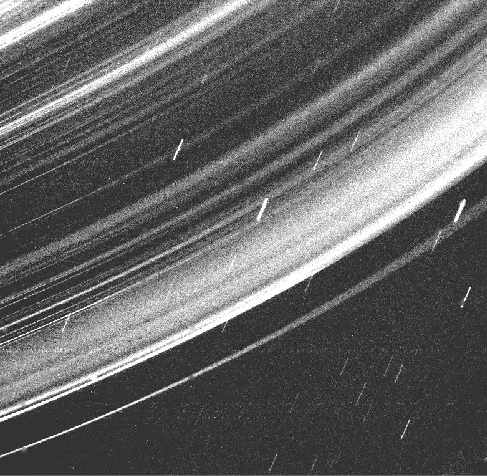
Uranus’ rings are narrow and black, making them almost invisible from Earth. The nine main rings were discovered in 1977 from observations made of a star as Uranus passed in front of it. We call such a passage of one astronomical object in front of another an occultation. During the 1977 occultation, astronomers expected the star’s light to disappear as the planet moved across it. But in addition, the star dimmed briefly several times before Uranus reached it, as each narrow ring passed between the star and the telescope. Thus, the rings were mapped out in detail even though they could not be seen or photographed directly, like counting the number of cars in a train at night by watching the blinking of a light as the cars successively pass in front of it. When Voyager approached Uranus in 1986, it was able to study the rings at close range; the spacecraft also photographed two new rings (Figure 12.30).
英語のヒント
天王星の環は細くて黒いため、地球からはほとんど見えない。主要な九つの環は1977年、天王星がある恒星の手前を通過するときの観測から発見された。ある天体が別の天体の前を通る現象を、掩蔽(えんぺい)という。1977年の掩蔽では、天文学者たちは、惑星が恒星の前を横切ると恒星の光が消えると予想していた。ところが、それに加えて、天王星本体が恒星の位置に達する前にも、恒星は何度か短時間暗くなった。細い環が一つずつ恒星と望遠鏡の間を通ったためだ。このように、環を直接見たり撮影したりできなくても、その配置を詳しく描き出せた。夜、列車の各車両が光の前を順に通過するときの明滅を見て、車両の数を数えるようなものだ。ボイジャーは1986年に天王星へ接近すると、環を間近で調べることができ、さらに新たな二つの環も撮影した(図12.30)。
Rings of Uranus.天王星の環。
credit: modification of work by NASA/JPL · JPL image use policy
Figure 12.30 The Voyager team had to expose this image for a long time to get a glimpse of Uranus’ narrow dark rings. You can see the grainy structure of “noise” in the electronics of the camera in the picture background. (credit: modification of work by NASA/JPL)
図12.30 ボイジャーのチームは、天王星の細く暗い環をわずかでも捉えるため、この画像を長時間露光しなければならなかった。画像の背景には、カメラの電子系による「ノイズ」の粒状模様が見える。(クレジット:NASA/JPLの作品を改変)
The outermost and most massive of Uranus’ rings is called the Epsilon Ring. It is only about 100 kilometers wide and probably no more than 100 meters thick (similar to the F Ring of Saturn). The Epsilon Ring encircles Uranus at a distance of 51,000 kilometers, about twice the radius of Uranus. This ring probably contains as much mass as all of Uranus’ other ten rings combined; most of them are narrow ribbons less than 10 kilometers wide, just the reverse of the broad rings of Saturn.
英語のヒント
天王星の環のうち最も外側にあり、質量も最大なのがイプシロン環だ。幅は約100kmしかなく、厚さもおそらく100m以下だ(土星のF環に似ている)。イプシロン環は天王星の半径の約2倍に当たる、中心から5万1000kmの距離で天王星を取り巻いている。この環だけで、天王星のほかの十個の環をすべて合わせたほどの質量を含んでいると考えられる。ほかの環の大部分は幅10km未満の細い帯で、土星の幅広い環とはまるで逆だ。
The individual particles in the uranian rings are nearly as black as lumps of coal. While astronomers do not understand the composition of this material in detail, it seems to consist in large part of carbon and hydrocarbon compounds. Organic material of this sort is rather common in the outer solar system. Many of the asteroids and comets are also composed of dark, tarlike materials. In the case of Uranus, its ten small inner moons have a similar composition, suggesting that one or more moons might have broken up to make the rings.
英語のヒント
天王星の環の個々の粒子は、石炭の塊とほぼ同じくらい黒いものだ。この物質の詳しい組成はわかっていないが、大部分が炭素と炭化水素の化合物からなるようだ。この種の有機物は外側の太陽系ではかなり一般的で、多くの小惑星や彗星も暗いタール状の物質からできている。天王星の場合、内側にある十個の小衛星も似た組成を持ち、一つまたは複数の衛星が壊れて環ができた可能性を示唆している。
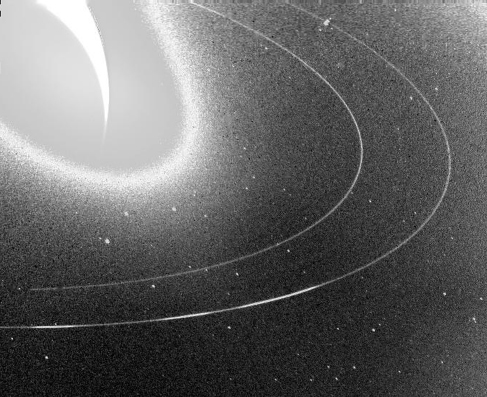
Neptune’s rings are generally similar to those of Uranus but even more tenuous (Figure 12.31). There are only four of them, and the particles are not uniformly distributed along their lengths. Because these rings are so difficult to investigate from Earth, it will probably be a long time before we understand them very well.
英語のヒント
海王星の環は全般に天王星の環に似ているが、さらに希薄だ(図12.31)。環は四つしかなく、粒子は環に沿って均等に分布しているわけではない。これらの環を地球から調べるのは非常に難しいため、詳しく理解できるまでには、おそらく長い時間がかかるだろう。
Rings of Neptune.海王星の環。
credit: modification of work by NASA/JPL · JPL image use policy
Figure 12.31 This long exposure of Neptune’s rings was photographed by Voyager 2. Note the two denser regions of the outer ring. (credit: modification of work by NASA/JPL)
図12.31 ボイジャー2号が長時間露光で撮影した海王星の環。外側の環にある、密度の高い二つの部分に注目しよう。(クレジット:NASA/JPLの作品を改変)
Resolution of Planetary Rings惑星の環を見分ける解像度
Using the occultations of stars by the rings of Saturn, astronomers have been able to measure details in the ring structure to a resolution of 10 km. This is a much higher resolution than can be obtained in a conventional photo of the rings. Let’s figure out what angular resolution (in arcsec) a space telescope in Earth orbit would have to achieve to obtain equal resolution.
英語のヒント
土星の環による恒星の掩蔽を利用して、天文学者たちは環の構造を10kmの解像度で詳しく測定できた。これは通常の環の写真から得られる解像度をはるかに上回る。同じ解像度を得るには、地球を周回する宇宙望遠鏡がどれほどの角分解能(角秒)を達成しなければならないか、求めてみよう。
Solution解き方
To solve this problem, we use the “small-angle formula” to relate angular and linear diameters in the sky. For angles in the sky that are small, the formula is usually written as
英語のヒント
この問題を解くには「小角近似の公式」を使い、空で見える角直径と実際の直径を結び付ける。空での角度が小さいとき、この公式は通常、次のように書かれる。
where angular diameter is expressed in arcsec. The distance of Saturn near opposition is about
. Substituting in the above formula and solving for the angular resolution, we get
英語のヒント
ここで角直径は角秒で表す。衝の近くにある土星までの距離は約だ。上の公式に代入して角分解能について解くと、次の値が得られる。
which is about arcsec, or a milliarcsec. This is not possible for our telescopes to achieve. For comparison, the best resolution from either the Hubble Space Telescope or ground-based telescopes is about 0.1 arcsec, or 100 times worse than what we would need. This is why such occultation measurements are so useful for astronomers.
英語のヒント
これは約角秒、すなわち1ミリ角秒だ。この分解能は、現在の私たちの望遠鏡では達成できない。比較すると、ハッブル宇宙望遠鏡でも地上の望遠鏡でも、最高の分解能は約0.1角秒で、必要な分解能より100倍粗くなる。だからこそ、このような掩蔽の測定は天文学者にとって非常に有用なのだ。
Check Your Learning理解を確かめよう
How close to Saturn would a spacecraft have to be to make out detail in its rings as small as 20 km, if its camera has an angular resolution of 5 arcsec?
カメラの角分解能が5角秒のとき、環の中の20kmという小さな構造まで見分けるには、探査機は土星にどれほど近づく必要があるだろうか。
Interactions between Rings and Moons環と衛星の相互作用
Much of our fascination with planetary rings is a result of their intricate structures, most of which owe their existence to the gravitational effect of moons, without which the rings would be flat and featureless. Indeed, it is becoming clear that without moons there would probably be no rings at all because, left to themselves, thin disks of small particles gradually spread and dissipate.
英語のヒント
惑星の環に私たちが強く引かれるのは、その入り組んだ構造によるところが大きく、その構造の大部分は衛星の重力によって存在している。衛星がなければ、環は平らで特徴のないものになるだろう。実際、衛星なしでは、おそらく環そのものが存在しないことが明らかになりつつある。小さな粒子からなる薄い円盤は、そのまま放っておけば徐々に広がって散逸してしまうからだ。
Most of the gaps in Saturn’s rings, and also the location of the outer edge of the A Ring, result from gravitational resonances with small inner moons. A resonance takes place when two objects have orbital periods that are exact ratios of each other, such as 1:2 or 2:3. For example, any particle in the gap at the inner side of the Cassini Division of Saturn’s rings would have a period equal to one-half that of Saturn’s moon Mimas. Such a particle would be nearest Mimas in the same part of its orbit every second revolution. The repeated gravitational tugs of Mimas, acting always in the same direction, would perturb it, forcing it into a new orbit outside the gap. In this way, the Cassini Division became depleted of ring material over long periods of time.
英語のヒント
土星の環の隙間の大部分やA環の外縁の位置は、内側の小衛星との重力共鳴によって生じる。共鳴は、二つの天体の公転周期が1:2や2:3のような正確な比をなすときに起こる。たとえば土星の環のカッシーニの間隙の内側寄りの隙間にある粒子は、どれも土星の衛星ミマスの半分に等しい周期を持つことになる。その粒子は2周するごとに、軌道の同じ場所でミマスに最も近づくだろう。ミマスの重力による引力が常に同じ方向から繰り返し働くと、粒子の運動が乱され、隙間の外にある新たな軌道へと押しやられる。このようにして長い時間をかけ、カッシーニの間隙から環の物質が失われた。
The Cassini mission revealed a great deal of fine structure in Saturn’s rings. Unlike the earlier Voyager flybys, Cassini was able to observe the rings for more than a decade, revealing a remarkable range of changes, on time scales from a few minutes to several years. Many of the features newly seen in Cassini data indicated the presence of condensations or small moons only a few tens of meters across imbedded in the rings. As each small moon moves, it produces waves in the surrounding ring material like the wake left by a moving ship. Even when the moon is too small to be resolved, its characteristic waves could be photographed by Cassini.
英語のヒント
カッシーニの探査は、土星の環にある豊富な微細構造を明らかにした。それ以前のボイジャーのフライバイとは異なり、カッシーニは10年以上にわたって環を観測でき、数分から数年までの時間尺度で、驚くほど多様な変化を見いだした。カッシーニのデータで新たに見つかった特徴の多くは、環の中に、物質の集積や、直径がわずか数十mの小衛星が埋め込まれていることを示していた。小衛星は動くたびに、航行する船が残す航跡のような波を、周囲の環の物質に作る。衛星が小さすぎて見分けられなくても、その特徴的な波をカッシーニは撮影できた。
One of the most interesting rings of Saturn is the narrow F Ring, which contains several apparent ringlets within its 90-kilometer width. In places, the F Ring breaks up into two or three parallel strands that sometimes show bends or kinks. Most of the rings of Uranus and Neptune are also narrow ribbons like the F Ring of Saturn. Clearly, the gravity of some objects must be keeping the particles in these thin rings from spreading out.
英語のヒント
土星の環の中でも特に興味深いものの一つが、細いF環だ。その幅90kmの中に、さらに細い環らしき筋がいくつもある。場所によってはF環は平行な2〜3本の筋に分かれ、ときには曲がりや折れも見せる。天王星と海王星の環の大部分も、土星のF環のような細い帯だ。明らかに、何らかの天体の重力が、これらの細い環の粒子が広がるのを抑えているはずだ。
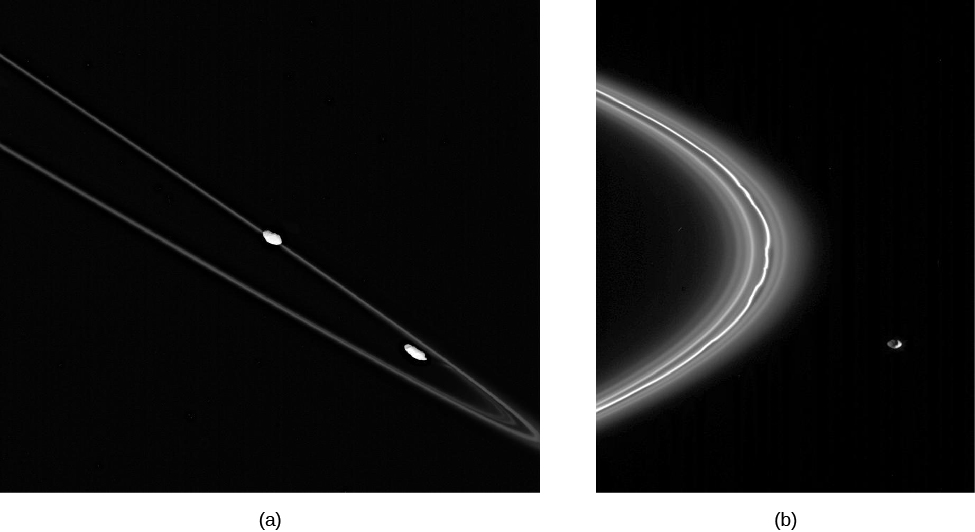
As we have seen, the largest features in the rings of Saturn are produced by gravitational resonances with the inner moons, while much of the fine structure is caused by smaller embedded moons. In the case of Saturn’s F Ring, close-up images revealed that it is bounded by the orbits of two moons, called Pandora and Prometheus (Figure 12.32). These two small moons (each about 100 kilometers in diameter) are referred to as shepherd moons, since their gravitation serves to “shepherd” the ring particles and keep them confined to a narrow ribbon. A similar situation applies to the Epsilon Ring of Uranus, which is shepherded by the moons Cordelia and Ophelia. These two shepherds, each about 50 kilometers in diameter, orbit about 2000 kilometers inside and outside the ring.
英語のヒント
すでに見たように、土星の環の大きな構造は内側の衛星との重力共鳴によってでき、微細構造の多くは環の中に埋め込まれた小衛星によってできる。土星のF環の場合、近接画像から、パンドラとプロメテウスという二つの衛星の軌道に挟まれていることがわかった(図12.32)。この二つの小衛星はそれぞれ直径約100kmで、羊飼い衛星と呼ばれる。重力で環の粒子を「羊の群れのようにまとめ」、細い帯の中へ閉じ込めておく役割を果たすためだ。天王星のイプシロン環でも状況は似ており、コーデリアとオフィーリアが羊飼い役を務める。この二つの衛星はそれぞれ直径約50kmで、環から約2000km内側と外側を公転している。
Saturn’s F Ring and Its Shepherd Moons.土星のF環と羊飼い衛星。
credit a, b: modification of work by NASA/JPL/Space Science Institute · JPL image use policy
Figure 12.32 (a) This Cassini image shows the narrow, complex F Ring of Saturn, with its two small shepherd moons Pandora (left) and Prometheus (right). (b) In this closer view, the shepherd moon Pandora (84 kilometers across) is seen next to the F ring, in which the moon is perturbing the main (brightest) strand of ring particles as it passes. You can see the dark side of Pandora on this image because it is being illuminated by the light reflected from Saturn. (credit a, b: modification of work by NASA/JPL/Space Science Institute)
図12.32 (a)このカッシーニの画像では、土星の細く複雑なF環と、二つの小さな羊飼い衛星、パンドラ(左)とプロメテウス(右)が見える。(b)こちらの拡大画像では、羊飼い衛星パンドラ(直径84km)がF環のそばに見える。衛星は通り過ぎる際、環の粒子からなる主な筋(最も明るい筋)を乱している。この画像でパンドラの暗い側が見えるのは、土星から反射した光に照らされているためだ。(a・bのクレジット:NASA/JPL/Space Science Instituteの作品を改変)
Theoretical calculations suggest that the other narrow rings in the uranian and neptunian systems should also be controlled by shepherd moons, but none has been located. The calculated diameter for such shepherds (about 10 kilometers) was just at the limit of detectability for the Voyager cameras, so it is impossible to say whether they are present or not. (Given all the narrow rings we see, some scientists still hope to find another more satisfactory mechanism for keeping them confined.)
英語のヒント
理論計算では、天王星系や海王星系のほかの細い環も、羊飼い衛星によって制御されているはずだと示唆されているが、そのような衛星は見つかっていない。計算される羊飼い衛星の直径は約10kmで、ボイジャーのカメラで検出できる限界ぎりぎりだったため、存在するとも、しないともいえない。(これほど多くの細い環が見えることから、一部の科学者は、環を狭い範囲に閉じ込める、もっと納得のいく別の仕組みが見つかることをいまも期待している。)
One of the outstanding problems with understanding the rings is determining their ages. Have the giant planets always had the ring systems we see today, or might these be a recent or temporary, feature of the solar system? Most of the research on this problem concerns the rings of Saturn, which have been intensively studied, thanks to data from the Cassini mission that orbited Saturn for 13 years. The mass of these rings is about the same as that of the inner moon Mimas, suggesting that they could have been formed by the break-up of a similar icy moon. Such a violent event would have been more likely early in the history of the solar system, when there was more debris orbiting the Sun. However, recent analyses of Cassini data indicate that the rings may be relatively young, less than a few hundred million years old. The evidence is based on estimates of the inflow of dark, carbon-rich dust into the Saturn system, which would gradually darken the icy ring particles. Yet the rings of Saturn actually reflect light very well, meaning they are not particularly dark. The origin and age of the ring systems thus remains one of the intriguing mysteries of the solar system.
英語のヒント
環を理解する上で残る大きな問題の一つは、その年齢を決めることだ。巨大惑星は、現在見えている環をずっと持ち続けてきたのだろうか。それとも、環は太陽系に最近できたもの、あるいは一時的な特徴なのだろうか。この問題の研究の大部分は土星の環を対象にしている。土星を13年間周回したカッシーニのデータのおかげで、集中的に調べられているからだ。環の質量は内側の衛星ミマスとほぼ同じで、同程度の氷の衛星が壊れてできた可能性を示唆する。そのような激しい出来事は、太陽の周りを回る破片がもっと多かった太陽系初期に、より起こりやすかっただろう。しかし最近のカッシーニのデータ解析では、環は比較的若く、数億年未満かもしれないと示されている。根拠となるのは、炭素に富んだ暗い塵が土星系へ流入する量の推定だ。その塵は氷の環の粒子を徐々に暗くするはずだが、実際の土星の環は光を非常によく反射し、特に暗いわけではない。このように、環の系の起源と年齢は、太陽系に残る興味深い謎の一つなのだ。