第12章環・衛星・冥王星Rings, Moons, and Pluto
Europa, a Moon with an Ocean海を持つ衛星、エウロパ
Europa and Io, the inner two Galilean moons, are not icy worlds like most of the moons of the outer planets. With densities and sizes similar to our Moon, they appear to be predominantly rocky objects. How did they fail to acquire a majority share of the ice that must have been plentiful in the outer solar system at the time of their formation?
英語のヒント
ガリレオ衛星の内側の2つ、エウロパとイオは、外惑星の衛星の大半のような氷の世界ではない。密度と大きさが地球の月と似ていることから、主として岩石からなる天体のように見える。形成当時、太陽系の外側には氷が豊富にあったはずなのに、なぜ両衛星は、組成の大部分を占めるほどの氷を取り込まなかったのだろうか。
The arrangement of mostly rocky moons close to Jupiter, and icy ones further away, reflects the same pattern that we saw in the planets of the solar system (see Origin of the Solar System). Astronomers think the large moons of Jupiter also formed from a disk of material and that the inner parts were warmer because they moved faster and experienced more friction.
英語のヒント
木星に近いところには主に岩石からなる衛星が、遠いところには氷に富む衛星がある。この配置は、太陽系の惑星で見たのと同じパターンを反映している(「太陽系の起源」参照)。天文学者は、木星の大衛星も物質の円盤から形成されたと考えている。そして内側の部分は、より速く動いて強い摩擦を受けたため、より温かかったと考えている。
Despite its mainly rocky composition, Europa has an ice-covered surface, as astronomers have long known from examining spectra of sunlight reflected from it. In this it resembles Earth, which has a layer of water on its surface, but in Europa’s case the water is capped by a thick crust of ice. There are very few impact craters in this ice, indicating that the surface of Europa is in a continual state of geological self-renewal. Judging from crater counts, the surface must be no more than a few million years old, and perhaps substantially less. In terms of its ability to erase impact craters, Europa is more geologically active than Earth.
英語のヒント
主に岩石からなるにもかかわらず、エウロパの表面は氷に覆われている。天文学者は、反射された太陽光のスペクトルを調べることで、このことを以前から知っていた。表面に水の層があるという点では地球に似ているが、エウロパでは水の上を厚い氷の地殻が覆っている。この氷には衝突クレーターが非常に少なく、表面が地質学的に絶えず新しく作り直されていることを示している。クレーター数から判断すると、表面は古くても数百万年前のもので、おそらくそれよりかなり若い。衝突クレーターを消す能力という点では、エウロパは地球より地質活動が活発である。
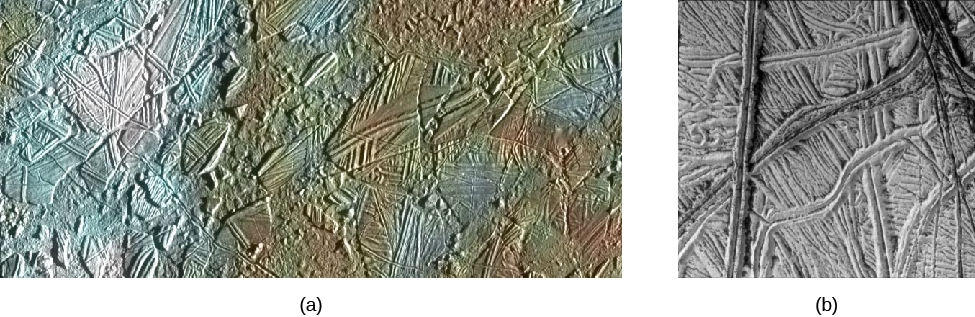
When we look at close-up photos of Europa, we see a strange, complicated surface (Figure 12.5). For the most part, the icy crust is extremely smooth, but it is crisscrossed with cracks and low ridges that often stretch for thousands of kilometers. Some of these long lines are single, but most are double or multiple, looking rather like the remnants of a colossal freeway system.
英語のヒント
エウロパの近接写真を見ると、奇妙で複雑な表面が見える(図12.5)。氷の地殻の大部分は極めて滑らかだが、亀裂と低い尾根が縦横に走り、その長さはしばしば数千キロメートルに及ぶ。こうした長い線には1本だけのものもあるが、大半は2本以上が並び、巨大な高速道路網の名残のようにも見える。
Evidence for an Ocean on Europa.エウロパに海がある証拠。
credit a: modification of work by NASA/JPL/University of Arizona; credit b: modification of work by NASA/JPL · JPL image use policy
Figure 12.5 (a) A close-up of an area called Conamara Chaos is shown here with enhanced color. This view is 70 kilometers wide in its long dimension. It appears that Conamara is a region where Europa’s icy crust is (or recently was) relatively thin and there is easier access to the possible liquid or slushy ocean beneath. Not anchored to solid crust underneath, many of the ice blocks here seem to have slid or rotated from their original positions. In fact, the formations seen here look similar to views of floating sea-ice and icebergs in Earth’s Arctic Ocean. (b) In this high-resolution view, the ice is wrinkled and crisscrossed by long ridges. Where these ridges intersect, we can see which ones are older and which younger; the younger ones cross over the older ones. While superficially this system of ridges resembles a giant freeway system on Europa, the ridges are much wider than our freeways and are a natural result of the flexing of the moon. (credit a: modification of work by NASA/JPL/University of Arizona; credit b: modification of work by NASA/JPL)
図12.5 (a)コナマラ・カオスと呼ばれる領域を近くから撮り、色を強調した画像。長い方向の幅は70キロメートルである。コナマラではエウロパの氷の地殻が比較的薄い、あるいは最近まで薄かったため、その下にあるかもしれない液体または半融解状態の海との間で、物質が行き来しやすいように見える。下の固い地殻に固定されていないため、ここにある多くの氷塊は、元の位置から滑ったり回転したりしたように見える。実際、この地形は地球の北極海に浮かぶ海氷や氷山の眺めに似ている。(b)高解像度のこの画像では、氷にしわが寄り、長い尾根が縦横に走っている。尾根の交差部では、新しい尾根が古い尾根を横切っているため、どちらが古く、どちらが新しいかわかる。一見するとエウロパの巨大な高速道路網のようだが、尾根の幅は私たちの高速道路よりはるかに広く、衛星がたわむことで自然に生じたものである。(クレジットa:NASA/JPL/University of Arizonaの作品を改変。b:NASA/JPLの作品を改変)
It is very difficult to make straight lines on a planetary surface. In discussing Mars, we explained that when Percival Lowell saw what appeared to him to be straight lines (the so-called martian “canals”), he attributed them to the engineering efforts of intelligent beings. We now know the lines on Mars were optical illusions, but the lines on Europa are real. These long cracks can form in the icy crust if it is floating without much friction on an ocean of liquid water (Figure 12.6).
英語のヒント
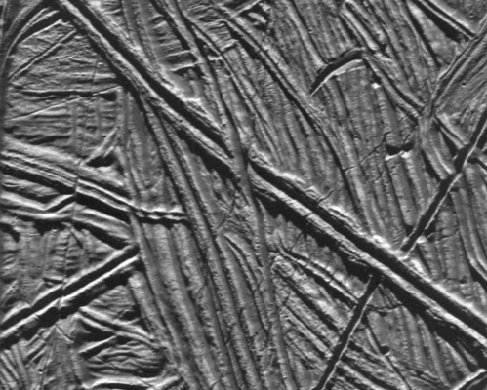
惑星の表面に直線を作ることは、非常に難しい。火星を取り上げたとき、パーシヴァル・ローウェルが、自分には直線に見えるもの、いわゆる火星の「運河」を見つけ、それを知的生命による土木工事の成果だと考えたことを説明した。火星の線は錯視だったと今ではわかっているが、エウロパの線は実在する。氷の地殻が、液体の水の海の上を大きな摩擦なしに浮いていれば、こうした長い亀裂ができる可能性がある(図12.6)。
Very High-Resolution Galileo Image of One Young Double Ridge on Europa.ガリレオが極めて高い解像度で捉えた、エウロパの新しい二重尾根の一つ。
credit: modification of work by NASA/JPL · JPL image use policy
Figure 12.6 The area in this picture is only 15 kilometers across. It appears to have formed when viscous icy material was forced up through a long, straight crack in the crust. Note how the young ridge going from top left toward bottom right lies on top of older features, which are themselves on top of even older ones. (credit: modification of work by NASA/JPL)
図12.6 この写真の領域の幅はわずか15キロメートルである。地殻の長くまっすぐな亀裂を通って、粘り気のある氷の物質が押し上げられたときにできたように見える。左上から右下へ延びる新しい尾根が古い地形の上に乗り、その古い地形自体もさらに古いものの上にある様子に注目しよう。(クレジット:NASA/JPLの作品を改変)
The close-up Galileo images appear to confirm the existence of a global ocean. In many places, the surface of Europa looks just as we would expect for a thick layer of ice that was broken up into giant icebergs and ice floes and then refrozen in place. When the ice breaks, water or slush from below may be able to seep up through the cracks and make the ridges and multiple-line features we observe. Many episodes of ice cracking, shifting, rotating, and refreezing are required to explain the complexity we see. The icy crust might vary in thickness from a kilometer or so up to 20 kilometers. Further confirmation that a liquid ocean exists below the ice comes from measurements of the small magnetic field induced by Europa’s interactions with the magnetosphere of Jupiter. The “magnetic signature” of Europa is that of a liquid water ocean, not one of ice or rock. Data from the Juno spacecraft in 2024 complicate this picture, however, indicating that the thickness of the Europa ice crust could be as much as twice the value deduced from earlier observations. While this does not change our general picture of Europa’s internal structure, a thicker ice crust suggests that the deep ocean may be more difficult to access than we previously thought.
英語のヒント
ガリレオの近接画像は、全球を覆う海の存在を裏付けているように見える。多くの場所でエウロパの表面は、厚い氷の層が巨大な氷山や流氷に砕け、その場で再び凍った場合に予想される姿をそのまま示している。氷が割れると、下から水や半融解状態の氷が亀裂を通ってしみ出し、観測される尾根や複数の線の模様を作ることがある。この複雑さを説明するには、氷が割れ、ずれ、回転し、凍り直す過程が何度も必要になる。氷の地殻の厚さは、1キロメートル程度から20キロメートルまで変化しているかもしれない。氷の下に液体の海があるという、さらに別の裏付けは、エウロパと木星磁気圏との相互作用によって誘導される小さな磁場の測定から得られる。エウロパの「磁気的な特徴」は、氷や岩石のものではなく、液体の水の海の特徴である。しかし2024年のジュノーのデータは、この見方を複雑にしている。エウロパの氷の地殻は、以前の観測から推定された厚さの2倍に達する可能性が示されたのである。これは内部構造についての全体像を変えるものではないが、地殻が厚ければ、深部の海へ到達するのは以前考えていたより難しいかもしれない。
If Europa really has a large ocean of liquid water under its ice, then it may be the only place in the solar system, other than Earth, with really large amounts of liquid water.While Europa was the first moon in the outer solar system where we found evidence of an ocean under the icy surface, today a number of other moons are showing similar evidence, including Jupiter’s Ganymede and Saturn’s Enceladus. To remain liquid, this ocean must be warmed by heat escaping from the interior of Europa. Hot (or at least warm) springs might be active there, analogous to those we have discovered in the deep oceans of Earth. The necessary internal heat is generated by tidal heating (see the discussion later in this chapter).
英語のヒント
エウロパの氷の下に、本当に液体の水の大きな海があるなら、地球以外で、本当に大量の液体の水を持つ太陽系唯一の場所かもしれない。エウロパは、外側の太陽系で氷の表面の下に海がある証拠が初めて見つかった衛星だった。しかし現在では、木星のガニメデや土星のエンケラドゥスなど、ほかの衛星でも同様の証拠がいくつも示されている。液体を保つには、この海はエウロパ内部から逃げ出す熱によって温められなければならない。地球の深海で発見されたものと似た、熱い、あるいは少なくとも温かい湧水が活動しているかもしれない。必要な内部熱は潮汐加熱によって生じる(この章の後の説明を参照)。
What makes the idea of an ocean with warm springs exciting is the discovery in Earth’s oceans of large ecosystems clustered around deep ocean hot springs. Such life derives all its energy from the mineral-laden water and thrives independent of the sunlight shining on Earth’s surface. Is it possible that similar ecosystems could exist today under the ice of Europa?
英語のヒント
温かい湧水のある海という考えが胸を躍らせるのは、地球の海で、深海の熱水噴出孔の周囲に集まる大きな生態系が発見されたからである。そこに生きる生物は、鉱物を豊富に含む水からすべてのエネルギーを得ており、地表に降り注ぐ太陽光に依存せず繁栄している。同じような生態系が、現在のエウロパの氷の下にも存在する可能性はあるだろうか。
Many scientists now think that Europa is the most likely place beyond Earth to find life in the solar system. In response, NASA is launching a Europa mission to characterize its liquid ocean and its ice crust, and to identify locations where material from inside has risen to the surface. Such interior material might reveal direct evidence for microbial life. This “Europa Clipper” mission will not orbit Europa, where the intense energetic particles from Jupiter’s magnetosphere would quickly destroy its electronics, but instead will swoop in for brief close flybys. It was successfully launched in October 2024, with arrival in the Jupiter system scheduled for the year 2030.
英語のヒント
現在、多くの科学者は、太陽系で地球以外の生命を見つけられる可能性が最も高い場所は、エウロパだと考えている。これを受けてNASAは、液体の海と氷の地殻の性質を調べ、内部の物質が表面へ上がってきた場所を特定するため、エウロパ探査計画を進めている。内部の物質は、微生物の生命の直接的な証拠を示してくれるかもしれない。「エウロパ・クリッパー」はエウロパを周回しない。そこでは木星磁気圏からの強烈な高エネルギー粒子が、電子機器をたちまち破壊してしまうからだ。代わりに、短時間の近接フライバイのために接近する。探査機は2024年10月に無事打ち上げられ、木星系への到着は2030年に予定されている。