第7章ほかの世界――太陽系入門Other Worlds: An Introduction to the Solar System
7.4 Origin of the Solar System7.4 太陽系の起源
Learning Objectives学習の目標
By the end of this section, you will be able to:
この節を学び終えると、次のことができるようになる。
Describe the characteristics of planets that are used to create formation models of the solar system
太陽系の形成モデルを作る際に用いられる、惑星の特徴を説明する。
Describe how the characteristics of extrasolar systems help us to model our own solar system
太陽系外の惑星系の特徴が、私たちの太陽系のモデルづくりにどう役立つかを説明する。
Explain the importance of collisions in the formation of the solar system
太陽系の形成における衝突の重要性を説明する。
Much of astronomy is motivated by a desire to understand the origin of things: to find at least partial answers to age-old questions of where the universe, the Sun, Earth, and we ourselves came from. Each planet and moon is a fascinating place that may stimulate our imagination as we try to picture what it would be like to visit. Taken together, the members of the solar system preserve patterns that can tell us about the formation of the entire system. As we begin our exploration of the planets, we want to introduce our modern picture of how the solar system formed.
英語のヒント
天文学の多くを動かしているのは、物事の起源を理解したいという願いである。宇宙、太陽、地球、そして私たち自身がどこから来たのかという、昔からの問いに、せめて部分的な答えを見つけようとするのだ。惑星や衛星は一つ一つが魅力的な場所であり、訪れたらどのような所だろうかと思い描くと、想像力を刺激される。太陽系の天体をまとめて見れば、系全体の形成を教えてくれる規則性が残されている。惑星の探究を始めるにあたり、太陽系がどのように形成されたかについて、現在の私たちの描像を紹介しよう。
The recent discovery of thousands of planets in orbit around other stars has shown astronomers that many exoplanetary systems can be quite different from our own solar system. For example, it is common for these systems to include planets intermediate in size between our terrestrial and giant planets. These are often called superearths. Some exoplanet systems even have giant planets close to the star, reversing the order we see in our system. In The Birth of Stars and the Discovery of Planets outside the Solar System, we will look at these exoplanet systems. But for now, let us focus on theories of how our own particular system has formed and evolved.
英語のヒント
近年、ほかの恒星を回る惑星が何千個も発見され、多くの太陽系外惑星系は、私たちの太陽系とかなり異なりうることがわかった。例えば、地球型惑星と巨大惑星の中間の大きさの惑星を含む系は、よく見られる。こうした惑星はスーパーアースと呼ばれることが多い。恒星のすぐ近くに巨大惑星がある系さえあり、私たちの太陽系で見られる順序が逆転している。これらの太陽系外惑星系については、「星の誕生と太陽系外惑星の発見」で見ることにする。今は、私たち自身の太陽系がどのように形成され、変化してきたかという理論に焦点を当てよう。
Looking for Patterns規則性を探す
One way to approach our question of origin is to look for regularities among the planets. We found, for example, that all the planets lie in nearly the same plane and revolve in the same direction around the Sun. The Sun also spins in the same direction about its own axis. Astronomers interpret this pattern as evidence that the Sun and planets formed together from a spinning cloud of gas and dust that we call the solar nebula (Figure 7.17).
英語のヒント
起源という問いに取り組む方法の一つは、惑星の間に規則性を探すことである。例えば、すべての惑星はほぼ同じ平面上にあり、太陽の周りを同じ向きに公転することを見てきた。太陽もまた、その自転軸の周りを同じ向きに回転している。天文学者は、この規則性を、太陽と惑星が「太陽系星雲」と呼ばれる回転するガスと塵の雲から一緒に形成された証拠だと解釈する(図7.17)。
Solar Nebula.太陽系星雲。
Figure 7.17 This artist’s conception of the solar nebula shows the flattened cloud of gas and dust from which our planetary system formed. Icy and rocky planetesimals (precursors of the planets) can be seen in the foreground. The bright center is where the Sun is forming. (credit: William K. Hartmann, Planetary Science Institute)
図7.17 この太陽系星雲の想像図は、私たちの惑星系が形成された、ガスと塵の平たい雲を示している。手前には、氷や岩石からなる微惑星(惑星の前身)が見える。明るい中心では、太陽が形成されている。(提供:William K. Hartmann、Planetary Science Institute)
The composition of the planets gives another clue about origins. Spectroscopic analysis allows us to determine which elements are present in the Sun and the planets. The Sun has the same hydrogen-dominated composition as Jupiter and Saturn, and therefore appears to have been formed from the same reservoir of material. In comparison, the terrestrial planets and our Moon are relatively deficient in the light gases and the various ices that form from the common elements oxygen, carbon, and nitrogen. Instead, on Earth and its neighbors, we see mostly the rarer heavy elements such as iron and silicon. This pattern suggests that the processes that led to planet formation in the inner solar system must somehow have excluded much of the lighter materials that are common elsewhere. These lighter materials must have escaped, leaving a residue of heavy stuff.
英語のヒント
惑星の組成も、起源を知るもう一つの手がかりになる。分光分析によって、太陽や惑星にどの元素があるかを求められる。太陽は木星や土星と同じく、水素が優勢な組成を持つため、同じ物質の蓄えから形成されたと考えられる。それに比べて地球型惑星と月には、軽い気体や、宇宙に多い元素である酸素、炭素、窒素からできるさまざまな氷が、比較的少ない。地球とその近隣の惑星で主に見られるのは、むしろ、鉄やケイ素のような、より少ない重い元素である。この規則性は、太陽系内側で惑星を形成した過程が、ほかの場所では普通にある軽い物質の多くを、何らかの仕方で取り除いたに違いないことを示唆する。軽い物質は逃げ去り、重い物質が残りかすとして残ったはずなのだ。
The reason for this involves the fact that temperatures were higher in the inner part of the disk of material that formed the planets. You might at first think that this inner material was hot because it was closer to the Sun’s heating rays. But those rays had trouble penetrating the dense disk. The greater heating was because the inner parts of the disk were moving faster (remember Kepler’s laws from Orbits and Gravity). This meant there was more friction among the particles, and that heated the inner disk to high temperatures. This part of the disk was thus too warm for water to condense as ice. The result was that the inner planets were rocky, and the icy worlds had to be further from the Sun.
英語のヒント
この理由には、惑星を形成した物質の円盤で、内側ほど温度が高かったという事実が関係する。初めは、この内側の物質が熱かったのは、暖める太陽光に近かったからだと思うかもしれない。しかし、その光は密な円盤をなかなか透過できなかった。内側が強く加熱されたのは、円盤の内側ほど速く動いていたからである(「軌道と重力」のケプラーの法則を思い出そう)。そのため粒子間の摩擦が大きくなり、円盤の内側は高温になった。この部分は暖かすぎて、水が氷として凝結できなかった。その結果、内側の惑星は岩石質となり、氷の世界は太陽からもっと遠い所にできることになった。
The Evidence from Far Away遠くから届く証拠
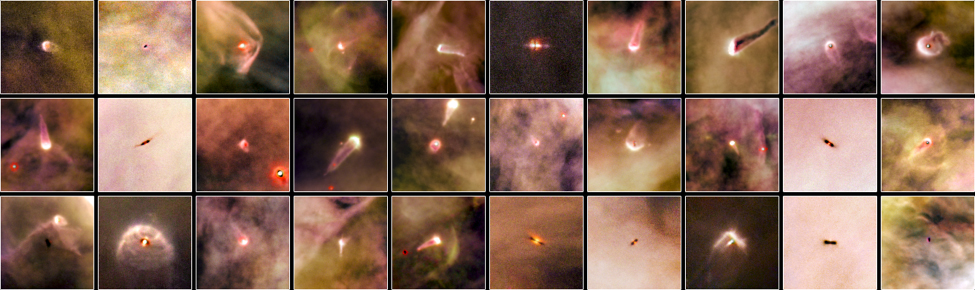
A second approach to understanding the origins of the solar system is to look outward for evidence that other systems of planets are forming elsewhere. We cannot look back in time to the formation of our own system, but many stars in space are much younger than the Sun. In these systems, the processes of planet formation might still be accessible to direct observation. We observe that there are many other “solar nebulas” or circumstellar disks—flattened, spinning clouds of gas and dust surrounding young stars. These disks resemble our own solar system’s initial stages of formation billions of years ago (Figure 7.18).
英語のヒント
太陽系の起源を理解する第二の方法は、外へ目を向け、ほかの場所で別の惑星系が形成されている証拠を探すことだ。時間をさかのぼって私たちの太陽系の形成を見ることはできないが、宇宙には太陽よりずっと若い恒星がたくさんある。そのような系では、惑星の形成過程を、まだ直接観測できるかもしれない。若い恒星を囲む、平たく回転するガスと塵の雲、すなわち別の「太陽系星雲」や星周円盤が、数多く観測されている。これらの円盤は、何十億年も前の私たちの太陽系の形成初期に似ている(図7.18)。
Atlas of Planetary Nurseries.惑星の誕生現場の写真集。
credit: modification of work by NASA/ESA, L. Ricci (ESO) · CC BY 4.0
Figure 7.18 These Hubble Space Telescope photos show sections of the Orion Nebula, a relatively close-by region where stars are currently forming. Each image shows an embedded circumstellar disk orbiting a very young star. Seen from different angles, some are energized to glow by the light of a nearby star while others are dark and seen in silhouette against the bright glowing gas of the Orion Nebula. Each is a contemporary analog of our own solar nebula—a location where planets are probably being formed today. (credit: modification of work by NASA/ESA, L. Ricci (ESO))
図7.18 これらのハッブル宇宙望遠鏡の写真は、比較的近くにあり、現在も恒星が形成されているオリオン星雲の一部を示している。各画像には、非常に若い恒星を回る、星雲に埋もれた星周円盤が写っている。見る角度が異なり、近くの恒星の光に励起されて輝くものもあれば、暗く、オリオン星雲の明るいガスを背景にシルエットとなるものもある。それぞれは、現代に見られる私たちの太陽系星雲の類似物であり、おそらく今、惑星が作られている場所である。(提供:NASA/ESA、L. Ricci(ESO)の作品を改変)