第7章ほかの世界――太陽系入門Other Worlds: An Introduction to the Solar System
7.1 Overview of Our Planetary System7.1 私たちの惑星系を見渡す
Learning Objectives学習の目標
By the end of this section, you will be able to:
この節を学び終えると、次のことができるようになる。
Describe how the objects in our solar system are identified, explored, and characterized
太陽系の天体が、どのように同定・探査され、性質を調べられているか説明する。
Describe the types of small bodies in our solar system, their locations, and how they formed
太陽系の小天体の種類、分布、形成の仕方を説明する。
Model the solar system with distances from everyday life to better comprehend distances in space
宇宙の距離を理解しやすくするため、日常の距離を使った太陽系の模型を作る。
The solar systemThe generic term for a group of planets and other bodies circling a star is planetary system. Ours is called the solar system because our Sun is sometimes called Sol. Strictly speaking, then, there is only one solar system; planets orbiting other stars are in planetary systems. consists of the Sun and many smaller objects: the planets, their moons and rings, and such “debris” as asteroids, comets, and dust. Decades of observation and spacecraft exploration have revealed that most of these objects formed together with the Sun about 4.5 billion years ago. They represent clumps of material that condensed from an enormous cloud of gas and dust. The central part of this cloud became the Sun, and a small fraction of the material in the outer parts eventually formed the other objects.
英語のヒント
太陽系は、太陽と多くの小さな天体からなる。惑星、それらの衛星や環、そして小惑星、彗星、塵といった「かけら」である。何十年にもわたる観測と探査機による調査から、これらの大部分が約45億年前に太陽とともに形成されたことがわかった。巨大なガスと塵の雲から凝縮した、物質の塊なのである。その雲の中心部は太陽になり、外側の物質のわずかな部分が、やがてほかの天体になった。用語について:恒星を回る惑星などの天体の集まりは、一般にplanetary system、すなわち惑星系という。私たちの系がsolar system、太陽系と呼ばれるのは、太陽をSolと呼ぶことがあるためである。したがって厳密には、太陽系は一つしかない。ほかの恒星を回る惑星は、それぞれの惑星系に属する。
During the past 50 years, we have learned more about the solar system than anyone imagined before the space age. In addition to gathering information with powerful new telescopes, we have sent spacecraft directly to many members of the planetary system. (Planetary astronomy is the only branch of our science in which we can, at least vicariously, travel to the objects we want to study.) With evocative names such as Voyager, Pioneer, Curiosity, and Pathfinder, our robot explorers have flown past, orbited, or landed on every planet, returning images and data that have dazzled both astronomers and the public. In the process, we have also investigated two dwarf planets, hundreds of fascinating moons, four ring systems, a dozen asteroids, and several comets (smaller members of our solar system that we will discuss later).
英語のヒント
過去50年間に、私たちは宇宙時代以前の誰もが想像した以上に、太陽系について学んできた。強力な新望遠鏡で情報を集めるだけでなく、惑星系の多くの天体へ探査機を直接送ってきた。惑星天文学は、少なくとも探査機を自分の代わりにして、研究したい対象へ旅のできる唯一の天文学の分野である。ボイジャー、パイオニア、キュリオシティ、パスファインダーなど、想像をかき立てる名を持つロボット探査機は、すべての惑星で接近通過、周回、あるいは着陸を行い、天文学者も一般の人も驚く画像やデータを送り返してきた。その過程で、二つの準惑星、数百の魅力的な衛星、四つの環の系、12個の小惑星、そしていくつかの彗星も調べてきた。彗星は太陽系の小さな構成員で、後で取り上げる。
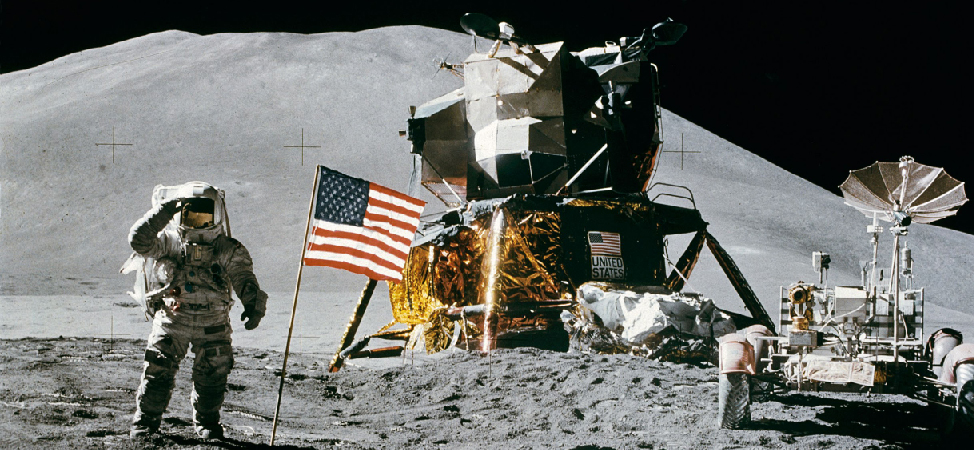
Our probes have penetrated the atmosphere of Jupiter and landed on the surfaces of Venus, Mars, our Moon, Saturn’s moon Titan, the asteroids Eros, Itokawa, Ryugu, and Bennu, and the Comet Churyumov-Gerasimenko (usually referred to as 67P). Humans have set foot on the Moon and returned samples of its surface soil for laboratory analysis (Figure 7.2). We have flown a helicopter drone on Mars. We have even discovered other places in our solar system that might be able to support some kind of life.
英語のヒント
探査機は木星の大気へ入り、金星、火星、月、土星の衛星タイタン、小惑星エロス・イトカワ・リュウグウ・ベンヌ、そして通常67Pと呼ばれるチュリュモフ・ゲラシメンコ彗星の表面に着陸した。人間は月に足を踏み入れ、表面の土を試料として持ち帰り、実験室で分析した(図7.2)。火星では無人ヘリコプターを飛ばした。太陽系内には、何らかの生命を支えられるかもしれない、地球以外の場所があることさえわかってきた。
Astronauts on the Moon.月面の宇宙飛行士たち。
credit: modification of work by David R. Scott, NASA · NASA media use guidelines
Figure 7.2 The lunar lander and surface rover from the Apollo 15 mission are seen in this view of the one place beyond Earth that has been explored directly by humans. (credit: modification of work by David R. Scott, NASA)
図7.2 地球以外で人間が直接探査した唯一の場所を写したこの画像には、アポロ15号の月着陸船と月面車が見える。(クレジット:David R. Scott、NASAの作品を改変)
An Inventory太陽系の構成員を数える
The Sun, a star that is brighter than about 80% of the stars in the Galaxy, is by far the most massive member of the solar system, as shown in Table 7.1. It is an enormous ball about 1.4 million kilometers in diameter, with surface layers of incandescent gas and an interior temperature of millions of degrees. The Sun will be discussed in later chapters as our first, and best-studied, example of a star.
英語のヒント
天の川銀河にある星の約80%より明るい恒星である太陽は、表7.1に示すとおり、太陽系の中で桁違いに質量が大きい。直径約140万キロメートルの巨大な球で、表面の層は白熱するガスからなり、内部の温度は数百万度に達する。後の章では、最初に取り上げる、そして最もよく研究されている恒星の例として、太陽を詳しく説明する。
Mass of Members of the Solar System 太陽系の構成員の質量 |
|
|---|---|
Object 天体 |
Percentage of Total Mass of Solar System 太陽系の全質量に対する割合(%) |
Sun 太陽 |
99.80 |
Jupiter 木星 |
0.10 |
Comets 彗星 |
0.0005–0.03 (estimate) 0.0005〜0.03(推定) |
All other planets and dwarf planets その他すべての惑星と準惑星 |
0.04 |
Moons and rings 衛星と環 |
0.00005 |
Asteroids 小惑星 |
0.000002 (estimate) 0.000002(推定) |
Cosmic dust 宇宙塵 |
0.0000001 (estimate) 0.0000001(推定) |
Table 7.1 also shows that most of the material of the planets is actually concentrated in the largest one, Jupiter, which is more massive than all the rest of the planets combined. Astronomers were able to determine the masses of the planets centuries ago using Kepler’s laws of planetary motion and Newton’s law of gravity to measure the planets’ gravitational effects on one another or on moons that orbit them (see Orbits and Gravity). Today, we make even more precise measurements of their masses by tracking their gravitational effects on the motion of spacecraft that pass near them.
英語のヒント
表7.1からは、惑星を構成する物質の大部分が、実は最大の惑星である木星に集中していることもわかる。木星は、ほかの惑星をすべて合わせたものより質量が大きい。天文学者は何世紀も前に、ケプラーの惑星運動の法則とニュートンの重力の法則を使い、惑星同士や、そのまわりを回る衛星への重力の影響を測って、惑星の質量を求めた。「軌道と重力」を参照してほしい。今日では、惑星の近くを通る探査機の運動に対する重力の影響を追跡することで、質量をさらに精密に測定している。
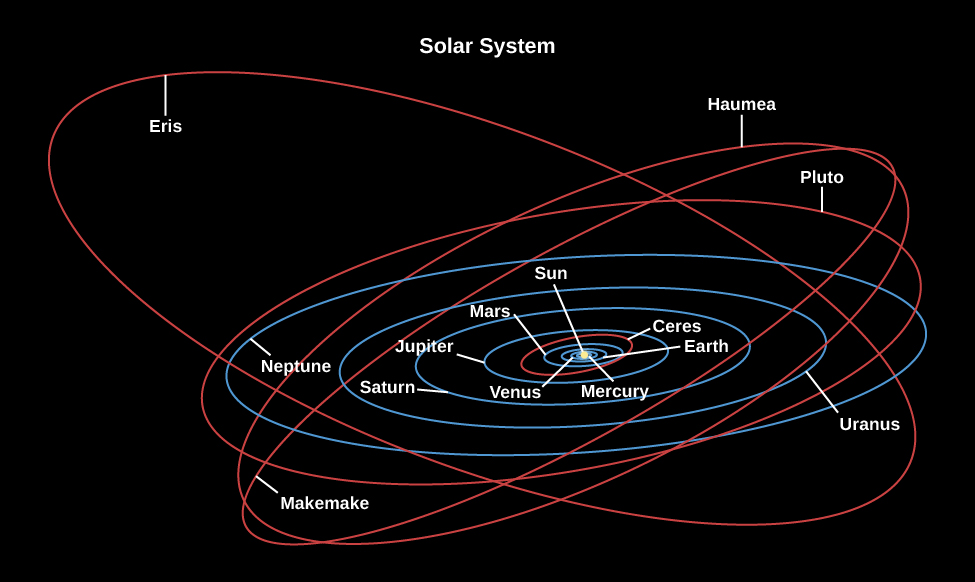
Beside Earth, five other planets were known to the ancients—Mercury, Venus, Mars, Jupiter, and Saturn—and two were discovered after the invention of the telescope: Uranus and Neptune. The eight planets all revolve in the same direction around the Sun. They orbit in approximately the same plane, like cars traveling on concentric tracks on a giant, flat racecourse. Each planet stays in its own “traffic lane,” following a nearly circular orbit about the Sun and obeying the “traffic” laws discovered by Galileo, Kepler, and Newton. Besides these planets, we have also been discovering smaller worlds beyond Neptune that are called trans-Neptunian objects or TNOs (see Figure 7.3). The first to be found, in 1930, was Pluto, but others have been discovered during the twenty-first century. One of them, Eris, is about the same size as Pluto and has at least one moon (Pluto has five known moons.) The largest TNOs are also classed as dwarf planets, as is the largest asteroid, Ceres. (Dwarf planets will be discussed further in the chapter on Rings, Moons, and Pluto). To date, more than 3900 of these TNOs have been discovered, and one, called Arrokoth, was explored by the New Horizons spacecraft.
英語のヒント
地球のほかに、水星、金星、火星、木星、土星の五つの惑星は古代から知られていた。天王星と海王星の二つは、望遠鏡の発明後に発見された。八つの惑星はすべて、太陽のまわりを同じ向きに公転する。巨大で平らな競走路の同心円状のコースを走る車のように、ほぼ同じ平面内を回っている。それぞれの惑星は、自分の「走行車線」を守り、ガリレオ、ケプラー、ニュートンが見いだした「交通法規」に従って、太陽のまわりのほぼ円形の軌道を進む。これらの惑星のほかにも、海王星より遠くにある小さな世界が次々に見つかっている。太陽系外縁天体、英語でtrans-Neptunian objects、略してTNOと呼ばれる(図7.3)。最初に見つかったのは1930年の冥王星だが、21世紀に入ってからも別の天体が発見されている。その一つのエリスは冥王星とほぼ同じ大きさで、少なくとも一つの衛星を持つ。冥王星には五つの衛星が知られている。大きなTNOは準惑星にも分類され、最大の小惑星ケレスも同じ分類に入る。準惑星については「環・衛星・冥王星」の章でさらに説明する。これまでに3900個を超えるTNOが発見され、その一つアロコスは、探査機ニューホライズンズによって調べられた。
Orbits of the Planets.惑星の軌道。
OpenStax / Rice University · CC BY 4.0
Figure 7.3 All eight major planets orbit the Sun in roughly the same plane. The five currently known dwarf planets are also shown: Eris, Haumea, Pluto, Ceres, and Makemake. Note that Pluto’s orbit is not in the plane of the planets.
図7.3 八つの主要な惑星はすべて、ほぼ同じ平面内で太陽を回る。現在知られている五つの準惑星、エリス、ハウメア、冥王星、ケレス、マケマケも示してある。冥王星の軌道が、惑星の軌道面から外れていることに注目しよう。
Each of the planets and dwarf planets also rotates (spins) about an axis running through it, and in most cases the direction of rotation is the same as the direction of revolution about the Sun. The exceptions are Venus, which rotates backward very slowly (that is, in a retrograde direction), and Uranus and Pluto, which also have strange rotations, each spinning about an axis tipped nearly on its side. We do not yet know the spin orientations of Eris, Haumea, and Makemake.
英語のヒント
惑星も準惑星も、それぞれ自らを貫く軸のまわりに回転、すなわち自転している。多くの場合、その向きは太陽のまわりの公転と同じである。例外は、非常にゆっくり逆向き、つまり逆行方向に自転する金星と、やはり変わった自転をする天王星と冥王星である。後の二つは、それぞれほぼ横倒しに傾いた軸のまわりを回る。エリス、ハウメア、マケマケの自転軸の向きは、まだわかっていない。
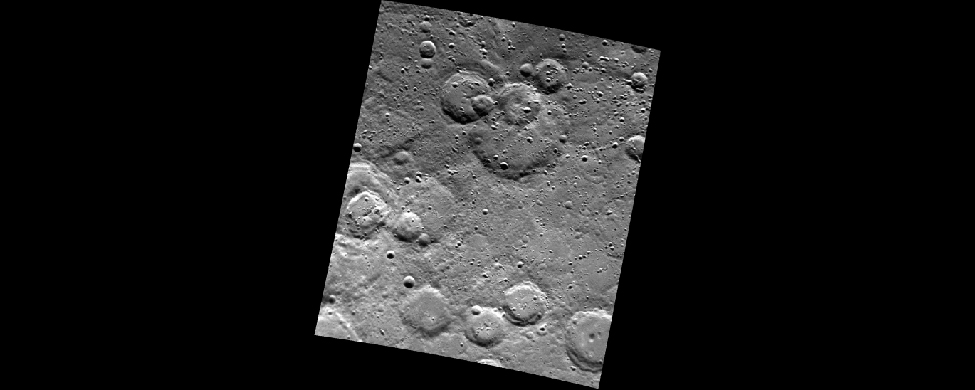
The four planets closest to the Sun (Mercury through Mars) are called the inner or terrestrial planets. Often, the Moon is also discussed as a part of this group, bringing the total of terrestrial objects to five. (We generally call Earth’s satellite “the Moon,” with a capital M, and the other satellites “moons,” with lowercase m’s.) The terrestrial planets are relatively small worlds, composed primarily of rock and metal. All of them have solid surfaces that bear the records of their geological history in the forms of craters, mountains, and volcanoes (Figure 7.4).
英語のヒント
太陽に近い四つの惑星、水星から火星までは、内側の惑星、あるいは地球型惑星と呼ばれる。月もこのグループに含めて論じることが多く、その場合は地球型の天体が合計五つになる。英語では通常、地球の衛星である月を大文字のMで始まるthe Moonと書き、ほかの衛星は小文字のmを使ってmoonsと呼ぶ。地球型惑星は比較的小さな世界で、主に岩石と金属でできている。いずれも固体の表面を持ち、クレーター、山、火山という形で地質学的な歴史の記録を残している(図7.4)。
Surface of Mercury.水星の表面。
credit: modification of work by NASA/John Hopkins University Applied Physics Laboratory/Carnegie Institution of Washington · NASA media use guidelines
Figure 7.4 The pockmarked face of the terrestrial world of Mercury is more typical of the inner planets than the watery surface of Earth. This black-and-white image, taken with the Mariner 10 spacecraft, shows a region more than 400 kilometers wide. (credit: modification of work by NASA/John Hopkins University Applied Physics Laboratory/Carnegie Institution of Washington)
図7.4 地球型の世界である水星の、あばた状のクレーターに覆われた顔は、水に覆われた地球の表面よりも、内側の惑星の典型的な姿に近い。マリナー10号が撮ったこの白黒画像には、幅400キロメートルを超える領域が写っている。(クレジット:NASA/John Hopkins University Applied Physics Laboratory/Carnegie Institution of Washingtonの作品を改変)
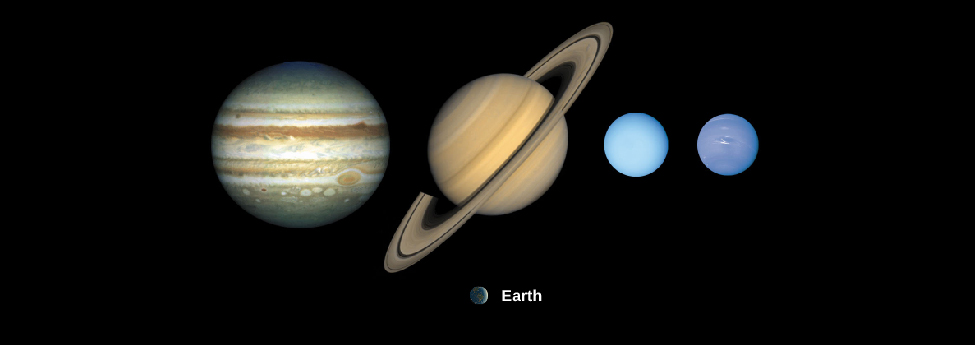
The next four planets (Jupiter through Neptune) are much larger and are composed primarily of lighter ices, liquids, and gases. We call these four the jovian planets (after “Jove,” another name for Jupiter in mythology) or giant planets—a name they richly deserve (Figure 7.5). About 1,300 Earths could fit inside Jupiter, for example. These planets do not have solid surfaces on which future explorers might land. They are more like vast, spherical oceans with much smaller, dense cores.
英語のヒント
次の四つ、木星から海王星までの惑星は、はるかに大きく、主により軽い氷、液体、気体でできている。この四つを木星型惑星という。英語のjovianは、神話のユピテルの別名Joveにちなむ。また、巨大惑星とも呼び、その名にまさしくふさわしい天体である(図7.5)。たとえば木星の中には、地球がおよそ1300個も入る。これらの惑星には、将来の探検家が降り立てる固体の表面がない。むしろ、内部にはるかに小さく高密度の核を持つ、巨大で球形の海のようなものである。
The Four Giant Planets.四つの巨大惑星。
credit: modification of work by NASA, Solar System Exploration · NASA media use guidelines
Figure 7.5 This montage shows the four giant planets: Jupiter, Saturn, Uranus, and Neptune. Below them, Earth is shown to scale. (credit: modification of work by NASA, Solar System Exploration)
図7.5 この合成図は、木星、土星、天王星、海王星という四つの巨大惑星を示す。その下には、同じ縮尺の地球を置いてある。(クレジット:NASA、Solar System Explorationの作品を改変)
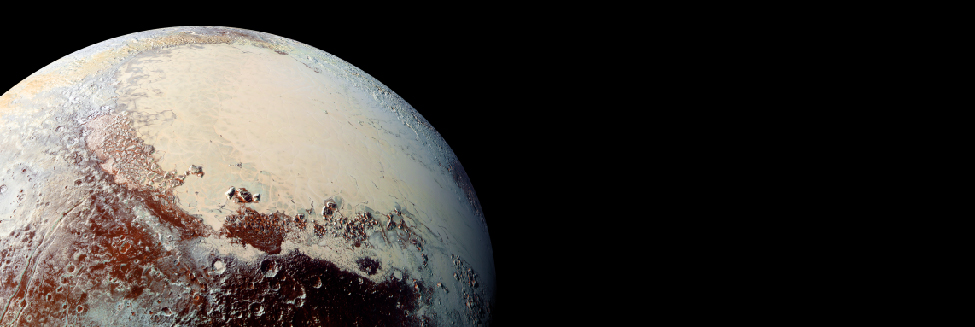
Near the outer edge of the system lies Pluto, which was the first of the distant icy worlds to be discovered beyond Neptune (Pluto was visited by a spacecraft, the NASA New Horizons mission, in 2015 [see Figure 7.6]). Table 7.2 summarizes some of the main facts about the planets.
英語のヒント
太陽系の外縁近くには冥王星がある。海王星より外側の遠い氷の世界として、最初に発見された天体である。2015年にはNASAの探査機ニューホライズンズが訪れた(図7.6)。表7.2に、惑星についての主な基本情報をまとめる。
Pluto Close-up.冥王星のクローズアップ。
credit: modification of work by NASA/Johns Hopkins University Applied Physics Laboratory/Southwest Research Institute · NASA media use guidelines
Figure 7.6 This intriguing image from the New Horizons spacecraft, taken when it flew by the dwarf planet in July 2015, shows some of its complex surface features. The rounded white area is called the Sputnik Plain, after humanity’s first spacecraft. (credit: modification of work by NASA/Johns Hopkins University Applied Physics Laboratory/Southwest Research Institute)
図7.6 2015年7月にこの準惑星を接近通過したニューホライズンズが撮った、興味深い画像。複雑な表面地形の一部がわかる。丸みを帯びた白い領域は、人類最初の宇宙機にちなんでスプートニク平原と呼ばれる。(クレジット:NASA/Johns Hopkins University Applied Physics Laboratory/Southwest Research Instituteの作品を改変)
The Planets 惑星 |
|||||
|---|---|---|---|---|---|
Name 名称 |
Distance from Sun 太陽からの距離(AU)。AU、すなわち天文単位は、地球から太陽までの距離である。 |
Revolution Period 公転周期(年) |
Diameter 直径(km) |
Mass 質量(10²³ kg) |
Density 密度(g/cm³)。水の密度が1 g/cm³となる単位で示す。kg/m³での密度にするには、表の値を1000倍する。 |
Mercury 水星 |
0.39 | 0.24 | 4,878 | 3.3 | 5.4 |
Venus 金星 |
0.72 | 0.62 | 12,120 | 48.7 | 5.2 |
Earth 地球 |
1.00 | 1.00 | 12,756 | 59.8 | 5.5 |
Mars 火星 |
1.52 | 1.88 | 6,787 | 6.4 | 3.9 |
Jupiter 木星 |
5.20 | 11.86 | 142,984 | 18,991 | 1.3 |
Saturn 土星 |
9.54 | 29.46 | 120,536 | 5686 | 0.7 |
Uranus 天王星 |
19.18 | 84.07 | 51,118 | 866 | 1.3 |
Neptune 海王星 |
30.06 | 164.82 | 49,660 | 1030 | 1.6 |
Comparing Densities密度を比較する
Let’s compare the densities of several members of the solar system. The density of an object equals its mass divided by its volume. The volume (V) of a sphere (like a planet) is calculated using the equation
英語のヒント
太陽系のいくつかの天体について、密度を比べてみよう。物体の密度は、その質量を体積で割った値に等しい。惑星のような球の体積 V は、次の式で計算できる。
where π (the Greek letter pi) has a value of approximately 3.14. Although planets are not perfect spheres, this equation works well enough. The masses and diameters of the planets are given in Table 7.2. For data on selected moons, see Appendix G. Let’s use Saturn’s moon Mimas as our example, with a mass of kg and a diameter of approximately 400 km (radius, ).
英語のヒント
ここで π(ギリシャ文字のパイ)の値は約3.14である。惑星は完全な球ではないが、この式で十分に計算できる。惑星の質量と直径は表7.2に示してある。主な衛星のデータは付録Gを参照しよう。例として、土星の衛星ミマスを用いる。その質量は kg、直径は約400 km(半径は )である。
Solution解き方
The volume of Mimas is
ミマスの体積は、
Density is mass divided by volume:
密度は質量を体積で割ったものなので、
Note that the density of water in these units is 1000 kg/m3, so Mimas must be made mainly of ice, not rock. (Note that the density of Mimas given in Appendix G is 1.2, but the units used there are different. In that table, we give density in units of
g/cm3, for which the density of water equals 1. Can you show, by converting units, that 1 g/cm3 is the same as 1000 kg/m3?)
英語のヒント
この単位では、水の密度は1000 kg/m³であることに注目しよう。したがって、ミマスは主として岩石ではなく氷からできているはずである。(付録Gに示したミマスの密度は1.2だが、そこで使っている単位は異なる。その表では密度をg/cm³という単位で示しており、この単位で表すと水の密度は1となる。単位を換算して、1 g/cm³が1000 kg/m³と同じであることを示せるだろうか。)