第7章ほかの世界――太陽系入門Other Worlds: An Introduction to the Solar System
7.2 Composition and Structure of Planets7.2 惑星の組成と構造
Learning Objectives学習の目標
By the end of this section, you will be able to:
この節を学び終えると、次のことができるようになる。
Describe the characteristics of the giant planets, terrestrial planets, and small bodies in the solar system
太陽系の巨大惑星、地球型惑星、小天体の特徴を説明する。
Explain what influences the temperature of a planet’s surface
惑星の表面温度に何が影響するかを説明する。
Explain why there is geological activity on some planets and not on others
地質活動が起こる惑星と、起こらない惑星がある理由を説明する。
The fact that there are two distinct kinds of planets—the rocky terrestrial planets and the gas-rich jovian planets—leads us to believe that they formed under different conditions. Certainly their compositions are dominated by different elements. Let us look at each type in more detail.
英語のヒント
岩石質の地球型惑星と、気体を多く含む木星型惑星という、はっきり異なる二種類の惑星がある。この事実から、両者は異なる条件のもとで形成されたと考えられる。確かに、それぞれの組成を主に占める元素は異なっている。各種類を、もう少し詳しく見ていこう。
The Giant Planets巨大惑星
The two largest planets, Jupiter and Saturn, have nearly the same chemical makeup as the Sun; they are composed primarily of the two elements hydrogen and helium, with 75% of their mass being hydrogen and 25% helium. On Earth, both hydrogen and helium are gases, so Jupiter and Saturn are sometimes called gas planets. But, this name is misleading. Jupiter and Saturn are so large that the gas is compressed in their interior until the hydrogen becomes a liquid. Because the bulk of both planets consists of compressed, liquefied hydrogen, we should really call them liquid planets.
英語のヒント
最大の二つの惑星、木星と土星は、太陽とほぼ同じ化学組成を持つ。主として水素とヘリウムという二つの元素でできており、質量の75%を水素、25%をヘリウムが占める。地球上では水素もヘリウムも気体なので、木星と土星はガス惑星と呼ばれることがある。しかし、この名前は誤解を招く。木星と土星は非常に大きいため、内部では気体が圧縮され、水素が液体になるほどである。どちらの惑星も大部分が圧縮されて液化した水素からできているのだから、本当は液体惑星と呼ぶべきなのだ。
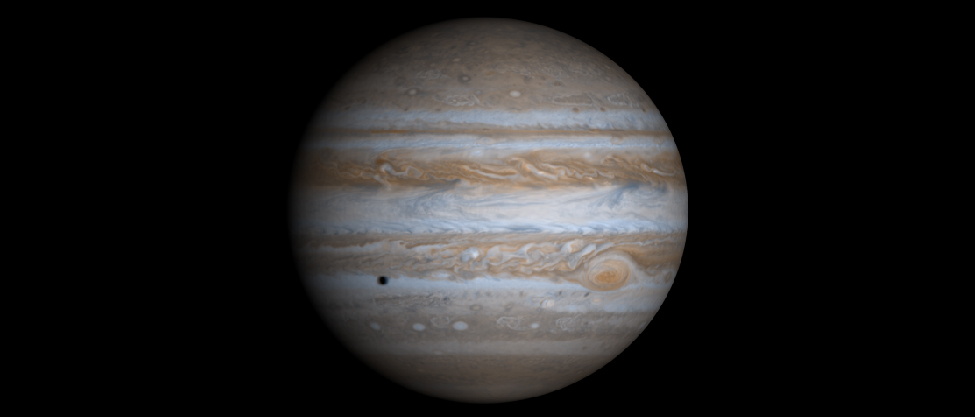
Under the force of gravity, the heavier elements sink toward the inner parts of a liquid or gaseous planet. Both Jupiter and Saturn, therefore, have cores composed of heavier rock, metal, and ice, but we cannot see these regions directly. In fact, when we look down from above, all we see is the atmosphere with its swirling clouds (Figure 7.11). We must infer the existence of the denser core inside these planets from studies of each planet’s gravity.
英語のヒント
重力のもとでは、重い元素は液体や気体の惑星の内側へ沈んでいく。そのため木星と土星はいずれも、重い岩石、金属、氷からなる核を持つが、この領域を直接見ることはできない。実際、上方から見下ろしたときに見えるのは、渦を巻く雲を伴った大気だけである(図7.11)。これらの惑星の内部に高密度の核があることは、それぞれの惑星の重力を調べて推定しなければならない。
Jupiter.木星。
credit: modification of work by NASA/JPL/University of Arizona · JPL image use policy
Figure 7.11 This true-color image of Jupiter was taken from the Cassini spacecraft in 2000. The dark spot is the shadow of one of the giant planet’s moons. (credit: modification of work by NASA/JPL/University of Arizona)
図7.11 この自然な色の木星画像は、2000年に探査機カッシーニから撮影したものである。黒い点は、この巨大惑星の衛星の一つの影である。(提供:NASA/JPL/University of Arizonaの作品を改変)
Uranus and Neptune are much smaller than Jupiter and Saturn, but each also has a core of rock, metal, and ice. Uranus and Neptune were less efficient at attracting hydrogen and helium gas, so they have much smaller atmospheres in proportion to their cores.
英語のヒント
天王星と海王星は木星や土星よりずっと小さいが、それぞれ岩石、金属、氷からなる核を持つ。天王星と海王星は水素やヘリウムの気体をあまり効率よく引き寄せられなかったため、核に対する大気の割合は、はるかに小さい。
Chemically, each giant planet is dominated by hydrogen and its many compounds. Nearly all the oxygen present is combined chemically with hydrogen to form water (H2O). Chemists call such a hydrogen-dominated composition reduced. Throughout the outer solar system, we find abundant water (mostly in the form of ice) and reducing chemistry.
英語のヒント
化学的に見ると、巨大惑星はどれも、水素とそのさまざまな化合物が主成分である。存在する酸素のほぼすべてが、水素と化学結合して水(H₂O)になっている。化学者は、このように水素が優勢な組成を「還元的」と呼ぶ。太陽系の外側では至る所に、豊富な水(主に氷の形で)と、還元的な化学組成が見られる。
The Terrestrial Planets地球型惑星
The terrestrial planets are quite different from the giants. In addition to being much smaller, they are composed primarily of rocks and metals. These, in turn, are made of elements that are less common in the universe as a whole. The most abundant rocks, called silicates, are made of silicon and oxygen, and the most common metal is iron. We can tell from their densities (see Table 7.2) that Mercury has the greatest proportion of metals (which are denser) and the Moon has the lowest. Earth, Venus, and Mars all have roughly similar bulk compositions: about one third of their mass consists of iron-nickel or iron-sulfur combinations; two thirds is made of silicates. Because these planets are largely composed of oxygen compounds (such as the silicate minerals of their crusts), their chemistry is said to be oxidized.
英語のヒント
地球型惑星は巨大惑星とはかなり異なる。はるかに小さいうえ、主として岩石と金属からできている。その岩石や金属を作る元素は、宇宙全体で見るとあまり多くない。最も豊富な岩石はケイ酸塩と呼ばれ、ケイ素と酸素からなる。最も一般的な金属は鉄である。密度から(水星などのデータは表7.2を参照)、密度の高い金属の割合が最も大きいのは水星、最も小さいのは月だとわかる。地球、金星、火星の全体的な組成は、おおむね似ている。質量の約3分の1は鉄とニッケル、または鉄と硫黄の組み合わせで、3分の2はケイ酸塩でできている。これらの惑星は、大部分が酸素の化合物(地殻のケイ酸塩鉱物など)でできているため、その化学組成は酸化的だといわれる。
When we look at the internal structure of each of the terrestrial planets, we find that the densest metals are in a central core, with the lighter silicates near the surface. If these planets were liquid, like the giant planets, we could understand this effect as the result the sinking of heavier elements due to the pull of gravity. This leads us to conclude that, although the terrestrial planets are solid today, at one time they must have been hot enough to melt.
英語のヒント
地球型惑星の内部構造を見ると、密度の高い金属は中心の核にあり、軽いケイ酸塩は表面の近くにある。これらの惑星が巨大惑星のように液体であれば、この状態は、重い元素が重力に引かれて沈んだ結果だと理解できる。このことから、地球型惑星は今では固体だが、かつては溶けるほど高温だったに違いない、と結論できる。
Differentiation is the process by which gravity helps separate a planet’s interior into layers of different compositions and densities. The heavier metals sink to form a core, while the lightest minerals float to the surface to form a crust. Later, when the planet cools, this layered structure is preserved. In order for a rocky planet to differentiate, it must be heated to the melting point of rocks, which is typically more than 1300 K.
英語のヒント
分化とは、重力の働きによって、惑星の内部が組成と密度の異なる層に分かれる過程である。重い金属は沈んで核を作り、最も軽い鉱物は表面へ浮かび上がって地殻を作る。その後、惑星が冷えると、この層状の構造が保たれる。岩石惑星が分化するには、岩石の融点、典型的には1300 Kを超える温度まで加熱されなければならない。
Moons, Asteroids, and Comets衛星・小惑星・彗星
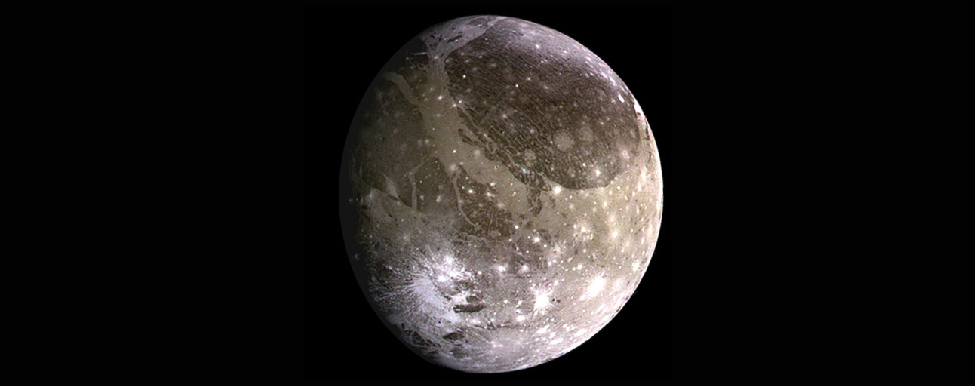
Chemically and structurally, Earth’s Moon is like the terrestrial planets, but most moons are in the outer solar system, and they have compositions similar to the cores of the giant planets around which they orbit. The three largest moons—Ganymede and Callisto in the jovian system, and Titan in the saturnian system—are composed half of frozen water, and half of rocks and metals. Most of these moons differentiated during formation, and today they have cores of rock and metal, with upper layers and crusts of very cold and—thus very hard—ice (Figure 7.12).
英語のヒント
地球の月は、化学組成や構造では地球型惑星に似ている。しかし、衛星の大半は太陽系の外側にあり、その組成は、周回している巨大惑星の核に似ている。最大級の三つの衛星――木星系のガニメデとカリスト、土星系のタイタン――は、半分が凍った水、もう半分が岩石と金属からできている。これらの衛星のほとんどは形成中に分化し、現在は岩石と金属の核を持つ。その上を覆う層や地殻は、非常に冷たく、そのため非常に硬い氷からできている(図7.12)。
Ganymede.ガニメデ。
credit: modification of work by NASA/JPL · JPL image use policy
Figure 7.12 This view of Jupiter’s moon Ganymede was taken in June 1996 by the Galileo spacecraft. The brownish gray color of the surface indicates a dusty mixture of rocky material and ice. The bright spots are places where recent impacts have uncovered fresh ice from underneath. (credit: modification of work by NASA/JPL)
図7.12 木星の衛星ガニメデを、探査機ガリレオが1996年6月に撮影した画像。表面の茶色がかった灰色は、塵を含む岩石物質と氷の混合物であることを示す。明るい斑点は、最近の衝突で下にあった新しい氷が露出した場所である。(提供:NASA/JPLの作品を改変)
Astronomers have also found that a number of the larger moons may have oceans—mostly shallow—of liquid water in their interiors. These moons are being called “water worlds,” and are a subject of intense interest. What allows these oceans to remain liquid in these cold outer regions? Their interior temperature may be influenced by tides, raised by the moons’ gravitational interaction with neighboring worlds. Under the right circumstances, the energy from such tides can heat the moon’s interior and even melt an ice layer there. In the extreme case of Jupiter’s closest large moon Io, the tides actually power widespread volcanism, which erupts from the surface.
英語のヒント
天文学者たちは、大きな衛星のいくつかが、内部に液体の水の海を持つ可能性も見いだしている。その多くは浅い海である。これらの衛星は「水の世界」と呼ばれ、強い関心を集めている。外側のこのような寒冷な領域で、何が海を液体に保っているのだろうか。衛星の内部温度は、近隣の天体との重力相互作用によって生じる潮汐の影響を受ける可能性がある。条件が整えば、その潮汐のエネルギーが衛星の内部を加熱し、そこにある氷の層を溶かすことさえできる。極端な例は、木星に最も近い大きな衛星イオである。ここでは潮汐が実際に、表面から噴出する広範な火山活動の原動力となっている。
Most of the asteroids and comets, as well as the smallest moons, were probably never heated to the melting point. However, some of the largest asteroids, such as Vesta, appear to be differentiated; others are fragments from differentiated bodies. Many of the smaller objects seem to be fragments or rubble piles that are the result of collisions. Because most asteroids and comets retain their original composition, they represent relatively unmodified material dating back to the time of the formation of the solar system. In a sense, they act as chemical fossils, helping us to learn about a time long ago whose traces have been erased on larger worlds.
英語のヒント
ほとんどの小惑星と彗星、それに最も小さな衛星は、おそらく一度も融点まで加熱されなかった。しかし、ベスタなどの大きな小惑星の一部は分化しているようであり、別のものは、分化した天体の破片である。小天体の多くは、衝突によって生じた破片、または瓦礫が寄り集まったものと考えられる。ほとんどの小惑星と彗星はもとの組成を保っているため、太陽系形成時までさかのぼる、比較的変化の少ない物質だといえる。ある意味で、化学的な化石として働き、より大きな世界では痕跡が消されてしまった、はるか昔の時代を知る手がかりとなる。