第7章ほかの世界――太陽系入門Other Worlds: An Introduction to the Solar System
Smaller Members of the Solar System太陽系の小さな仲間たち
Most of the planets are accompanied by one or more moons; only Mercury and Venus move through space alone. There are some 430 known moons orbiting planets and dwarf planets (see Appendix G for a listing of the larger ones), and undoubtedly many other small ones remain undiscovered. The largest of the moons are as big as small planets and just as interesting. In addition to our Moon, they include the four largest moons of Jupiter (called the Galilean moons, after their discoverer) and the largest moons of Saturn and Neptune (confusingly named Titan and Triton).
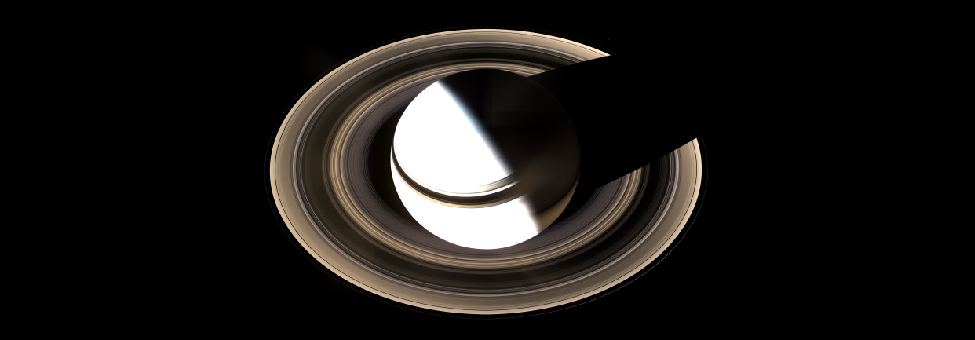
Each of the giant planets also has rings made up of countless small bodies ranging in size from mountains to mere grains of dust, all in orbit about the equator of the planet. The bright rings of Saturn are, by far, the easiest to see. They are among the most beautiful sights in the solar system (Figure 7.7). But, all four ring systems are interesting to scientists because of their complicated forms, influenced by the pull of the moons that also orbit these giant planets.
credit: modification of work by NASA/JPL/Space Science Institute · JPL image use policy
Figure 7.7 This 2007 Cassini image shows Saturn and its complex system of rings, taken from a distance of about 1.2 million kilometers. This natural-color image is a composite of 36 images taken over the course of 2.5 hours. (credit: modification of work by NASA/JPL/Space Science Institute)
The solar system has many other less-conspicuous members. Another group is the asteroids, rocky bodies that orbit the Sun like miniature planets, mostly in the space between Mars and Jupiter (although some do cross the orbits of planets like Earth—see Figure 7.8). Most asteroids are remnants of the initial population of the solar system that existed before the planets themselves formed. Some of the smallest moons of the planets, such as the moons of Mars, are very likely captured asteroids.
Figure 7.8 This small Earth-crossing asteroid image was taken by the NEAR-Shoemaker spacecraft from an altitude of about 100 kilometers. This view of the heavily cratered surface is about 10 kilometers wide. The spacecraft orbited Eros for a year before landing gently on its surface. (credit: modification of work by NASA/JHUAPL)
Another class of small bodies is composed mostly of ice, made of frozen gases such as water, carbon dioxide, and carbon monoxide; these objects are called comets (see Figure 7.9). Comets also are remnants from the formation of the solar system, but they were formed and continue (with rare exceptions) to orbit the Sun in distant, cooler regions—stored in a sort of cosmic deep freeze. This is also the realm of the larger icy worlds, called dwarf planets.
credit: modification of work by ESA/Rosetta/NAVACAM, CC BY-SA IGO 3.0 · CC BY-SA 3.0 IGO
Figure 7.9 This image shows Comet Churyumov-Gerasimenko, also known as 67P, near its closest approach to the Sun in 2015, as seen from the Rosetta spacecraft. Note the jets of gas escaping from the solid surface. (credit: modification of work by ESA/Rosetta/NAVACAM, CC BY-SA IGO 3.0)
図7.9 この画像は、67Pとも呼ばれるチュリュモフ・ゲラシメンコ彗星が2015年に太陽へ最も近づいたころの姿を、探査機ロゼッタから撮影したものである。固体の表面から噴き出すガスのジェットに注目しよう。(提供:ESA/Rosetta/NAVACAMの作品を改変、CC BY-SA IGO 3.0)
Finally, there are countless grains of broken rock, which we call cosmic dust, scattered throughout the solar system. When these particles enter Earth’s atmosphere (as millions do each day) they burn up, producing a brief flash of light in the night sky known as a meteor (meteors are often referred to as shooting stars). Occasionally, some larger chunk of rocky or metallic material survives its passage through the atmosphere and lands on Earth. Any piece that strikes the ground is known as a meteorite. (You can see meteorites on display in many natural history museums and can sometimes even purchase pieces of them from gem and mineral dealers.)