第11章巨大惑星The Giant Planets
11.1 Exploring the Outer Planets11.1 外側の惑星を探る
Learning Objectives学習の目標
By the end of this section, you will be able to:
この節を学び終えると、次のことができるようになる。
Provide an overview of the composition of the giant planets
巨大惑星の組成の概要を説明する。
Chronicle the robotic exploration of the outer solar system
無人探査機による木星以遠の領域の探査の歩みをたどる。
Summarize the missions sent to orbit the gas giants
巨大ガス惑星を周回するために送られた探査計画を要約する。
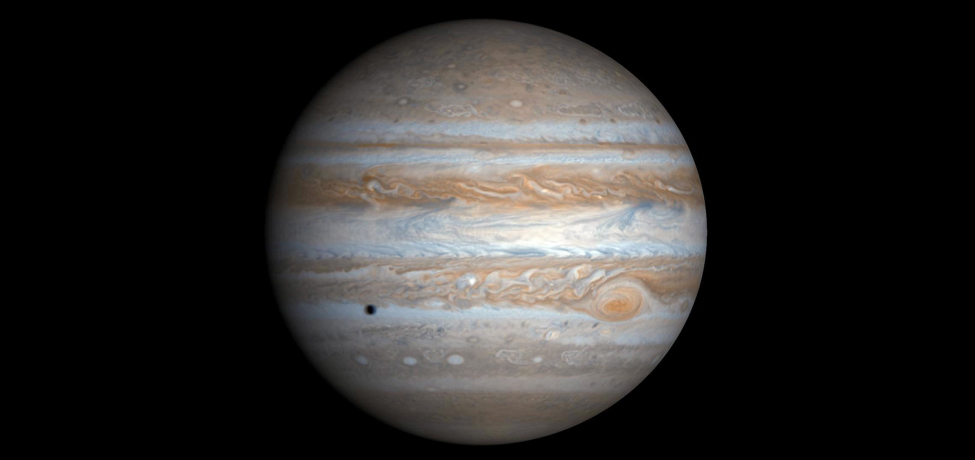
The giant planets hold most of the mass in our planetary system. Jupiter alone exceeds the mass of all the other planets combined (Figure 11.2). The material available to build these planets can be divided into three classes by what they are made of: “gases,” “ices,” and “rocks” (see Table 11.1). The “gases” are primarily hydrogen and helium, the most abundant elements in the universe. The way it is used here, the term “ices” refers to composition only and not whether a substance is actually in a solid state. “Ices” means compounds that form from the next most abundant elements: oxygen, carbon, and nitrogen. Common ices are water, methane, and ammonia, but ices may also include carbon monoxide, carbon dioxide, and others. “Rocks” are even less abundant than ices, and include everything else: magnesium, silicon, iron, and so on.
英語のヒント
巨大惑星は、太陽系の惑星全体の質量の大部分を占める。木星だけで、他のすべての惑星を合わせた質量を上回る(図11.2)。これらの惑星を作る材料は、何からできているかによって、「ガス」「氷」「岩石」の3つに分けられる(表11.1参照)。「ガス」は主として、宇宙で最も豊富な元素である水素とヘリウムである。ここで使う「氷」という言葉は組成だけを指しており、物質が実際に固体であるかどうかを意味しない。「氷」とは、それらに次いで豊富な酸素、炭素、窒素という元素からできる化合物を指す。一般的な氷には、水、メタン、アンモニアがあるが、一酸化炭素や二酸化炭素なども含まれることがある。「岩石」は氷よりもさらに少なく、マグネシウム、ケイ素、鉄など、それ以外のすべての物質を含む。
Jupiter.木星。
credit: modification of work by NASA/JPL · JPL image use policy
Figure 11.2 The Cassini spacecraft imaged Jupiter on its way to Saturn in 2012. The giant storm system called the Great Red Spot is visible to the lower right. The dark spot to the lower left is the shadow of Jupiter’s moon Europa. (credit: modification of work by NASA/JPL)
図11.2 カッシーニ探査機は2012年、土星に向かう途中で木星を撮影した。右下に見える巨大な嵐の系は大赤斑と呼ばれる。左下の暗い点は、木星の衛星エウロパの影である。(クレジット:NASA/JPLの作品を改変)
Abundances in the Outer Solar System 外側の太陽系における存在量 |
||
|---|---|---|
Type of Material 物質の種類 |
Name 名称 |
Approximate % (by Mass) おおよその割合(質量%) |
Gas ガス |
Hydrogen (H2) 水素(H₂) |
75 |
Gas ガス |
Helium (He) ヘリウム(He) |
24 |
Ice 氷 |
Water (H2O) 水(H₂O) |
0.6 |
Ice 氷 |
Methane (CH4) メタン(CH₄) |
0.4 |
Ice 氷 |
Ammonia (NH3) アンモニア(NH₃) |
0.1 |
Rock 岩石 |
Magnesium (Mg), iron (Fe), silicon (Si) マグネシウム(Mg)、鉄(Fe)、ケイ素(Si) |
0.3 |
In the outer solar system, gases dominate the two largest planets, Jupiter and Saturn, hence their nickname “gas giants.” Uranus and Neptune are sometimes called “ice giants” because their interiors contain far more of the “ice” component than their larger cousins. The chemistry for all four giant planet atmospheres is dominated by hydrogen. This hydrogen caused the chemistry of the outer solar system to become reducing, meaning that other elements tend to combine with hydrogen first. In the early solar system, most of the oxygen combined with hydrogen to make H2O and was thus unavailable to form the kinds of oxidized compounds with other elements that are more familiar to us in the inner solar system (such as CO2). As a result, the compounds detected in the atmosphere of the giant planets are mostly hydrogen-based gases such as methane (CH4) and ammonia (NH3), or more complex hydrocarbons (combinations of hydrogen and carbon) such as ethane (C2H6) and acetylene (C2H2).
英語のヒント
外側の太陽系では、最大の2つの惑星である木星と土星の主成分はガスであり、そのため「巨大ガス惑星」と呼ばれている。天王星と海王星は、より大きなこの2惑星に比べて内部の「氷」成分がはるかに多いため、「巨大氷惑星」と呼ばれることがある。4つの巨大惑星すべてで、大気の化学を支配しているのは水素である。この水素によって、外側の太陽系の化学的環境は還元的になった。つまり、他の元素はまず水素と結びつきやすくなったのである。初期の太陽系では、酸素の大部分が水素と結びついてH₂Oとなった。このため酸素は、太陽系の内側で私たちになじみ深い、他の元素との酸化化合物(CO₂など)を作るためには使えなくなった。その結果、巨大惑星の大気で検出される化合物は、主にメタン(CH₄)やアンモニア(NH₃)などの水素を含むガス、またはエタン(C₂H₆)やアセチレン(C₂H₂)のような、より複雑な炭化水素(水素と炭素の組み合わせ)である。
Exploration of the Outer Solar System So Farこれまでの木星以遠の領域の探査
Nine spacecraft have penetrated beyond the asteroid belt into the realm of the giants. Table 11.2 summarizes the spacecraft missions to the outer solar system.
英語のヒント
9機の探査機が、小惑星帯を越えて巨大惑星の領域に進んだ。表11.2に、外側の太陽系を探査した各計画をまとめる。
Missions to the Giant Planets 巨大惑星への探査計画 |
|||
|---|---|---|---|
Planet 惑星 |
SpacecraftBoth the Ulysses and the New Horizons spacecraft (designed to study the Sun and Pluto, respectively) flew past Jupiter for a gravity boost (gaining energy by “stealing” a little bit from the giant planet’s rotation). 探査機ユリシーズとニュー・ホライズンズは、それぞれ太陽と冥王星の研究のために設計された探査機だが、どちらも木星のそばを通過して重力による加速を受けた(巨大惑星の自転から少しだけエネルギーを「盗む」ことで、エネルギーを得る)。 |
Encounter Date 接近時期 |
Type 種類 |
Jupiter 木星 |
Pioneer 10 パイオニア10号 |
December 1973 1973年12月 |
Flyby フライバイ |
Pioneer 11 パイオニア11号 |
December 1974 1974年12月 |
Flyby フライバイ |
|
Voyager 1 ボイジャー1号 |
March 1979 1979年3月 |
Flyby フライバイ |
|
Voyager 2 ボイジャー2号 |
July 1979 1979年7月 |
Flyby フライバイ |
|
Ulysses ユリシーズ |
February 1992 1992年2月 |
Flyby during gravity assist 重力アシスト時のフライバイ |
|
Galileo ガリレオ |
December 1995 1995年12月 |
Orbiter and probe 周回機と大気突入プローブ |
|
Cassini カッシーニ |
December 2002 2002年12月 |
Flyby フライバイ |
|
New Horizons ニュー・ホライズンズ |
February 2007 2007年2月 |
Flyby during gravity assist 重力アシスト時のフライバイ |
|
Juno ジュノー |
July 2016 2016年7月 |
Orbiter 周回機 |
|
Saturn 土星 |
Pioneer 11 パイオニア11号 |
September 1979 1979年9月 |
Flyby フライバイ |
Voyager 1 ボイジャー1号 |
November 1980 1980年11月 |
Flyby フライバイ |
|
Voyager 2 ボイジャー2号 |
August 1981 1981年8月 |
Flyby フライバイ |
|
Cassini カッシーニ |
July 2004 2004年7月 |
Orbiter 周回機 |
|
Uranus 天王星 |
Voyager 2 ボイジャー2号 |
January 1986 1986年1月 |
Flyby フライバイ |
Neptune 海王星 |
Voyager 2 ボイジャー2号 |
August 1989 1989年8月 |
Flyby フライバイ |
The challenges of exploring so far away from Earth are considerable. Flight times to the giant planets are measured in years to decades, rather than the months required to reach Venus or Mars. Even at the speed of light, messages take hours to pass between Earth and the spacecraft. If a problem develops near Saturn, for example, a wait of hours for the alarm to reach Earth and for instructions to be routed back to the spacecraft could spell disaster. Spacecraft to the outer solar system must therefore be highly reliable and capable of a greater degree of independence and autonomy. Outer solar system missions also must carry their own power sources since the Sun is too far away to provide enough energy, or else they must have very large arrays of solar cells. Heaters are required to keep instruments at proper operating temperatures, and spacecraft must have radio transmitters powerful enough to send their data to receivers on distant Earth.
英語のヒント
地球からこれほど遠い場所を探査するには、大きな困難が伴う。巨大惑星までの飛行時間は、金星や火星に到達するのに必要な数か月ではなく、数年から数十年という単位になる。光の速さでさえ、地球と探査機との間でメッセージをやり取りするには何時間もかかる。たとえば土星の近くで問題が起これば、警報が地球に届き、指示が探査機に送り返されるまでの数時間の待ち時間が、致命的な事態を招くこともある。したがって、太陽系の外側に向かう探査機には、高い信頼性と、より高度な独立性・自律性が必要である。また、太陽が遠すぎて十分なエネルギーを得られないため、独自の電源を搭載するか、さもなければ非常に大きな太陽電池の配列を備える必要がある。機器を適切な動作温度に保つにはヒーターが必要であり、遠い地球の受信機にデータを届けるだけの出力を持つ無線送信機も必要になる。
The first spacecraft to investigate the regions past Mars were the NASA Pioneers 10 and 11, launched in 1972 and 1973 as pathfinders to Jupiter. One of their main objectives was simply to determine whether a spacecraft could actually navigate through the belt of asteroids that lies beyond Mars without getting destroyed by collisions with asteroidal dust. Another objective was to measure the radiation hazards in the magnetosphere (or zone of magnetic influence) of Jupiter. Both spacecraft passed through the asteroid belt without incident, but the energetic particles in Jupiter’s magnetic field nearly wiped out their electronics, providing information necessary for the safe design of subsequent missions.
英語のヒント
火星の向こう側を調べた最初の探査機は、木星への先行探査として1972年と1973年に打ち上げられたNASAのパイオニア10号と11号である。主な目的の一つは、探査機が小惑星のちりとの衝突で破壊されることなく、火星の外側に横たわる小惑星帯を本当に通り抜けられるかどうかを確かめることだった。もう一つの目的は、木星の磁気圏、すなわち磁場の影響が及ぶ領域における放射線の危険性を測ることだった。両機とも小惑星帯は無事に通過したが、木星の磁場の中にある高エネルギー粒子は、電子機器を危うく使い物にならなくするところだった。この経験によって、後の探査機を安全に設計するために必要な情報が得られた。
Pioneer 10 flew past Jupiter in 1973, after which it sped outward toward the limits of the solar system. Pioneer 11 undertook a more ambitious program, using the gravity of Jupiter to aim for Saturn, which it reached in 1979. The twin Voyager spacecraft launched the next wave of outer planet exploration in 1977. Voyagers 1 and 2 each carried 11 scientific instruments, including cameras and spectrometers, as well as devices to measure the characteristics of planetary magnetospheres. Since they kept going outward after their planetary encounters, these are now the most distant spacecraft ever launched by humanity.
英語のヒント
パイオニア10号は1973年に木星のそばを通過し、その後、太陽系の果てに向かって外側へ飛び去った。パイオニア11号はさらに野心的な計画を実行し、木星の重力を利用して土星を目指し、1979年に到達した。1977年には、双子のボイジャー探査機が外惑星探査の次の波を切り開いた。ボイジャー1号と2号は、それぞれカメラや分光計、惑星の磁気圏の性質を測る装置など、11種類の科学機器を搭載していた。惑星への接近後も外側へ進み続けたため、現在では人類がこれまでに打ち上げた中で最も遠くにある探査機になっている。
Voyager 1 reached Jupiter in 1979 and used a gravity assist from that planet to take it on to Saturn in 1980. Voyager 2 arrived at Jupiter four months later, but then followed a different path to visit all the outer planets, reaching Saturn in 1981, Uranus in 1986, and Neptune in 1989. This trajectory was made possible by the approximate alignment of the four giant planets on the same side of the Sun. About once every 175 years, these planets are in such a position, and it allows a single spacecraft to visit them all by using gravity-assisted flybys to adjust course for each subsequent encounter; such a maneuver has been nicknamed a “Grand Tour” by astronomers.
英語のヒント
ボイジャー1号は1979年に木星に到達し、その重力アシストを利用して、1980年に土星へ向かった。ボイジャー2号は4か月遅れて木星に到達したが、その後は別の経路をたどってすべての外惑星を訪れ、1981年に土星、1986年に天王星、1989年に海王星へ到達した。この軌道を可能にしたのは、4つの巨大惑星が太陽の同じ側におおむね並んでいたことである。約175年に一度、これらの惑星はそのような位置関係になる。すると、一つの探査機が重力アシストを伴うフライバイで、次の接近に向けて進路を調整しながら、すべての惑星を訪れることができる。天文学者はこのような飛行を「グランドツアー」と呼んでいる。