第11章巨大惑星The Giant Planets
11.2 The Giant Planets11.2 巨大惑星
Learning Objectives学習の目標
By the end of this section, you will be able to:
この節を学び終えると、次のことができるようになる。
Describe the basic physical characteristics, general appearance, and rotation of the giant planets
巨大惑星の基本的な物理的特徴、全体的な外観、自転を説明する。
Describe the composition and structure of Jupiter, Saturn, Uranus, and Neptune
木星、土星、天王星、海王星の組成と構造を説明する。
Compare and contrast the internal heat sources of the giant planets
巨大惑星の内部熱源の共通点と相違点を比較する。
Describe the discovery and characteristics of the giant planets’ magnetic fields
巨大惑星の磁場の発見とその特徴を説明する。
Let us now examine the four giant (or jovian) planets in more detail. Our approach is not just to catalog their characteristics, but to compare them with each other, noting their similarities and differences and attempting to relate their properties to their differing masses and distances from the Sun.
英語のヒント
ここからは、4つの巨大惑星、すなわち木星型惑星をさらに詳しく見ていこう。単に特徴を列挙するだけでなく、惑星どうしを比較して共通点と相違点を見いだし、その性質を、それぞれの質量や太陽からの距離の違いと結びつけて考えていく。
Basic Characteristics基本的な特徴
The giant planets are very far from the Sun. Jupiter is more than five times farther from the Sun than Earth’s distance (5 AU), and takes just under 12 years to circle the Sun. Saturn is about twice as far away as Jupiter (almost 10 AU) and takes nearly 30 years to complete one orbit. Uranus orbits at 19 AU with a period of 84 years, while Neptune, at 30 AU, requires 165 years for each circuit of the Sun. These long timescales make it difficult for us short-lived humans to study seasonal change on the outer planets.
英語のヒント
巨大惑星は太陽から非常に遠いところにある。木星は太陽から、地球と太陽の距離の5倍以上、約5天文単位離れており、太陽を一周するのに12年弱かかる。土星は木星の約2倍の距離、ほぼ10天文単位のところにあり、一周するのに30年近くかかる。天王星は19天文単位の軌道を84年周期で回り、海王星は30天文単位の距離で、太陽を一周するのに165年かかる。このような長い時間尺度のため、寿命の短い私たち人間には、外惑星の季節変化を調べることが難しい。
Jupiter and Saturn have many similarities in composition and internal structure, although Jupiter is nearly four times more massive. Uranus and Neptune are smaller and differ in composition and internal structure from their large siblings. Some of the main properties of these four planets are summarized in Table 11.3.
英語のヒント
木星は土星の4倍近い質量を持つが、両者の組成や内部構造には多くの共通点がある。天王星と海王星はそれより小さく、組成と内部構造も、大きなこの兄弟たちとは異なる。4惑星の主な性質の一部を表11.3にまとめる。
Basic Properties of the Jovian Planets 木星型惑星の基本的な性質 |
||||||
|---|---|---|---|---|---|---|
Planet 惑星 |
Distance 距離(天文単位) |
Period 公転周期(年) |
Diameter 直径(km) |
Mass 質量(地球=1) |
Density 密度(g/cm³) |
Rotation 自転周期(時間) |
Jupiter 木星 |
5.2 | 11.9 | 142,800 | 318 | 1.3 | 9.9 |
Saturn 土星 |
9.5 | 29.5 | 120,540 | 95 | 0.7 | 10.7 |
Uranus 天王星 |
19.2 | 84.1 | 51,200 | 14 | 1.3 | 17.2 |
Neptune 海王星 |
30.0 | 164.8 | 49,500 | 17 | 1.6 | 16.1 |
Jupiter, the giant among giants, has enough mass to make 318 Earths. Its diameter is about 11 times that of Earth (and about one tenth that of the Sun). Jupiter’s average density is 1.3 g/cm3, much lower than that of any of the terrestrial planets. (Recall that water has a density of 1 g/cm3.) Jupiter’s material is spread out over a volume so large that about 1,300 Earths could fit within it.
英語のヒント
巨人の中の巨人である木星は、地球を318個作れるだけの質量を持つ。その直径は地球の約11倍で、太陽の直径の約10分の1である。平均密度は1.3 g/cm³と、どの地球型惑星よりもずっと低い(水の密度は1 g/cm³であることを思い出そう)。木星を構成する物質は、地球が約1300個も収まるほど大きな体積に広がっている。
Saturn’s mass is 95 times that of Earth, and its average density is only 0.7 g/cm3—the lowest of any planet. Since this is less than the density of water, Saturn would be light enough to float.
土星の質量は地球の95倍だが、平均密度はわずか0.7 g/cm³で、惑星の中で最も低い。これは水の密度より小さいので、土星は水に浮かべるほど軽いことになる。
Uranus and Neptune each have a mass about 15 times that of Earth and, hence, are only 5% as massive as Jupiter. Their densities of 1.3 g/cm3 and 1.6 g/cm3, respectively, are much higher than that of Saturn. This is one piece of evidence that tells us that their composition must differ fundamentally from the gas giants. When astronomers began to discover other planetary systems (exoplanets), we found that planets the size of Uranus and Neptune are common, and that there are even more exoplanets intermediate in size between Earth and these ice giants, a type of planet not found in our solar system.
英語のヒント
天王星と海王星は、それぞれ地球の約15倍の質量を持ち、したがって木星の質量のわずか5%ほどである。密度はそれぞれ1.3 g/cm³と1.6 g/cm³で、土星よりもずっと高い。これは、両者の組成が巨大ガス惑星とは根本的に異なるはずだと示す証拠の一つである。天文学者が太陽系以外の惑星系、すなわち系外惑星を発見し始めると、天王星や海王星ほどの大きさの惑星はありふれていることがわかった。そして、地球とこの2つの巨大氷惑星の中間の大きさを持つ系外惑星は、それ以上に多いこともわかった。この型の惑星は、私たちの太陽系には存在しない。
Appearance and Rotation外観と自転
When we look at the planets, we see only their atmospheres, composed primarily of hydrogen and helium gas (see Figure 11.1). The uppermost clouds of Jupiter and Saturn, the part we see when looking down at these planets from above, are composed of ammonia crystals. On Neptune, the upper clouds are made of methane. On Uranus, we see no obvious cloud layer at all, but only a deep and featureless haze.
英語のヒント
これらの惑星を眺めても、見えるのは主に水素とヘリウムのガスからなる大気だけである(図11.1参照)。木星と土星の最も上にある雲、つまり上空から見下ろしたときに目に入る部分は、アンモニアの結晶でできている。海王星の上層の雲はメタンからなる。天王星では、はっきりした雲の層はまったく見えず、深く、目立った模様のないもやだけが見える。
Seen through a telescope, Jupiter is a colorful and dynamic planet. Distinct details in its cloud patterns allow us to determine the rotation rate of its atmosphere at the cloud level, although such atmosphere rotation may have little to do with the spin of the underlying planet. Much more fundamental is the rotation of the mantle and core; these can be determined by periodic variations in radio waves coming from Jupiter, which are controlled by its magnetic field. Since the magnetic field (which we will discuss below) originates deep inside the planet, it shares the rotation of the interior. The rotation period we measure in this way is 9 hours 56 minutes, which gives Jupiter the shortest “day” of any planet. In the same way, we can measure that the underlying rotation period of Saturn is 10 hours 40 minutes. Uranus and Neptune have slightly longer rotation periods of about 17 hours, also determined from the rotation of their magnetic fields.
英語のヒント
望遠鏡を通して見る木星は、色彩豊かで変化に富む惑星である。雲の模様にはっきりした特徴があるため、雲の高度での大気の回転速度を測定できる。ただし、その大気の回転は、その下にある惑星本体の自転とはあまり関係がないかもしれない。より根本的に重要なのは、マントルと核の回転である。これらは、木星から届く電波の周期的な変化によって測定できる。電波の変化は木星の磁場に支配されている。磁場については後で説明するが、磁場は惑星内部の深いところで生じるため、内部と同じように回転する。この方法で測った自転周期は9時間56分で、木星の「1日」は惑星の中で最も短い。同じ方法で、土星本体の自転周期は10時間40分だと測定できる。天王星と海王星の自転周期は少し長く、約17時間である。これも磁場の回転から求められる。
Remember that Earth and Mars have seasons because their spin axes, instead of “standing up straight,” are tilted relative to the orbital plane of the solar system. This means that as Earth revolves around the Sun, sometimes one hemisphere and sometimes the other “leans into” the Sun.
英語のヒント
地球と火星に季節があるのは、自転軸が太陽系の公転面に対して「まっすぐ立って」おらず、傾いているためだったことを思い出そう。そのため、地球が太陽の周囲を公転すると、ある時期には一方の半球が、別の時期にはもう一方の半球が、太陽に向かって「身を乗り出す」形になる。
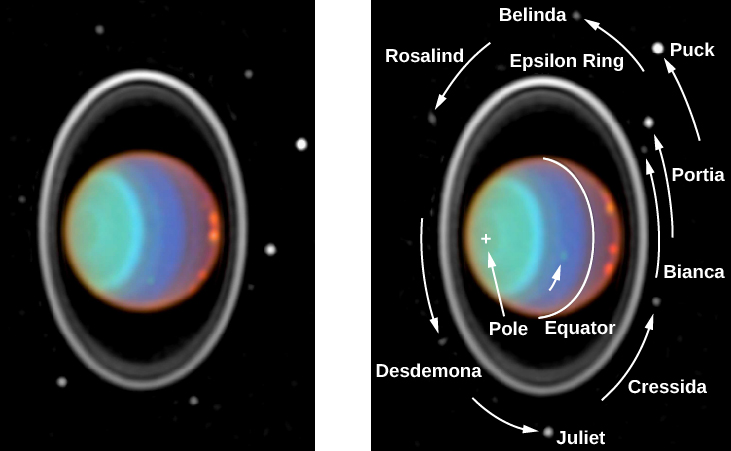
What are the seasons like for the giant planets? The spin axis of Jupiter is tilted by only 3°, so there are no seasons to speak of. Saturn, however, does have seasons, since its spin axis is inclined at 27° to the perpendicular to its orbit. Neptune has about the same tilt as Saturn (29°); therefore, it experiences similar seasons (only more slowly). The strangest seasons of all are on Uranus, which has a spin axis tilted by 98° with respect to the north direction. Practically speaking, we can say that Uranus orbits on its side, and its ring and moon system follow along, orbiting about Uranus’ equator (Figure 11.5).
英語のヒント
巨大惑星の季節はどのようなものだろうか。木星の自転軸の傾きはわずか3°なので、これといった季節はない。しかし、土星には確かに季節がある。自転軸が、公転軌道に垂直な方向から27°傾いているからである。海王星の傾きは29°と土星とほぼ同じなので、よく似た季節の変化が起こる。ただし、変化はもっとゆっくりである。最も奇妙な季節があるのは天王星で、自転軸は北向きの方向に対して98°傾いている。実質的には、天王星は横倒しになって公転していると言える。その環や衛星の系もそれに従い、天王星の赤道のまわりを回っている(図11.5)。
Infrared Image of Uranus.天王星の赤外線画像。
credit: modification of work by Erich Karkoschka (University of Arizona), and NASA/ESA · NASA media use guidelines
Figure 11.5 The infrared camera on the Hubble Space Telescope took these false-color images of the planet Uranus, its ring system, and moons in 1997. The south pole of the planet (marked with a “+” on the right image) faces the Sun; its green color shows a strong local haze. The two images were taken 90 minutes apart, and during that time the five reddish clouds can be seen to rotate around the parallel to the equator. The rings (which are very faint in the visible light, but prominent in infrared) and eight moons can be seen around the equator. This was the “bull’s eye” arrangement that Voyager saw as it approached Uranus in 1986. (credit: modification of work by Erich Karkoschka (University of Arizona), and NASA/ESA)
図11.5 ハッブル宇宙望遠鏡の赤外線カメラが、1997年に天王星とその環、衛星を撮影した疑似カラー画像。惑星の南極(右の画像の「+」)は太陽を向いており、緑色はその場所に濃いもやがあることを示す。2枚の画像は90分の間隔で撮影された。その間に、5つの赤みを帯びた雲が、赤道に平行な緯度の線に沿って回転していることがわかる。赤道のまわりには環と8つの衛星が見える。環は可視光では非常に淡いが、赤外線でははっきりしている。これは、1986年にボイジャーが天王星に接近したときに見た、的の中心のような配置である。(クレジット:Erich Karkoschka〔University of Arizona〕、NASA/ESAの作品を改変)
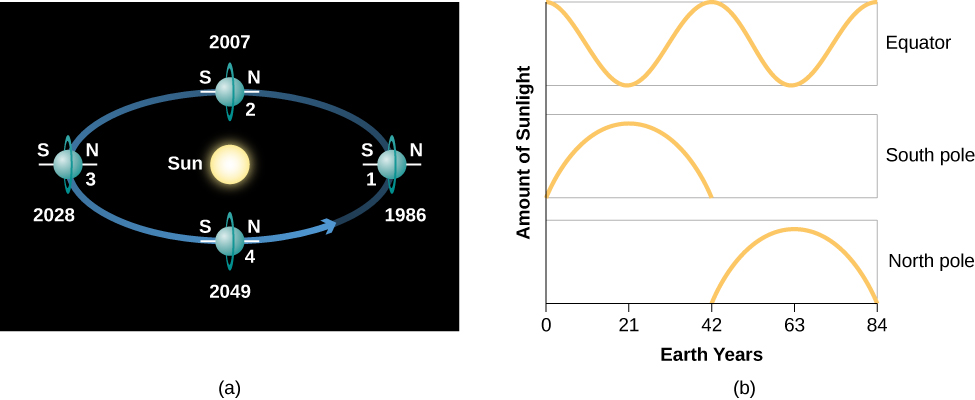
We don’t know what caused Uranus to be tipped over like this, but one possibility is a collision with a large planetary body when our system was first forming. Whatever the cause, this unusual tilt creates dramatic seasons. When Voyager 2 arrived at Uranus, its south pole was facing directly into the Sun. The southern hemisphere was experiencing a 21-year sunlit summer, while during that same period the northern hemisphere was plunged into darkness. For the next 21-year season, the Sun shines on Uranus’ equator, and both hemispheres go through cycles of light and dark as the planet rotates (Figure 11.6). Then there are 21 years of an illuminated northern hemisphere and a dark southern hemisphere. After that the pattern of alternating day and night repeats.
英語のヒント
何が天王星をこのように横倒しにしたのかはわかっていない。一つの可能性は、太陽系が形成され始めたころに、大きな惑星天体と衝突したことである。原因が何であれ、この異常な傾きは極端な季節を生み出す。ボイジャー2号が天王星に到着したとき、南極は真正面から太陽を向いていた。南半球では21年続く日差しのある夏が進行しており、その同じ期間、北半球は闇に包まれていた。次の21年間の季節には、太陽は天王星の赤道を照らし、惑星の自転に伴って両半球とも明暗を繰り返す(図11.6)。その次の21年間は北半球が照らされ、南半球は暗くなる。その後、昼と夜が交互に訪れるパターンが繰り返される。
Just as on Earth, the seasons are even more extreme at the poles. If you were to install a floating platform at the south pole of Uranus, for example, it would experience 42 years of light and 42 years of darkness. Any future astronauts crazy enough to set up camp there could spend most of their lives without ever seeing the Sun.
英語のヒント
地球と同じように、極では季節の変化がいっそう極端になる。たとえば天王星の南極に浮遊式のプラットフォームを設置したとすると、そこでは42年間の明るい時期と、42年間の暗い時期を経験することになる。将来、そこにキャンプを張るほど物好きな宇宙飛行士がいれば、太陽を一度も見ずに生涯の大半を過ごすこともあり得る。
Strange Seasons on Uranus.天王星の奇妙な季節。
OpenStax / Rice University · CC BY 4.0
Figure 11.6 (a) This diagram shows the orbit of Uranus as seen from above. At the time Voyager 2 arrived (position 1), the South Pole was facing the Sun. As we move counterclockwise in the diagram, we see the planet 21 years later at each step. (b) This graph compares the amount of sunlight seen at the poles and the equator of Uranus over the course of its 84-year revolution around the Sun.
図11.6 (a)上から見た天王星の軌道。ボイジャー2号が到着した時点(位置1)では、南極が太陽を向いていた。図を反時計回りにたどると、一段階ごとに21年後の惑星の姿が示されている。(b)天王星が84年かけて太陽を一周する間に、両極と赤道で見られる日光の量を比較したグラフ。