第11章巨大惑星The Giant Planets
Winds and Weather風と気象
The atmospheres of the jovian planets have many regions of high pressure (where there is more air) and low pressure (where there is less). Just as it does on Earth, air flows between these regions, setting up wind patterns that are then distorted by the rotation of the planet. By observing the changing cloud patterns on the jovian planets, we can measure wind speeds and track the circulation of their atmospheres.
英語のヒント
木星型惑星の大気には、高圧の領域(空気が多いところ)と低圧の領域(空気が少ないところ)が数多くある。地球と同様に、空気はそれらの領域の間を流れ、風のパターンを作る。そのパターンは、惑星の自転によって変形される。木星型惑星の雲の模様がどう変わるかを観測すれば、風速を測り、大気の循環を追跡できる。
The atmospheric motions we see on these planets are fundamentally different from those on the terrestrial planets. The giants spin faster, and their rapid rotation tends to smear out of the circulation into horizontal (east-west) patterns parallel to the equator. In addition, there is no solid surface below the atmosphere against which the circulation patterns can rub and lose energy (which is how tropical storms on Earth ultimately die out when they come over land).
英語のヒント
これらの惑星に見られる大気の運動は、地球型惑星のものとは根本的に異なる。巨大惑星は自転が速く、その速い回転によって、循環は赤道に平行な水平方向、すなわち東西方向のパターンへ引き延ばされやすい。さらに、大気の下には固体の表面がないため、大気の循環が表面と摩擦を起こしてエネルギーを失うこともない。地球の熱帯性の嵐が陸地に上がるとやがて消滅するのは、まさにこの摩擦による。
As we have seen, on all the giants except Uranus, heat from the inside contributes about as much energy to the atmosphere as sunlight from the outside. This means that deep convection currents of rising hot air and falling cooler air circulate throughout the atmospheres of the planets in the vertical direction.
英語のヒント
これまで見てきたように、天王星を除くすべての巨大惑星では、内部からの熱が、外からの太陽光とほぼ同じだけのエネルギーを大気に与えている。そのため、高温の空気が上昇し、低温の空気が下降する深い対流が、惑星の大気全体を上下方向に循環している。
The main features of Jupiter’s visible clouds (see Figure 11.2 and Figure 11.10, for example) are alternating dark and light bands that stretch around the planet parallel to the equator. These bands are semi-permanent features, although they shift in intensity and position from year to year. Consistent with the small tilt of Jupiter’s axis, the pattern does not change with the seasons.
英語のヒント
木星の目に見える雲の主な特徴は、赤道に平行に惑星を一周する、明暗が交互に並んだ帯である(たとえば図11.2と図11.10)。帯の強さや位置は年ごとに変化するものの、半永久的に存在する特徴である。木星の自転軸の傾きが小さいことと整合して、このパターンは季節によって変化しない。
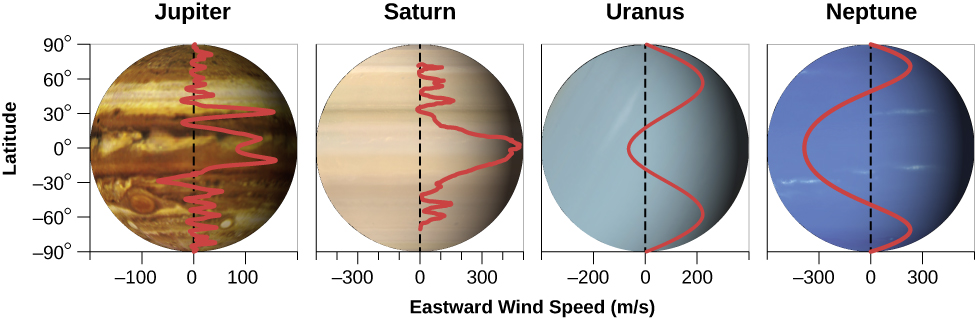
More fundamental than these bands are underlying east-west wind patterns in the atmosphere, which do not appear to change at all, even over many decades. These are illustrated in Figure 11.17, which indicates how strong the winds are at each latitude for the giant planets. At Jupiter’s equator, a jet stream flows eastward with a speed of about 90 meters per second (300 kilometers per hour), similar to the speed of jet streams in Earth’s upper atmosphere. At higher latitudes there are alternating east- and west-moving streams, with each hemisphere an almost perfect mirror image of the other. Saturn shows a similar pattern, but with a much stronger equatorial jet stream, as we noted earlier.
英語のヒント
こうした帯よりも根本的なものは、その下にある大気の東西方向の風のパターンである。こちらは、何十年経ってもまったく変化しないように見える。図11.17に、それぞれの巨大惑星で、緯度ごとに風がどれほど強いかを示している。木星の赤道では、ジェット気流が毎秒約90メートル、時速約300キロメートルで東向きに流れている。これは地球の上層大気のジェット気流に近い速さである。高緯度では東向きと西向きの流れが交互に並び、両半球は互いにほぼ完全な鏡像になっている。土星にも似たパターンがあるが、先に述べたように、赤道のジェット気流はずっと強い。
Winds on the Giant Planets.巨大惑星の風。
OpenStax / Rice University · CC BY 4.0
Figure 11.17 This image compares the winds of the giant planets, illustrating that wind speed (shown on the horizontal axis) and wind direction vary with latitude (shown on the vertical axis). Winds are measured relative to a planet’s internal rotation speed. A positive velocity means that the winds are blowing in the same direction as, but faster than, the planet’s internal rotation. A negative velocity means that the winds are blowing more slowly than the planet’s internal rotation.
図11.17 巨大惑星の風を比較した図。風速(横軸)と風向きが、緯度(縦軸)によって変わることを示している。風は、惑星内部の自転速度を基準に測定される。正の速度は、風が内部の自転と同じ方向へ、それより速く吹くことを意味する。負の速度は、風が内部の自転よりゆっくり吹くことを意味する。
The light zones on Jupiter are regions of upwelling air capped by white ammonia cirrus clouds. They apparently represent the tops of upward-moving convection currents.Recall from earlier chapters that convection is a process in which liquids, heated from underneath, have regions where hot material rises and cooler material descends. You can see convection at work if you heat oatmeal on a stovetop or watch miso soup boil. The darker belts are regions where the cooler atmosphere moves downward, completing the convection cycle; they are darker because fewer ammonia clouds mean we can see deeper into the atmosphere, perhaps down to a region of ammonium hydrosulfide (NH4SH) clouds. The Galileo probe sampled one of the clearest of these dry downdrafts.
英語のヒント
木星の明るいゾーンは、上昇する空気の上を、白いアンモニアの巻雲が覆っている領域である。これらは、上昇する対流の上端を示していると考えられる。以前の章で見たように、対流とは、下から加熱された液体の中に、温かい物質が上昇し、冷たい物質が下降する領域ができる過程である。コンロでオートミールを温めたり、味噌汁が煮立つ様子を眺めたりすると、対流が働いているところを見られる。暗いベルトは、冷えた大気が下降して対流の循環を閉じる領域である。アンモニアの雲が少ないため大気の奥まで見えるので暗く、場合によっては硫化水素アンモニウム(NH₄SH)の雲の領域まで見えているのかもしれない。ガリレオ・プローブが測定したのは、こうした乾いた下降流の中でも、特に雲のない領域の一つだった。
In spite of the strange seasons induced by the 98° tilt of its axis, Uranus’ basic circulation is parallel with its equator, as is the case on Jupiter and Saturn. The mass of the atmosphere and its capacity to store heat are so great that the alternating 42-year periods of sunlight and darkness have little effect. In fact, Voyager measurements show that the atmospheric temperature is even a few degrees higher on the dark winter side than on the hemisphere facing the Sun. This is another indication that the behavior of such giant planet atmospheres is a complex problem that we do not fully understand.
英語のヒント
自転軸の98°の傾きが奇妙な季節を生むにもかかわらず、天王星の基本的な循環は、木星や土星と同じように赤道に平行である。大気の質量も熱を蓄える能力も非常に大きいため、日光と暗闇が42年ずつ交互に続いても、その影響は小さい。実際、ボイジャーの測定によれば、暗い冬側の大気温度は、太陽を向いた半球より数度高いほどである。これも、巨大惑星の大気の振る舞いが、私たちのまだ十分に理解していない複雑な問題であることを示している。
Neptune’s weather is characterized by strong east-west winds generally similar to those observed on Jupiter and Saturn. The highest wind speeds near its equator reach 2100 kilometers per hour, even higher than the peak winds on Saturn. The Neptune equatorial jet stream actually approaches supersonic speeds (faster than the speed of sound in Neptune’s air).
英語のヒント
海王星の気象の特徴は、木星や土星で観測されるものと全体としてよく似た、強い東西方向の風である。赤道付近の最高風速は時速2100キロメートルに達し、土星の最大風速さえ上回る。海王星の赤道ジェット気流は、実際に超音速、つまり海王星の大気中の音速を超える速さに近づいている。
Giant Storms on Giant Planets巨大惑星の巨大な嵐
Superimposed on the regular atmospheric circulation patterns we have just described are many local disturbances—weather systems or storms, to borrow the term we use on Earth. The most prominent of these are large, oval-shaped, high-pressure regions on both Jupiter (Figure 11.18) and Neptune.
英語のヒント
ここまで説明した規則的な大気の循環パターンに重なって、数多くの局所的な乱れが存在する。地球で使う言葉を借りれば、気象系や嵐である。特に目立つのが、木星(図11.18)と海王星の両方に見られる、大きな楕円形の高気圧領域である。
Storms on Jupiter.木星の嵐。
credit a: modification of work by Reta Beebe, Amy Simon (New Mexico State Univ.), and NASA; credit b: modification of work by NASA, ESA, and A. Simon-Miller (NASA Goddard Space Flight Center) · NASA media use guidelines
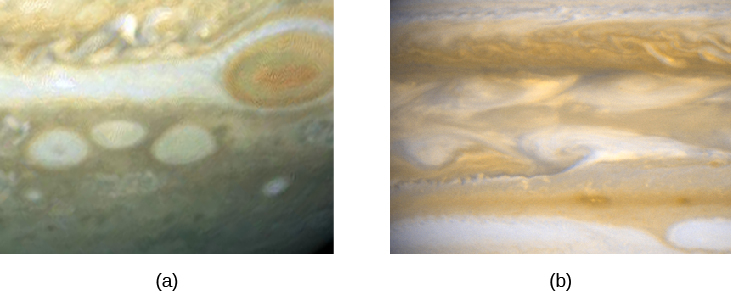
Figure 11.18 Two examples of storms on Jupiter illustrate the use of enhanced color and contrast to bring out faint features. (a) The three oval-shaped white storms below and to the left of Jupiter’s Great Red Spot are highly active, and moved closer together over the course of seven months between 1994 and 1995. (b) The clouds of Jupiter are turbulent and ever-changing, as shown in this Hubble Space Telescope image from 2007. (credit a: modification of work by Reta Beebe, Amy Simon (New Mexico State Univ.), and NASA; credit b: modification of work by NASA, ESA, and A. Simon-Miller (NASA Goddard Space Flight Center))
図11.18 木星の嵐の2例。色とコントラストを強調することで、かすかな特徴を浮かび上がらせている。(a)木星の大赤斑の左下にある3つの楕円形の白い嵐は非常に活発で、1994~1995年の7か月間に互いに近づいた。(b)2007年のハッブル宇宙望遠鏡画像に見られるように、木星の雲は乱れながら絶えず変化している。(クレジットa:Reta Beebe、Amy Simon〔New Mexico State Univ.〕、NASAの作品を改変。b:NASA、ESA、A. Simon-Miller〔NASA Goddard Space Flight Center〕の作品を改変)
The largest and most famous of Jupiter’s storms is the Great Red Spot, a reddish oval in the southern hemisphere that changes slowly; it was 25,000 kilometers long when Voyager arrived in 1979, but it had shrunk to 20,000 kilometers by the end of the Galileo mission in 2000 (Figure 11.19). The giant storm has persisted in Jupiter’s atmosphere ever since astronomers were first able to observe it after the invention of the telescope, more than 300 years ago. However, it has continued to shrink and has become more nearly circular, raising speculation that we may see its end within a few decades. Measurements from the Juno spacecraft of variations in Jupiter’s gravity field indicate that the depth of the Red Spot storm system is only a few hundred kilometers—a finding that challenges some of the models astronomers have made of this long-lasting weather system.
英語のヒント
木星の嵐の中で最大かつ最も有名なのは大赤斑である。南半球にある赤みを帯びた楕円で、ゆっくり変化する。1979年にボイジャーが到着したときは長さ2万5000キロメートルだったが、2000年のガリレオ計画終了時には2万キロメートルまで縮んでいた(図11.19)。この巨大な嵐は、300年以上前に望遠鏡が発明され、天文学者が初めて観測できるようになって以来、木星大気の中で続いている。しかし縮小は続き、形はより円に近づいており、数十年以内に消えるのを目にするかもしれないと推測されている。ジュノーによる木星重力場の変化の測定から、大赤斑という嵐の系の深さは数百キロメートルしかないと示された。この発見は、長寿命のこの気象系について天文学者が作ってきたモデルの一部に、見直しを迫るものである。
Jupiter’s Great Red Spot.木星の大赤斑。
credit: NASA/JPL · JPL image use policy
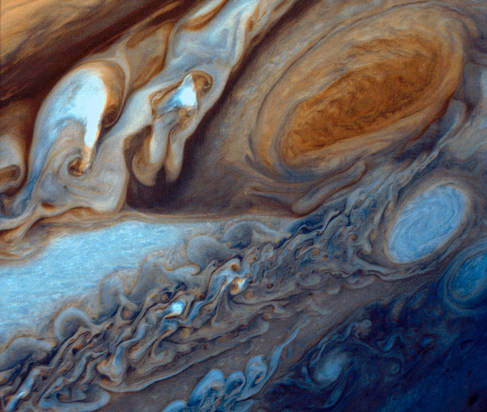
Figure 11.19 This is the largest storm system on Jupiter, as seen during the Voyager spacecraft flyby. Below and to the right of the Red Spot is one of the white ovals, which are similar but smaller high-pressure features. The white oval is roughly the size of planet Earth, to give you a sense of the huge scale of the weather patterns we are seeing. The colors on the Jupiter image have been somewhat exaggerated here so astronomers (and astronomy students) can study their differences more effectively. See Figure 11.2 to get a better sense of the colors your eye would actually see near Jupiter. (credit: NASA/JPL)
図11.19 ボイジャー探査機のフライバイ時に見た、木星最大の嵐の系。大赤斑の右下には、よく似ているが小さい高気圧の特徴である、白い楕円の一つが見える。この白い楕円は地球ほどの大きさであり、ここで見ている気象パターンの途方もない規模がわかる。天文学者や天文学を学ぶ人が違いを詳しく調べられるよう、ここでは木星画像の色をやや強調している。木星の近くで実際に目に見える色の感じを知るには、図11.2を見てほしい。(クレジット:NASA/JPL)
In addition to its longevity, the Red Spot differs from terrestrial storms in being a high-pressure region; on our planet, such storms are regions of lower pressure. The Red Spot’s counterclockwise rotation has a period of six days. Three similar but smaller disturbances (about as big as Earth) formed on Jupiter in the 1930s. They look like white ovals, and one can be seen clearly below and to the right of the Great Red Spot in Figure 11.19. In 1998, the Galileo spacecraft watched as two of these ovals collided and merged into one.
英語のヒント
大赤斑は長寿命であることに加え、高気圧の領域である点でも地球の嵐と異なる。地球では、このような嵐は低気圧の領域である。大赤斑は反時計回りに6日周期で回転する。1930年代には、これと似ているがもっと小さく、地球ほどの大きさの乱れが3つ、木星に生じた。これらは白い楕円に見え、その一つが図11.19の大赤斑の右下にはっきり写っている。1998年、ガリレオ探査機は、この楕円のうち2つが衝突して一つに合体する様子を観測した。
We don’t know what causes the Great Red Spot or the white ovals, but we do have an idea how they can last so long once they form. On Earth, the lifetime of a large oceanic hurricane or typhoon is typically a few weeks, or even less when it moves over the continents and encounters friction with the land. Jupiter has no solid surface to slow down an atmospheric disturbance; furthermore, the sheer size of the disturbances lends them stability. We can calculate that on a planet with no solid surface, the lifetime of anything as large as the Red Spot should be measured in centuries, while lifetimes for the white ovals should be measured in decades, which is pretty much what we have observed.
英語のヒント
大赤斑や白い楕円が何によって生じるかはわからない。しかし、ひとたびできると、なぜこれほど長く続くのかについては見当がついている。地球では、海上の大きなハリケーンや台風の寿命は通常数週間であり、大陸上へ移動して陸地との摩擦を受けると、さらに短くなる。木星には大気の乱れを減速させる固体の表面がない。しかも、その乱れ自体の途方もない大きさが安定性をもたらす。固体表面を持たない惑星では、大赤斑ほど大きなものの寿命は数百年単位、白い楕円の寿命は数十年単位になるはずだと計算できる。これは観測結果とほぼ一致している。
Despite Neptune’s smaller size and different cloud composition, Voyager showed that it had an atmospheric feature surprisingly similar to Jupiter’s Great Red Spot. Neptune’s Great Dark Spot was nearly 10,000 kilometers long (Figure 11.15). On both planets, the giant storms formed at latitude 20° S, had the same shape, and took up about the same fraction of the planet’s diameter. The Great Dark Spot rotated with a period of 17 days, versus about 6 days for the Great Red Spot. When the Hubble Space Telescope examined Neptune in the mid-1990s, however, astronomers could find no trace of the Great Dark Spot on their images.
英語のヒント
海王星は木星より小さく、雲の組成も違うが、ボイジャーによって、木星の大赤斑と驚くほどよく似た大気の特徴を持つことがわかった。海王星の大暗斑は、長さが1万キロメートル近くあった(図11.15)。両惑星とも巨大な嵐は南緯20°にでき、形も同じで、長さが惑星の直径に占める割合もほぼ同じだった。大暗斑の回転周期は17日で、大赤斑の約6日とは異なっていた。しかし1990年代半ばにハッブル宇宙望遠鏡が海王星を調べたとき、天文学者は画像のどこにも大暗斑の痕跡を見つけられなかった。
Although many of the details of the weather on the jovian planets are not yet understood, it is clear that if you are a fan of dramatic weather, these worlds are the place to look. We study the features in these atmospheres not only for what they have to teach us about conditions in the jovian planets, but also because we hope they can help us understand the weather on Earth just a bit better.
英語のヒント
木星型惑星の気象については、細部の多くがまだ理解されていない。それでも、劇的な気象が好きなら、これらの世界に目を向けるべきことは明らかである。私たちがこうした大気の特徴を研究するのは、それが木星型惑星の環境を教えてくれるからだけではない。地球の気象をほんの少しでもよく理解する助けになると期待しているからでもある。
Storms and Winds嵐と風
The wind speeds in circular storm systems can be formidable on both Earth and the giant planets. Think about our big terrestrial hurricanes. If you watch their behavior in satellite images shown on weather outlets, you will see that they require about one day to rotate. If a storm has a diameter of 400 km and rotates once in 24 h, what is the wind speed?
英語のヒント
円形の嵐の系では、地球でも巨大惑星でも、風速がすさまじくなることがある。地球の大きなハリケーンを考えてみよう。気象情報で示される衛星画像でその動きを見ると、一回転するのに約1日かかることがわかる。直径400 kmの嵐が24時間で一回転するなら、風速はいくらだろうか。
Solution解き方
Speed equals distance divided by time. The distance in this case is the circumference (2πR or πd), or approximately 1250 km, and the time is 24 h, so the speed at the edge of the storm would be about 52 km/h. Toward the center of the storm, the wind speeds can be much higher.
速さは距離を時間で割ったものに等しい。この場合の距離は円周(2πRまたはπd)、すなわち約1250 kmで、時間は24時間なので、嵐の外縁の速さは約52 km/hとなる。嵐の中心に近づくにつれて、風速はずっと高くなることがある。
Check Your Learning理解を確かめよう
Jupiter’s Great Red Spot rotates in 6 d and has a circumference equivalent to a circle with radius 10,000 km. Calculate the wind speed at the outer edge of the spot.
木星の大赤斑は6日で一回転し、その周長は半径1万 kmの円の円周に相当する。大赤斑の外縁の風速を計算しよう。