第11章巨大惑星The Giant Planets
Composition and Structure組成と構造
Although we cannot see into these planets, astronomers are confident that the interiors of Jupiter and Saturn are composed primarily of hydrogen and helium. Of course, these gases have been measured only in their atmosphere, but calculations first carried out more than 50 years ago showed that these two light gases are the only possible materials out of which a planet with the observed masses and densities of Jupiter and Saturn could be constructed.
英語のヒント
これらの惑星の内部を直接見ることはできないが、天文学者は、木星と土星の内部が主として水素とヘリウムでできていると確信している。もちろん、これらのガスが測定されているのは大気中だけである。しかし、50年以上前に初めて行われた計算から、木星や土星で観測された質量と密度を持つ惑星を作れる物質は、この2つの軽いガスしかないことが示された。
The deep internal structures of these two planets are difficult to predict. This is mainly because these planets are so big that the hydrogen and helium in their centers become tremendously compressed and behave in ways that these gases can never behave on Earth. The best theoretical models we have of Jupiter’s structure predict a central pressure greater than 100 million bars and a central density of about 31 g/cm3. (By contrast, Earth’s core has a central pressure of 4 million bars and a central density of 17 g/cm3.)
英語のヒント
この2惑星の深部の構造を予測することは難しい。その主な理由は、惑星が非常に大きいため、中心部の水素とヘリウムが極度に圧縮され、地球上では決して見られない振る舞いをすることにある。木星の構造についての最良の理論モデルは、中心圧力が1億バールを超え、中心密度が約31 g/cm³になると予測している。これに対して、地球の核の中心圧力は400万バール、中心密度は17 g/cm³である。
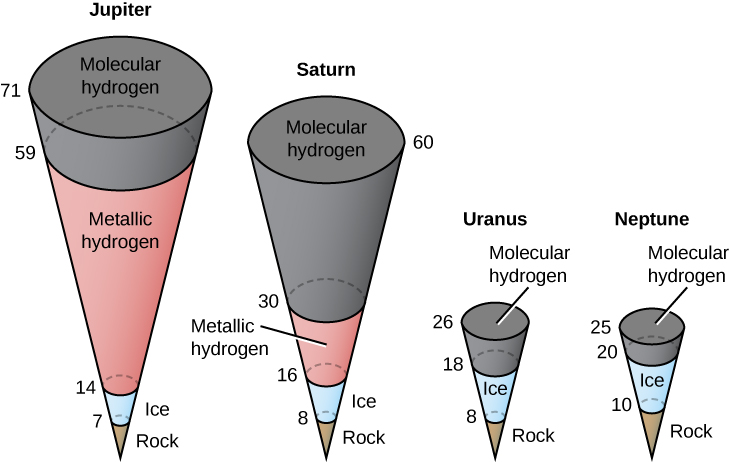
At the pressures inside the giant planets, familiar materials can take on strange forms. A few thousand kilometers below the visible clouds of Jupiter and Saturn, pressures become so great that hydrogen changes from a gaseous to a liquid state. Still deeper, this liquid hydrogen is further compressed and begins to act like a metal, something it never does on Earth. (In a metal, electrons are not firmly attached to their parent nuclei but can wander around. This is why metals are such good conductors of electricity.) On Jupiter, the greater part of the interior is liquid metallic hydrogen.
英語のヒント
巨大惑星の内部の圧力のもとでは、なじみ深い物質が奇妙な形態をとることがある。木星と土星で、目に見える雲から数千キロメートル下に進むと、圧力が非常に高くなり、水素は気体から液体へと変わる。さらに深いところでは、この液体水素がいっそう圧縮され、金属のように振る舞い始める。水素は地球上では決してこのようには振る舞わない。金属では、電子が自分の原子核に固く束縛されず、動き回ることができる。そのため金属は電気をよく通す。木星では、内部の大部分が液体の金属水素になっている。
Because Saturn is less massive, it has only a small volume of metallic hydrogen, but most of its interior is liquid. Uranus and Neptune are too small to reach internal pressures sufficient to liquefy hydrogen. We will return to the discussion of the metallic hydrogen layers when we examine the magnetic fields of the giant planets.
英語のヒント
土星は質量が小さいため、金属水素の体積はわずかであるが、内部の大部分は液体である。天王星と海王星は小さすぎて、水素を液化できるだけの内部圧力に達しない。巨大惑星の磁場を調べるときに、金属水素の層について再び取り上げる。
Each of these planets has a core composed of heavier materials, as demonstrated by detailed analyses of their gravitational fields. Presumably these cores are the original rock-and-ice bodies that formed before the capture of gas from the surrounding nebula. The cores exist at pressures of tens of millions of bars. While scientists speak of the giant planet cores being composed of rock and ice, we can be sure that neither rock nor ice assumes any familiar forms at such pressures and temperatures. Remember that what is really meant by “rock” is any material made up primarily of iron, silicon, and oxygen, while the term “ice” in this chapter denotes materials composed primarily of the elements carbon, nitrogen, and oxygen in combination with hydrogen.
英語のヒント
これらの惑星はどれも、より重い物質からなる核を持つ。このことは、重力場の詳しい解析によって示されている。おそらくこれらの核は、周囲の星雲からガスを取り込む前にできた、もともとの岩石と氷の天体である。核は数千万バールの圧力のもとにある。科学者は巨大惑星の核が岩石と氷からなると言うが、そのような圧力と温度のもとで、岩石も氷も、私たちになじみのある形をとらないことは確かである。「岩石」が実際に意味するのは、主として鉄、ケイ素、酸素からできた物質であることを思い出そう。一方、この章の「氷」という言葉は、主に炭素、窒素、酸素という元素が水素と結びついてできた物質を指している。
Figure 11.7 illustrates the likely interior structures of the four jovian planets. It appears that all four have similar cores of rock and ice. On Jupiter and Saturn, the cores constitute only a few percent of the total mass, consistent with the initial composition of raw materials shown in Table 11.1. However, most of the mass of Uranus and Neptune resides in these cores, demonstrating that the two outer planets were unable to attract massive quantities of hydrogen and helium when they were first forming.
英語のヒント
図11.7は、4つの木星型惑星の内部に考えられる構造を示す。4惑星とも、岩石と氷からなるよく似た核を持つように見える。木星と土星では核は総質量の数%しかなく、これは表11.1に示した初期の材料の組成と整合している。しかし、天王星と海王星では、質量の大部分がこれらの核にある。これは、外側の2惑星が形成され始めたときに、大量の水素とヘリウムを引き寄せられなかったことを示している。
Internal Structures of the Jovian Planets.木星型惑星の内部構造。
OpenStax / Rice University · CC BY 4.0
Figure 11.7 Jupiter and Saturn are composed primarily of hydrogen and helium (but hydrogen dominates), but Uranus and Neptune consist in large part of compounds of carbon, nitrogen, and oxygen. (The diagrams are drawn to scale; numbers show radii in thousands of kilometers.)
図11.7 木星と土星は主として水素とヘリウムからなり、そのうち水素が優勢である。一方、天王星と海王星の大部分は、炭素、窒素、酸素の化合物からなる。(図は同じ縮尺で描かれている。数値は半径を1000キロメートル単位で示す。)
Internal Heat Sources内部熱源
Because of their large sizes, all the giant planets were strongly heated during their formation by the collapse of surrounding material onto their cores. Jupiter, being the largest, was the hottest. Some of this primordial heat can still remain inside such large planets. In addition, it is possible for giant, largely gaseous planets to generate heat after formation by slowly contracting. (With so large a mass, even a minuscule amount of shrinking can generate significant heat.) The effect of these internal energy sources is to raise the temperatures in the interiors and atmospheres of the planets higher than we would expect from the heating effect of the Sun alone.
英語のヒント
巨大惑星はどれも大きいため、形成時に周囲の物質が核へ落ち込むことで強く加熱された。最大の木星が最も高温になった。このように大きな惑星では、形成当初の熱の一部が今も内部に残っていることがある。また、主としてガスからなる巨大な惑星は、形成後にもゆっくり収縮することで熱を発生させられる。このように大きな質量では、ごくわずかな収縮でもかなりの熱が生じる。こうした内部のエネルギー源により、惑星の内部や大気の温度は、太陽による加熱だけから予想される温度よりも高くなる。
Jupiter has the largest internal energy source, amounting to watts; that is, it is heated from inside with energy equivalent to 4 million billion 100-watt lightbulbs. This energy is about the same as the total solar energy absorbed by Jupiter. The atmosphere of Jupiter is therefore something of a cross between a normal planetary atmosphere (like Earth’s), which obtains most of its energy from the Sun, and the atmosphere of a star, which is entirely heated by an internal energy source. Most of the internal energy of Jupiter is primordial heat, left over from the formation of the planet 4.5 billion years ago.
英語のヒント
木星は最大の内部エネルギー源を持ち、その出力はワットに達する。つまり、100ワットの電球4000兆個に相当するエネルギーで、内側から加熱されている。このエネルギーは、木星が吸収する太陽エネルギーの総量とほぼ同じである。したがって木星の大気は、エネルギーの大部分を太陽から得る地球のような普通の惑星大気と、すべてを内部のエネルギー源によって加熱される恒星の大気との、中間的な性質を持つ。木星の内部エネルギーの大部分は、45億年前に惑星が形成されたときから残っている原始の熱である。
Saturn has an internal energy source about half as large as that of Jupiter, which means (since its mass is only about one quarter as great) that it is producing twice as much energy per kilogram of material as does Jupiter. Since Saturn is expected to have much less primordial heat, there must be another source at work generating most of this watts of power. This source is the separation of helium from hydrogen in Saturn’s interior. In the liquid hydrogen mantle, the heavier helium forms droplets that sink toward the core, releasing gravitational energy. In effect, Saturn is still differentiating—letting lighter material rise and heavier material fall.
英語のヒント
土星の内部エネルギー源の出力は、木星の約半分である。土星の質量は木星の約4分の1しかないので、これは物質1キログラムあたりでは木星の2倍のエネルギーを生み出していることになる。土星には形成当初の熱がもっと少なくしか残っていないはずなので、ワットという出力の大部分を生み出す、別の熱源が働いているに違いない。その熱源は、土星内部でヘリウムが水素から分離することである。液体水素のマントルの中では、より重いヘリウムが液滴を作って核へ沈み、重力エネルギーを放出する。事実上、土星では今も、軽い物質が上昇し、重い物質が沈む分化が続いている。
Uranus and Neptune are different. Neptune has a small internal energy source, while Uranus does not emit a measurable amount of internal heat. As a result, these two planets have almost the same atmospheric temperature, in spite of Neptune’s greater distance from the Sun. No one knows why these two planets differ in their internal heat, but all this shows how nature can contrive to make each world a little bit different from its neighbors.
英語のヒント
天王星と海王星は異なっている。海王星には小さな内部エネルギー源があるが、天王星は測定可能な量の内部熱を放射していない。その結果、海王星のほうが太陽から遠いにもかかわらず、両惑星の大気温度はほぼ同じになっている。なぜこの2惑星で内部熱が異なるのかは誰にもわかっていない。しかし、こうしたことはすべて、自然がいかにして、それぞれの世界を隣の世界と少しずつ違うものに作り上げるかを示している。