第11章巨大惑星The Giant Planets
Clouds and Atmospheric Structure雲と大気構造
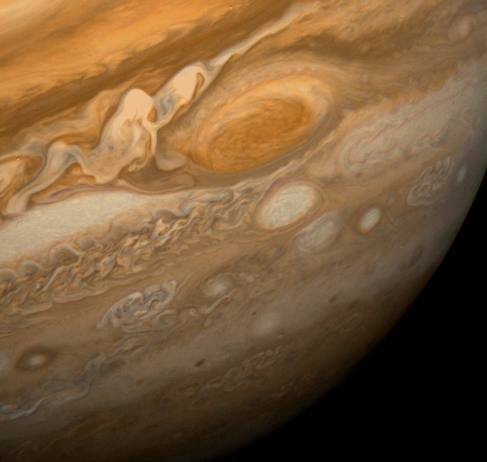
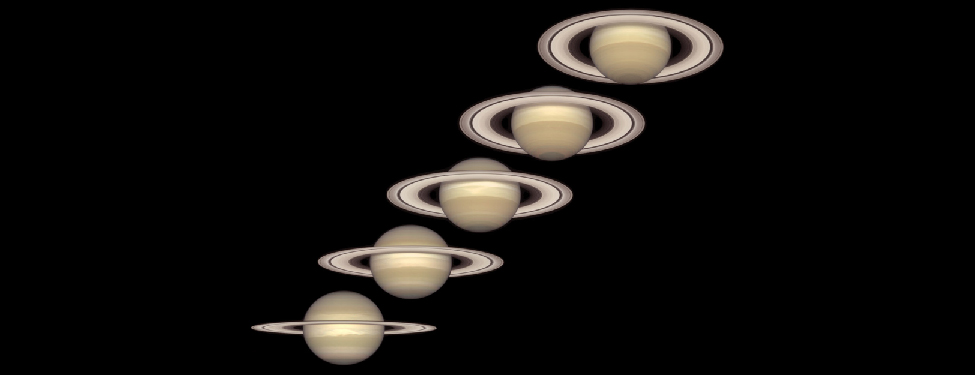
The clouds of Jupiter (Figure 11.10) are among the most spectacular sights in the solar system, much beloved by makers of science-fiction films. They range in color from white to orange to red to brown, swirling and twisting in a constantly changing kaleidoscope of patterns. Saturn shows similar but much more subdued cloud activity; instead of vivid colors, its clouds have a nearly uniform butterscotch hue (Figure 11.11).
英語のヒント
木星の雲(図11.10)は、太陽系でも特に壮観な眺めの一つで、SF映画の制作者たちにも大いに愛されている。白から橙、赤、茶色までさまざまな色があり、渦を巻き、ねじれながら、模様の万華鏡を絶えず変化させている。土星にも似た雲の活動があるが、ずっと控えめである。鮮やかな色彩ではなく、雲はほぼ一様なバタースコッチ色、つまり淡い黄褐色をしている(図11.11)。
Jupiter’s Colorful Clouds.木星の色彩豊かな雲。
credit: modification of work by Voyager Project, JPL, and NASA · JPL image use policy
Figure 11.10 The vibrant colors of the clouds on Jupiter present a puzzle to astronomers: given the cool temperatures and the composition of nearly 90% hydrogen, the atmosphere should be colorless. One hypothesis suggests that perhaps colorful hydrogen compounds rise from warm areas. The actual colors are a bit more muted, as shown in Figure 11.2. (credit: modification of work by Voyager Project, JPL, and NASA)
図11.10 木星の雲の鮮やかな色は、天文学者にとって謎である。温度が低く、組成のほぼ90%を水素が占めることを考えると、大気は無色のはずだからだ。一つの仮説では、温かい領域から色の付いた水素化合物が上昇してくる可能性が指摘されている。実際の色彩は、図11.2に示すように、もう少し落ち着いている。(クレジット:Voyager Project、JPL、NASAの作品を改変)
Different gases freeze at different temperatures. At the temperatures and pressures of the upper atmospheres of Jupiter and Saturn, methane remains a gas, but ammonia can condense and freeze. (Similarly, water vapor condenses high in Earth’s atmosphere to produce clouds of ice crystals.) The primary clouds that we see around these planets, whether from a spacecraft or through a telescope, are composed of frozen ammonia crystals. The ammonia clouds mark the upper edge of the planets’ tropospheres; above that is the stratosphere, the coldest part of the atmosphere. (These layers were initially defined in Earth as a Planet.)
英語のヒント
ガスは種類によって異なる温度で凍る。木星と土星の上層大気の温度と圧力では、メタンは気体のままだが、アンモニアは凝結して凍結する。同様に、地球では水蒸気が大気の高いところで凝結し、氷の結晶からなる雲を作る。探査機からでも望遠鏡を通してでも、これらの惑星のまわりに見える主な雲は、凍ったアンモニアの結晶からなる。アンモニアの雲は対流圏の上端を示し、その上には、大気中で最も温度の低い成層圏がある。これらの層は、「惑星としての地球」の章で最初に定義した。
Saturn over Five Years.5年間にわたる土星の姿。
credit: modification of work by NASA and The Hubble Heritage Team (STScI/AURA) · CC BY 4.0
Figure 11.11 These beautiful images of Saturn were recorded by the Hubble Space Telescope between 1996 and 2000. Since Saturn is tilted by 27°, we see the orientation of Saturn’s rings around its equator change as the planet moves along its orbit. Note the horizontal bands in the atmosphere. (credit: modification of work by NASA and The Hubble Heritage Team (STScI/AURA))
図11.11 ハッブル宇宙望遠鏡が1996~2000年に記録した、土星の美しい画像。土星は27°傾いているため、公転軌道を進むにつれて、赤道を取り巻く環の向きが変化して見える。大気の水平方向の帯にも注目しよう。(クレジット:NASA、The Hubble Heritage Team〔STScI/AURA〕の作品を改変)
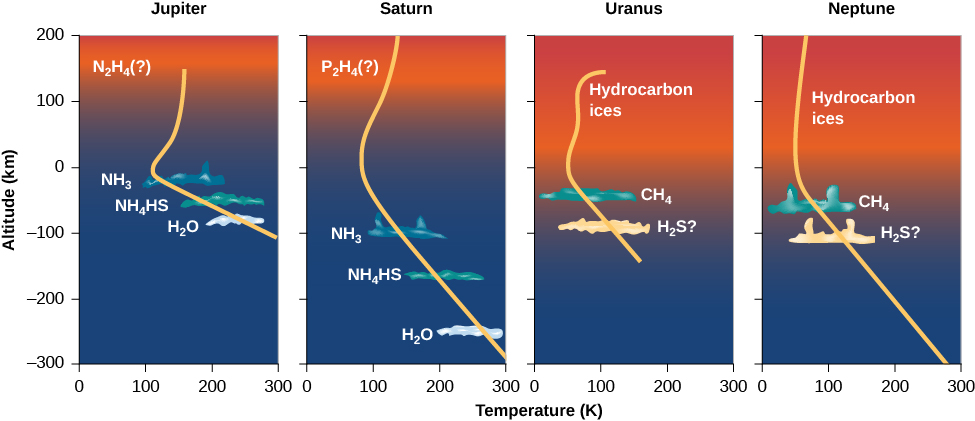
The diagrams in Figure 11.12 show the structure and clouds in the atmospheres of all four jovian planets. On both Jupiter and Saturn, the temperature near the cloud tops is about 140 K (only a little cooler than the polar caps of Mars). On Jupiter, this cloud level is at a pressure of about 0.1 bar (one tenth the atmospheric pressure at the surface of Earth), but on Saturn it occurs lower in the atmosphere, at about 1 bar. Because the ammonia clouds lie so much deeper on Saturn, they are more difficult to see, and the overall appearance of the planet is much blander than is Jupiter’s appearance.
英語のヒント
図11.12は、4つの木星型惑星すべてについて、大気の構造と雲を示している。木星でも土星でも、雲頂付近の温度は約140 Kで、火星の極冠よりわずかに低い程度である。木星では、この雲の高さの圧力は約0.1バール、つまり地表の大気圧の10分の1だが、土星では大気のもっと深いところ、約1バールの高さにある。土星のアンモニア雲はそれほど深いところにあるため、見えにくく、惑星全体の外観は木星に比べてずっと変化に乏しい。
Atmospheric Structure of the Jovian Planets.木星型惑星の大気構造。
OpenStax / Rice University · CC BY 4.0
Figure 11.12 In each diagram, the yellow line shows how the temperature (see the scale on the bottom) changes with altitude (see the scale at the left). The location of the main layers on each planet is also shown.
図11.12 各図の黄色の線は、高度(左の目盛り)とともに温度(下の目盛り)がどのように変わるかを示す。各惑星の主な層の位置も示されている。
Within the tropospheres of these planets, the temperature and pressure both increase with depth. Through breaks in the ammonia clouds, we can see tantalizing glimpses of other cloud layers that can form in these deeper regions of the atmosphere—regions that were sampled directly for Jupiter by the Galileo probe that fell into the planet.
英語のヒント
これらの惑星の対流圏の内部では、温度と圧力はどちらも深くなるほど高くなる。アンモニア雲の切れ間から、大気のさらに深い領域にできる別の雲の層を、ほんのわずかに垣間見ることができる。木星では、惑星へ落下したガリレオ・プローブが、こうした深い領域を直接測定した。
As it descended to a pressure of 5 bars, the probe should have passed into a region of frozen water clouds, then below that into clouds of liquid water droplets, perhaps similar to the common clouds of the terrestrial troposphere. At least this is what scientists expected. But the probe saw no water clouds, and it measured a surprisingly low abundance of water vapor in the atmosphere. It soon became clear to the Galileo scientists that the probe happened to descend through an unusually dry, cloud-free region of the atmosphere—a giant downdraft of cool, dry gas. Andrew Ingersoll of Caltech, a member of the Galileo team, called this entry site the “desert” of Jupiter. It’s a pity that the probe did not enter a more representative region, but that’s the luck of the cosmic draw. The probe continued to make measurements to a pressure of 22 bars but found no other cloud layers before its instruments stopped working. It also detected lightning storms, but only at great distances, further suggesting that the probe itself was in a region of clear weather.
英語のヒント
プローブは圧力5バールまで降下すると、まず凍った水の雲がある領域を通り、その下では液体の水滴の雲、おそらく地球の対流圏によくある雲に似たものへ入るはずだった。少なくとも科学者たちはそう予想していた。しかし、プローブは水の雲を見ず、大気中の水蒸気の存在量も驚くほど少ないと測定した。やがてガリレオの科学者たちには、プローブが偶然、大気中でも異常に乾燥した雲のない領域、冷たく乾いたガスの巨大な下降流の中を降りたことが明らかになった。ガリレオ・チームの一員であるカリフォルニア工科大学のアンドリュー・インガソルは、この突入地点を木星の「砂漠」と呼んだ。プローブがもっと代表的な領域に入らなかったのは残念だが、宇宙での巡り合わせとはそういうものである。プローブは圧力22バールまで測定を続けたが、機器が動かなくなるまで、ほかの雲の層は見つからなかった。雷を伴う嵐も検出したが、いずれも非常に遠くにあった。このことも、プローブ自身は晴天域にいたことを示している。
Above the visible ammonia clouds in Jupiter’s atmosphere, we find the clear stratosphere, which reaches a minimum temperature near 120 K. At still higher altitudes, temperatures rise again, just as they do in the upper atmosphere of Earth, because here the molecules absorb ultraviolet light from the Sun. The cloud colors are due to impurities, the product of chemical reactions among the atmospheric gases in a process we call photochemistry. In Jupiter’s upper atmosphere, photochemical reactions create a variety of fairly complex compounds of hydrogen and carbon that form a thin layer of smog far above the visible clouds. We show this smog as a fuzzy orange region in Figure 11.12; however, this thin layer does not block our view of the clouds beneath it.
英語のヒント
木星大気の、目に見えるアンモニア雲の上には、澄んだ成層圏があり、その最低温度は約120 Kに達する。さらに高いところでは、地球の上層大気と同じように温度が再び上がる。この領域では分子が太陽からの紫外線を吸収するからである。雲の色は不純物によるもので、その不純物は大気中のガスが化学反応してできる。この過程を光化学という。木星の上層大気では、光化学反応によって、水素と炭素からなるかなり複雑な化合物がいろいろと作られ、見える雲よりはるか上に薄いスモッグの層を形成する。図11.12では、このスモッグをぼんやりした橙色の領域として示している。ただし、この薄い層は、その下の雲を見る妨げにはならない。
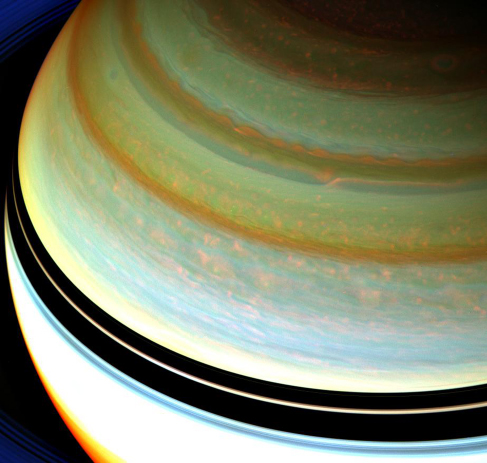
The visible atmosphere of Saturn is composed of approximately 75% hydrogen and 25% helium, with trace amounts of methane, ethane, propane, and other hydrocarbons. The overall structure is similar to that of Jupiter. Temperatures are somewhat colder, however, and the atmosphere is more extended due to Saturn’s lower surface gravity. Thus, the layers are stretched out over a longer distance, as you can see in Figure 11.12. Overall, though, the same atmospheric regions, condensation cloud, and photochemical reactions that we see on Jupiter should be present on Saturn (Figure 11.13).
英語のヒント
土星の目に見える大気は、約75%の水素と25%のヘリウムからなり、ごく微量のメタン、エタン、プロパン、その他の炭化水素を含む。全体的な構造は木星と似ている。しかし温度はやや低く、土星の表面重力が小さいため、大気はより広がっている。そのため図11.12でわかるように、各層はより長い距離に引き伸ばされている。全体としては、木星に見られるのと同じ大気の領域、凝結してできる雲、光化学反応が、土星にもあるはずである(図11.13)。
Cloud Structure on Saturn.土星の雲の構造。
credit: NASA/JPL-Caltech/Space Science Institute · JPL image use policy
Figure 11.13 In this Cassini image, colors have been intensified, so we can see the bands and zones and storms in the atmosphere. The dark band is the shadow of the rings on the planet. (credit: NASA/JPL-Caltech/Space Science Institute)
図11.13 このカッシーニ画像では色を強調しているため、大気の帯やゾーン、嵐を見ることができる。暗い帯は、環が惑星に落とした影である。(クレジット:NASA/JPL-Caltech/Space Science Institute)
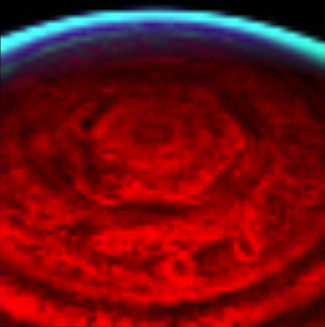
Saturn has one anomalous cloud structure that has mystified scientists: a hexagonal wave pattern around the north pole, shown in Figure 11.14. The six sides of the hexagon are each longer than the diameter of Earth. Winds are also extremely high on Saturn, with speeds of up to 1800 kilometers per hour measured near the equator.
英語のヒント
土星には、科学者を困惑させてきた異常な雲の構造が一つある。図11.14に示す、北極のまわりの六角形の波模様である。六角形の各辺は、地球の直径より長い。土星では風も極めて強く、赤道付近で時速1800キロメートルに達する速度が測定されている。
Hexagon Pattern on Saturn’s North Pole.土星の北極の六角形模様。
credit: NASA/JPL/University of Arizona · JPL image use policy
Figure 11.14 In this infrared nighttime image from the Cassini mission, the path of Saturn’s hexagonal jet stream is visible as the planet’s north pole emerges from the darkness of winter. (credit: NASA/JPL/University of Arizona)
図11.14 カッシーニが撮影した夜側の赤外線画像。土星の北極が冬の暗闇から姿を現し、六角形のジェット気流の通り道が見える。(クレジット:NASA/JPL/University of Arizona)
Unlike Jupiter and Saturn, Uranus is almost entirely featureless as seen at wavelengths that range from the ultraviolet to the infrared (see its rather boring image in Figure 11.1). Calculations indicate that the basic atmospheric structure of Uranus should resemble that of Jupiter and Saturn, although its upper clouds (at the 1-bar pressure level) are composed of methane rather than ammonia. However, the absence of an internal heat source suppresses up-and-down movement and leads to a very stable atmosphere with little visible structure.
英語のヒント
木星や土星と違い、天王星は紫外線から赤外線までの波長で見ても、ほとんどまったく模様がない(図11.1の、やや単調な天王星の画像を見てほしい)。計算によれば、天王星の基本的な大気構造は木星や土星と似ているはずだが、圧力1バールの高さにある上層の雲は、アンモニアではなくメタンでできている。内部熱源がないことで上下の運動が抑えられ、目に見える構造のほとんどない、非常に安定した大気になっている。
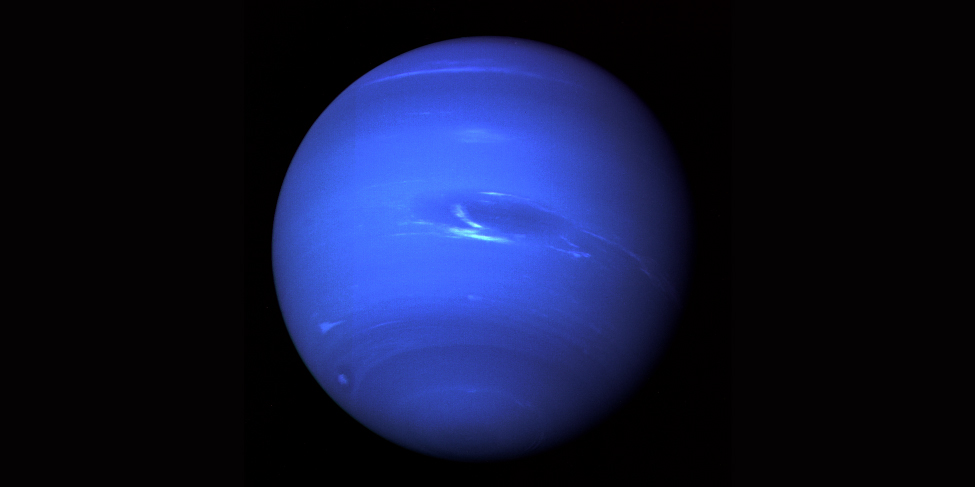
Neptune differs from Uranus in its appearance, although their basic atmospheric temperatures are similar. The upper clouds are composed of methane, which forms a thin cloud layer near the top of the troposphere at a temperature of 70 K and a pressure of 1.5 bars. Most the atmosphere above this level is clear and transparent, with less haze than is found on Uranus. The scattering of sunlight by gas molecules lends Neptune a pale blue color similar to that of Earth’s atmosphere (Figure 11.15). Another cloud layer, perhaps composed of hydrogen sulfide ice particles, exists below the methane clouds at a pressure of 3 bars.
英語のヒント
海王星の基本的な大気温度は天王星と似ているが、見た目は異なる。上層の雲はメタンからなり、温度70 K、圧力1.5バールの対流圏上端付近で、薄い雲の層を作る。その高さより上の大気の大部分は澄んで透明であり、天王星ほどもやが多くない。ガス分子が太陽光を散乱するため、海王星は地球の大気と似た淡い青色になる(図11.15)。メタン雲の下、圧力3バールのところには、硫化水素の氷粒子からできている可能性のある別の雲の層が存在する。
Neptune.海王星。
credit: modification of work by NASA · NASA media use guidelines
Figure 11.15 The planet Neptune is seen here as photographed by Voyager in 1989. The blue color, exaggerated with computer processing, is caused by the scattering of sunlight in the planet’s upper atmosphere. (credit: modification of work by NASA)
図11.15 1989年にボイジャーが撮影した海王星。コンピューター処理で強調された青色は、惑星の上層大気で太陽光が散乱することによって生じる。(クレジット:NASAの作品を改変)
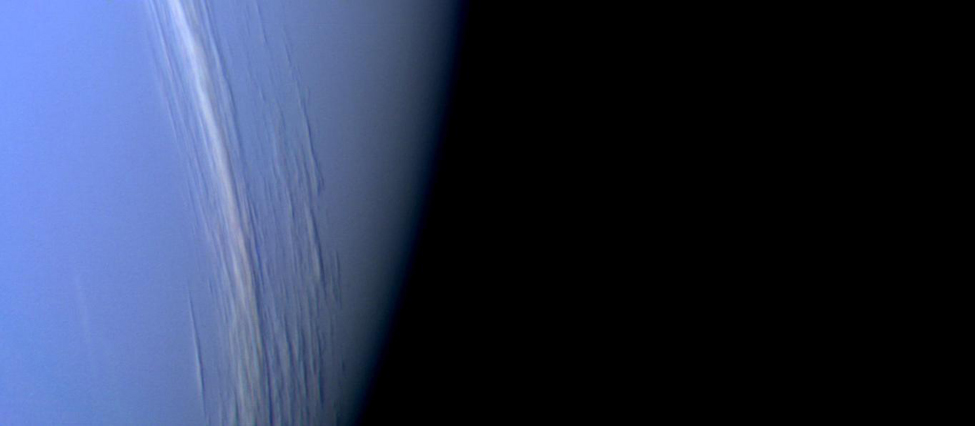
Unlike Uranus, Neptune has an atmosphere in which convection currents—vertical drafts of gas—emanate from the interior, powered by the planet’s internal heat source. These currents carry warm gas above the 1.5-bar cloud level, forming additional clouds at elevations about 75 kilometers higher. These high-altitude clouds form bright white patterns against the blue planet beneath. Voyager photographed distinct shadows on the methane cloud tops, permitting the altitudes of the high clouds to be calculated. Figure 11.16 is a remarkable close-up of Neptune’s outer layers that could never have been obtained from Earth.
英語のヒント
天王星と違い、海王星の大気には、惑星の内部熱源を動力として、内部から湧き上がる対流、すなわちガスの上下方向の流れがある。これらの流れは温かいガスを圧力1.5バールの雲の高さより上へ運び、さらに約75キロメートル高いところに別の雲を作る。高層の雲は、その下の青い惑星を背景に、明るい白い模様を描く。ボイジャーはメタン雲の上端にはっきりした影を撮影し、それによって高い雲の高度を計算できた。図11.16は海王星の外層を近くから捉えた見事な画像で、地球からでは決して得られなかったものである。
High Clouds in the Atmosphere of Neptune.海王星の大気の高層雲。
credit: modification of work by NASA/JPL · JPL image use policy
Figure 11.16 These bright, narrow cirrus clouds are made of methane ice crystals. From the shadows they cast on the thicker cloud layer below, we can measure that they are about 75 kilometers higher than the main clouds. (credit: modification of work by NASA/JPL)
図11.16 明るく細いこれらの巻雲は、メタンの氷結晶からできている。その下の厚い雲の層に落とす影から、主な雲の層より約75キロメートル高いところにあると測定できる。(クレジット:NASA/JPLの作品を改変)