第11章巨大惑星The Giant Planets
Enter the Orbiters: Galileo, Cassini, and Juno周回探査機の登場――ガリレオ、カッシーニ、ジュノー
The Pioneer and Voyager missions were flybys of the giant planets: they each produced only quick looks before the spacecraft sped onward. For more detailed studies of these worlds, we require spacecraft that can go into orbit around a planet. For Jupiter and Saturn, these orbiters were the Galileo, Cassini, and Juno spacecraft. To date, no orbiter missions have been started for Uranus and Neptune, although planetary scientists have expressed keen interest.
英語のヒント
パイオニアとボイジャーによる巨大惑星探査は、フライバイだった。どの探査機も、その先へ飛び去るまでの短い間だけ観測したのである。これらの世界をさらに詳しく調べるには、惑星の周回軌道に入れる探査機が必要になる。木星と土星では、その役割をガリレオ、カッシーニ、ジュノーが担った。惑星科学者たちは強い関心を示しているが、現在までのところ、天王星と海王星に向かう周回探査計画はまだ始まっていない。
The Galileo spacecraft was launched toward Jupiter in 1989 and arrived in 1995. Galileo began its investigations by deploying an entry probe into Jupiter, for the first direct studies of the planet’s outer atmospheric layers.
英語のヒント
ガリレオ探査機は1989年に木星に向けて打ち上げられ、1995年に到着した。ガリレオはまず木星に大気突入プローブを送り込み、この惑星の大気外層を初めて直接調べることから観測を始めた。
The probe plunged at a shallow angle into Jupiter’s atmosphere, traveling at a speed of 50 kilometers per second—that’s fast enough to fly from New York to San Francisco in 100 seconds! This was the highest speed at which any probe has so far entered the atmosphere of a planet, and it put great demands on the heat shield protecting it. The high entry speed was a result of acceleration by the strong gravitational attraction of Jupiter.
英語のヒント
プローブは浅い角度で木星の大気に突入し、毎秒50キロメートルの速さで進んだ。これはニューヨークからサンフランシスコまで100秒で飛べるほどの速さである。これは、それまでに探査プローブが惑星の大気へ突入した際の最高速度であり、プローブを保護する熱シールドには極めて厳しい要求が課された。突入速度が高かったのは、木星の強い重力によって加速されたためである。
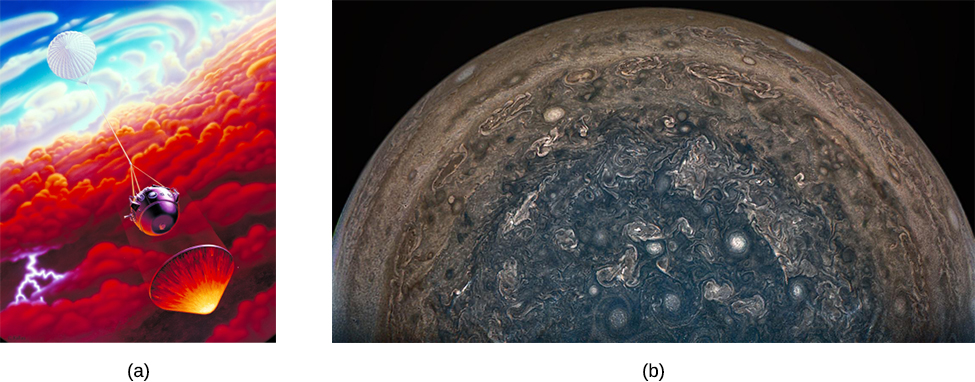
Atmospheric friction slowed the probe within 2 minutes, producing temperatures at the front of its heat shield as high as 15,000 °C. As the probe’s speed dropped to 2500 kilometers per hour, the remains of the glowing heat shield were jettisoned, and a parachute was deployed to lower the instrumented probe spacecraft more gently into the atmosphere (Figure 11.3). The data from the probe instruments were relayed to Earth via the main Galileo spacecraft.
英語のヒント
大気との摩擦によって、プローブは2分以内に減速し、その熱シールドの前面では温度が1万5000℃に達した。プローブの速度が時速2500キロメートルまで下がると、赤熱した熱シールドの残りが切り離され、パラシュートが開いた。これにより、観測機器を積んだプローブは大気の中をよりゆっくり降下した(図11.3)。プローブの観測機器からのデータは、ガリレオ本体を経由して地球に中継された。
Galileo Probe Falling into Jupiter and Juno Image of Jupiter's South Pole.木星へ降下するガリレオ・プローブと、ジュノーが捉えた木星の南極。
credit a: modification of work by NASA/Ames Research Center; credit b: modification of work by NASA/JPL-Caltech/SwRI/MSSS/John Landino · JPL image use policy
Figure 11.3 (a) This artist’s depiction shows the Galileo probe descending into the clouds via parachute just after the protective heat shield separated. The probe made its measurements of Jupiter’s atmosphere on December 7, 1995. (b) This Juno image, taken in 2017 from about 100,000 kilometers above the cloudtops, shows the south polar region of Jupiter with its dramatic complex of storms and clouds. The enhanced-color image was processed for NASA/JPL by citizen scientist John Landino. (credit a: modification of work by NASA/Ames Research Center; credit b: modification of work by NASA/JPL-Caltech/SwRI/MSSS/John Landino)
図11.3 (a)熱シールドを切り離した直後、パラシュートで雲の中を降下するガリレオ・プローブの想像図。プローブが木星の大気を測定したのは1995年12月7日である。(b)2017年、雲頂の約10万キロメートル上空からジュノーが撮影した画像。木星の南極域に、嵐と雲が複雑に入り組む印象的な様子が見える。色を強調したこの画像は、市民科学者ジョン・ランディーノがNASA/JPLのために処理した。(クレジットa:NASA/Ames Research Centerの作品を改変。b:NASA/JPL-Caltech/SwRI/MSSS/John Landinoの作品を改変)
The probe continued to operate for an hour, descending 200 kilometers into the atmosphere. A few minutes later the polyester parachute melted, and within a few hours the main aluminum and titanium structure of the probe vaporized to become a part of Jupiter itself. About 2 hours after receipt of the final probe data, the main spacecraft fired its retro-rockets so it could be captured into orbit around the planet, where its primary objectives were to study Jupiter’s large and often puzzling moons.
英語のヒント
プローブは1時間動作を続け、大気中を200キロメートル降下した。その数分後にはポリエステル製のパラシュートが溶け、数時間以内にアルミニウムとチタンを主材料とするプローブの構造も蒸発して、木星そのものの一部になった。プローブから最後のデータを受け取って約2時間後、探査機本体は逆噴射ロケットを作動させ、木星を回る軌道に入った。その軌道での主な目的は、木星の大きく、しばしば謎めいた衛星たちを調べることだった。
The Cassini mission to Saturn (Figure 11.4), a cooperative venture between NASA and the European Space Agency, was similar to Galileo in its two-fold approach. Launched in 1997, Cassini arrived in 2004 and went into orbit around Saturn, beginning extensive studies of its rings and moons, as well as the planet itself. In January 2005, Cassini deployed an entry probe into the atmosphere of Saturn’s large moon, Titan, where it successfully landed on the surface. (We’ll discuss the probe and what it found in the chapter on Rings, Moons, and Pluto.)
英語のヒント
NASAとヨーロッパ宇宙機関が協力して進めた土星探査計画カッシーニ(図11.4)は、二本立ての観測方式という点でガリレオと似ていた。1997年に打ち上げられたカッシーニは、2004年に到着して土星の周回軌道に入り、土星本体に加えて、その環や衛星を広く調べ始めた。2005年1月、カッシーニは土星の大きな衛星タイタンの大気に突入プローブを送り込み、プローブは無事に地表へ着陸した。(このプローブとその発見については、「環・衛星・冥王星」の章で扱う。)
The Voyager and Galileo missions to Jupiter were primarily designed to study the moons and the atmosphere of the planet. The next NASA mission, an orbiter called Juno, arrived at Jupiter in July 2016. In order to meet its objectives of studying the jovian magnetosphere, it has a very elongated (eccentric) 55-day orbit, that takes it from 4 thousand kilometers above the cloud tops out to 76 thousand kilometers. The orbit takes the craft over Jupiter’s poles, giving us remarkable close-ups of the polar regions (previous spacecraft viewed the planet from lower latitudes).
英語のヒント
ボイジャーとガリレオの木星探査は、主として衛星と木星大気を調べるために計画された。NASAの次の探査機である周回機ジュノーは、2016年7月に木星へ到着した。木星磁気圏を調べるという目的を果たすため、ジュノーは55日周期の非常に細長い、離心率の大きな軌道をとる。この軌道により、雲頂から4000キロメートルの高度から、7万6000キロメートルの高度までを行き来する。その軌道は木星の両極の上空を通るため、極域の見事な近接画像を得られる(以前の探査機は、もっと低緯度から木星を観測した)。
Juno was originally designed without a camera, but fortunately scientists rectified this omission, adding a simple downward-looking color camera to use during close passes by Jupiter. Recognizing the value of such images, both scientific and artistic, it was decided to post the raw images and encourage “citizen scientists” to process them. The product has been many dramatic, brightly colored views of Jupiter, such as Figure 11.3.
英語のヒント
ジュノーは当初、カメラを搭載しない設計だった。しかし幸いにも、科学者たちはこの見落としを修正し、木星に接近した際に使う、下向きに撮影する簡単なカラーカメラを追加した。こうした画像の科学的・芸術的な価値が認められ、未処理の画像を公開して、「市民科学者」に画像処理を促すことになった。その成果として、図11.3のような、鮮やかな色彩で木星を印象的に捉えた画像が数多く生まれた。
Earth as Seen from Saturn.土星から見た地球。
credit: modification of work by NASA/JPL-Caltech/Space Science Institute · JPL image use policy
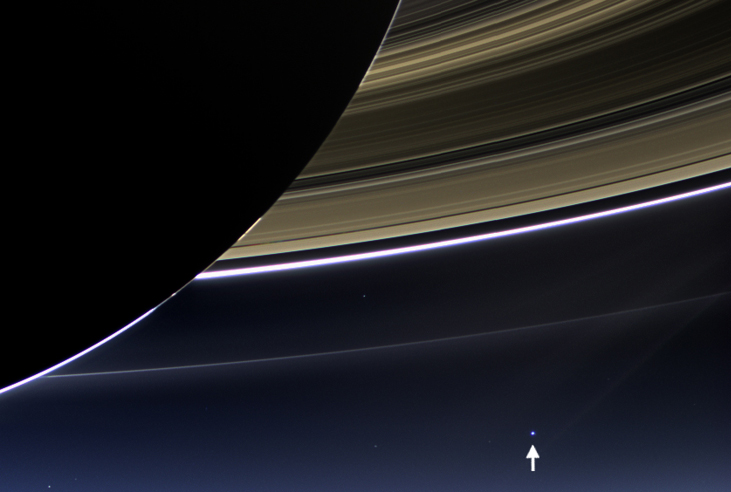
Figure 11.4 This popular Cassini image shows Earth as a tiny dot (marked with an arrow) seen below Saturn’s rings. It was taken in July 2013, when Saturn was 1.4 billion kilometers from Earth. (credit: modification of work by NASA/JPL-Caltech/Space Science Institute)
図11.4 よく知られたこのカッシーニの画像では、土星の環の下に、地球が小さな点として写っている(矢印で表示)。撮影は2013年7月で、土星は地球から14億キロメートル離れていた。(クレジット:NASA/JPL-Caltech/Space Science Instituteの作品を改変)
Key Concepts and Summary重要事項のまとめ
The outer solar system contains the four giant planets: Jupiter, Saturn, Uranus, and Neptune. The gas giants Jupiter and Saturn have overall compositions similar to that of the Sun. These planets have been explored by the Pioneer, Voyager, Galileo, and Cassini spacecraft. Voyager 2, perhaps the most successful of all space-science missions, explored Jupiter (1979), Saturn (1981), Uranus (1986), and Neptune (1989)—a grand tour of the giant planets—and these flybys have been the only explorations to date of the ice giants Uranus and Neptune. The Galileo and Cassini missions were long-lived orbiters, and each also deployed an entry probe, one into Jupiter and one into Saturn’s moon Titan.
太陽系の外側には、木星、土星、天王星、海王星という4つの巨大惑星がある。巨大ガス惑星の木星と土星は、全体として太陽に似た組成を持つ。これらの惑星は、パイオニア、ボイジャー、ガリレオ、カッシーニによって探査されてきた。おそらく宇宙科学の全探査計画の中でも特に成功したボイジャー2号は、木星(1979年)、土星(1981年)、天王星(1986年)、海王星(1989年)を探査し、巨大惑星のグランドツアーを行った。このフライバイは、巨大氷惑星の天王星と海王星に対して現在までに行われた唯一の直接探査である。ガリレオとカッシーニは長期間活動した周回機であり、それぞれ大気突入プローブも送り込んだ。一方は木星へ、もう一方は土星の衛星タイタンへ向かった。