第29章ビッグバンThe Big Bang
Ages of Distant Galaxies遠方銀河の年齢
In the chapter on Galaxies, we discussed how we can use Hubble’s law to measure the distance to a galaxy. But that simple method only works with galaxies that are not too far away. Once we get to large distances, we are looking so far into the past that we must take into account changes in the rate of the expansion of the universe. Since we cannot measure these changes directly, we must assume one of the models of the universe to be able to convert large redshifts into distances.
英語のヒント
「銀河」では、ハッブルの法則で銀河までの距離を測る方法を論じた。しかし、その単純な方法が使えるのは、遠すぎない銀河だけである。距離が大きくなると、あまりにも昔を見ているため、宇宙の膨張の速さの変化を考慮しなければならない。そうした変化は直接には測れないので、大きな赤方偏移を距離に換算するには、いずれかの宇宙モデルを仮定する必要がある。
This is why astronomers squirm when reporters and students ask them exactly how far away some newly discovered distant quasar or galaxy is. We really can’t give an answer without first explaining the model of the universe we are assuming in calculating it (by which time a reporter or student is long gone or asleep). Specifically, we must use a model that includes the change in the expansion rate with time. The key ingredients of the model are the amounts of matter, including dark matter, and the equivalent mass (according to E = mc2) of the dark energy along with the Hubble constant.
英語のヒント
新しく見つかった遠方のクエーサーや銀河が、正確にはどれだけ遠いのかと記者や学生に聞かれると、天文学者が身をよじるのはこのためである。計算でどの宇宙モデルを仮定しているかをまず説明しないと、本当には答えられない。その説明が済むころには、記者や学生はとっくに帰ったか、眠ってしまっている。具体的には、膨張の速さが時間とともに変わることを含むモデルが必要だ。その主要な材料は、暗黒物質も含む物質の量、E = mc2 に従って暗黒エネルギーを換算した相当質量、そしてハッブル定数である。
Elsewhere in this book, we have estimated the mass density of ordinary matter plus dark matter as roughly 0.3 times the critical density, and the mass equivalent of dark energy as roughly 0.7 times the critical density. We will refer to these values as the “standard model of the universe.” The latest (slightly improved) estimates for these values and the evidence for them will be given later in this chapter. Calculations also require the current value of the Hubble constant. For Table 29.1, we have adopted a Hubble constant of 67.3 kilometers/second/million parsecs (rather than rounding it to 70 kilometers/second/million parsecs), which is consistent with the 13.8 billion-year age of the universe estimated by the latest observations.
英語のヒント
本書の別の箇所では、通常の物質と暗黒物質を合わせた質量密度を臨界密度の約0.3倍、暗黒エネルギーの質量換算分を約0.7倍と見積もった。これらの値を使うものを「宇宙の標準モデル」と呼ぶことにする。少し改善された最新の推定値と、その証拠はこの章の後半で示す。計算には現在のハッブル定数も必要である。表29.1では、70km/s/100万パーセクに丸めず、67.3km/s/100万パーセクを採用した。これは、最新の観測から推定された138億年という宇宙年齢と整合する値である。
Once we assume a model, we can use it to calculate the age of the universe at the time an object emitted the light we see. As an example, Table 29.1 lists the times that light was emitted by objects at different redshifts as fractions of the current age of the universe. The times are given for two very different models so you can get a feeling for the fact that the calculated ages are fairly similar. The first model assumes that the universe has a critical density of matter and no dark energy. The second model is the standard model described in the preceding paragraph. The first column in the table is the redshift, which is given by the equation z = Δλ/λ0 and is a measure of how much the wavelength of light has been stretched by the expansion of the universe on its long journey to us.
英語のヒント
モデルを一つ仮定すれば、今見ている光が天体から放たれたとき、宇宙が何歳だったかを計算できる。例として表29.1には、異なる赤方偏移を持つ天体が光を放った時点を、現在の宇宙年齢に対する割合で示した。かなり違う二つのモデルについて時点を載せてあり、計算された年齢がどれほど似ているかを感じ取れる。最初のモデルは、物質の密度が臨界密度に等しく、暗黒エネルギーはないと仮定する。二つ目は、前の段落で述べた標準モデルである。表の第1列は赤方偏移で、z = Δλ/λ0 という式で与えられる。光が私たちへ届く長い旅の間に、宇宙の膨張で波長がどれほど伸びたかを示す尺度である。
Ages of the Universe at Different Redshifts 異なる赤方偏移における宇宙の年齢 |
||
|---|---|---|
Redshift 赤方偏移 |
Percent of Current Age of Universe When the Light Was Emitted (mass = critical density) 光が放たれたときの宇宙年齢(現在の年齢に対する%、物質の密度=臨界密度) |
Percent of Current Age of Universe When the Light Was Emitted (mass = 0.3 critical density; dark energy = 0.7 critical density) 光が放たれたときの宇宙年齢(現在の年齢に対する%、物質の密度=臨界密度の0.3倍、暗黒エネルギー=臨界密度の0.7倍) |
| 0 | 100 (now) 100(現在) |
100 (now) 100(現在) |
| 0.5 | 54 | 63 |
| 1.0 | 35 | 43 |
| 2.0 | 19 | 24 |
| 3.0 | 13 | 16 |
| 4.0 | 9 | 11 |
| 5.0 | 7 | 9 |
| 8.0 | 4 | 5 |
| 11.9 | 2.1 | 2.7 |
Infinite 無限大 |
0 | 0 |
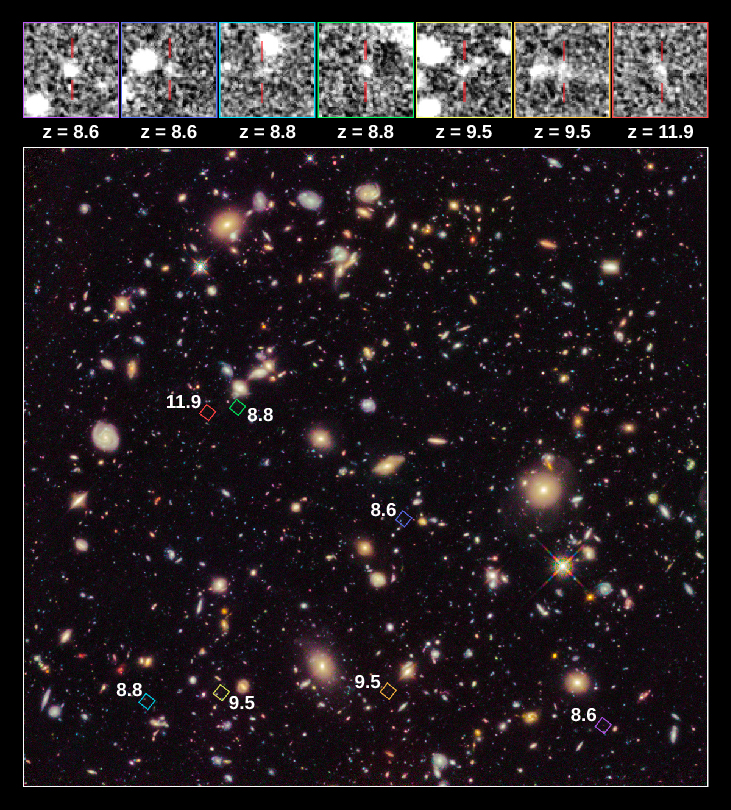
Notice that as we find objects with higher and higher redshifts, we are looking back to smaller and smaller fractions of the age of the universe. The highest observed redshifts that can be measured with the Hubble Space Telescope are close to 12 (Figure 29.10). As Table 29.1 shows, we are seeing these galaxies as they were when the universe was only about 3% as old as it is now. Remarkably, they were already formed at a time that was only about 380 million years after the Big Bang. With the James Webb telescope, astronomers are now pushing that redshift limit even higher and further back in time.
英語のヒント
より大きな赤方偏移の天体を見つけるほど、現在の宇宙年齢に対してますます小さな割合しか経過していない時代を見ていることに注目しよう。ハッブル宇宙望遠鏡で測れる最大級の赤方偏移は12に近い(図29.10)。表29.1によれば、その銀河は宇宙が今の約3%の年齢だったころの姿である。驚くべきことに、ビッグバンから約3.8億年しかたっていない時代に、すでに形成されていた。ジェイムズ・ウェッブ望遠鏡によって、天文学者はいま、その赤方偏移の限界をさらに押し上げ、もっと古い時代へと迫っている。
Hubble Ultra-Deep Field.ハッブル・ウルトラ・ディープ・フィールド。
credit: modification of work by NASA, ESA, R. Ellis (Caltech), and the UDF 2012 Team · NASA media use guidelines
Figure 29.10 This image, called the Hubble Ultra Deep Field, shows faint galaxies, seen very far away and therefore very far back in time. The colored squares in the main image outline the locations of the galaxies. Enlarged views of each galaxy are shown in the black-and-white images. The red lines mark each galaxy’s location. The “redshift” of each galaxy is indicated below each box, denoted by the symbol “z.” The redshift measures how much a galaxy’s ultraviolet and visible light has been stretched to infrared wavelengths by the universe’s expansion. The larger the redshift, the more distant the galaxy, and therefore the further astronomers are seeing back in time. One of the seven galaxies may be a distance breaker, observed at a redshift of 11.9. If this redshift is confirmed by additional measurements, the galaxy is seen as it appeared only 380 million years after the Big Bang, when the universe was less than 3% of its present age. (credit: modification of work by NASA, ESA, R. Ellis (Caltech), and the UDF 2012 Team)
英語のヒント
図29.10 ハッブル・ウルトラ・ディープ・フィールドと呼ばれるこの画像には、非常に遠く、したがって非常に古い時代の暗い銀河が写っている。主画像の色付きの四角は銀河の位置を示し、白黒画像はそれぞれを拡大したものだ。赤い線が各銀河の位置を示す。各枠の下には、記号zで「赤方偏移」が記されている。これは、銀河の紫外線や可視光が、宇宙の膨張によって赤外線の波長にまで、どれほど引き伸ばされたかを表す。赤方偏移が大きいほど銀河は遠く、天文学者は古い時代を見ている。七つの銀河のうち一つは、距離の記録を更新する可能性がある。観測された赤方偏移は11.9だ。追加測定でこれが確認されれば、ビッグバンからわずか3億8000万年後、宇宙が現在の3%にも満たない年齢だったころの姿を見ていることになる。(クレジット:NASA、ESA、R. Ellis〈Caltech〉、UDF 2012 Teamの作品を改変)
Key Concepts and Summary重要事項のまとめ
For describing the large-scale properties of the universe, a model that is isotropic and homogeneous (same everywhere) is a pretty good approximation of reality. The universe is expanding, which means that the universe undergoes a change in scale with time; space stretches and distances grow larger by the same factor everywhere at a given time. Observations show that the mass density of the universe is less than the critical density. In other words, there is not enough matter in the universe to stop the expansion. With the discovery of dark energy, which is accelerating the rate of expansion, the observational evidence is strong that the universe will expand forever. Observations tell us that the expansion started about 13.8 billion years ago.
宇宙の大きなスケールでの性質を述べるには、等方的かつ一様、すなわちどこでも同じとするモデルが、現実のかなりよい近似となる。宇宙の膨張とは、尺度が時間とともに変わることだ。空間が伸び、ある一つの時刻には、どこでも同じ倍率で距離が増す。観測による宇宙の物質密度は、臨界密度を下回る。つまり、膨張を止めるだけの物質が宇宙にはない。膨張を加速させる暗黒エネルギーの発見によって、宇宙が永遠に膨張するという観測上の証拠はいっそう強くなった。観測は、膨張が約138億年前に始まったことを示している。
closed universe
閉じた宇宙
a model in which the universe expands from a Big Bang, stops, and then contracts to a big crunch
宇宙がビッグバンから膨張し、いったん停止した後、収縮してビッグクランチに至るモデル。
critical density
臨界密度
in cosmology, the density 3H²/(8πG); a universe whose total mass-energy density equals this value has spatially flat geometry
宇宙論における密度3H²/(8πG)。総質量・エネルギー密度がこの値に等しい宇宙は、平坦な空間幾何を持つ。
open universe
開いた宇宙
a model in which the density of the universe is not high enough to bring the expansion of the universe to a halt
宇宙の密度が、膨張を止めるほど高くないモデル。