第29章ビッグバンThe Big Bang
29.3 The Beginning of the Universe29.3 宇宙の始まり
Learning Objectives学習の目標
By the end of this section, you will be able to:
この節を終えると、次のことができるようになる。
Describe what the universe was like during the first few minutes after it began to expand
膨張開始後の最初の数分間に、宇宙がどのような状態だったか説明する。
Explain how the first new elements were formed during the first few minutes after the Big Bang
ビッグバン後の最初の数分間に、最初の新しい元素がどう作られたか説明する。
Describe how the contents of the universe change as the temperature of the universe decreases
宇宙の温度が下がると、その中身がどう変わるか説明する。
The best evidence we have today indicates that the first galaxies did not begin to form until a few hundred million years after the Big Bang. What were things like before there were galaxies and space had not yet stretched very significantly? Amazingly, scientists have been able to calculate in some detail what was happening in the universe in the first few minutes after the Big Bang.
英語のヒント
現在の最良の証拠によれば、最初の銀河が形成され始めたのは、ビッグバンから数億年後だった。銀河がまだなく、空間もそれほど大きく伸びていなかったころは、どのような状態だったのだろうか。驚くべきことに、科学者はビッグバン後の最初の数分間に宇宙で何が起こっていたかを、かなり詳しく計算できている。
The History of the Idea考え方の歴史
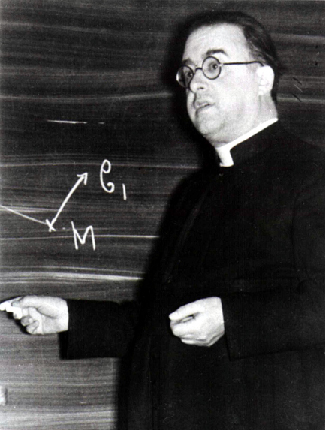
It is one thing to say the universe had a beginning (as the equations of general relativity imply) and quite another to describe that beginning. The Belgian priest and cosmologist Georges Lemaître was probably the first to propose a specific model for the Big Bang itself (Figure 29.11). He envisioned all the matter of the universe starting in one great bulk he called the primeval atom, which then broke into tremendous numbers of pieces. Each of these pieces continued to fragment further until they became the present atoms of the universe, created in a vast nuclear fission. In a popular account of his theory, Lemaître wrote, [Quotation omitted for rights reasons.]
英語のヒント
宇宙に始まりがあったと言うことと、その始まりを描写することは、別の問題である。一般相対論の方程式は前者を示唆する。ベルギーの司祭で宇宙論研究者のジョルジュ・ルメートルは、おそらくビッグバンそのものの具体的なモデルを初めて提案した人だった(図29.11)。彼は、宇宙のすべての物質が、「原始原子」と呼ぶ一つの巨大な塊から始まり、それが膨大な数の破片に分かれたと考えた。それぞれの破片はさらに分裂を続け、巨大な核分裂によって、現在の宇宙にある原子になったというのである。自身の理論を一般向けに説明した文章で、ルメートルはこう書いた。〔権利の関係で割愛〕
Abbé Georges Lemaître (1894–1966).ジョルジュ・ルメートル神父(1894〜1966年)。
OpenStax / Rice University · CC BY 4.0
Figure 29.11 This Belgian cosmologist studied theology at Mechelen and mathematics and physics at the University of Leuven. It was there that he began to explore the expansion of the universe and postulated its explosive beginning. He actually predicted Hubble’s law 2 years before its verification, and he was the first to consider seriously the physical processes by which the universe began.
英語のヒント
図29.11 このベルギーの宇宙論研究者は、メヘレンで神学を、ルーヴェン大学で数学と物理学を学んだ。彼が宇宙の膨張を探り始め、爆発的な始まりを提唱したのは、そこでのことである。実際、彼はハッブルの法則が観測で確認される2年前にそれを予測し、宇宙が始まる物理過程を初めて真剣に考察した人物だった。
Physicists today know much more about nuclear physics than was known in the 1920s, and they have shown that the primeval fission model cannot be correct. Yet Lemaître’s vision was in some respects quite prophetic. We still believe that everything was together at the beginning; it was just not in the form of matter we now know. Basic physical principles tell us that when the universe was much denser, it was also much hotter, and that it cools as it expands, much as gas cools when sprayed from an aerosol can.
英語のヒント
今日の物理学者は、1920年代の人々より核物理学をはるかによく理解しており、原初の核分裂モデルが正しくありえないことを示している。それでもルメートルの見通しは、ある点では非常に先見的だった。始まりにはすべてが一緒だったという考えは今も変わらない。ただし、それは現在知られている物質の形ではなかった。基本的な物理原理によれば、宇宙がもっと高密度だったころは、温度ももっと高かった。また、宇宙は膨張すると冷える。スプレー缶から噴き出したガスが冷えるのと、よく似ている。
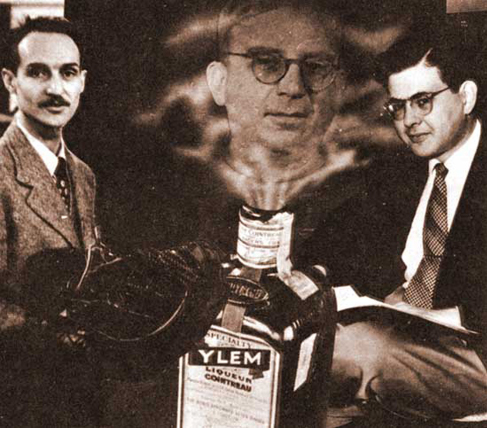
By the 1940s, scientists knew that fusion of hydrogen into helium was the source of the Sun’s energy. Fusion requires high temperatures, and the early universe must have been hot. Based on these ideas, American physicist George Gamow (Figure 29.12) suggested a universe with a different kind of beginning that involved nuclear fusion instead of fission. Ralph Alpher worked out the details for his PhD thesis, and the results were published in 1948. (Gamow, who had a quirky sense of humor, decided at the last minute to add the name of physicist Hans Bethe to their paper, so that the coauthors on this paper about the beginning of things would be Alpher, Bethe, and Gamow, a pun on the first three letters of the Greek alphabet: alpha, beta, and gamma.) Gamow’s universe started with fundamental particles that built up the heavy elements by fusion in the Big Bang.
英語のヒント
1940年代までには、水素からヘリウムへの核融合が太陽のエネルギー源だとわかっていた。核融合には高温が必要であり、初期宇宙も高温だったはずだ。この考えから、米国の物理学者ジョージ・ガモフ(図29.12)は、核分裂ではなく核融合を伴う、別の始まり方をする宇宙を提案した。ラルフ・アルファーが博士論文で詳細を計算し、結果は1948年に発表された。独特のユーモアの持ち主だったガモフは、発表直前に物理学者ハンス・ベーテの名前も共著者へ加えることにした。ものごとの始まりを扱う論文の著者が、アルファー、ベーテ、ガモフとなり、ギリシャ文字の初めの三文字、アルファ、ベータ、ガンマに掛けたしゃれになるからだ。ガモフの宇宙は基本的な粒子から始まり、ビッグバンでの核融合によって重い元素が作られるものだった。
George Gamow and Collaborators.ジョージ・ガモフと共同研究者たち。
OpenStax / Rice University · CC BY 4.0
Figure 29.12 This composite image shows George Gamow emerging like a genie from a bottle of ylem, a Greek term for the original substance from which the world formed. Gamow revived the term to describe the material of the hot Big Bang. Flanking him are Robert Herman (left) and Ralph Alpher (right), with whom he collaborated in working out the physics of the Big Bang. (The modern composer Karlheinz Stockhausen was inspired by Gamow’s ideas to write a piece of music called Ylem, in which the players actually move away from the stage as they perform, simulating the expansion of the universe.)
英語のヒント
図29.12 この合成画像では、ジョージ・ガモフがイーレムの瓶から魔人のように現れている。イーレムは、世界を形作った原初の物質を表すギリシャ語に由来する言葉だ。ガモフは、高温のビッグバンにあった材料を表すため、この言葉を復活させた。両側にいるのはロバート・ハーマン(左)とラルフ・アルファー(右)で、ビッグバンの物理を解き明かす共同研究を行った。現代音楽の作曲家カールハインツ・シュトックハウゼンは、ガモフの考えに触発されて「イーレム」という曲を書いた。その曲では、演奏者が実際に舞台から離れながら演奏し、宇宙の膨張を再現する。
Gamow’s ideas were close to our modern view, except we now know that the early universe remained hot enough for fusion for only a short while. Thus, only the three lightest elements—hydrogen, helium, and a small amount of lithium—were formed in appreciable abundances at the beginning. The heavier elements formed later in stars. Since the 1940s, many astronomers and physicists have worked on a detailed theory of what happened in the early stages of the universe.
英語のヒント
ガモフの考えは現在の見方に近かった。ただし今では、初期宇宙が核融合できるほど高温だった期間は、短かったとわかっている。そのため、初めに無視できない量が作られたのは、最も軽い三元素、すなわち水素、ヘリウム、少量のリチウムだけだった。もっと重い元素は、後に恒星の中でできた。1940年代以降、多くの天文学者と物理学者が、宇宙の初期段階で起きたことを詳しく説明する理論に取り組んできた。
The First Few Minutes最初の数分間
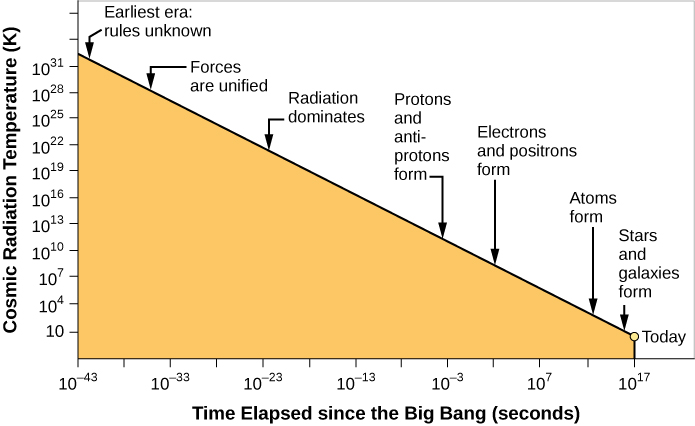
Let’s start with the first few minutes following the Big Bang. Three basic ideas hold the key to tracing the changes that occurred during the time just after the universe began. The first, as we have already mentioned, is that the universe cools as it expands. Figure 29.13 shows how the temperature changes with the passage of time. Note that a huge span of time, from a tiny fraction of a second to billions of years, is summarized in this diagram. In the first fraction of a second, the universe was unimaginably hot. By the time 0.01 second had elapsed, the temperature had dropped to 100 billion (1011) K. After about 3 minutes, it had fallen to about 1 billion (109) K, still some 70 times hotter than the interior of the Sun. After a few hundred thousand years, the temperature was down to a mere 3000 K, and the universe has continued to cool since that time.
英語のヒント
ビッグバン後の最初の数分間から始めよう。宇宙が始まった直後の変化をたどる鍵は、三つの基本的な考え方にある。第一は、すでに述べたように、宇宙が膨張すると冷えることである。図29.13は、温度が時間とともにどう変わるかを示す。1秒にも満たないほんの一瞬から数十億年まで、膨大な時間の幅が一枚にまとめられている点に注目しよう。最初の1秒未満の間、宇宙は想像もつかないほど高温だった。0.01秒が過ぎたころには、温度は1000億(1011)Kに下がった。約3分後には約10億(109)Kとなったが、それでも太陽内部のおよそ70倍の温度である。数十万年後にはわずか3000Kに下がり、その後も宇宙は冷え続けている。
Temperature of the Universe.宇宙の温度。
OpenStax / Rice University · CC BY 4.0
Figure 29.13 This graph shows how the temperature of the universe varies with time as predicted by the standard model of the Big Bang. Note that both the temperature (vertical axis) and the time in seconds (horizontal axis) change over vast scales on this compressed diagram.
図29.13 ビッグバンの標準モデルが予測する、宇宙の温度の時間変化。この圧縮された図では、縦軸の温度も、横軸の秒単位の時間も、きわめて広い範囲にわたって変わる。
All of these temperatures but the last are derived from theoretical calculations since (obviously) no one was there to measure them directly. As we shall see in the next section, however, we have actually detected the feeble glow of radiation emitted at a time when the universe was a few hundred thousand years old. We can measure the characteristics of that radiation to learn what things were like long ago. Indeed, the fact that we have found this ancient glow is one of the strongest arguments in favor of the Big Bang model.
英語のヒント
これらの温度は、最後のものを除き、すべて理論計算から導かれた。当然、直接測る人はその場にいなかったからだ。しかし、次の節で見るように、宇宙が数十万歳だった時代に放たれた、かすかな放射の光は実際に検出されている。その放射の性質を測れば、はるか昔の様子を知ることができる。この古い光を発見したという事実は、ビッグバンモデルを支持する最も強い根拠の一つなのである。
The second step in understanding the evolution of the universe is to realize that at very early times, it was so hot that it contained mostly radiation (and not the matter that we see today). The photons that filled the universe could collide and produce material particles; that is, under the conditions just after the Big Bang, energy could turn into matter (and matter could turn into energy). We can calculate how much mass is produced from a given amount of energy by using Einstein’s formula (see the chapter on The Sun: A Nuclear Powerhouse).
英語のヒント
宇宙の進化を理解する第二の段階は、非常に早い時期には、宇宙があまりに高温で、主に放射からなっていたと理解することだ。今日見えるような物質が主ではなかった。宇宙を満たす光子は、衝突して物質の粒子を作ることができた。つまりビッグバン直後の条件では、エネルギーが物質に、物質がエネルギーに変わりえた。ある量のエネルギーから生じる質量は、アインシュタインの式 を使って計算できる。「太陽――核エネルギーの源」の章を参照しよう。
The idea that energy could turn into matter in the universe at large is a new one for many students, since it is not part of our everyday experience. That’s because, when we compare the universe today to what it was like right after the Big Bang, we live in cold, hard times. The photons in the universe today typically have far-less energy than the amount required to make new matter. In the discussion on the source of the Sun’s energy in The Sun: A Nuclear Powerhouse, we briefly mentioned that when subatomic particles of matter and antimatter collide, they turn into pure energy. But the reverse, energy turning into matter and antimatter, is equally possible. This process has been observed in particle accelerators around the world. If we have enough energy, under the right circumstances, new particles of matter (and antimatter) are indeed created —and the conditions were right during the first few minutes after the expansion of the universe began.
英語のヒント
宇宙全体でエネルギーが物質に変わりうるという考えは、多くの学生にとって新鮮だろう。日常にはない経験だからである。ビッグバン直後の宇宙と比べると、私たちは冷たく厳しい時代に暮らしているのだ。現在の宇宙の光子は、普通、新しい物質を作るのに必要な量より、ずっと少ないエネルギーしか持たない。「太陽――核エネルギーの源」で太陽のエネルギー源を論じたとき、物質と反物質の粒子が衝突すると純粋なエネルギーに変わることに少し触れた。しかし、その逆に、エネルギーが物質と反物質へ変わることも同じく可能である。この過程は、世界各地の粒子加速器で観測されている。十分なエネルギーがあり、条件が適切なら、新しい物質と反物質の粒子は実際に生まれる。宇宙の膨張が始まってから最初の数分間は、まさに適切な条件にあった。
Our third key point is that the hotter the universe was, the more energetic were the photons available to make matter and antimatter (see Figure 29.13). To take a specific example, at a temperature of 6 billion (6 × 10⁹) K, the collision of two typical photons can create an electron and its antimatter counterpart, a positron. If the temperature exceeds 1014 K, much more massive protons and antiprotons can be created.
英語のヒント
第三の重要な点は、宇宙が高温であるほど、物質や反物質を作れる光子のエネルギーも高かったことである(図29.13)。具体例を挙げると、60億(6 × 10⁹)Kでは、典型的な光子2個の衝突によって、電子と、その反物質の相手である陽電子を作れる。温度が1014Kを超えると、はるかに重い陽子と反陽子を作ることができる。