第29章ビッグバンThe Big Bang
Grand Unified Theories大統一理論
While inflation is an intriguing idea and widely accepted by researchers, we cannot directly observe events so early in the universe. The conditions at the time of inflation were so extreme that we cannot reproduce them in our laboratories or high-energy accelerators, but scientists have some ideas about what the universe might have been like. These ideas are called grand unified theories or GUTs.
英語のヒント
インフレーションは興味深い考えで、研究者に広く受け入れられているが、それほど初期の宇宙の出来事を直接観測することはできない。当時の条件はあまりに極端で、実験室や高エネルギー加速器では再現できない。それでも科学者は、宇宙がどのような状態だったかについて、いくつかの考えを持っている。これらを大統一理論、略してGUTと呼ぶ。
In GUT models, the forces that we are familiar with here on Earth, including gravity and electromagnetism, behaved very differently in the extreme conditions of the early universe than they do today. In physical science, the term force is used to describe anything that can change the motion of a particle or body. One of the remarkable discoveries of modern science is that all known physical processes can be described through the action of just four forces: gravity, electromagnetism, the strong nuclear force, and the weak nuclear force (Table 29.3).
英語のヒント
GUTモデルでは、重力や電磁気力など、地球で馴染みのある力は、初期宇宙の極端な条件では現在と大きく異なる振る舞いをした。物理科学で「力」とは、粒子や物体の運動を変えられるものを指す。現代科学の驚くべき発見の一つは、知られているすべての物理過程を、わずか四つの力の働きで記述できることだ。重力、電磁気力、強い核力、弱い核力である(表29.3)。
The Forces of Nature 自然界の力 |
|||
|---|---|---|---|
Force 力 |
Relative Strength Today 現在の相対的な強さ |
Range of Action 作用する範囲 |
Important Applications 重要な働き |
Gravity 重力 |
1 | Whole universe 宇宙全体 |
Motions of planets, stars, galaxies 惑星・恒星・銀河の運動 |
Electromagnetism 電磁気力 |
1036 | Whole universe 宇宙全体 |
Atoms, molecules, electricity, magnetic fields 原子、分子、電気、磁場 |
Weak nuclear force 弱い核力 |
1033 | 10–17 meters 10–17m |
Radioactive decay 放射性崩壊 |
Strong nuclear force 強い核力 |
1038 | 10–15 meters 10–15m |
The existence of atomic nuclei 原子核の存在 |
Gravity is perhaps the most familiar force, and certainly appears strong if you jump off a tall building. However, the force of gravity between two elementary particles—say two protons—is by far the weakest of the four forces. Electromagnetism—which includes both magnetic and electrical forces, holds atoms together, and produces the electromagnetic radiation that we use to study the universe—is much stronger, as you can see in Table 29.3. The weak nuclear force is only weak in comparison to its strong “cousin,” but it is in fact much stronger than gravity.
英語のヒント
重力はおそらく最も馴染みのある力であり、高い建物から飛び降りれば、確かに強く感じられる。しかし、たとえば陽子2個という素粒子間に働く重力は、四つの力の中で断然弱い。電磁気力は電気力と磁力を含み、原子を結び付け、宇宙の研究に使う電磁波を生む。表29.3にあるように、重力よりはるかに強い。「弱い」核力も、強いほうの「いとこ」と比べて弱いだけで、実際には重力よりずっと強い。
Both the weak and strong nuclear forces differ from the first two forces in that they act only over very small distances—those comparable to the size of an atomic nucleus or less. The weak force is involved in radioactive decay and in reactions that result in the production of neutrinos. The strong force holds protons and neutrons together in an atomic nucleus.
英語のヒント
弱い核力と強い核力は、どちらも、原子核の大きさ程度かそれ以下という極めて短い距離でしか働かない点で、最初の二つの力と異なる。弱い力は放射性崩壊や、ニュートリノを作る反応に関わる。強い力は、原子核の中で陽子と中性子を結び付けている。
Physicists have wondered why there are four forces in the universe—why not 300 or, preferably, just one? An important hint comes from the name electromagnetic force. For a long time, scientists thought that the forces of electricity and magnetism were separate, but James Clerk Maxwell (see the chapter on Radiation and Spectra) was able to unify these forces—to show that they are aspects of the same phenomenon. In the same way, many scientists (including Einstein) have wondered if the four forces we now know could also be unified. Physicists have actually developed GUTs that unify three of the four forces (but not gravity).
英語のヒント
物理学者は、宇宙になぜ四つの力があるのか考えてきた。なぜ300ではないのか。それより、たった一つならなおよいのではないか。重要なヒントは「電磁気力」という名前にある。長い間、科学者は電気の力と磁気の力を別のものだと考えていた。しかしジェイムズ・クラーク・マクスウェルは、それらを統一し、同じ現象の異なる側面だと示した。「放射とスペクトル」の章を参照しよう。同じようにアインシュタインを含む多くの科学者は、現在知られている四つの力も統一できないかと考えてきた。実際、物理学者は、重力を除く三つの力を統一するGUTを作り上げている。
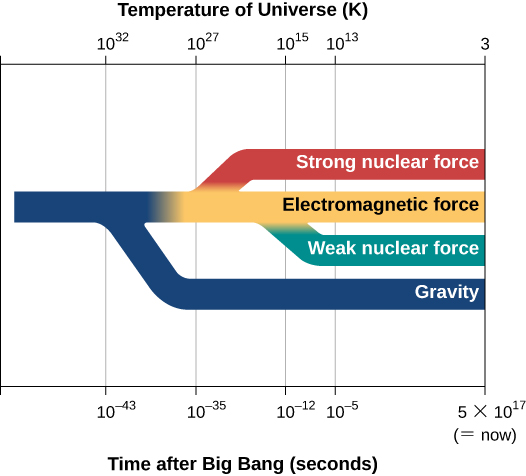
In these theories, the strong, weak, and electromagnetic forces are not three independent forces but instead are different manifestations or aspects of what is, in fact, a single force. The theories predict that at high enough temperatures, there would be only one force. At lower temperatures (like the ones in the universe today), however, this single force has changed into three different forces (Figure 29.27). Just as different gases or liquids freeze at different temperatures, we can say that the different forces “froze out” of the unified force at different temperatures. Unfortunately, the temperatures at which the three forces acted as one force are so high that they cannot be reached in any laboratory on Earth. Only the early universe, at times prior to 10–35 second, was hot enough to unify these forces.
英語のヒント
これらの理論では、強い力、弱い力、電磁気力は独立した三つの力ではなく、実際には一つの力の異なる現れ、異なる側面である。十分に高温なら力は一つしかない、と理論は予測する。しかし、現在の宇宙のように温度が下がると、その一つの力が三つの力に変わっている(図29.27)。異なる気体や液体が異なる温度で凍るのと同じように、各力は異なる温度で、統一された力から「凍り出した」と言える。残念ながら、三つの力が一つとして働く温度は極めて高く、地球のどんな実験室でも達成できない。10–35秒より前の初期宇宙だけが、それらを統一できるほど高温だった。
Four Forces That Govern the Universe.宇宙を支配する四つの力。
OpenStax / Rice University · CC BY 4.0
Figure 29.27 The behavior of the four forces depends on the temperature of the universe. This diagram (inspired by proposed unification theories) shows that at very early times when the temperature of the universe was very high, all four forces resembled one another and were indistinguishable. As the universe cooled, the forces took on separate and distinctive characteristics.
英語のヒント
図29.27 四つの力の振る舞いは、宇宙の温度に依存する。提案されている統一理論に着想を得たこの図は、宇宙が非常に高温だった最初期には、四つの力が互いに似ていて区別できなかったことを示す。宇宙が冷えると、力はそれぞれ別の、固有の性質を持つようになった。
Many physicists think that gravity was also unified with the three other forces at still higher temperatures, and scientists have tried to develop a theory that combines all four forces. For example, in string theory, the point-like particles of matter that we have discussed in this book are replaced by one-dimensional objects called strings. In this theory, infinitesimal strings, which have length but not height or width, are the building blocks used to construct all the forms of matter and energy in the universe. In superstring theories, these strings exist in 10-dimensional spacetime (not the 4-dimensional spacetime with which we are familiar). The strings vibrate in the various dimensions, and depending on how they vibrate, they are seen in our world as matter or gravity or light. As you can imagine, the mathematics of string theory is very complex, and the theory remains untested by experiments. Even the largest particle accelerators on Earth do not achieve high enough energy to show whether string theory applies to the real world.
英語のヒント
もっと高温では重力もほかの三つの力と統一されていた、と多くの物理学者は考えており、四つを結ぶ理論を作ろうとしてきた。たとえば弦理論では、本書で扱ってきた点状の物質粒子を、弦と呼ぶ一次元のものに置き換える。極微の弦には長さはあるが、高さも幅もなく、それが宇宙のあらゆる形の物質とエネルギーを組み立てる部品となる。超弦理論では、これらの弦は、馴染みのある四次元時空ではなく、十次元の時空に存在する。さまざまな次元で振動し、その振動の仕方によって、この世界では物質、重力、光として見える。想像できるように、弦理論の数学は非常に複雑で、まだ実験で検証されていない。地球最大の粒子加速器でも、弦理論が現実に当てはまるかを示せるほどのエネルギーには達しない。
String theory is interesting to scientists because it is currently the only approach that seems to have the potential of combining all four forces to produce what physicists have termed the Theory of Everything.This name became the title of a film about physicist Stephen Hawking in 2014. Theories of the earliest phases of the universe must take both quantum mechanics and gravity into account, but at the simplest level, gravity and quantum mechanics are incompatible. General relativity, our best theory of gravity, says that the motions of objects can be predicted exactly. Quantum mechanics says you can only calculate the probability (chance) that an object will do something. String theory is an attempt to resolve this paradox. The mathematics that underpins string theory is elegant and beautiful, but it remains to be seen whether it will make predictions that can be tested by observations in yet-to-be-developed, high-energy accelerators on Earth or by observations of the early universe.
英語のヒント
科学者が弦理論に興味を持つのは、四つの力をまとめて「万物の理論」を作れる可能性を持つ、現在唯一の取り組みと思われるからである。この名前は、2014年に物理学者スティーヴン・ホーキングを描いた映画の題名にもなった。宇宙の最初期を扱う理論には、量子力学と重力の両方が必要だが、最も単純な水準では、両者は相いれない。最良の重力理論である一般相対性理論は、物体の運動を正確に予測できるとする。量子力学は、ある動作をする確率しか計算できないとする。弦理論は、この矛盾の解消を目指している。その基礎となる数学は優美で美しい。しかし、今後開発される地球の高エネルギー加速器や初期宇宙の観測によって、検証できる予測を出せるかどうかは、まだわからない。
The earliest period in the history of the universe from time zero to 10–43 second is called the Planck time. The universe was unimaginably hot and dense, and theorists believe that at this time, quantum effects of gravity dominated physical interactions—and, as we have just discussed, we have no tested theory of quantum gravity. Inflation is hypothesized to have occurred somewhat later, when the universe was between perhaps 10–35 and 10–33 second old and the temperature was 1027 to 1028 K. This rapid expansion took place when three forces (electromagnetic, strong, and weak) are thought to have been unified, and this is when GUTs are applicable.
英語のヒント
時刻ゼロから10–43秒までの宇宙の最初期を、プランク時間と呼ぶ。宇宙は想像できないほど高温・高密度で、理論家は、このとき重力の量子効果が物理的な相互作用を支配していたと考える。すでに述べたとおり、検証済みの量子重力理論はない。インフレーションはそれより少し後、おそらく宇宙が10–35〜10–33秒齢、温度が1027〜1028Kだったときに起こったと仮定される。この急膨張の時期には、電磁気力、強い力、弱い力の三つが統一されていたと考えられ、GUTが適用される。
After inflation, the universe continued to expand (but more slowly) and to cool. An important milestone was reached when the temperature was down to 1015 K and the universe was 10–10 second old. Under these conditions, all four forces were separate and distinct. High-energy particle accelerators can achieve similar conditions, and so theories of the history of the universe from this point on have a sound basis in experiments.
英語のヒント
インフレーションの後も、宇宙はよりゆっくりと膨張し、冷え続けた。温度が1015Kに下がり、宇宙が10–10秒齢になったとき、重要な節目に達した。この条件では、四つの力はすべて別々で、異なるものだった。高エネルギー粒子加速器は似た条件を作れるので、この時点以降の宇宙史の理論には、実験に裏付けられた確かな基盤がある。
As yet, we have no direct evidence of what the conditions were during the inflationary epoch, and the ideas presented here are speculative. Researchers are trying to devise some experimental tests. For example, the quantum fluctuations in the very early universe would have caused variations in density and produced gravitational waves that may have left a detectable imprint on the CMB. Detection of such an imprint will require observations with equipment whose sensitivity is improved from what we have today. Ultimately, however, it may provide confirmation that we live in a universe that once experienced an epoch of rapid inflation.
英語のヒント
インフレーション期の条件について、今のところ直接の証拠はなく、ここに示した考えは仮説的なものである。研究者は実験による検証法を考えようとしている。たとえば、極初期の量子ゆらぎは密度の違いと重力波を生み、その重力波がCMBに検出可能な痕跡を残したかもしれない。その痕跡を捉えるには、現在より感度を高めた装置で観測する必要がある。それでも、いつかは、かつて急激なインフレーションを経験した宇宙に私たちが住んでいるという、確認が得られるかもしれない。
If you are typical of the students who read this book, you may have found this brief discussion of dark matter, inflation, and cosmology a bit frustrating. We have offered glimpses of theories and observations, but have raised more questions than we have answered. What is dark matter? What is dark energy? Inflation explains the observations of flatness and uniformity of the universe, but did it actually happen? These ideas are at the forefront of modern science, where progress almost always leads to new puzzles, and much more work is needed before we can see clearly. Bear in mind that less than a century has passed since Hubble demonstrated the existence of other galaxies. The quest to understand just how the universe of galaxies came to be will keep astronomers busy for a long time to come.
英語のヒント
この本を読む学生の多くと同じなら、暗黒物質、インフレーション、宇宙論についてのこの短い議論に、少しもどかしさを覚えたかもしれない。理論や観測を垣間見せたが、答えた以上に多くの問いを生んだからだ。暗黒物質とは何か。暗黒エネルギーとは何か。インフレーションは宇宙の平坦さと一様さを説明するが、本当に起きたのか。これらは現代科学の最前線にある考えで、進展はほぼ必ず新しい謎を生む。はっきり見えるようになるには、まだ多くの仕事が必要だ。ハッブルがほかの銀河の存在を示してから、まだ1世紀もたっていないことを心に留めよう。銀河の宇宙がまさにどう生まれたのかを理解する探求は、この先も長い間、天文学者を忙しくさせるだろう。