第29章ビッグバンThe Big Bang
29.1 The Age of the Universe29.1 宇宙の年齢
Learning Objectives学習の目標
By the end of this section, you will be able to:
この節を終えると、次のことができるようになる。
Describe how we estimate the age of the universe
宇宙の年齢をどのように推定するか説明する。
Explain how changes in the rate of expansion over time affect estimates of the age of the universe
膨張の速さが時間とともに変わると、宇宙の年齢の推定にどう影響するか説明する。
Describe the evidence that dark energy exists and that the rate of expansion is currently accelerating
暗黒エネルギーの存在と、現在の膨張が加速していることを示す証拠を説明する。
Describe some independent evidence for the age of the universe that is consistent with the age estimate based on the rate of expansion
膨張の速さから見積もった宇宙年齢と整合する、別の独立した証拠を説明する。
To explore the history of the universe, we will follow the same path that astronomers followed historically—beginning with studies of the nearby universe and then probing ever-more-distant objects and looking further back in time.
英語のヒント
宇宙の歴史を探るにあたって、天文学者たちが実際にたどってきたのと同じ道を進もう。近くの宇宙の研究から始め、さらに遠い天体へと調査を広げながら、時間をより遠くまでさかのぼっていく。
The realization that the universe changes with time came in the 1920s and 1930s when measurements of the redshifts of a large sample of galaxies became available. With hindsight, it is surprising that scientists were so shocked to discover that the universe is expanding. In fact, our theories of gravity demand that the universe must be either expanding or contracting. To show what we mean, let’s begin with a universe of finite size—say a giant ball of a thousand galaxies. All these galaxies attract each other because of their gravity. If they were initially stationary, they would inevitably begin to move closer together and eventually collide. They could avoid this collapse only if for some reason they happened to be moving away from each other at high speeds. In just the same way, only if a rocket is launched at high enough speed can it avoid falling back to Earth.
英語のヒント
宇宙が時間とともに変化するという認識が生まれたのは、多数の銀河の赤方偏移を測れるようになった1920〜1930年代のことだった。振り返ってみると、宇宙の膨張の発見に科学者たちがそれほど驚いたのは意外に思える。実際、重力の理論によれば、宇宙は膨張か収縮のどちらかをしていなければならない。何を意味しているのか、有限の大きさの宇宙から考えてみよう。たとえば1000個の銀河からなる巨大な球だとする。銀河はすべて、重力によって互いに引き合う。初めに静止していたなら、必然的に近づき始め、やがて衝突する。この崩壊を避けられるのは、何らかの理由で初めから高速で離れ合っていた場合だけである。ロケットが十分に速い速度で打ち上げられた場合に限って、地球への落下を免れられるのと、まったく同じことである。
The problem of what happens in an infinite universe is harder to solve, but Einstein (and others) used his general theory of relativity (which we described in Black Holes and Curved Spacetime) to show that even infinite universes cannot be static. Since astronomers at that time did not yet know the universe was expanding (and Einstein himself was philosophically unwilling to accept a universe in motion), he changed his equations by introducing an arbitrary new term (we might call it a fudge factor) called the cosmological constant. This constant represented a hypothetical force of repulsion that could balance gravitational attraction on the largest scales and permit galaxies to remain at fixed distances from one another. That way, the universe could remain still.
英語のヒント
無限に広い宇宙で何が起こるかという問題は、解くのがもっと難しい。それでもアインシュタインらは、「ブラックホールと曲がった時空」で説明した一般相対性理論を用い、無限の宇宙でも静止したままではいられないことを示した。当時の天文学者はまだ宇宙の膨張を知らず、アインシュタイン自身も、変化する宇宙を思想的に受け入れたくなかった。そこで彼は、宇宙定数と呼ばれる任意の新しい項を加え、方程式を変更した。つじつま合わせの補正項と呼んでもよいものだった。この定数は、最大のスケールで重力の引力と釣り合い、銀河同士の距離を一定に保てる、仮想的な反発力を表していた。これによって、宇宙は静止したままでいられるはずだった。
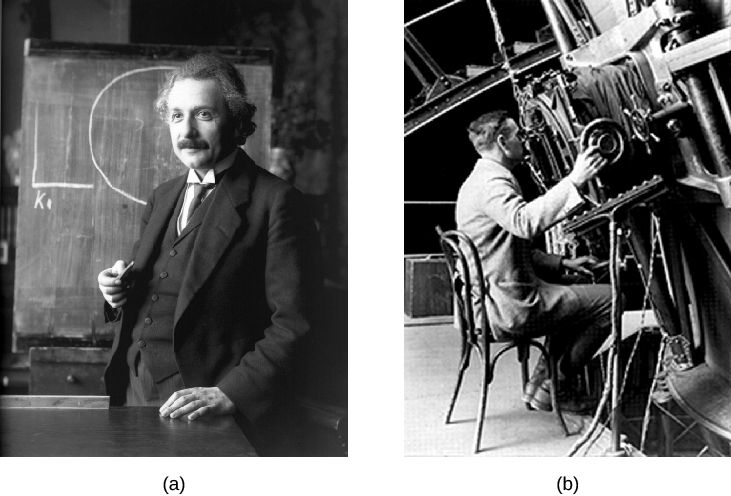
Einstein and Hubble.アインシュタインとハッブル。
OpenStax / Rice University · CC BY 4.0
Figure 29.2 (a) Albert Einstein is shown in a 1921 photograph. (b) Edwin Hubble at work in the Mt. Wilson Observatory.
図29.2 (a)1921年に撮影されたアルベルト・アインシュタイン。(b)ウィルソン山天文台で観測中のエドウィン・ハッブル。
About a decade later, Hubble, and his coworkers reported that the universe is expanding, so that no mysterious balancing force is needed. (We discussed this in the chapter on Galaxies.) Einstein is reported to have said that the introduction of the cosmological constant was “the biggest blunder of my life.” As we shall see later in this chapter, however, relatively recent observations indicate that the expansion is accelerating. Observations are now being carried out to determine whether this acceleration is consistent with a cosmological constant. In a way, it may turn out that Einstein was right after all.
英語のヒント
約10年後、ハッブルと共同研究者たちは宇宙が膨張していると報告した。したがって、釣り合いを保つ謎の力は必要なかった。この点は「銀河」で論じた。アインシュタインは、宇宙定数を導入したことを「生涯最大の失敗」と呼んだと伝えられている。ところが、この章で後ほど見るように、比較的最近の観測は膨張が加速していることを示している。この加速が宇宙定数と整合するかどうか、現在、観測による検証が進められている。ある意味では、結局アインシュタインが正しかったことになるのかもしれない。
The Hubble Timeハッブル時間
If we had a movie of the expanding universe and ran the film backward, what would we see? The galaxies, instead of moving apart, would move together in our movie—getting closer and closer all the time. Eventually, we would find that all the matter we can see today was once concentrated in an infinitesimally small volume. Astronomers identify this time with the beginning of the universe. The explosion of that concentrated universe at the beginning of time is called the Big Bang (not a bad term, since you can’t have a bigger bang than one that creates the entire universe). But when did this bang occur?
英語のヒント
膨張する宇宙を撮った映画があり、それを逆再生したら、何が見えるだろうか。その映画では、銀河は離れ合う代わりに集まり、どんどん近づいていくはずだ。ついには、今日見えるすべての物質が、かつて極めて小さな体積に集中していたとわかるだろう。天文学者は、この時を宇宙の始まりと考える。時間の始まりに、この凝縮した宇宙が爆発したことをビッグバンと呼ぶ。宇宙全体を生み出すもの以上に大きな爆発はありえないのだから、悪くない名称である。では、その爆発はいつ起こったのだろうか。
We can make a reasonable estimate of the time since the universal expansion began. To see how astronomers do this, let’s begin with an analogy. Suppose your astronomy class decides to have a party (a kind of “Big Bang”) at someone’s home to celebrate the end of the semester. Unfortunately, everyone is celebrating with so much enthusiasm that the neighbors call the police, who arrive and send everyone away at the same moment. You get home at 2 a.m., still somewhat upset about the way the party ended, and realize you forgot to look at your watch to see what time the police got there. But you use a map to measure that the distance between the party and your house is 40 kilometers. And you also remember that you drove the whole trip at a steady speed of 80 kilometers/hour (since you were worried about the police cars following you). Therefore, the trip must have taken:
英語のヒント
宇宙の膨張が始まってからの時間は、かなり妥当に見積もることができる。天文学者がどう計算するのか、たとえ話から見てみよう。天文学の授業の仲間が、学期末を祝って誰かの家でパーティー、いわば「ビッグバン」を開くことにしたとする。ところが、みんながあまりにも熱心に騒ぐので、近所の人が警察を呼んでしまう。到着した警察官は、その場で全員を帰らせた。午前2時に帰宅したあなたは、パーティーの幕切れにまだ少し腹を立てていて、警察が来た時刻を確かめるために時計を見るのを忘れたと気づく。しかし、地図を使って、会場から自宅までの距離が40kmだとわかった。また、パトカーに追跡されるのが心配で、帰り道をずっと時速80kmで走ったことも覚えている。したがって、移動にかかった時間は次のはずである。
So the party must have broken up at 1:30 a.m.
英語のヒント
したがって、パーティーが解散したのは午前1時30分だったはずだ。
No humans were around to look at their watches when the universe began, but we can use the same technique to estimate when the galaxies began moving away from each other. (Remember that, in reality, it is space that is expanding, not the galaxies that are moving through static space.) If we can measure how far apart the galaxies are now, and how fast they are moving, we can figure out how long a trip it’s been.
英語のヒント
宇宙が始まったとき、時計を見る人間はいなかった。それでも同じ方法で、銀河がいつ離れ合い始めたかを見積もることができる。実際に膨張しているのは空間であり、銀河が静止した空間の中を動いているわけではないことを思い出そう。銀河同士が今どれだけ離れ、どれくらいの速さで離れ合っているか測定できれば、その旅にどれほど時間がかかったかを求められる。
Let’s call the age of the universe measured in this way T0. Let’s first do a simple case by assuming that the expansion has been at a constant rate ever since the expansion of the universe began. In this case, the time it has taken a galaxy to move a distance, d, away from the Milky Way (remember that at the beginning the galaxies were all together in a very tiny volume) is (as in our example)
英語のヒント
この方法で測った宇宙の年齢を T0 としよう。まず簡単な場合として、宇宙の膨張が始まって以来、膨張の速さが一定だったと仮定する。この場合、ある銀河が天の川銀河から距離 d だけ離れるのにかかった時間は、先ほどの例と同じく、次のようになる。初めには、銀河はすべて極めて小さな体積に集まっていたことを思い出そう。
where v is the velocity of the galaxy. If we can measure the speed with which galaxies are moving away, and also the distances between them, we can establish how long ago the expansion began.
英語のヒント
ここで v は銀河の速度である。銀河が離れ合う速さと、銀河同士の距離を測れれば、膨張がどれほど昔に始まったかを求められる。
Making such measurements should sound very familiar. This is just what Hubble and many astronomers after him needed to do in order to establish the Hubble law and the Hubble constant. We learned in Galaxies that a galaxy’s distance and its velocity in the expanding universe are related by
英語のヒント
こうした測定を行うという話には、聞き覚えがあるはずだ。これはまさに、ハッブルと後に続く多くの天文学者が、ハッブルの法則とハッブル定数を確立するために行う必要があったことである。「銀河」では、膨張する宇宙の中で、銀河の距離と速度が次の関係で結ばれることを学んだ。
where H is the Hubble constant. Combining these two expressions gives us
ここで H はハッブル定数である。この二つの式を組み合わせると、次の式が得られる。
We see, then, that the work of calculating this time was already done for us when astronomers measured the Hubble constant. The age of the universe estimated in this way turns out to be just the reciprocal of the Hubble constant (that is, 1/H). This age estimate is sometimes called the Hubble time. For a Hubble constant of 20 kilometers/second per million light-years, the Hubble time is about 15 billion years. (By the way, the unit used by astronomers for the Hubble constant is kilometers/second per million parsecs. In these units, the Hubble constant is equal to about 70 kilometers/second per million parsecs, again with an uncertainty of about 5%.)
英語のヒント
つまり、この時間を計算する仕事は、天文学者がハッブル定数を測ったときに、すでに済んでいたのである。この方法で見積もった宇宙の年齢は、ハッブル定数の逆数、すなわち 1/H にほかならない。この年齢の見積もりを、ハッブル時間と呼ぶことがある。ハッブル定数を100万光年当たり毎秒20kmとすると、ハッブル時間は約150億年になる。なお、天文学者がハッブル定数に使う単位は、100万パーセク当たりの毎秒のキロメートル数である。この単位では、ハッブル定数は100万パーセク当たり約70km/sとなり、やはり約5%の不確かさがある。
To make numbers easier to remember, we have done some rounding here. Estimates for the Hubble constant are actually closer to 21 or 22 kilometers/second per million light-years, which would make the age closer to 14 billion years. But there is still about a 5% uncertainty in the Hubble constant, which means the age of the universe estimated in this way is also uncertain by about 5%.
英語のヒント
数字を覚えやすくするため、ここでは少し丸めている。ハッブル定数の推定値は、実際には100万光年当たり毎秒21〜22kmに近く、それなら年齢は140億年に近くなる。ただし、ハッブル定数にはなお約5%の不確かさがある。そのため、この方法で見積もる宇宙年齢にも約5%の不確かさが残る。
To put these uncertainties in perspective, however, you should know that 50 years ago, the uncertainty was a factor of 2. Remarkable progress toward pinning down the Hubble constant has been made in the last couple of decades.
英語のヒント
この不確かさがどれほどのものかを捉えるには、50年前には値に2倍もの幅があったことを知っておくとよい。この20年ほどで、ハッブル定数を絞り込む研究は目覚ましく進んだ。