第14章宇宙からの試料と太陽系の起源Cosmic Samples and the Origin of the Solar System
14.3 Formation of the Solar System14.3 太陽系の形成
Learning Objectives学習の目標
By the end of this section, you will be able to:
この節を読み終えると、次のことができるようになる。
Describe the motion, chemical, and age constraints that must be met by any theory of solar system formation
太陽系形成のどの理論も満たさなければならない、運動・化学組成・年代に関する制約を説明する
Summarize the physical and chemical changes during the solar nebula stage of solar system formation
太陽系形成の原始太陽系星雲の段階で起こった、物理的・化学的な変化をまとめる
Explain the formation process of the terrestrial and giant planets
地球型惑星と巨大惑星の形成過程を説明する
Describe the main events of the further evolution of the solar system
その後の太陽系の進化で起こった主な出来事を説明する
As we have seen, the comets, asteroids, and meteorites are surviving remnants from the processes that formed the solar system. The planets, moons, and the Sun, of course, also are the products of the formation process, although the material in them has undergone a wide range of changes. We are now ready to put together the information from all these objects to discuss what is known about the origin of the solar system.
英語のヒント
これまで見てきたように、彗星・小惑星・隕石は、太陽系を形成した過程から生き残った残骸である。惑星・衛星・太陽も、もちろんその形成過程の産物だが、それらの中の物質はさまざまな変化を経験している。いまや、これらすべての天体から得た情報をまとめ、太陽系の起源について何が分かっているかを考える準備が整った。
Observational Constraints観測から課される制約
There are certain basic properties of the planetary system that any theory of its formation must explain. These may be summarized under three categories: motion constraints, chemical constraints, and age constraints. We call them constraints because they place restrictions on our theories; unless a theory can explain the observed facts, it will not survive in the competitive marketplace of ideas that characterizes the endeavor of science. Let’s take a look at these constraints one by one.
英語のヒント
惑星系には、その形成を説明するどんな理論も説明しなければならない、基本的な性質がある。これらは、運動に関する制約、化学組成に関する制約、年代に関する制約という三つにまとめられる。制約と呼ぶのは、理論に限界を課すからである。観測された事実を説明できなければ、科学という営みを特徴付ける、考え方どうしが競い合う場で、その理論は生き残れない。これらの制約を一つずつ見ていこう。
There are many regularities to the motions in the solar system. We saw that the planets all revolve around the Sun in the same direction and approximately in the plane of the Sun’s own rotation. In addition, most of the planets rotate in the same direction as they revolve, and most of the moons also move in counterclockwise orbits (when seen from the north). With the exception of the comets and other trans-neptunian objects, the motions of the system members define a disk or Frisbee shape. Nevertheless, a full theory must also be prepared to deal with the exceptions to these trends, such as the retrograde rotation (not revolution) of Venus.
英語のヒント
太陽系の運動には多くの規則性がある。惑星はすべて太陽の周りを同じ向きに公転し、その軌道は太陽自身の自転面とほぼ同じ平面上にあることを見た。さらに、大部分の惑星は公転と同じ向きに自転し、大部分の衛星も、北側から見て反時計回りの軌道を動く。彗星や、ほかの海王星以遠天体を除けば、太陽系の天体の運動は円盤、あるいはフリスビーの形を描いている。それでも、完全な理論は、こうした傾向の例外にも対応できなければならない。例えば金星の逆向きの自転であり、ここでいうのは公転ではない。
In the realm of chemistry, we saw that Jupiter and Saturn have approximately the same composition—dominated by hydrogen and helium. These are the two largest planets, with sufficient gravity to hold on to any gas present when and where they formed; thus, we might expect them to be representative of the original material out of which the solar system formed. Each of the other members of the planetary system is, to some degree, lacking in the light elements. A careful examination of the composition of solid solar-system objects shows a striking progression from the metal-rich inner planets, through those made predominantly of rocky materials, out to objects with ice-dominated compositions in the outer solar system. The comets in the Oort cloud and the trans-neptunian objects in the Kuiper belt are also icy objects, whereas the asteroids represent a transitional rocky composition with abundant dark, carbon-rich material.
英語のヒント
化学組成について見ると、木星と土星はほぼ同じ組成を持ち、水素とヘリウムが大半を占めることを学んだ。この二つは最大の惑星であり、形成された時と場所に存在したガスを、どれでもつなぎ留められるだけの重力を持つ。そのため、太陽系を作った元の物質を代表していると期待できる。惑星系のほかの天体は、それぞれ程度の差はあれ、軽い元素が不足している。太陽系の固体天体の組成を詳しく調べると、金属に富む内側の惑星から、主に岩石質の物質からなる天体を経て、太陽系外側の氷を主成分とする天体へと、はっきりした変化の並びが見られる。オールトの雲の彗星やカイパーベルトの海王星以遠天体も氷天体である。一方、小惑星は、暗い炭素に富む物質を多く含む、中間的な岩石質の組成を示す。
As we saw in Other Worlds: An Introduction to the Solar System, this general chemical pattern can be interpreted as a temperature sequence: hot near the Sun and cooler as we move outward. The inner parts of the system are generally missing those materials that could not condense (form a solid) at the high temperatures found near the Sun. However, there are (again) important exceptions to the general pattern. For example, it is difficult to explain the presence of water on Earth and Mars if these planets formed in a region where the temperature was too hot for ice to condense, unless the ice or water was brought in later from cooler regions. The extreme example is the observation that there are polar deposits of ice on both Mercury and the Moon; these are almost certainly formed and maintained by occasional comet impacts.
英語のヒント
「ほかの世界――太陽系入門」で見たように、この全般的な化学組成の分布は、温度の順序として解釈できる。太陽に近いほど高温で、外へ行くほど低温だったということだ。太陽系の内側には一般に、太陽近くの高温では凝縮して固体になれなかった物質が欠けている。しかし、ここにも全般的な傾向から外れる重要な例外がある。例えば地球や火星が、氷が凝縮するには高温すぎる領域でできたのなら、それらに水があることは説明しにくい。後から、より低温の領域から氷や水が運び込まれたのでなければならない。極端な例は、水星と月の両方の極地で氷の堆積が観測されていることだ。これらは、時折起こる彗星の衝突によって形成され、維持されているとほぼ確実に考えられる。
As far as age is concerned, we discussed that radioactive dating demonstrates that some rocks on the surface of Earth have been present for at least 3.8 billion years, and that certain lunar samples are 4.4 billion years old. The primitive meteorites all have radioactive ages near 4.5 billion years. The age of these unaltered building blocks is considered the age of the planetary system. The similarity of the measured ages tells us that planets formed and their crusts cooled within a few tens of millions of years (at most) of the beginning of the solar system. Further, detailed examination of primitive meteorites indicates that they are made primarily from material that condensed or coagulated out of a hot gas; few identifiable fragments appear to have survived from before this hot-vapor stage 4.5 billion years ago.
英語のヒント
年代については、放射年代測定によって、地表の一部の岩石が少なくとも38億年前から存在していることや、ある月の試料が44億年前のものであることが分かると述べた。原始的な隕石の放射年代は、すべて45億年前後である。変質していないこうした構成材料の年代が、惑星系の年齢と見なされる。測定された年代が似ていることは、太陽系が始まってから、長くても数千万年以内に惑星が形成され、地殻が冷えたことを示す。さらに、原始的な隕石を詳しく調べると、主に高温のガスから凝縮したり凝集したりした物質からできていると分かる。45億年前のこの高温の蒸気の段階より前から生き残ったと識別できる破片は、ほとんどないようだ。
The Solar Nebula原始太陽系星雲
All the foregoing constraints are consistent with the general idea, introduced in Other Worlds: An Introduction to the Solar System, that the solar system formed 4.5 billion years ago out of a rotating cloud of vapor and dust—which we call the solar nebula—with an initial composition similar to that of the Sun today. As the solar nebula collapsed under its own gravity, material fell toward the center, where things became more and more concentrated and hot. Increasing temperatures in the shrinking nebula vaporized most of the solid material that was originally present.
英語のヒント
これまでの制約はすべて、「ほかの世界――太陽系入門」で紹介した大筋の考え方と整合する。太陽系は45億年前、原始太陽系星雲と呼ばれる、回転する蒸気と塵の雲から形成され、その初期組成は現在の太陽と似ていたという考え方だ。原始太陽系星雲が自身の重力で収縮すると、物質は中心へ落ち込み、そこでは物質がますます密集し、温度も上がった。収縮する星雲の温度上昇によって、初めから存在していた固体物質の大半が蒸発した。
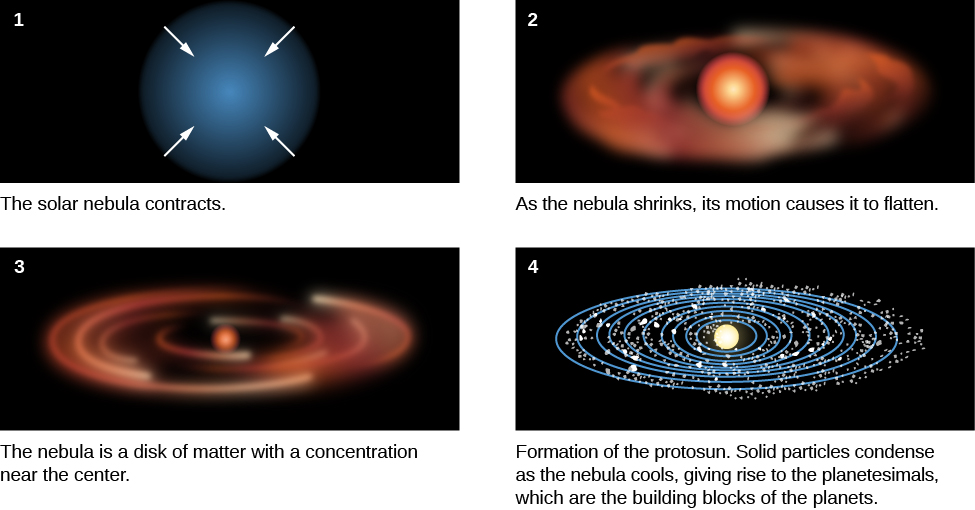
At the same time, the collapsing nebula began to rotate faster through the conservation of angular momentum (see the Orbits and Gravity and Earth, Moon, and Sky chapters). Like a figure skater pulling her arms in to spin faster, the shrinking cloud spun more quickly as time went on. Now, think about how a round object spins. Close to the poles, the spin rate is slow, and it gets faster as you get closer to the equator. In the same way, near the poles of the nebula, where orbits were slow, the nebular material fell directly into the center. Faster moving material, on the other hand, collapsed into a flat disk revolving around the central object (Figure 14.11). The existence of this disk-shaped rotating nebula explains the primary motions in the solar system that we discussed in the previous section. And since they formed from a rotating disk, the planets all orbit the same way.
英語のヒント
同時に、収縮する星雲は角運動量保存によって回転を速めた。「軌道と重力」と「地球・月・空」の章を参照してほしい。フィギュアスケートの選手が腕を体に引き寄せて速く回転するように、収縮する雲も時間とともに速く回転した。ここで、丸い物体がどのように回転するか考えてみよう。極の近くでは回転による動きは遅く、赤道に近づくほど速くなる。同じように、星雲の極付近では軌道運動が遅く、物質は中心へ直接落ち込んだ。一方、より速く動く物質は、中心天体の周りを回る平たい円盤へと収縮した(図14.11)。この円盤状の回転する星雲の存在によって、前の項で述べた太陽系の主要な運動を説明できる。また、惑星は回転する円盤からできたため、すべて同じ向きに公転する。
Steps in Forming the Solar System.太陽系が形成される段階。
OpenStax / Rice University · CC BY 4.0
Figure 14.11 This illustration shows the steps in the formation of the solar system from the solar nebula. As the nebula shrinks, its rotation causes it to flatten into a disk. Much of the material is concentrated in the hot center, which will ultimately become a star. Away from the center, solid particles can condense as the nebula cools, giving rise to planetesimals, the building blocks of the planets and moons.
図14.11 この図は、原始太陽系星雲から太陽系が形成される段階を示す。星雲が収縮すると、回転のために平たい円盤になる。物質の多くは高温の中心に集まり、そこは最終的に恒星となる。中心から離れたところでは、星雲が冷えるにつれて固体粒子が凝縮できるようになり、惑星や衛星の構成材料である微惑星が生まれる。
Picture the solar nebula at the end of the collapse phase, when it was at its hottest. With no more gravitational energy (from material falling in) to heat it, most of the nebula began to cool. The material in the center, however, where it was hottest and most crowded, formed a star that maintained high temperatures in its immediate neighborhood by producing its own energy. Turbulent motions and magnetic fields within the disk can drain away angular momentum, robbing the disk material of some of its spin. This allowed some material to continue to fall into the growing star, while the rest of the disk gradually stabilized.
英語のヒント
収縮段階が終わり、温度が最も高くなったときの原始太陽系星雲を思い描いてみよう。落ち込む物質からの重力エネルギーがもはや加熱を続けなくなると、星雲の大半は冷え始めた。しかし、最も高温で物質が最も密集していた中心の物質は恒星を作り、自らエネルギーを生み出して、ごく近い周辺を高温に保った。円盤内の乱流や磁場は、角運動量を運び去り、円盤の物質から回転の一部を奪うことができる。そのため、一部の物質は成長中の恒星へ落ち続け、円盤の残りの部分は徐々に安定した。
The temperature within the disk decreased with increasing distance from the Sun, much as the planets’ temperatures vary with position today. As the disk cooled, the gases interacted chemically to produce compounds; eventually these compounds condensed into liquid droplets or solid grains. This is similar to the process by which raindrops on Earth condense from moist air as it rises over a mountain.
英語のヒント
円盤内の温度は太陽から遠くなるほど低かった。現在の惑星の温度が、位置によって変わるのとよく似ている。円盤が冷えると、ガスが化学的に反応して化合物を作り、やがてそれらが凝縮して液滴や固体の粒になった。これは地球上で、湿った空気が山を越えて上昇する際、水が凝縮して雨粒を作る過程に似ている。
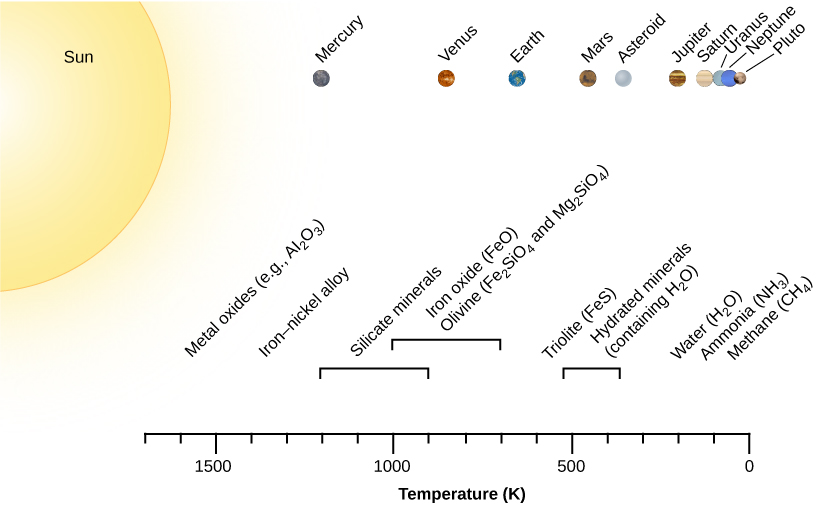
Let’s look in more detail at how material condensed at different places in the maturing disk (Figure 14.12). The first materials to form solid grains were the metals and various rock-forming silicates. As the temperature dropped, these were joined throughout much of the solar nebula by sulfur compounds and by carbon- and water-rich silicates, such as those now found abundantly among the asteroids. However, in the inner parts of the disk, the temperature never dropped low enough for such materials as ice or carbonaceous organic compounds to condense, so they were lacking on the innermost planets.
英語のヒント
成長していく円盤のさまざまな場所で、物質がどのように凝縮したかを、もう少し詳しく見よう(図14.12)。最初に固体の粒を作った物質は、金属と、さまざまな岩石形成ケイ酸塩だった。温度が下がるにつれ、原始太陽系星雲の広い範囲で、硫黄化合物や、炭素と水に富んだケイ酸塩が加わった。現在、小惑星に豊富に見つかる物質がその例である。しかし円盤の内側では、氷や炭素質の有機化合物のような物質が凝縮できるほどには、温度が下がらなかった。そのため、最も内側の惑星には、これらの物質が不足していた。
Chemical Condensation Sequence in the Solar Nebula.原始太陽系星雲における化学的な凝縮の順序。
OpenStax / Rice University · CC BY 4.0
Figure 14.12 The scale along the bottom shows temperature; above are the materials that would condense out at each temperature under the conditions expected to prevail in the nebula.
図14.12 下部の目盛りは温度を示す。その上には、星雲で支配的だったと考えられる条件のもとで、各温度で凝縮する物質が記されている。
Far from the Sun, cooler temperatures allowed the oxygen to combine with hydrogen and condense in the form of water (H2O) ice. Beyond the orbit of Saturn, carbon and nitrogen combined with hydrogen to make ices such as methane (CH4) and ammonia (NH3). This sequence of events explains the basic chemical composition differences among various regions of the solar system.
英語のヒント
太陽から遠い場所では、温度が低いため酸素が水素と結合し、水(H₂O)の氷として凝縮できた。土星の軌道より外では、炭素や窒素が水素と結び付き、メタン(CH₄)やアンモニア(NH₃)などの氷を作った。この一連の出来事によって、太陽系の領域ごとの基本的な化学組成の違いが説明できる。
Rotation of the Solar Nebula原始太陽系星雲の回転
We can use the concept of angular momentum to trace the evolution of the collapsing solar nebula. The angular momentum of an object is proportional to the square of its size (diameter) divided by its period of rotation . If angular momentum is conserved, then any change in the size of a nebula must be compensated for by a proportional change in period, in order to keep constant. Suppose the solar nebula began with a diameter of 10,000 AU and a rotation period of 1 million years. What is its rotation period when it has shrunk to the size of Pluto’s orbit, which Appendix F tells us has a radius of about 40 AU?
英語のヒント
角運動量の概念を使うと、収縮する原始太陽系星雲の進化をたどれる。物体の角運動量は、大きさ、すなわち直径の2乗を自転周期で割ったものに比例する。角運動量が保存されるなら、を一定に保つため、星雲の大きさの変化は、周期の比例的な変化で埋め合わせられなければならない。原始太陽系星雲が直径1万AU、回転周期100万年で始まったとしよう。付録Fによれば半径約40AUである冥王星の軌道の大きさまで収縮したとき、回転周期はいくらになるだろうか。
Solution解き方
We are given that the final diameter of the solar nebula is about 80 AU. Noting the initial state before the collapse and the final state at Pluto’s orbit, then
原始太陽系星雲の最終的な直径は約80AUと分かっている。収縮前の初期状態と、冥王星の軌道の大きさになった最終状態に注目すると、次のようになる。
With Pinitial equal to 1,000,000 years, Pfinal, the new rotation period, is 64 years. This is a lot shorter than the actual time Pluto takes to go around the Sun, but it gives you a sense of the kind of speeding up the conservation of angular momentum can produce. As we noted earlier, other mechanisms helped the material in the disk lose angular momentum before the planets fully formed.
英語のヒント
初期の周期P_initialが100万年なので、新しい回転周期P_finalは64年である。これは、冥王星が実際に太陽を一周する時間よりはるかに短いが、角運動量保存によってどれほど回転が速まりうるか、感覚をつかめるだろう。前に述べたように、惑星が完全に形成される前に、ほかの仕組みが円盤の物質から角運動量を失わせた。
Check Your Learning理解を確かめよう
What would the rotation period of the nebula in our example be when it had shrunk to the size of Jupiter’s orbit?
この例の星雲が木星の軌道の大きさまで収縮したとき、回転周期はいくらになるだろうか。