第14章宇宙からの試料と太陽系の起源Cosmic Samples and the Origin of the Solar System
14.2 Meteorites: Stones from Heaven14.2 隕石――空から来た石
Learning Objectives学習の目標
By the end of this section, you will be able to:
この節を読み終えると、次のことができるようになる。
Explain the origin of meteorites and the difference between a meteor and a meteorite
隕石の起源と、流星と隕石の違いを説明する
Describe how most meteorites have been found
隕石の多くがどのように発見されてきたかを説明する
Explain how primitive stone meteorites are significantly different from other types
原始的な石質隕石が、ほかの種類とどのように大きく異なるかを説明する
Explain how the study of meteorites informs our understanding of the age of the solar system.
隕石の研究が、太陽系の年齢の理解にどう役立つかを説明する
Any fragment of interplanetary debris that survives its fiery plunge through Earth’s atmosphere is called a meteorite. Meteorites fall only very rarely in any one locality, but over the entire Earth thousands fall each year. Some meteorites are loners, but many are fragments from the breakup in the atmosphere of a single larger object. These rocks from the sky carry a remarkable record of the formation and early history of the solar system.
英語のヒント
惑星間の破片のうち、地球の大気を通る燃えるような突入を生き延びたかけらは、隕石と呼ばれる。隕石が落ちることは、ある一つの地域だけを見ればきわめてまれだが、地球全体では毎年数千個にのぼる。単独で落ちる隕石もあるが、多くは一つの大きな天体が大気中で分裂してできた破片だ。これらの空から来た岩石は、太陽系の形成と初期の歴史の、驚くべき記録を運んでくる。
Extraterrestrial Origin of Meteorites隕石は地球の外から来た
Occasional meteorites have been found throughout history, but their extraterrestrial origin was not accepted by scientists until the beginning of the nineteenth century. Before that, these strange stones were either ignored or considered to have a supernatural origin.
英語のヒント
隕石は歴史を通じて時折見つかってきたが、地球の外に起源があることを科学者が認めたのは、19世紀初めになってからである。それ以前には、こうした奇妙な石は無視されるか、超自然的な起源を持つと考えられていた。
The falls of the earliest recovered meteorites are lost in the fog of mythology. A number of religious texts speak of stones from heaven, which sometimes arrived at opportune moments to smite the enemies of the authors of those texts. At least one sacred meteorite has apparently survived in the form of the Ka’aba, the holy black stone in Mecca that is revered by Islam as a relic from the time of the Patriarchs—although understandably, no chip from this sacred stone has been subject to detailed chemical analysis.
英語のヒント
最も早い時代に拾われた隕石がいつどのように落ちたのかは、神話の霧の中に埋もれている。多くの宗教文書は天から来た石について語り、それらは時に、文書の書き手の敵を打ち倒すのに都合のよい瞬間に現れたという。少なくとも一つの聖なる隕石は、メッカの聖なる黒い石、カアバという形で、どうやら今日まで残っているらしい。イスラム教では族長たちの時代の遺物として崇敬されている。ただし、当然ながら、この聖なる石のかけらが詳しい化学分析にかけられたことはない。
The modern scientific history of the meteorites begins in the late eighteenth century, when a few scientists suggested that some strange-looking stones had such peculiar composition and structure that they were probably not of terrestrial origin. The idea that indeed “stones fall from the sky” was generally accepted only after a scientific team led by French physicist Jean-Baptiste Biot investigated a well-observed fall in 1803.
英語のヒント
隕石の近代的な科学史は18世紀後半に始まる。何人かの科学者が、奇妙な外見の石の中には、組成や構造があまりに特異で、地球由来とは考えにくいものがあると指摘したのだ。実際に「石が空から降ってくる」という考え方が広く受け入れられたのは、フランスの物理学者ジャン=バティスト・ビオが率いる調査団が、1803年に十分な目撃記録のある落下を調べた後のことだった。
Meteorites sometimes fall in groups or showers. Such a fall occurs when a single larger object breaks up during its violent passage through the atmosphere. It is important to remember that such a shower of meteorites has nothing to do with a meteor shower. No meteorites have ever been recovered in association with meteor showers. Whatever the ultimate source of the meteorites, they do not appear to come from the comets or their associated particle streams.
英語のヒント
隕石は、集団で、あるいは雨のように降ってくることがある。これは、一つの大きな天体が大気を激しく通過する際に分裂するときに起こる。このような隕石の雨は、流星群とは何の関係もないという点を覚えておくことが大切だ。流星群に伴って隕石が回収された例はない。隕石の究極の供給源が何であれ、彗星や、それに伴う粒子の流れから来ているようには見えない。
Meteorite Falls and Finds落下が観測された隕石と、後から発見された隕石
Meteorites are found in two ways. First, sometimes bright meteors (fireballs) are observed to penetrate the atmosphere to low altitudes. If we search the area beneath the point where the fireball burned out, we may find one or more remnants that reached the ground. Observed meteorite falls, in other words, may lead to the recovery of fallen meteorites. (A few meteorites have even hit buildings or, very rarely, people; see Making Connections: Some Striking Meteorites). The 2013 Chelyabinsk fireball, which we discussed in the chapter on Comets and Asteroids: Debris of the Solar System, produced tens of thousands of small meteorites, many of them easy to find because these dark stones fell on snow.
英語のヒント
隕石は二つの方法で見つかる。第一に、ときどき、明るい流星、すなわち火球が、大気の低い高度まで入り込む様子が観測される。火球が燃え尽きた地点の下を探すと、地表に達した一つ、あるいは複数の残骸が見つかることがある。言い換えれば、隕石の落下が観測されることで、落ちた隕石の回収につながる場合がある。(建物に当たった隕石もあり、ごくまれには人に当たったこともある。「つながりを考える:衝突してきた隕石たち」を参照。)「彗星と小惑星――太陽系に残されたかけら」の章で取り上げた2013年のチェリャビンスク火球は、数万個の小さな隕石を生じた。黒っぽい石が雪の上に落ちたため、その多くは容易に見つかった。
There are, however, many false alarms about meteorite falls. Most observers of a bright fireball conclude that part of it hit the ground, but that is rarely the case. Every few months news outlets report that a meteorite has been implicated in the start of a fire. Such stories have always proved to be wrong. The meteorite is ice-cold in space, and most of its interior remains cold even after its brief fiery plunge through the atmosphere. A freshly fallen meteorite is more likely to acquire a coating of frost than to start a fire.
英語のヒント
しかし、隕石の落下をめぐっては、誤報も多い。明るい火球を見た人の多くは、その一部が地面にぶつかったと考えるが、実際にそうなることはめったにない。数か月おきに、隕石が火災の発生に関係したというニュースが流れる。しかし、こうした話はいつも誤りだと分かってきた。隕石は宇宙では氷のように冷たく、大気を通る短い燃えるような突入の後でも、内部の大部分は冷たいままである。落ちたばかりの隕石は、火事を起こすより、表面に霜が付く可能性のほうが高い。
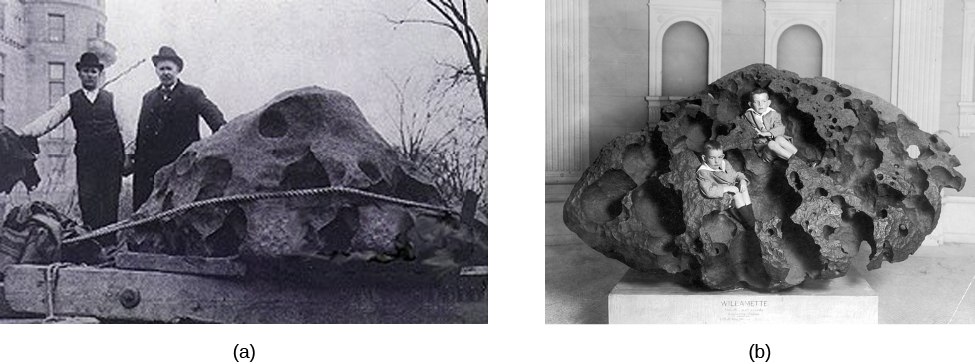
People sometimes discover unusual-looking rocks that turn out to be meteoritic; these rocks are termed meteorite finds. Now that the public has become meteorite-conscious, many unusual fragments, not all of which turn out to be from space, are sent to experts each year. Some scientists divide these objects into two categories: “meteorites” and “meteorwrongs.” Outside Antarctica (see the next paragraph), genuine meteorites turn up at an average rate of 25 or so per year. Most of these end up in natural history museums or specialized meteoritical laboratories throughout the world, although there is a growing group of private collectors interested in them as well. (Figure 14.6)
英語のヒント
人が見慣れない外見の岩石を見つけ、それが隕石だと判明することもある。こうした岩石は、発見隕石と呼ばれる。一般の人々が隕石を意識するようになった現在では、毎年、多くの変わった破片が専門家に送られてくる。ただし、そのすべてが宇宙由来と判明するわけではない。科学者の中には、こうした物体を meteorites(隕石)と meteorwrongs(隕石の見間違い)の二種類に分ける人もいる。南極以外では(南極については次の段落を参照)、本物の隕石は平均して年に25個ほど見つかる。その大半は世界各地の自然史博物館や隕石専門の研究室に収まるが、関心を持つ個人収集家も増えている(図14.6)。
Meteorite Find.発見された隕石。
OpenStax / Rice University · CC BY 4.0
Figure 14.6 (a) This early twentieth century photo shows a 15-ton iron meteorite found in the Willamette Valley in Oregon. Although known to Native Americans in the area, it was “discovered” by an enterprising local farmer in 1902, who proceeded to steal it and put it on display. (b) It was eventually purchased for the American Museum of Natural History and is now on display in the museum’s Rose Center in New York City as the largest iron meteorite in the United States. In this 1911 photo, two young boys are perched in the meteor’s crevices.
図14.6 (a)20世紀初頭のこの写真は、オレゴン州ウィラメット渓谷で見つかった15トンの鉄隕石を写している。この地域の先住民には知られていたものの、1902年に商才に富む地元の農民が「発見」し、その後、盗み出して展示した。(b)やがてアメリカ自然史博物館のために購入され、現在は米国最大の鉄隕石として、ニューヨーク市にある同館のローズ・センターに展示されている。この1911年の写真では、二人の少年が隕石のくぼみに腰掛けている。
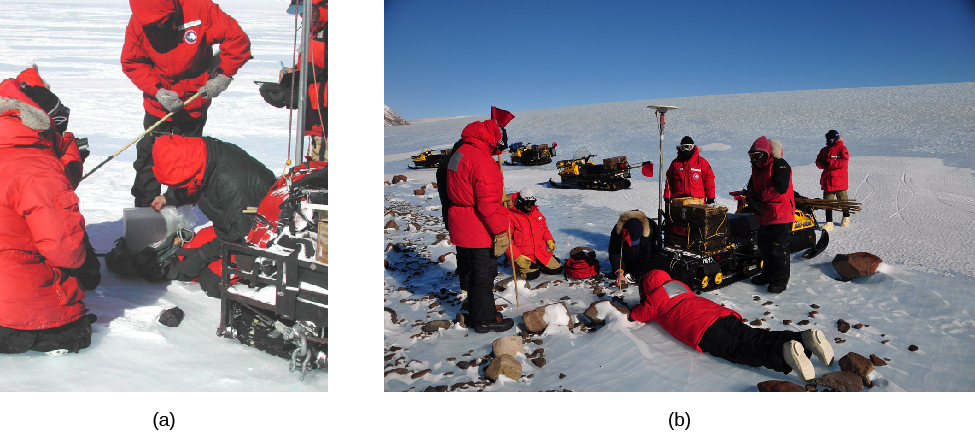
Since the 1980s, sources in the Antarctic have dramatically increased our knowledge of meteorites. More than ten thousand meteorites have been recovered from the Antarctic as a result of the motion of the ice in some parts of that continent (Figure 14.7). Meteorites that fall in regions where ice accumulates are buried and then carried slowly to other areas where the ice is gradually worn away. After thousands of years, the rock again finds itself on the surface, along with other meteorites carried to these same locations. The ice thus concentrates the meteorites that have fallen both over a large area and over a long period of time. Once on the surface, the rocks stand out in contrast to the ice and are thus easier to spot than in other places on our rocky planet.
英語のヒント
1980年代以降、南極で得られた試料は、隕石に関する知識を飛躍的に増やした。南極大陸の一部で起こる氷の動きのおかげで、1万個を超える隕石が回収されている(図14.7)。氷が蓄積する地域に落ちた隕石は埋もれ、その後、氷が徐々に削り取られる別の地域へゆっくり運ばれる。数千年後、その岩石は、同じ場所へ運ばれたほかの隕石とともに、再び表面に姿を現す。このようにして氷は、広い地域に、かつ長い期間にわたって落ちた隕石を集める。いったん表面に出ると、岩石は氷との対比ではっきり目立つ。そのため、岩石の多い地球のほかの場所より見つけやすい。
Antarctic Meteorite.南極の隕石。
credit a, b: modification of work by NASA · NASA media use guidelines
Figure 14.7 (a) The US Antarctic Search for Meteorites (ANSMET) team recovers a meteorite from the Antarctic ice during a 2001–2002 mission. (b) The team is shown with some of the equipment used in the search. (credit a, b: modification of work by NASA)
図14.7 (a)米国南極隕石探査(ANSMET)隊が、2001〜2002年の調査で南極の氷から隕石を回収している。(b)探査に使った機材の一部とともに写る隊員たち。(a、bのクレジット:NASAの作品を改変)