第13章彗星と小惑星――太陽系に残されたかけらComets and Asteroids: Debris of the Solar System
13.2 Asteroids and Planetary Defense13.2 小惑星と地球防衛
Learning Objectives学習の目標
By the end of this section, you will be able to:
この節を終えると、次のことができるようになる。
Recognize the threat that near-Earth objects represent for Earth
地球近傍天体が地球に及ぼす脅威を理解する。
Discuss possible defensive strategies to protect our planet
地球を守るために考えられる防衛策を論じる。
Not all asteroids are in the main asteroid belt. In this section, we consider some special groups of asteroids with orbits that approach or cross the orbit of Earth. These pose the risk of a catastrophic collision with our planet, such as the collision 65 million years ago that killed the dinosaurs.
英語のヒント
すべての小惑星が主要な小惑星帯にあるわけではない。この節では、軌道が地球の軌道へ近づいたり交差したりする、特別な小惑星の集団を取り上げる。こうした天体は、6500万年前に恐竜を絶滅させた衝突のような、壊滅的な地球衝突の危険をもたらす。
Earth-Approaching Asteroids地球へ接近する小惑星
Asteroids that stray far outside the main belt are of interest mostly to astronomers. But asteroids that come inward, especially those with orbits that come close to or cross the orbit of Earth, are of interest to political leaders, military planners—indeed, everyone alive on Earth. Some of these asteroids briefly become the closest celestial object to us.
英語のヒント
主要な小惑星帯からはるか外側へ外れる小惑星に関心を持つのは、主として天文学者だ。しかし、内側へやって来る小惑星、特に地球の軌道へ接近したり交差したりする軌道を持つものは、政治指導者や軍の立案担当者、いや、地球上で暮らすすべての人に関わる。一部の小惑星は、短時間ながら、私たちに最も近い天体になる。
In 1994, a 1-kilometer object was picked up passing closer than the Moon, causing a stir of interest in the news media. Today, it is routine to read of small asteroids coming this close to Earth. (They were always there, but only in recent years have astronomers been able to detect such faint objects.)
英語のヒント
1994年には、1kmの天体が月より近くを通過するところが検出され、報道機関で大きな関心を呼んだ。今日では、小さな小惑星がこれほど地球へ接近する話を読むのは、ごく普通のことだ。(それらは以前から存在したが、こんな暗い天体を天文学者が検出できるようになったのは、つい近年のことなのである。)
In 2013, a small asteroid hit our planet, streaking across the sky over the Russian city of Chelyabinsk and exploding with the energy of a nuclear bomb (Figure 13.13). The impactor was a stony object about 20 meters in diameter, exploding about 30 kilometers high with an energy of 500 kilotons (about 30 times larger than the nuclear bombs dropped on Japan in World War II). No one was hurt by the blast itself, although it briefly became as bright as the Sun, drawing many spectators to the windows in their offices and homes. When the blast wave from the explosion then reached the town, it blew out the windows. About 1500 people had to seek medical attention from injuries from the shattered glass.
英語のヒント
2013年、小さな小惑星が地球に衝突し、ロシアのチェリャビンスク市上空を走り抜け、核爆弾に匹敵するエネルギーで爆発した(図13.13)。衝突天体は直径約20mの岩石質天体で、高度約30kmで、500キロトンのエネルギーを放って爆発した。第二次世界大戦中に日本へ投下された原子爆弾の約30倍に相当する。爆発そのものによる負傷者はいなかったが、一時的に太陽と同じほど明るくなり、多くの人が職場や自宅の窓へ見に来た。その後、爆発の衝撃波が町に到達すると、窓が吹き飛んだ。割れたガラスによるけがで、約1500人が医療機関の手当てを必要とした。
A much larger atmospheric explosion took place in Russia in 1908, caused by an asteroid about 50 meters in diameter, releasing an energy of 10 megatons, as large the most powerful nuclear weapons of today. Fortunately, the area directly affected, on the Tunguska River in Siberia, was unpopulated, and no one was killed. However, the area of forest destroyed by the blast was large—equal to the size of a major city (Figure 13.13).
英語のヒント
1908年には、ロシアで、はるかに大きな大気中の爆発が起こった。直径約50mの小惑星が原因で、現在の最も強力な核兵器に匹敵する10メガトンのエネルギーを放出した。幸い、直接の影響を受けたシベリアのツングースカ川沿いの地域には人が住んでおらず、死者は出なかった。それでも爆風で破壊された森林は、大都市の面積に等しいほど広かった(図13.13)。
Together with any comets that come close to our planet, such asteroids are known collectively as near-Earth objects (NEOs). As we saw in Cosmic Influences on the Evolution of Earth (and as the dinosaurs found out 65 million years ago,) the collision of a significant-sized NEO could be a catastrophe for life on our planet.
英語のヒント
このような小惑星は、地球に近づく彗星と合わせて、地球近傍天体、略してNEOと総称される。「地球の進化に及ぼす宇宙の影響」で見たように、そして恐竜が6500万年前に思い知らされたように、ある程度大きなNEOの衝突は、地球の生命に大災害をもたらしうる。
Impacts with Earth.地球への衝突。
Figure 13.13 (a) As the Chelyabinsk meteor passed through the atmosphere, it left a trail of smoke and briefly became as bright as the Sun. (b) Hundreds of kilometers of forest trees were knocked down and burned at the Tunguska impact site. (credit a: modification of work by Alex Alishevskikh)
図13.13 (a)チェリャビンスク流星は大気を通過しながら煙の跡を残し、一時的に太陽と同じほど明るくなった。(b)ツングースカの衝突地点では、何百kmにもわたる森林の木々がなぎ倒され、燃えた。(aのクレジット:Alex Alishevskikhの作品を改変)
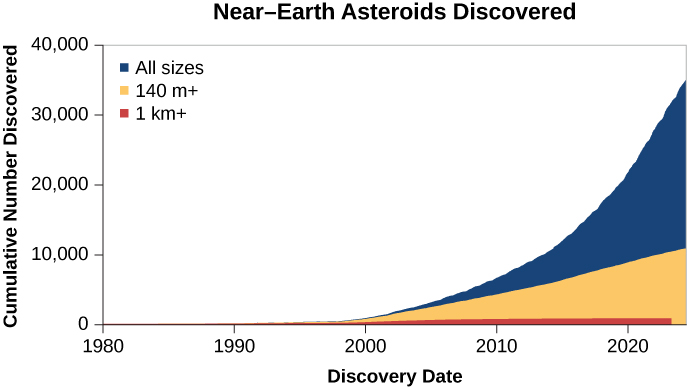
Astronomers have urged that the first step in protecting Earth from future impacts by NEOs must be to learn what potential impactors are out there. In 1998, NASA began the Spaceguard Survey, with the goal to discover and track 90% of Earth-approaching asteroids greater than 1 kilometer in diameter. The size of 1 kilometer was selected to include all asteroids capable of causing global damage, not merely local or regional effects. At 1 kilometer or larger, the impact could blast so much dust into the atmosphere that the sunlight would be dimmed for months, causing global crop failures—an event that could threaten the survival of our civilization. The Spaceguard goal of 90% was reached in 2012 when nearly a thousand of these 1-kilometer near-Earth asteroids (NEAs) had been found, along with more than 10,000 smaller asteroids. Figure 13.14 shows how the pace of NEA discoveries has been increasing over recent years. By 2025, astronomers knew of more than 38,000.
英語のヒント
天文学者たちは、将来のNEO衝突から地球を守るための第一歩は、衝突する可能性のある天体が宇宙に何個あるのかを知ることだと訴えてきた。1998年、NASAはスペースガード・サーベイを開始した。目標は、地球へ接近する直径1km超の小惑星の90%を発見し、追跡することだった。1kmという大きさを選んだのは、局所的・地域的な影響にとどまらず、地球全体に被害を及ぼしうる小惑星をすべて含めるためだ。1km以上になると、衝突によって大量の塵が大気へ吹き上げられ、日光が何か月も弱まり、世界的な不作を引き起こしかねない。それは文明の存続を脅かしうる出来事だ。スペースガードの90%という目標は2012年に達成された。そのとき、この大きさ1km級の地球近傍小惑星(NEA)が1000個近く、さらに小さな小惑星が1万個以上見つかっていた。図13.14は、NEAの発見ペースが近年どのように高まってきたかを示す。2025年までには、3万8000個以上が知られていた。
Discovery of Near-Earth Asteroids.地球近傍小惑星の発見。
OpenStax / Rice University · CC BY 4.0
Figure 13.14 The accelerating rate of discovery of NEAs is illustrated in this graph, which shows the total number of known NEAs, the number over 140 meters in diameter, and the number over 1 kilometer in diameter, the size that poses the dominant impact risk on Earth.
図13.14 このグラフは、NEAの発見率の加速を示す。既知のNEAの総数、直径140m超の数、そして地球への衝突リスクの主要部分を占める大きさである、直径1km超の数が描かれている。
How did astronomers know when they had discovered 90% of the larger asteroids? There are several ways to estimate the total number, even before they were individually located. One way is to look at the numbers of large craters on the dark lunar maria. Remember that these craters were made by impacts just like the ones we are considering. They are preserved on the Moon’s airless surface, whereas Earth soon erases the imprints of past impacts. Thus, the number of large craters on the Moon allows us to estimate how often impacts have occurred on both the Moon and Earth over the past several billion years. The number of impacts is directly related to the number of asteroids and comets on Earth-crossing orbits.
英語のヒント
天文学者は、どの時点で大型の小惑星の90%を発見したとわかったのだろうか。一つひとつの位置を特定する前でも、総数を推定する方法はいくつかある。一つは、月の暗い海にある大きなクレーターの数を見ることだ。これらのクレーターは、いま考えているものと同じ衝突でできたことを思い出そう。大気のない月面では保存されるが、地球では過去の衝突の痕跡はすぐ消えてしまう。したがって、月の大きなクレーターの数から、過去数十億年に月と地球の両方で、どれくらいの頻度で衝突が起こったかを推定できる。衝突の数は、地球の軌道を横切る軌道にある小惑星や彗星の数に直接関係している。
Another approach is to see how often the surveys (which are automated searches for faint points of light that move among the stars) rediscover a previously known asteroid. At the beginning of a survey, all the NEAs it finds will be new. But as the survey becomes more complete, more and more of the moving points the survey cameras record will be rediscoveries. The more rediscoveries each survey experiences, the more complete our inventory of these asteroids must be.
英語のヒント
もう一つの方法は、サーベイで、既知の小惑星をどのくらいの頻度で再発見するかを見ることだ。サーベイとは、星々の間を動くかすかな光の点を自動で探す観測である。サーベイの開始時には、見つかるNEAはすべて新発見になる。しかし調査が行き届くにつれて、サーベイのカメラが記録する動く点のうち、再発見がますます増える。各サーベイで再発見が多くなるほど、これらの小惑星の一覧は、より完全に近づいているはずだ。
We have been relieved to find that none of the NEAs discovered so far is on a trajectory that will impact Earth within the foreseeable future. However, we can’t speak for the handful of asteroids larger than 1 kilometer that have not yet been found, or for the much more numerous smaller ones. It is estimated that there are a million NEAs capable of hitting Earth that are smaller than 1 kilometer but still large enough to destroy a city, and our surveys have found about 25% of them. Researchers who work with asteroid orbits estimate that for smaller (and therefore fainter) asteroids we are not yet tracking, we will have about a 5-second warning that one is going to hit Earth—in other words, we won’t see it until it enters the atmosphere. Clearly, this estimate gives us a lot of motivation to continue these surveys to track as many asteroids as possible.
英語のヒント
これまでに発見されたNEAのどれも、予見できる将来に地球へ衝突する経路にないとわかり、私たちは安心している。しかし、まだ見つかっていない直径1km超の少数の小惑星や、それよりはるかに数の多い小型のものについては、何もいえない。地球に衝突しうるNEAのうち、1km未満でも都市を破壊するには十分大きいものは100万個あると推定され、その約25%がサーベイで見つかっている。小惑星の軌道を研究する人々の推定では、まだ追跡できていない小さくて暗い小惑星の場合、地球に衝突するという警告を得られるのは約5秒前だ。言い換えると、大気に入るまで見えないのである。明らかに、この推定は、サーベイを続けて可能な限り多くの小惑星を追跡する、大きな動機となる。
Though entirely predictable over times of a few centuries, the orbits of Earth-approaching asteroids are unstable over long time spans as they are tugged by the gravitational attractions of the planets. These objects will eventually meet one of two fates: either they will impact one of the terrestrial planets or the Sun, or they will be ejected gravitationally from the inner solar system due to a near-encounter with a planet. The probabilities of these two outcomes are about the same. The timescale for impact or ejection is only about a hundred million years, very short compared with the 4-billion-year age of the solar system. Calculations show that only approximately one quarter of the current Earth-approaching asteroids will eventually end up colliding with Earth itself.
英語のヒント
地球へ接近する小惑星の軌道は、数世紀という時間では完全に予測できても、惑星の重力に引かれるため、長い時間では不安定になる。これらの天体は、最終的に二つの運命のいずれかをたどる。地球型惑星の一つや太陽に衝突するか、惑星への近接遭遇によって、重力で太陽系内側から放り出されるかだ。この二つの結果の確率は、ほぼ同じである。衝突または放出までの時間尺度は約1億年しかなく、太陽系の年齢40億年と比べると非常に短い。計算によると、現在の地球接近小惑星のうち、最終的に地球そのものに衝突するのは約4分の1にすぎない。
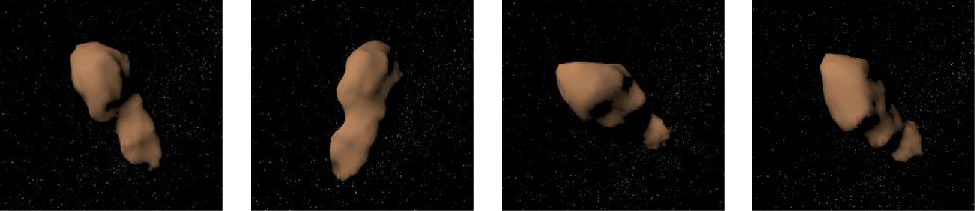
If most of the current population of Earth-approaching asteroids will be removed by impact or ejection in a hundred million years, there must be a continuing source of new objects to replenish our supply of NEAs. Most of them come from the asteroid belt between Mars and Jupiter, where collisions between asteroids can eject fragments into Earth-crossing orbits (see Figure 13.15). Others may be “dead” comets that have exhausted their volatile materials (which we’ll discuss in the next section).
英語のヒント
現在の地球接近小惑星の集団の大部分が、1億年で衝突や放出によって取り除かれるのなら、NEAを補う新たな天体の供給源が、継続して存在するはずだ。大部分は火星と木星の間の小惑星帯から来る。そこでは、小惑星どうしの衝突が、地球の軌道を横切る軌道へ破片を放り出すことがある(図13.15参照)。残りの一部は、揮発性物質を使い果たした「死んだ」彗星かもしれない。これについては次の節で論じる。
Near-Earth Asteroid.地球近傍小惑星。
credit: modification of work by NASA · NASA media use guidelines
Figure 13.15 Toutatis is a 5-kilometer long NEA that approached within 3 million kilometers of Earth in 1992. This series of images is a reconstruction its size and shape obtained from bouncing radar waves off the asteroid during its close flyby. Toutatis appears to consist of two irregular, lumpy bodies rotating in contact with each other. (Note that the color has been artificially added.) (credit: modification of work by NASA)
図13.15 トータティスは長さ5kmのNEAで、1992年に地球から300万km以内へ接近した。この一連の画像は、近接フライバイ中に小惑星へレーダー波を当てて反射を測定し、得られた大きさと形を復元したものだ。トータティスは、不規則でごつごつした二つの天体が接触したまま回転しているように見える。(色は人工的に加えられている。)(クレジット:NASAの作品を改変)
One reason scientists are interested in the composition and interior structure of NEAs is that humans will probably need to defend themselves against an asteroid impact someday. If we ever found one of these asteroids on a collision course with us, we would need to deflect it so it would miss Earth. The most straightforward way to deflect it would be to crash a spacecraft into it, either slowing it or speeding it up, slightly changing its orbital period. If this were done several years before the predicted collision, the asteroid would miss the planet entirely—making an asteroid impact the only natural hazard that we could eliminate completely by the application of technology. Alternatively, such deflection could be done by exploding a nuclear bomb near the asteroid to nudge it off course, although the use of nuclear explosives in space raises other concerns.
英語のヒント
科学者がNEAの組成や内部構造に関心を持つ理由の一つは、人類がいつか小惑星衝突から身を守る必要に迫られるだろうということだ。もしそのような小惑星が地球への衝突軌道にあるとわかったら、地球を外れるよう進路を変えなければならない。最も直接的な方法は、探査機を衝突させることだ。小惑星をわずかに減速または加速させ、公転周期を少し変える。予測される衝突の数年前にこれを行えば、小惑星は地球を完全に外れるだろう。そうなれば、小惑星衝突は、技術の応用で完全に取り除ける唯一の自然災害となる。別の方法として、小惑星の近くで核爆弾を爆発させて少し押し、進路を外すことも考えられる。ただし、宇宙で核爆発物を使うことには、別の懸念が生じる。
To achieve a successful deflection by either technique, we need to know more about the density and interior structure of the asteroid. A spacecraft impact or a nearby explosion would have a greater effect on a solid rocky asteroid such as Eros than on a loose rubble pile. Think of climbing a sand dune compared to climbing a rocky hill with the same slope. On the dune, much of our energy is absorbed in the slipping sand, so the climb is much more difficult and takes more energy.
英語のヒント
どちらの方法で進路変更を成功させるにも、小惑星の密度と内部構造について、さらに知る必要がある。探査機の衝突や近くでの爆発は、緩いがれきの集まりより、エロスのような一体の岩石小惑星に対して大きな効果を持つだろう。同じ勾配の砂丘と岩山を登る場合を比べてみよう。砂丘では、エネルギーの多くが滑り落ちる砂に吸収されるため、登るのはずっと難しく、より多くのエネルギーを必要とする。
The NASA Planetary Protection Office has sponsored a first space mission to test asteroid deflection technology. The DART (Double Asteroid Redirection Test) was launched in November 2021, and eleven months later, the half-ton spacecraft collided with Dimorphos, the moon of asteroid Didymos. Dimorphos is roughly the size of one of the great Egyptian pyramids. The automated spacecraft homed in on this tiny target and returned a spectacular set of images as it approached at 6 km/s. The primary mission objective was to measure the momentum the collision transferred to the target asteroid by tracking the change in the orbital period of Dimorphos using telescopes on Earth. The post-impact period was shortened by 32 minutes, which showed us that the large plume of ejected debris (visible in Earth-based telescopes) transferred additional momentum beyond that of the spacecraft impact itself, amplifying the collision by about a factor of three.
英語のヒント
NASAの惑星保護室は、小惑星の進路を変える技術を試す初の宇宙ミッションを支援した。DART(二重小惑星進路変更試験)は2021年11月に打ち上げられ、11か月後、質量0.5トンの探査機が、小惑星ディディモスの衛星ディモルフォスに衝突した。ディモルフォスの大きさは、エジプトの大ピラミッドの一つとおおよそ同じだ。自律型の探査機はこの小さな標的へ誘導され、毎秒6kmで接近する間、すばらしい一連の画像を送り返した。主な目的は、地上の望遠鏡でディモルフォスの公転周期の変化を追跡し、衝突によって標的の小惑星へ移った運動量を測定することだった。衝突後、公転周期は32分短くなった。これは、地上の望遠鏡でも見えた大きな破片の噴出が、探査機そのものの衝突に加えて運動量を伝え、衝突の効果を約3倍に増幅したことを示した。
The Hera mission is a follow-up European spacecraft, launched in 2024, on a two-year flight to the Didymos system. It will rendezvous with Dimorphos to improve our knowledge of the DART results by measuring the mass and composition of Dimorphos and examining the impact crater we made.
英語のヒント
ヘラは、後続の欧州の探査機で、ディディモス系への2年間の飛行に向けて2024年に打ち上げられた。ディモルフォスとランデブーし、その質量と組成の測定や、人類が作った衝突クレーターの調査によって、DARTの結果への理解を深める予定だ。
Planetary defense has become a subject of increasing international interest. The United Nations has formed two technical committees on planetary defense, recognizing that the entire planet is at risk from asteroid impacts. However, the fundamental problem remains one of finding NEAs in time for defensive measures to be taken. We must be able to find the next impactor before it finds us. And that’s a job for the astronomers! The search will expand significantly using the new Rubin wide-field telescope and a planned NASA search with the NEO Surveyor satellite, now under development.
英語のヒント
地球防衛は、国際的な関心がますます高まるテーマとなっている。国際連合は、小惑星衝突の危険に地球全体がさらされていることを認識し、地球防衛について二つの技術委員会を設置した。しかし根本的な問題は、防衛措置を取るのに間に合う時期にNEAを見つけることにある。次の衝突天体が私たちを見つける前に、こちらから見つけられなければならない。そして、それこそ天文学者の仕事だ! 新しいルービン広視野望遠鏡と、現在開発中のNEOサーベイヤー衛星を使うNASAの計画によって、探索は大幅に拡充されるだろう。