第4章地球・月・空Earth, Moon, and Sky
Mean Solar Time and Standard Time平均太陽時と標準時
Instead, we can consider the mean solar time, which is based on the average value of the solar day over the course of the year. A mean solar day contains exactly 24 hours and is what we use in our everyday timekeeping. Although mean solar time has the advantage of progressing at a uniform rate, it is still inconvenient for practical use because it is determined by the position of the Sun. For example, noon occurs when the Sun is highest in the sky on the meridian (but not necessarily at the zenith). But because we live on a round Earth, the exact time of noon is different as you change your longitude by moving east or west.
英語のヒント
そこで代わりに、1年を通じた太陽日の平均値を基礎とする平均太陽時を考えられる。1平均太陽日はちょうど24時間で、日常の時刻を測る際に使われるものである。平均太陽時には一定の速さで進む利点があるが、太陽の位置によって決まるため、実用上はなお不便である。たとえば正午は、太陽が子午線上で空の最も高い位置に来るときである。ただし、それが必ず天頂とは限らない。しかも私たちは丸い地球に住んでいるため、東西に移動して経度が変わると、正午になる正確な時刻も変わる。
If mean solar time were strictly observed, people traveling east or west would have to reset their watches continually as the longitude changed, just to read the local mean time correctly. For instance, a commuter traveling from Oyster Bay on Long Island to New York City would have to adjust the time on the trip through the East River tunnel because Oyster Bay time is actually about 1.6 minutes more advanced than that of Manhattan. (Imagine an airplane trip in which an obnoxious flight attendant gets on the intercom every minute, saying, “Please reset your watch for local mean time.”)
英語のヒント
平均太陽時を厳密に守るなら、東や西へ移動する人は、その場所の平均時を正しく読むだけのために、経度が変わるたびに時計を合わせ直さなければならない。たとえばロングアイランドのオイスターベイからニューヨーク市へ通勤する人は、イースト川のトンネルを通る途中で時刻を直す必要がある。オイスターベイの時刻は、実際にマンハッタンより約1.6分進んでいるからである。飛行機の旅で、うるさい客室乗務員が毎分インターホンを使い、「時計を現地の平均時に合わせ直してください」と言うところを想像してみよう。
Until near the end of the nineteenth century, every city and town in the United States kept its own local mean time. With the development of railroads and the telegraph, however, the need for some kind of standardization became evident. In 1883, the United States was divided into four standard time zones (now six, including Hawaii and Alaska), each with one system of time within that zone.
英語のヒント
19世紀末近くまで、アメリカのどの都市や町も、独自の地方平均時を使っていた。しかし鉄道と電信が発達すると、何らかの標準化が必要なのは明らかになった。1883年、アメリカは四つの標準時間帯に分けられ、それぞれの帯の内部では一つの時刻体系を使うようになった。現在はハワイとアラスカを含めて六つである。
By 1900, most of the world was using the system of 24 standardized global time zones. Within each zone, all places keep the same standard time, with the local mean solar time of a standard line of longitude running more or less through the middle of each zone. Now travelers reset their watches only when the time change has amounted to a full hour. Pacific standard time is 3 hours earlier than eastern standard time, a fact that becomes painfully obvious in California when someone on the East Coast forgets and calls you at 5:00 a.m.
英語のヒント
1900年までには、世界の大半が、地球を24の標準時間帯に分ける仕組みを使っていた。各時間帯の中では、ほぼその中央を通る基準の経線の地方平均太陽時を使い、どの場所でも同じ標準時を保つ。旅行者が時計を合わせ直すのは、時差が丸1時間になったときだけでよくなった。太平洋標準時は東部標準時より3時間遅い。東海岸の人がそれを忘れて午前5時に電話をかけてきたとき、カリフォルニアの人はこの事実を痛感する。
Globally, almost all countries have adopted one or more standard time zones, although one of the largest nations, India, has settled on a half-zone, being 5.5 hours from Greenwich standard. Also, China officially uses only one time zone, so all the clocks in that country keep the same time. In Tibet, for example, the Sun rises while the clocks (which keep Beijing time) say it is midmorning already.
英語のヒント
世界では、ほぼすべての国が一つ以上の標準時間帯を採用している。ただし、大国の一つインドは、グリニッジの標準時との差が5.5時間となる、半時間ずれた時間帯を選んでいる。また、中国では公式には一つの時間帯しか使わないので、国内のすべての時計が同じ時刻を示す。たとえばチベットでは、北京時間を示す時計がすでに午前の半ばを指しているころ、太陽が昇る。
Daylight saving time is simply the local standard time of the place plus 1 hour. It has been adopted for spring and summer use in most states in the United States, as well as in many countries, to prolong the sunlight into evening hours, on the apparent theory that it is easier to change the time by government action than it would be for individuals or businesses to adjust their own schedules to produce the same effect. It does not, of course, “save” any daylight at all—because the amount of sunlight is not determined by what we do with our clocks—and its observance is a point of legislative debate in some states.
英語のヒント
夏時間は、その場所の標準時に1時間を足したものにすぎない。アメリカの大半の州と多くの国で、春と夏に採用され、日光のある時間を時計の上で夕方のほうへ延ばす。個人や企業がそれぞれ予定を調整して同じ効果を得るより、政府が時刻を変えるほうが簡単だ、という考えに基づくようである。もちろん、日光そのものを少しでも「節約」するわけではない。日光の量は、私たちが時計をどう扱うかでは決まらないからである。夏時間を実施するかどうかは、一部の州で立法上の論点になっている。
The International Date Line国際日付変更線
The fact that time is always advancing as you move toward the east presents a problem. Suppose you travel eastward around the world. You pass into a new time zone, on the average, about every 15° of longitude you travel, and each time you dutifully set your watch ahead an hour. By the time you have completed your trip, you have set your watch ahead a full 24 hours and thus gained a day over those who stayed at home.
英語のヒント
東へ進むほど時刻が先へ進むことには、一つ問題がある。東回りに世界を1周するとしよう。平均すれば、経度を約15°進むたびに新しい時間帯に入り、その都度きちんと時計を1時間進める。旅を終えるころには時計を合計24時間進めたことになり、家にとどまっていた人より1日先へ進んでしまう。
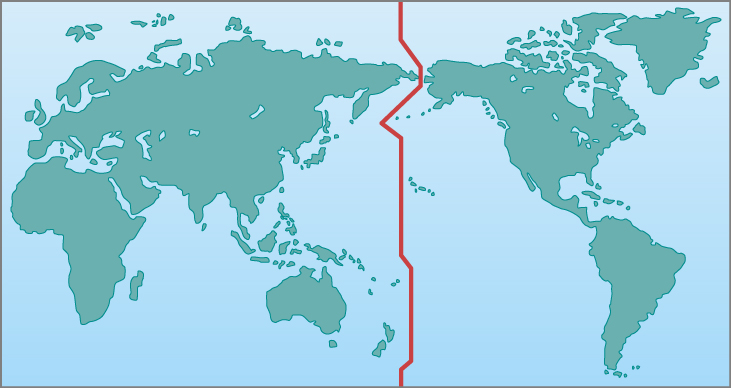
The solution to this dilemma is the International Date Line, set by international agreement to run approximately along the 180° meridian of longitude. The date line runs down the middle of the Pacific Ocean, although it jogs a bit in a few places to avoid cutting through groups of islands and through Alaska (Figure 4.11). By convention, at the date line, the date of the calendar is changed by one day. Crossing the date line from west to east, thus advancing your time, you compensate by decreasing the date; crossing from east to west, you increase the date by one day. To maintain our planet on a rational system of timekeeping, we simply must accept that the date will differ in different cities at the same time. A good example is the date when the Imperial Japanese Navy bombed Pearl Harbor in Hawaii, known in the United States as Sunday, December 7, 1941, but taught to Japanese students as Monday, December 8.
英語のヒント
この困りごとの解決策が国際日付変更線である。国際的な取り決めによって、おおむね経度180°の子午線に沿うように置かれている。日付変更線は太平洋の中央を南北に通るが、島々やアラスカを横切らないよう、所々で少し曲がっている(図4.11)。慣習により、この線で暦の日付を1日変える。西から東へ越えるときは、それまで時刻を進めてきた分を埋め合わせるため、日付を1日戻す。東から西へ越えるときは、日付を1日進める。地球全体で筋の通った時刻の仕組みを保つには、同じ瞬間でも都市によって日付が違うことを、受け入れなければならない。よい例が、日本海軍がハワイの真珠湾を爆撃した日である。アメリカでは1941年12月7日の日曜日として知られるが、日本の生徒には12月8日の月曜日と教えられる。
Where the Date Changes.日付が変わる場所。
OpenStax / Rice University · CC BY 4.0
Figure 4.11 The International Date Line is an arbitrarily drawn line on Earth where the date changes. So that neighbors do not have different days, the line is located where Earth’s surface is mostly water.
図4.11 国際日付変更線は、日付が変わる場所として地球上に取り決めて引いた線である。隣同士の地域で日付が違ってしまわないよう、地表の大半が海になっている場所を通す。