第4章地球・月・空Earth, Moon, and Sky
4.4 The Calendar4.4 暦
Learning Objectives学習の目標
By the end of this section, you will be able to:
この節を学ぶと、次のことができるようになる。
Understand how calendars varied among different cultures
文化によって暦がどのように異なっていたかを理解する。
Explain the origins of our modern calendar
現在の暦の起源を説明する。
“What’s today’s date?” is one of the most common questions you can ask (usually when signing a document or worrying about whether you should have started studying for your next astronomy exam). Long before the era of digital watches, smartphones, and fitness bands that tell the date, people used calendars to help measure the passage of time.
英語のヒント
「今日は何月何日?」は、私たちがよく尋ねる質問の一つである。書類に署名するときや、次の天文学の試験に向けて、もう勉強を始めるべきだったかと心配するときなどに出てくる。日付を教えてくれるデジタル時計、スマートフォン、活動量計バンドの時代よりはるか前から、人々は時の経過を測るために暦を使ってきた。
The Challenge of the Calendar暦の難しさ
There are two traditional functions of any calendar. First, it must keep track of time over the course of long spans, allowing people to anticipate the cycle of the seasons and to honor special religious or personal anniversaries. Second, to be useful to a large number of people, a calendar must use natural time intervals that everyone can agree on—those defined by the motions of Earth, the Moon, and sometimes even the planets. The natural units of our calendar are the day, based on the period of rotation of Earth; the month, based on the cycle of the Moon’s phases (see later in this chapter) about Earth; and the year, based on the period of revolution of Earth about the Sun. Difficulties have resulted from the fact that these three periods are not commensurable; that’s a fancy way of saying that one does not divide evenly into any of the others.
英語のヒント
どの暦にも、伝統的に二つの役割がある。一つは長い期間にわたって時を数え、季節の巡りを予測したり、宗教や個人の特別な記念日を祝ったりできるようにすることである。もう一つは、多くの人に役立つよう、誰もが同意できる自然の時間間隔を使うことである。それは地球や月、場合によっては惑星の運動が定める間隔である。暦の自然な単位は、地球の自転周期に基づく日、地球の周りを回る月の満ち欠けの周期に基づく月、そして地球が太陽の周りを公転する周期に基づく年である。月の満ち欠けについては、この章の後半で扱う。難しさは、この三つの周期が整数比にならないことにある。専門的には「通約できない」というが、要するに、どれか一つで別の周期を割っても、整数で割り切れないという意味である。
The rotation period of Earth is, by definition, 1.0000 day (and here the solar day is used, since that is the basis of human experience). The period required by the Moon to complete its cycle of phases, called the month, is 29.5306 days. The basic period of revolution of Earth, called the tropical year, is 365.2422 days. The ratios of these numbers are not convenient for calculations. This is the historic challenge of the calendar, dealt with in various ways by different cultures.
英語のヒント
地球の自転周期は、定義上1.0000日である。ここでは、人間の経験の基礎となる太陽日を使う。月の満ち欠けがひと巡りするのに要する周期は、1か月と呼ばれ、29.5306日である。地球の基本的な公転周期である太陽年は365.2422日である。これらの数値の比は、計算に都合のよいものではない。これが暦にまつわる歴史的な難問であり、文化ごとにさまざまな方法で対処してきた。
Early Calendars初期の暦
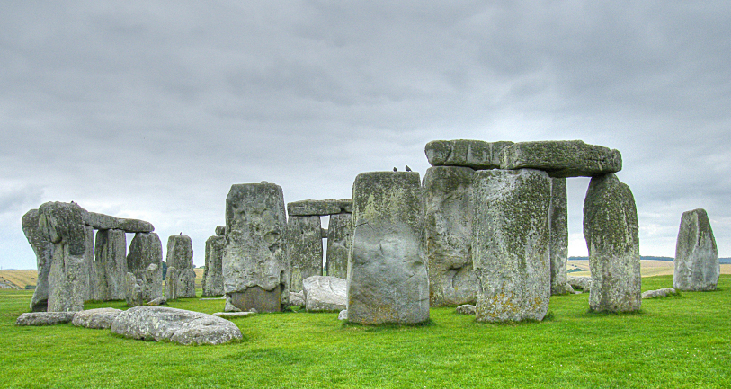
Even the earliest cultures were concerned with the keeping of time and the calendar. Some interesting examples include monuments left by Bronze Age people in northwestern Europe, especially the British Isles. The best preserved of the monuments is Stonehenge, about 13 kilometers from Salisbury in southwest England (Figure 4.12). It is a complex array of stones, ditches, and holes arranged in concentric circles. Carbon dating and other studies show that Stonehenge was built during three periods ranging from about 2800 to 1500 BCE. Some of the stones are aligned with the directions of the Sun and Moon during their risings and settings at critical times of the year (such as the summer and winter solstices), and it is generally believed that at least one function of the monument was connected with the keeping of a calendar.
英語のヒント
最も初期の文化でも、時を測ることや暦に関心が向けられていた。興味深い例として、ヨーロッパ北西部、とくにブリテン諸島に青銅器時代の人々が残した遺構がある。その中で最もよく保存されているのが、イングランド南西部のソールズベリーから約13キロメートルにあるストーンヘンジである(図4.12)。そこには石や溝、穴が、同心円状に複雑に配置されている。炭素年代測定などの研究は、ストーンヘンジが紀元前2800年ごろから前1500年ごろまでの三つの時期に建造されたことを示している。石の一部は、夏至や冬至といった1年の重要な時期に、太陽や月が昇り沈む方向に並ぶ。遺構の役割の少なくとも一つは、暦を保つことに関係していたと一般に考えられている。
Stonehenge.ストーンヘンジ。
credit: modification of work by Adriano Aurelio Araujo · CC BY 2.0
Figure 4.12 The ancient monument known as Stonehenge was used to keep track of the motions of the Sun and Moon. (credit: modification of work by Adriano Aurelio Araujo)
図4.12 ストーンヘンジとして知られる古代の遺構は、太陽と月の運動を追跡するために使われた。(出典:Adriano Aurelio Araujoの作品を改変)
The Maya in Central America, who thrived more than a thousand years ago, were also concerned with the keeping of time. Their calendar was as sophisticated as, and perhaps more complex than, contemporary calendars in Europe. The Maya did not attempt to correlate their calendar accurately with the length of the year or lunar month. Rather, their calendar was a system for keeping track of the passage of days and for counting time far into the past or future. Among other purposes, it was useful for predicting astronomical events, such as the position of Venus in the sky (Figure 4.13).
英語のヒント
1000年以上前に栄えた中央アメリカのマヤの人々も、時を測ることに関心を寄せていた。マヤの暦は、同時代のヨーロッパの暦と同じくらい高度で、おそらくそれ以上に複雑だった。マヤは、暦を1年や太陰月の長さに正確に一致させようとはしなかった。むしろその暦は、日々の経過を記録し、遠い過去や未来まで時間を数える仕組みだった。用途はいくつもあり、空での金星の位置など、天文学的な出来事の予測にも役立った(図4.13)。
El Caracol.エル・カラコル。
Figure 4.13 This Mayan observatory at Chichen Itza in the Yucatan, Mexico, dates from around the year 1000. (credit: “wiredtourist.com”/Flickr)
図4.13 メキシコのユカタン半島、チチェン・イツァにあるマヤの天文台。1000年ごろにさかのぼる。(出典:「wiredtourist.com」/Flickr)
The ancient Chinese developed an especially complex calendar, largely limited to a few privileged hereditary court astronomer-astrologers. In addition to the motions of Earth and the Moon, they were able to fit in the approximately 12-year cycle of Jupiter, which was central to their system of astrology. The Chinese still preserve some aspects of this system in their cycle of 12 “years”—the Year of the Dragon, the Year of the Pig, and so on—that are defined by the position of Jupiter in the zodiac.
英語のヒント
古代中国では、とりわけ複雑な暦が発達した。それを扱う権限は、主に、天文学と占星術を担う少数の特権的な世襲の宮廷官に限られていた。彼らは地球と月の運動に加え、占星術の体系で中心的な役割を持つ、木星の約12年の周期も暦に組み込むことができた。中国には今も、辰年や亥年など、12の「年」の巡りに、この仕組みの名残がある。それらは黄道帯での木星の位置によって定められたものである。
Our Western calendar derives from a long history of timekeeping beginning with the Sumerians, dating back to at least the second millennium BCE, and continuing with the Egyptians and the Greeks around the eighth century BCE. These calendars led, eventually, to the Julian calendar, introduced by Julius Caesar, which approximated the year at 365.25 days, fairly close to the actual value of 365.2422. The Romans achieved this approximation by declaring years to have 365 days each, with the exception of every fourth year. The leap year was to have one extra day, bringing its length to 366 days, and thus making the average length of the year in the Julian calendar 365.25 days.
英語のヒント
私たちの西洋の暦は、少なくとも紀元前2千年紀にさかのぼるシュメール人に始まり、紀元前8世紀ごろのエジプト人やギリシャ人へと続く、長い時の計測の歴史に由来する。これらの暦は、やがてユリウス・カエサルが導入したユリウス暦につながった。ユリウス暦は1年を365.25日で近似した。これは実際の365.2422日にかなり近い。ローマ人は、4年に1度を例外として、毎年を365日と定めることで、この近似を実現した。例外の閏年には1日を加えて366日とし、ユリウス暦の1年の平均を365.25日にしたのである。
In this calendar, the Romans had dropped the almost impossible task of trying to base their calendar on the Moon as well as the Sun, although a vestige of older lunar systems can be seen in the fact that our months have an average length of about 30 days. However, lunar calendars remained in use in other cultures, and Islamic calendars, for example, are still primarily lunar rather than solar.
英語のヒント
この暦でローマ人は、太陽と月の両方を暦の基準にしようとする、ほとんど不可能な課題を断念した。ただし、1か月の平均の長さが約30日であることには、古い太陰暦の名残が見える。ほかの文化では太陰暦が使われ続け、たとえばイスラム暦は今でも、基本的には太陽ではなく月に基づいている。