第4章地球・月・空Earth, Moon, and Sky
The Moon’s Revolution and Rotation月の公転と自転
The Moon’s sidereal period—that is, the period of its revolution about Earth measured with respect to the stars—is a little over 27 days: the sidereal month is 27.3217 days to be exact. The time interval in which the phases repeat—say, from full to full—is the solar month, 29.5306 days. The difference results from Earth’s motion around the Sun. The Moon must make more than a complete turn around the moving Earth to get back to the same phase with respect to the Sun. As we saw, the Moon changes its position on the celestial sphere rather rapidly: even during a single evening, the Moon creeps visibly eastward among the stars, traveling its own width in a little less than 1 hour. The delay in moonrise from one day to the next caused by this eastward motion averages about 50 minutes.
英語のヒント
月の恒星周期、すなわち恒星を基準に測った地球の周りの公転周期は、27日を少し超える。正確には、1恒星月は27.3217日である。満月から次の満月というように、位相が繰り返す時間間隔は朔望月で、29.5306日である。この違いは、地球が太陽の周りを動くために生じる。太陽に対して同じ位相へ戻るには、月は動く地球の周りを、ちょうど1周するより余分に回らなければならない。すでに見たように、月は天球上の位置をかなり速く変える。一晩の間でさえ、恒星の間を東へじりじり進むのが目に見え、1時間弱で月自身の幅だけ動く。この東向きの運動によって、月の出は翌日には平均約50分遅れる。
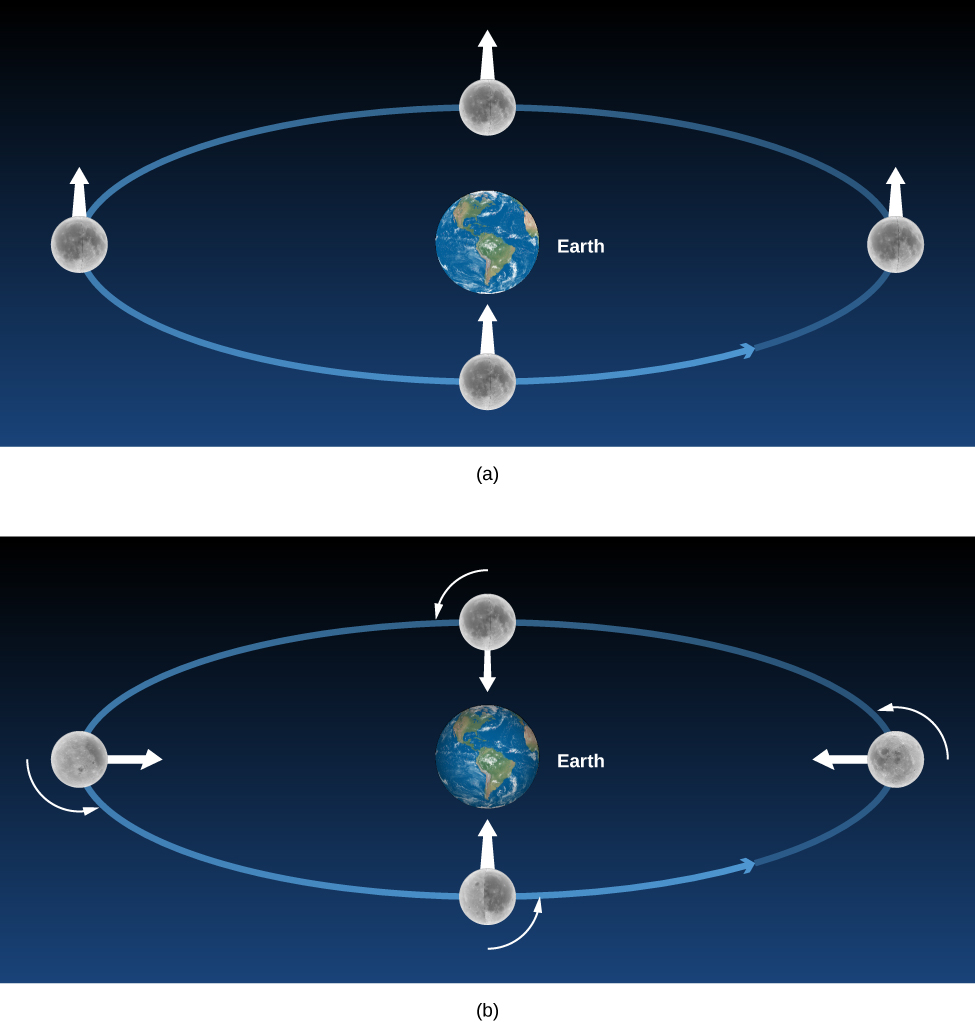
The Moon rotates on its axis in exactly the same time that it takes to revolve about Earth. As a consequence, the Moon always keeps the same face turned toward Earth (Figure 4.15). You can simulate this yourself by “orbiting” your roommate or another volunteer. Start by facing your roommate. If you make one rotation (spin) with your shoulders in the exact same time that you revolve around him or her, you will continue to face your roommate during the whole “orbit.” As we will see in coming chapters, our Moon is not the only world that exhibits this behavior, which scientists call synchronous rotation.
英語のヒント
月は、地球の周りを公転するのにかかる時間と、まったく同じ時間で自転する。その結果、月は常に同じ面を地球に向けている(図4.15)。これはルームメイトや協力者の周りを「公転」して、自分でも再現できる。まず相手に正面を向ける。相手の周りをひと回りするのとまったく同じ時間で、自分の肩の向きも1回転させれば、「軌道」の全体を通じて相手に顔を向け続けられる。後の章で見るように、この振る舞いを示す天体は月だけではない。科学者はこれを同期自転と呼ぶ。
The Moon without and with Rotation.月が自転しない場合と、自転する場合。
OpenStax / Rice University · CC BY 4.0
Figure 4.15 In this figure, we stuck a white arrow into a fixed point on the Moon to keep track of its sides. (a) If the Moon did not rotate as it orbited Earth, it would present all of its sides to our view; hence the white arrow would point directly toward Earth only in the bottom position on the diagram. (b) Actually, the Moon rotates in the same period that it revolves, so we always see the same side (the white arrow keeps pointing to Earth).
図4.15 この図では、月のどの面かを追えるよう、月の決まった地点に白い矢印を差し込んである。(a) 月が地球を回りながら自転しなければ、私たちからは月のあらゆる面が見える。そのため白い矢印が地球をまっすぐ向くのは、図の一番下の位置だけになる。(b) 実際の月は、公転と同じ周期で自転するので、私たちにはいつも同じ側が見える。白い矢印は、地球を向き続ける。
The differences in the Moon’s appearance from one night to the next are due to changing illumination by the Sun, not to its own rotation. You sometimes hear the back side of the Moon (the side we never see) called the “dark side.” This is a misunderstanding of the real situation: which side is light and which is dark changes as the Moon moves around Earth. The back side is dark no more frequently than the front side. Since the Moon rotates, the Sun rises and sets on all sides of the Moon. With apologies to Pink Floyd, there is simply no regular “Dark Side of the Moon.”
英語のヒント
月の見え方が夜ごとに変わるのは、太陽に照らされる向きが変わるためであり、月自身の自転によるのではない。月の裏側、つまり私たちから見えない側が、「暗い側」と呼ばれることがある。しかし、これは実際の状況を誤解している。月が地球を回るにつれて、どちらの側が明るく、どちらが暗いかは変わる。裏側が暗くなる頻度は、表側より高くはない。月は自転するので、月のどの側でも太陽が昇り、沈む。ピンク・フロイドには申し訳ないが、いつも決まった「Dark Side of the Moon」は存在しないのである。
Key Concepts and Summary重要事項のまとめ
The Moon’s monthly cycle of phases results from the changing angle of its illumination by the Sun. The full moon is visible in the sky only during the night; other phases are visible during the day as well. Because its period of revolution is the same as its period of rotation, the Moon always keeps the same face toward Earth.
月の約1か月の満ち欠けは、太陽に照らされる向きが変わることによって生じる。満月が空に見えるのは夜だけだが、ほかの位相は昼にも見える。月は公転周期と自転周期が等しいため、いつも同じ面を地球に向ける。
phases of the Moon
月の満ち欠け
the different appearance of light and dark on the Moon as seen from Earth during its monthly cycle, from new moon to full moon and back to new moon
約1か月の周期で、地球から見た月の明暗の形が変わること。新月から満月を経て、再び新月へ戻る。
sidereal month
恒星月
the period of the Moon’s revolution about Earth measured with respect to the stars
恒星を基準に測った、月が地球の周りを公転する周期。
solar month
朔望月
the time interval in which the phases repeat—say, from full to full phase
満月から次の満月というように、月の位相が繰り返す時間間隔。
synchronous rotation
同期自転
when a body (for example, the Moon) rotates at the same rate that it revolves around another body
月などの天体が、別の天体の周りを公転するのと同じ速さで自転すること。