第2章空を観測する――天文学の誕生Observing the Sky: The Birth of Astronomy
Galileo and the Beginning of Modern Scienceガリレオと近代科学の始まり
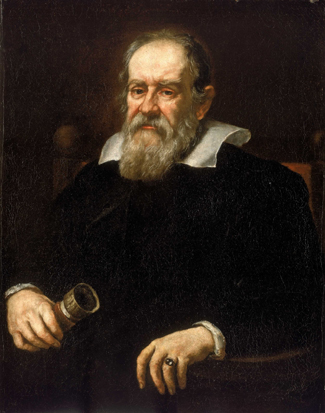
Many of the modern scientific concepts of observation, experimentation, and the testing of hypotheses through careful quantitative measurements were pioneered by a man who lived nearly a century after Copernicus. Galileo Galilei (Figure 2.19), a contemporary of Shakespeare, was born in Pisa. Like Copernicus, he began training for a medical career, but he had little interest in the subject and later switched to mathematics. He held faculty positions at the University of Pisa and the University of Padua, and eventually became mathematician to the Grand Duke of Tuscany in Florence.
英語のヒント
観測、実験、そして注意深い定量的な測定を通した仮説の検証といった、近代科学の考え方の多くを切り開いたのは、コペルニクスより一世紀ほど後に生きた人物であった。シェイクスピアと同時代のガリレオ・ガリレイ(図2.19)は、ピサに生まれた。コペルニクスと同じく医師を目指して学び始めたが、その分野にはあまり関心がなく、後に数学へ転じた。ピサ大学とパドヴァ大学で教員を務め、やがてフィレンツェでトスカーナ大公付きの数学者になった。
Galileo Galilei (1564–1642).ガリレオ・ガリレイ(1564〜1642年)
OpenStax / Rice University · CC BY 4.0
Figure 2.19 Galileo advocated that we perform experiments or make observations to ask nature its ways. When Galileo turned the telescope to the sky, he found things were not the way philosophers had supposed.
図2.19 ガリレオは、自然のあり方を自然に問いかけるために、実験や観測を行うべきだと主張した。望遠鏡を空へ向けると、そこにあったものは、哲学者たちが想定していたとおりではなかった。
Galileo’s greatest contributions were in the field of mechanics, the study of motion and the actions of forces on bodies. It was familiar to all persons then, as it is to us now, that if something is at rest, it tends to remain at rest and requires some outside influence to start it in motion. Rest was thus generally regarded as the natural state of matter. Galileo showed, however, that rest is no more natural than motion.
英語のヒント
ガリレオの最も大きな貢献は、物体の運動と、物体に及ぼす力の作用を研究する力学の分野にあった。何かが静止していると、そのまま静止し続けようとし、動き始めるには何らかの外からの作用が必要になる。このことは、今の私たちと同じように、当時の誰もが知っていた。このため、静止は一般に、物質の自然な状態だと考えられていた。しかしガリレオは、静止が運動より自然な状態であるわけではない、と示したのである。
If an object is slid along a rough horizontal floor, it soon comes to rest because friction between it and the floor acts as a retarding force. However, if the floor and the object are both highly polished, the object, given the same initial speed, will slide farther before stopping. On a smooth layer of ice, it will slide farther still. Galileo reasoned that if all resisting effects could be removed, the object would continue in a steady state of motion indefinitely. He argued that a force is required not only to start an object moving from rest but also to slow down, stop, speed up, or change the direction of a moving object. You will appreciate this if you have ever tried to stop a rolling car by leaning against it, or a moving boat by tugging on a line.
英語のヒント
粗い水平な床の上で物体を滑らせると、物体と床の間の摩擦が動きを妨げる力として働くため、すぐに止まる。しかし床と物体をどちらもよく磨けば、同じ初速を与えた物体は、止まるまでにもっと遠くへ滑る。滑らかな氷の上なら、さらに遠くまで滑るだろう。ガリレオは、抵抗となる作用をすべて取り除けたなら、物体は一定の運動状態をいつまでも保つだろうと推論した。そして、静止した物体を動かし始めるだけでなく、動いている物体を遅くする、止める、速くする、あるいは向きを変えるためにも、力が必要だと主張した。転がる自動車を体で押しとどめたり、動いている船を綱を引いて止めたりしたことがあれば、このことがよくわかるだろう。
Galileo also studied the way objects accelerate—change their speed or direction of motion. Galileo watched objects as they fell freely or rolled down a ramp. He found that such objects accelerate uniformly; that is, in equal intervals of time they gain equal increments in speed. Galileo formulated these newly found laws in precise mathematical terms that enabled future experimenters to predict how far and how fast objects would move in various lengths of time.
英語のヒント
ガリレオは、物体がどのように加速するか、つまり速さや運動の方向を変えるかも研究した。自由に落ちる物体や、斜面を転がり下りる物体を観察し、そのような物体が一様に加速することを発見した。すなわち、等しい時間がたつごとに、速さが同じ量だけ増えるのである。ガリレオは、こうして新たに見つけた法則を正確な数学の言葉で定式化した。これによって後の実験者は、さまざまな長さの時間のうちに、物体がどこまで動き、どれほど速くなるかを予測できるようになった。
Sometime in the 1590s, Galileo adopted the Copernican hypothesis of a heliocentric solar system. In Roman Catholic Italy, this was not a popular philosophy, for Church authorities still upheld the ideas of Aristotle and Ptolemy, and they had powerful political and economic reasons for insisting that Earth was the center of creation. Galileo not only challenged this thinking but also had the audacity to write in Italian rather than scholarly Latin, and to lecture publicly on those topics. For him, there was no contradiction between the authority of the Church in matters of religion and morality, and the authority of nature (revealed by experiments) in matters of science. It was primarily because of Galileo and his “dangerous” opinions that, in 1616, the Church issued a prohibition decree stating that the Copernican doctrine was “false and absurd” and not to be held or defended.
英語のヒント
1590年代のある時期に、ガリレオは、太陽を中心に置く太陽系についてのコペルニクスの仮説を受け入れた。ローマ・カトリックのイタリアでは、これは歓迎される考えではなかった。教会の権威者たちは依然としてアリストテレスとプトレマイオスの考えを支持し、地球が被造世界の中心だと言い張る、強い政治的・経済的な理由も持っていたからである。ガリレオはこの考えに挑むだけでなく、学者の言葉であるラテン語の代わりにイタリア語で書き、これらの話題について公に講義するという、大胆な行動にも出た。彼にとって、宗教や道徳の事柄における教会の権威と、科学の事柄における、実験によって明らかになる自然の権威との間には、矛盾はなかった。教会が1616年に、コペルニクスの学説は「誤りであり不合理」で、支持も擁護もしてはならないとする禁止令を出したのは、主にガリレオと彼の「危険な」意見のためであった。
Galileo’s Astronomical Observationsガリレオの天体観測
It is not certain who first conceived of the idea of combining two or more pieces of glass to produce an instrument that enlarged images of distant objects, making them appear nearer. The first such “spyglasses” (now called telescopes) that attracted much notice were made in 1608 by the Dutch spectacle maker Hans Lippershey (1570–1619). Galileo heard of the discovery and, without ever having seen an assembled telescope, constructed one of his own with a three-power magnification (3×), which made distant objects appear three times nearer and larger (Figure 2.20).
英語のヒント
二枚以上のガラスを組み合わせて、遠くの物体の像を拡大し、近くに見せる器具を作ることを、誰が最初に思いついたのかは、はっきりしていない。大きな注目を集めた最初のその種の「遠眼鏡」、現在の望遠鏡は、1608年に、オランダの眼鏡職人ハンス・リッペルハイ(1570〜1619年)によって作られた。ガリレオはその発見を聞き、組み上がった望遠鏡を一度も見ないまま、自分で倍率3倍(3×)の望遠鏡を作った。それによって遠くの物体は3倍近く、3倍大きく見えた(図2.20)。
Telescope Used by Galileo.ガリレオが用いた望遠鏡

OpenStax / Rice University · CC BY 4.0
Figure 2.20 The telescope has a wooden tube covered with paper and a lens 26 millimeters across.
図2.20 この望遠鏡には、紙を貼った木製の鏡筒と、直径26ミリメートルのレンズがある。
On August 25, 1609, Galileo demonstrated a telescope with a magnification of 9× to government officials of the city-state of Venice. By a magnification of 9×, we mean the linear dimensions of the objects being viewed appeared nine times larger or, alternatively, the objects appeared nine times closer than they really were. There were obvious military advantages associated with a device for seeing distant objects. For his invention, Galileo’s salary was nearly doubled, and he was granted lifetime tenure as a professor. (His university colleagues were outraged, particularly because the invention was not even original.)
英語のヒント
1609年8月25日、ガリレオは都市国家ヴェネツィアの政府の役人たちに、倍率9倍(9×)の望遠鏡を実演した。倍率9倍とは、見ている物体の縦や横の長さが9倍に見える、あるいは言い換えると、実際より9倍近くに見えるという意味である。遠くの物体を見る器具に軍事上の利点があるのは明らかであった。この発明により、ガリレオの給与はほぼ倍増し、教授として終身の地位を与えられた。(大学の同僚たちは激怒した。そもそも彼独自の発明ですらなかったことが、特に反感を招いたのである。)
Others had used the telescope before Galileo to observe things on Earth. But in a flash of insight that changed the history of astronomy, Galileo realized that he could turn the power of the telescope toward the heavens. Before using his telescope for astronomical observations, Galileo had to devise a stable mount and improve the optics. He increased the magnification to 30×. Galileo also needed to acquire confidence in the telescope.
英語のヒント
ガリレオより前にも、望遠鏡を使って地上の物を見る人はいた。しかし、天文学の歴史を変えることになるひらめきによって、ガリレオは、望遠鏡の力を天へ向けられると気づいた。天体観測に使うには、まず安定した架台を考案し、光学系を改良しなければならなかった。彼は倍率を30倍に高めた。さらに、望遠鏡を信頼できるという確信を得る必要もあった。
At that time, human eyes were believed to be the final arbiter of truth about size, shape, and color. Lenses, mirrors, and prisms were known to distort distant images by enlarging, reducing, or inverting them, or spreading the light into a spectrum (rainbow of colors). Galileo undertook repeated experiments to convince himself that what he saw through the telescope was identical to what he saw up close. Only then could he begin to believe that the miraculous phenomena the telescope revealed in the heavens were real.
英語のヒント
当時、大きさ、形、色について何が真実かを最終的に判定するのは、人間の目だと考えられていた。レンズ、鏡、プリズムは、遠くの像を拡大、縮小、反転させたり、光をスペクトル、すなわち虹のような色の帯に分けたりすることで、像をゆがめると知られていた。ガリレオは、望遠鏡を通して見たものが、間近で見たものと同じであることを自分で確信するため、繰り返し実験を行った。それを確かめて初めて、望遠鏡が天に明らかにした驚くべき現象が、本物だと信じ始めることができたのである。
Beginning his astronomical work late in 1609, Galileo found that many stars too faint to be seen with the unaided eye became visible with his telescope. In particular, he found that some nebulous blurs resolved into many stars, and that the Milky Way—the strip of whiteness across the night sky—was also made up of a multitude of individual stars.
英語のヒント
1609年の終わりごろに天文学の研究を始めたガリレオは、暗すぎて肉眼では見えない星が、望遠鏡では数多く見えることを発見した。特に、雲のようなぼんやりした光の一部が、多数の星に分かれて見えること、そして夜空を横切る白い帯である天の川も、多数の個々の恒星から成ることを見いだした。
Examining the planets, Galileo found four moons revolving about Jupiter in times ranging from just under 2 days to about 17 days. This discovery was particularly important because it showed that not everything has to revolve around Earth. Furthermore, it demonstrated that there could be centers of motion that are themselves in motion. Defenders of the geocentric view had argued that if Earth was in motion, then the Moon would be left behind because it could hardly keep up with a rapidly moving planet. Yet, here were Jupiter’s moons doing exactly that. (To recognize this discovery and honor his work, NASA named a spacecraft that explored the Jupiter system Galileo.)
英語のヒント
惑星を調べたガリレオは、木星のまわりを回る四つの衛星を発見した。その公転周期は、2日弱から約17日までにわたる。この発見は、すべてが地球のまわりを回る必要はないことを示したため、特に重要であった。さらに、運動の中心となる天体自体が動いていてもよいことを実証した。地球中心の見方を擁護する人々は、地球が動いていたら、速く動く惑星に月がついていくのは難しく、月は取り残されるはずだと主張していた。しかし、まさにそのことを、木星の衛星が実際にやっていたのである。(NASAは、この発見をたたえ、彼の仕事に敬意を表して、木星系を探査した宇宙機を「ガリレオ」と名付けた。)
With his telescope, Galileo was able to carry out the test of the Copernican theory mentioned earlier, based on the phases of Venus. Within a few months, he had found that Venus goes through phases like the Moon, showing that it must revolve about the Sun, so that we see different parts of its daylight side at different times (see Figure 2.18.) These observations could not be reconciled with Ptolemy’s model, in which Venus circled about Earth. In Ptolemy’s model, Venus could also show phases, but they were the wrong phases in the wrong order from what Galileo observed.
英語のヒント
ガリレオは望遠鏡によって、先に述べた、金星の満ち欠けに基づくコペルニクスの理論の検証を行えた。数か月のうちに、金星が月のように満ち欠けすることを見いだした。これは、金星が太陽のまわりを回っているはずであり、そのため時期によって、太陽に照らされた側の異なる部分が見えることを示す(図2.18を参照)。これらの観測は、金星が地球のまわりを回るプトレマイオスのモデルとは両立しなかった。プトレマイオスのモデルでも金星は満ち欠けしえるが、その形も順序も、ガリレオが観測したものとは違っていたのである。
Galileo also observed the Moon and saw craters, mountain ranges, valleys, and flat, dark areas that he thought might be water. These discoveries showed that the Moon might be not so dissimilar to Earth—suggesting that Earth, too, could belong to the realm of celestial bodies.
英語のヒント
ガリレオは月も観測し、クレーター、山脈、谷、そして水かもしれないと考えた、平らで暗い領域を見た。これらの発見は、月が地球とそれほど違わないかもしれないことを示し、地球もまた天体の世界に属しうることを示唆した。
After Galileo’s work, it became increasingly difficult to deny the Copernican view, and Earth was slowly dethroned from its central position in the universe and given its rightful place as one of the planets attending the Sun. Initially, however, Galileo met with a great deal of opposition. The Roman Catholic Church, still reeling from the Protestant Reformation, was looking to assert its authority and chose to make an example of Galileo. He had to appear before the Inquisition to answer charges that his work was heretical, and he was ultimately condemned to house arrest. His books were on the Church’s forbidden list until 1836, although in countries where the Roman Catholic Church held less sway, they were widely read and discussed. Not until 1992 did the Catholic Church admit publicly that it had erred in the matter of censoring Galileo’s ideas.
英語のヒント
ガリレオの仕事の後、コペルニクスの見方を否定することは次第に難しくなった。地球はゆっくりと宇宙の中心の座から退けられ、太陽に従う惑星の一つという、本来の位置を与えられた。しかし当初、ガリレオは激しい反対に遭った。プロテスタントの宗教改革でまだ動揺していたローマ・カトリック教会は、権威を主張しようとしており、ガリレオを見せしめにすることを選んだ。彼は自分の仕事が異端だという告発に答えるため、異端審問の場に出なければならず、最終的に自宅軟禁を命じられた。彼の著書は1836年まで教会の禁書目録に載っていた。それでも、ローマ・カトリック教会の影響力が弱い国々では、広く読まれ、議論された。カトリック教会が、ガリレオの考えを検閲した件で誤ったことを公に認めたのは、1992年になってからであった。
The new ideas of Copernicus and Galileo began a revolution in our conception of the cosmos. It eventually became evident that the universe is a vast place and that Earth’s role in it is relatively unimportant. The idea that Earth moves around the Sun like the other planets raised the possibility that they might be worlds themselves, perhaps even supporting life. As Earth was demoted from its position at the center of the universe, so, too, was humanity. The universe, despite what we may wish, does not revolve around us.
英語のヒント
コペルニクスとガリレオの新しい考えは、私たちの宇宙観に革命を起こした。やがて、宇宙は広大であり、その中で地球の果たす役割は相対的に重要でないことが明らかになった。地球がほかの惑星と同じように太陽のまわりを動くという考えは、ほかの惑星もそれぞれ一つの世界であり、ひょっとすると生命を育んでいるかもしれない、という可能性を生んだ。地球が宇宙の中心の地位を失うにつれ、人類もまた、その地位を失った。私たちがどう願おうと、宇宙は私たちのまわりを回っているわけではないのである。
Most of us take these things for granted today, but four centuries ago such concepts were frightening and heretical for some, immensely stimulating for others. The pioneers of the Renaissance started the European world along the path toward science and technology that we still tread today. For them, nature was rational and ultimately knowable, and experiments and observations provided the means to reveal its secrets.
英語のヒント
今日、私たちの大半はこうしたことを当然と受け止めている。しかし4世紀前には、それは、ある人々には恐ろしく異端的で、別の人々には非常に刺激的な考えであった。ルネサンスの先駆者たちは、今も私たちが歩む科学技術への道へ、ヨーロッパ世界を踏み出させた。彼らにとって自然は合理的で、究極的には知りうるものであり、実験と観測が、その秘密を明らかにする手段を与えてくれたのである。
Nicolaus Copernicus introduced the heliocentric cosmology to Renaissance Europe in his book De Revolutionibus. Although he retained the Aristotelian idea of uniform circular motion, Copernicus suggested that Earth is a planet and that the planets all circle about the Sun, dethroning Earth from its position at the center of the universe. Galileo was the father of both modern experimental physics and telescopic astronomy. He studied the acceleration of moving objects and, in 1609, began telescopic observations, discovering the nature of the Milky Way, the large-scale features of the Moon, the phases of Venus, and four moons of Jupiter. Although he was accused of heresy for his support of heliocentric cosmology, Galileo is credited with observations and brilliant writings that convinced most of his scientific contemporaries of the reality of the Copernican theory.
ニコラウス・コペルニクスは、著書『天球の回転について』を通じて、ルネサンス期のヨーロッパに太陽中心の宇宙観を導入した。アリストテレス以来の等速円運動という考えは保ったが、地球は惑星であり、すべての惑星が太陽のまわりを回ると提案し、地球を宇宙の中心の座から退けた。ガリレオは、近代的な実験物理学と望遠鏡天文学の両方の父であった。動く物体の加速度を研究し、1609年には望遠鏡による観測を始め、天の川の正体、月の大規模な地形、金星の満ち欠け、そして木星の四つの衛星を発見した。太陽中心の宇宙観を支持したために異端として告発されたが、観測と優れた著作によって、同時代の科学者の大半にコペルニクスの理論が現実を表していると確信させた功績が、ガリレオには認められている。