第2章空を観測する――天文学の誕生Observing the Sky: The Birth of Astronomy
2.4 The Birth of Modern Astronomy2.4 近代天文学の誕生
Learning Objectives学習の目標
By the end of this section, you will be able to:
この節を学ぶと、次のことができるようになる。
Explain how Copernicus developed the heliocentric model of the solar system
コペルニクスがどのように太陽中心の太陽系モデルを築いたかを説明する。
Explain the Copernican model of planetary motion and describe evidence or arguments in favor of it
コペルニクスの惑星運動のモデルを説明し、それを支持する証拠や論拠を述べる。
Describe Galileo’s discoveries concerning the study of motion and forces
運動と力の研究に関するガリレオの発見を述べる。
Explain how Galileo’s discoveries tilted the balance of evidence in favor of the Copernican model
ガリレオの発見が、証拠の重みをどのようにコペルニクスのモデルを支持する側へ傾けたかを説明する。
Astronomy made no major advances in strife-torn medieval Europe. The birth and expansion of Islam after the seventh century led to a flowering of Arabic and Jewish cultures that preserved, translated, and added to many of the astronomical ideas of the Greeks. Many of the names of the brightest stars, for example, are today taken from the Arabic, as are such astronomical terms as “zenith.”
英語のヒント
争いに引き裂かれた中世ヨーロッパでは、天文学に大きな進歩はなかった。7世紀以降のイスラム教の誕生と拡大は、アラビア人とユダヤ人の文化の開花につながり、それらの文化はギリシャ人の天文学上の考えを数多く保存し、翻訳し、さらに発展させた。たとえば明るい恒星の名前の多くは、今日もアラビア語に由来し、zenith(天頂)などの天文学用語も同様である。
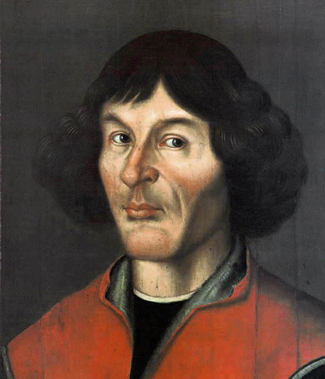
As European culture began to emerge from its long, dark age, trading with Arab countries led to a rediscovery of ancient texts such as Almagest and to a reawakening of interest in astronomical questions. This time of rebirth (in French, “renaissance”) in astronomy was embodied in the work of Copernicus (Figure 2.16).
英語のヒント
ヨーロッパの文化が長い暗黒時代から抜け出し始めると、アラブ諸国との交易によって『アルマゲスト』などの古代の文献が再発見され、天文学の問題への関心も再び目覚めた。天文学におけるこの再生の時代、フランス語でいう「ルネサンス」を体現したのが、コペルニクスの仕事であった(図2.16)。
Nicolaus Copernicus (1473–1543).ニコラウス・コペルニクス(1473〜1543年)
OpenStax / Rice University · CC BY 4.0
Figure 2.16 Copernicus was a cleric and scientist who played a leading role in the emergence of modern science. Although he could not prove that Earth revolves about the Sun, he presented such compelling arguments for this idea that he turned the tide of cosmological thought and laid the foundations upon which Galileo and Kepler so effectively built in the following century.
図2.16 コペルニクスは聖職者であり科学者でもあり、近代科学の成立で主導的な役割を果たした。地球が太陽のまわりを公転することを証明はできなかったが、その考えを支持する説得力のある論拠を示し、宇宙観の潮流を変えた。また、その翌世紀にガリレオとケプラーが大きな成果を積み上げるための土台を築いた。
Copernicusコペルニクス
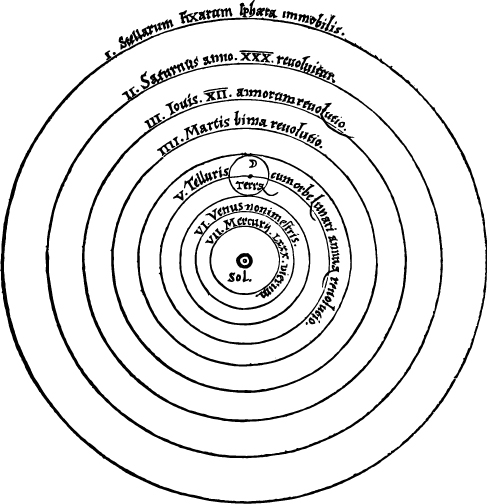
One of the most important events of the Renaissance was the displacement of Earth from the center of the universe, an intellectual revolution initiated by a Polish cleric in the sixteenth century. Nicolaus Copernicus was born in Torun, a mercantile town along the Vistula River. His training was in law and medicine, but his main interests were astronomy and mathematics. His great contribution to science was a critical reappraisal of the existing theories of planetary motion and the development of a new Sun-centered, or heliocentric, model of the solar system. Copernicus concluded that Earth is a planet and that all the planets circle the Sun. Only the Moon orbits Earth (Figure 2.17).
英語のヒント
ルネサンスの最も重要な出来事の一つは、地球が宇宙の中心という座から退けられたことであった。これは、16世紀にポーランドの一人の聖職者が始めた、知的な革命である。ニコラウス・コペルニクスは、ヴィスワ川沿いの商業都市トルンに生まれた。法律と医学を学んだが、主な関心は天文学と数学にあった。科学への大きな貢献は、それまでの惑星運動の理論を批判的に再検討し、太陽を中心とする新しい太陽系モデル、すなわち太陽中心説のモデルを発展させたことである。コペルニクスは、地球も惑星であり、すべての惑星は太陽のまわりを回ると結論した。地球のまわりを回るのは月だけである(図2.17)。
Copernicus’ System.コペルニクスの体系
credit: Nicolai Copernici · Public domain; OpenStax adaptation CC BY 4.0
Figure 2.17 Copernicus developed a heliocentric plan of the solar system. This system was published in the first edition of De Revolutionibus Orbium Coelestium. Notice the word Sol for “Sun” in the middle. (credit: Nicolai Copernici)
図2.17 コペルニクスは、太陽を中心に置く太陽系の構想を発展させた。この体系は『天球の回転について(De Revolutionibus Orbium Coelestium)』の初版に掲載された。中央に、太陽を意味する Sol という語があることに注目しよう。(クレジット:Nicolai Copernici)
Copernicus described his ideas in detail in his book De Revolutionibus Orbium Coelestium (On the Revolution of Celestial Orbs), published in 1543, the year of his death. By this time, the old Ptolemaic system needed significant adjustments to predict the positions of the planets correctly. Copernicus wanted to develop an improved theory from which to calculate planetary positions, but in doing so, he was himself not free of all traditional prejudices.
英語のヒント
コペルニクスは、死去した年である1543年に出版された著書『天球の回転について(De Revolutionibus Orbium Coelestium)』で、自分の考えを詳しく述べた。このころには、従来のプトレマイオスの体系で惑星の位置を正しく予測するには、大幅な調整が必要になっていた。コペルニクスは、惑星の位置を計算するための、より良い理論を作ろうとした。しかし、その際も、自身が従来の先入観をすべて脱していたわけではない。
He began with several assumptions that were common in his time, such as the idea that the motions of the heavenly bodies must be made up of combinations of uniform circular motions. But he did not assume (as most people did) that Earth had to be in the center of the universe, and he presented a defense of the heliocentric system that was elegant and persuasive. His ideas, although not widely accepted until more than a century after his death, were much discussed among scholars and, ultimately, had a profound influence on the course of world history.
英語のヒント
彼は、天体の運動は等速円運動の組み合わせからできていなければならない、という考えなど、当時一般的だったいくつかの前提から出発した。しかし、大半の人々とは違い、地球が宇宙の中心にあるはずだとは仮定せず、太陽中心の体系を、洗練された説得力のある議論で擁護した。その考えが広く受け入れられるのは、彼の死から一世紀以上たってからのことであった。それでも学者の間では盛んに議論され、最終的には世界史の流れに深い影響を及ぼした。
One of the objections raised to the heliocentric theory was that if Earth were moving, we would all sense or feel this motion. Solid objects would be ripped from the surface, a ball dropped from a great height would not strike the ground directly below it, and so forth. But a moving person is not necessarily aware of that motion. We have all experienced seeing an adjacent train, bus, or ship appear to move, only to discover that it is we who are moving.
英語のヒント
太陽中心説に対して出された反論の一つは、地球が動いているなら、誰もがその動きを感じるはずだというものであった。固体の物体は地表から引きはがされ、高い所から落とした球は真下の地面に当たらないはずだ、などというのである。しかし、動いている人が、必ずその運動に気づくとは限らない。隣の列車やバスや船が動いているように見えたのに、実は動いていたのは自分のほうだった、と気づく経験は、誰にでもあるだろう。
Copernicus argued that the apparent motion of the Sun about Earth during the course of a year could be represented equally well by a motion of Earth about the Sun. He also reasoned that the apparent rotation of the celestial sphere could be explained by assuming that Earth rotates while the celestial sphere is stationary. To the objection that if Earth rotated about an axis it would fly into pieces, Copernicus answered that if such motion would tear Earth apart, the still faster motion of the much larger celestial sphere required by the geocentric hypothesis would be even more devastating.
英語のヒント
コペルニクスは、一年を通して太陽が地球のまわりを動くという見かけの運動は、地球が太陽のまわりを動くことによっても、同じようにうまく表せると主張した。また、天球は静止していて地球が自転していると仮定すれば、天球の見かけの回転も説明できると考えた。地球が軸のまわりに回転すれば粉々に飛び散るはずだ、という反論には、次のように答えた。もしそのような運動で地球が引き裂かれるなら、地球中心説が必要とする、はるかに大きい天球の、さらに速い運動は、それ以上に破壊的なはずだというのである。
The Heliocentric Model太陽中心のモデル
The most important idea in Copernicus’ De Revolutionibus is that Earth is one of six (then-known) planets that revolve about the Sun. Using this concept, he was able to work out the correct general picture of the solar system. He placed the planets, starting nearest the Sun, in the correct order: Mercury, Venus, Earth, Mars, Jupiter, and Saturn. Further, he deduced that the nearer a planet is to the Sun, the greater its orbital speed. With his theory, he was able to explain the complex retrograde motions of the planets without epicycles and to work out a roughly correct scale for the solar system.
英語のヒント
コペルニクスの『天球の回転について』の最も重要な考えは、地球が、太陽のまわりを公転する、当時知られていた六つの惑星の一つだというものである。この考えを使い、太陽系のおおまかな姿を正しく組み立てることができた。太陽に近いほうから、水星、金星、地球、火星、木星、土星という正しい順序に惑星を並べたのである。さらに、惑星は太陽に近いほど公転の速さが大きいと推論した。この理論によって、惑星の複雑な逆行を周転円なしで説明し、太陽系の尺度もほぼ正しく求めることができた。
Copernicus could not prove that Earth revolves about the Sun. In fact, with some adjustments, the old Ptolemaic system could have accounted, as well, for the motions of the planets in the sky. But Copernicus pointed out that the Ptolemaic cosmology was clumsy and lacking the beauty and symmetry of its successor.
英語のヒント
コペルニクスは、地球が太陽のまわりを公転することを証明できなかった。実際、従来のプトレマイオスの体系も、いくらか調整すれば、空での惑星の動きを同じように説明できただろう。しかしコペルニクスは、プトレマイオスの宇宙体系は扱いにくく、それに代わる新しい体系の美しさと対称性を欠いていると指摘した。
In Copernicus’ time, in fact, few people thought there were ways to prove whether the heliocentric or the older geocentric system was correct. A long philosophical tradition, going back to the Greeks and defended by the Catholic Church, held that pure human thought combined with divine revelation represented the path to truth. Nature, as revealed by our senses, was suspect. For example, Aristotle had reasoned that heavier objects (having more of the quality that made them heavy) must fall to Earth faster than lighter ones. This is absolutely incorrect, as any simple experiment dropping two balls of different weights shows. However, in Copernicus’ day, experiments did not carry much weight (if you will pardon the expression); Aristotle’s reasoning was more convincing.
英語のヒント
実のところ、コペルニクスの時代には、太陽中心の体系と従来の地球中心の体系のどちらが正しいかを証明する方法がある、と考える人はほとんどいなかった。ギリシャ人にさかのぼり、カトリック教会も擁護した長い哲学の伝統では、人間の純粋な思考と神の啓示の組み合わせこそが、真理への道だとされていた。感覚を通して現れる自然は、疑わしいものとみなされたのである。たとえばアリストテレスは、重い物体は、それを重くする性質をより多く備えているのだから、軽い物体より速く地上へ落ちるはずだと考えた。重さの異なる二つの球を落とすだけの実験でわかるとおり、これは完全に誤りである。しかし、表現のしゃれをお許し願うなら、コペルニクスの時代に実験はさほど「重み」を持たず、アリストテレスの推論のほうが説得力を持っていた。
In this environment, there was little motivation to carry out observations or experiments to distinguish between competing cosmological theories (or anything else). It should not surprise us, therefore, that the heliocentric idea was debated for more than half a century without any tests being applied to determine its validity. (In fact, in the North American colonies, the older geocentric system was still taught at Harvard University in the first years after it was founded in 1636.)
英語のヒント
こうした環境では、競合する宇宙論のどちらが正しいかを見分けるために、あるいはほかの何かを確かめるために、観測や実験を行おうとする動機はほとんどなかった。したがって、太陽中心説が、その妥当性を確かめる検証を何も受けないまま、半世紀以上にわたって議論され続けたことは、驚くにはあたらない。(実際、北アメリカの植民地では、1636年に創設されたハーバード大学でも、開学後の最初の数年間は、従来の地球中心の体系がまだ教えられていた。)
Contrast this with the situation today, when scientists rush to test each new hypothesis and do not accept any ideas until the results are in. For example, when two researchers at the University of Utah announced in 1989 that they had discovered a way to achieve nuclear fusion (the process that powers the stars) at room temperature, other scientists at more than 25 laboratories around the United States attempted to duplicate “cold fusion” within a few weeks—without success, as it turned out. The cold fusion theory soon went down in flames.
英語のヒント
これを今日の状況と比べてみよう。現在の科学者は、新しい仮説が出るたびに急いで検証し、結果が出るまでは考えを受け入れない。たとえば1989年、ユタ大学の二人の研究者が、恒星のエネルギー源である核融合を室温で起こす方法を発見したと発表した。すると数週間のうちに、アメリカ各地の25を超える研究所で、ほかの科学者がこの「常温核融合」を再現しようと試みた。結局、成功は得られなかった。常温核融合の理論は、ほどなく瓦解したのである。
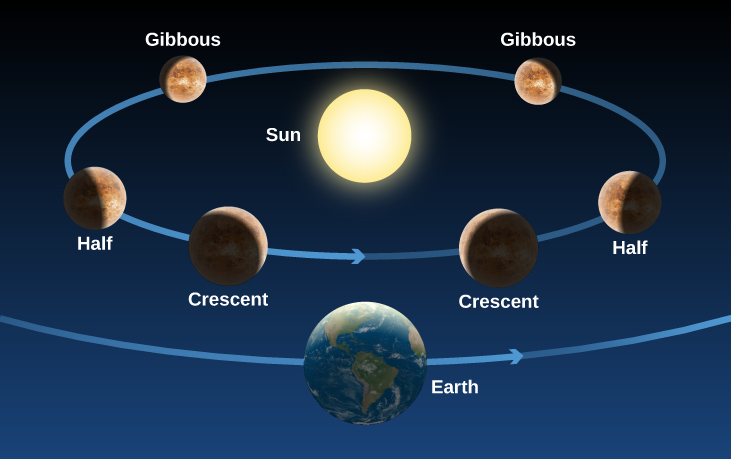
How would we look at Copernicus’ model today? When a new hypothesis or theory is proposed in science, it must first be checked for consistency with what is already known. Copernicus’ heliocentric idea passes this test, for it allows planetary positions to be calculated at least as well as does the geocentric theory. The next step is to determine which predictions the new hypothesis makes that differ from those of competing ideas. In the case of Copernicus, one example is the prediction that, if Venus circles the Sun, the planet should go through the full range of phases just as the Moon does, whereas if it circles Earth, it should not (Figure 2.18). Also, we should not be able to see the full phase of Venus from Earth because the Sun would then be between Venus and Earth. But in those days, before the telescope, no one imagined testing these predictions.
英語のヒント
今日なら、コペルニクスのモデルをどう見るだろうか。科学で新しい仮説や理論が提案されたときには、まず、すでに知られている事実との整合性を確認しなければならない。コペルニクスの太陽中心説はこの試験に合格する。惑星の位置を、少なくとも地球中心説と同じくらいよく計算できるからである。次の段階は、その新しい仮説が、競合する考えとは異なる、どんな予測をするのかを調べることである。コペルニクスの場合、その一例は金星の満ち欠けの予測である。金星が太陽のまわりを回るなら、月と同じように、満ち欠けのすべての段階を示すはずであるが、地球のまわりを回るなら、そうはならないはずである(図2.18)。また、金星が完全に満ちた姿は、そのとき太陽が金星と地球の間に来るため、地球からは見えないはずである。しかし、望遠鏡がまだなかった当時には、これらの予測を検証することを誰も思いつかなかった。
Phases of Venus.金星の満ち欠け
OpenStax / Rice University · CC BY 4.0
Figure 2.18 As Venus moves around the Sun, we see changing illumination of its surface, just as we see the face of the Moon illuminated differently in the course of a month.
図2.18 金星が太陽のまわりを動くと、地球から見える金星表面の照らされ方が変わる。これは、一か月の間に月の見える面の照らされ方が変わるのと同じである。