第2章空を観測する――天文学の誕生Observing the Sky: The Birth of Astronomy
Measurement of Earth by Eratosthenesエラトステネスによる地球の測定
The Greeks not only knew Earth was round, but also they were able to measure its size. The first fairly accurate determination of Earth’s diameter was made in about 200 BCE by Eratosthenes (276–194 BCE), a Greek living in Alexandria, Egypt. His method was a geometric one, based on observations of the Sun.
英語のヒント
ギリシャ人は地球が丸いと知っていただけでなく、その大きさも測定できた。地球の直径を初めてかなり正確に求めたのは、紀元前200年ごろ、エジプトのアレクサンドリアに住んでいたギリシャ人、エラトステネス(紀元前276〜194年)である。その方法は、太陽の観測に基づく幾何学的なものだった。
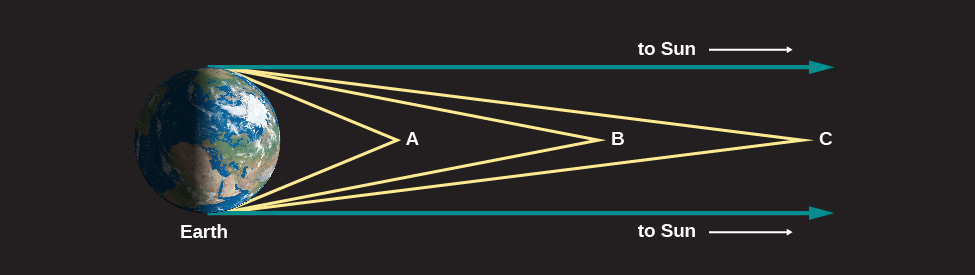
The Sun is so distant from us that all the light rays that strike our planet approach us along essentially parallel lines. To see why, look at Figure 2.10. Take a source of light near Earth—say, at position A. Its rays strike different parts of Earth along diverging paths. From a light source at B, or at C (which is still farther away), the angle between rays that strike opposite parts of Earth is smaller. The more distant the source, the smaller the angle between the rays. For a source infinitely distant, the rays travel along parallel lines.
英語のヒント
太陽は私たちから非常に遠いため、地球に当たる光線はすべて、ほぼ平行に近づいてくる。その理由は図2.10で考えてみよう。地球の近く、たとえばAの位置に光源を置く。そこからの光線は、互いに広がる道筋を通って、地球の異なる場所に当たる。光源をBに、あるいはさらに遠いCに置くと、地球の両側に当たる光線の間の角度は小さくなる。光源が遠いほど、光線の間の角度は小さくなるのである。光源が無限に遠ければ、光線は平行に進む。
Light Rays from Space.宇宙から届く光線。
OpenStax / Rice University · CC BY 4.0
Figure 2.10 The more distant an object, the more nearly parallel the rays of light coming from it.
図2.10 天体が遠いほど、そこから来る光線は、より平行に近くなる。
Of course, the Sun is not infinitely far away, but given its distance of 150 million kilometers, light rays striking Earth from a point on the Sun diverge from one another by an angle far too small to be observed with the unaided eye. As a consequence, if people all over Earth who could see the Sun were to point at it, their fingers would, essentially, all be parallel to one another. (The same is also true for the planets and stars—an idea we will use in our discussion of how telescopes work.)
英語のヒント
もちろん太陽は無限に遠いわけではない。それでも距離が1億5000万キロメートルあるため、太陽上の一点から地球へ届く光線同士の開きの角度は、肉眼では観測できないほど小さい。その結果、地球上のあらゆる場所で、太陽が見える人がその方向を指させば、その指は実質的に、すべて互いに平行になる。同じことは惑星や恒星にも当てはまる。この考え方は、望遠鏡の仕組みを説明する際に使う。
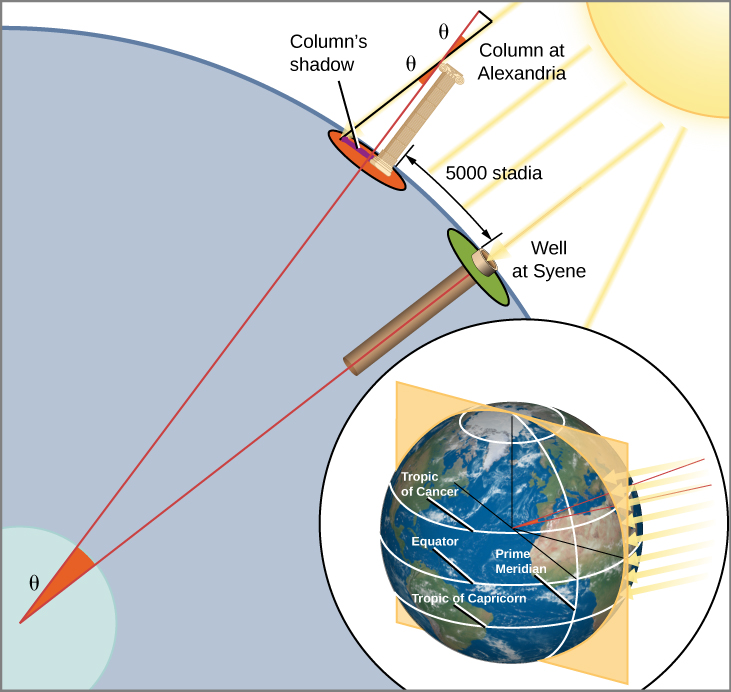
Eratosthenes was told that on the first day of summer at Syene, Egypt (near modern Aswan), sunlight struck the bottom of a vertical well at noon. This indicated that the Sun was directly over the well—meaning that Syene was on a direct line from the center of Earth to the Sun. At the corresponding time and date in Alexandria, Eratosthenes observed the shadow a column made and saw that the Sun was not directly overhead, but was slightly south of the zenith, so that its rays made an angle with the vertical equal to about 1/50 of a circle (7°). Because the Sun’s rays striking the two cities are parallel to one another, why would the two rays not make the same angle with Earth’s surface? Eratosthenes reasoned that the curvature of the round Earth meant that “straight up” was not the same in the two cities. And the measurement of the angle in Alexandria, he realized, allowed him to figure out the size of Earth. Alexandria, he saw, must be 1/50 of Earth’s circumference north of Syene (Figure 2.11). Alexandria had been measured to be 5000 stadia north of Syene. (The stadium was a Greek unit of length, derived from the length of the racetrack in a stadium.) Eratosthenes thus found that Earth’s circumference must be , or 250,000 stadia.
英語のヒント
エラトステネスは、エジプトのシエネ、現在のアスワン付近では、夏の初日に当たる日の正午、太陽光が垂直な井戸の底を照らすと聞いた。これは太陽が井戸の真上にあること、つまりシエネが地球の中心と太陽を結ぶ一直線上にあることを示していた。同じ日、同じ時刻のアレクサンドリアで、エラトステネスは柱がつくる影を観測した。そして太陽が頭の真上ではなく、天頂より少し南にあるため、光線が鉛直方向となす角度は、一周の約50分の1、約7度になるとわかった。二つの都市に当たる太陽光線は平行なのに、なぜ地表となす角度は同じにならないのだろうか。エラトステネスは、地球が丸く、表面が曲がっているため、二つの都市で「まっすぐ上」の方向が同じではないのだと考えた。そして、アレクサンドリアで角度を測れば、地球の大きさを計算できると気づいた。アレクサンドリアは、地球の周囲の50分の1だけ、シエネから北へ進んだところにあるはずだ(図2.11)。アレクサンドリアはシエネから5000スタディオン北にあると測定されていた。スタディオンは、競技場の走路の長さに由来する、ギリシャの長さの単位である。したがって、地球の周の長さは、すなわち250,000スタディオンになると、エラトステネスは求めた。
How Eratosthenes Measured the Size of Earth.エラトステネスが地球の大きさを測った方法。
credit: modification of work by NOAA Ocean Service Education · U.S. government work; OpenStax adaptation CC BY 4.0
Figure 2.11 Eratosthenes measured the size of Earth by observing the angle at which the Sun’s rays hit our planet’s surface. The Sun’s rays come in parallel, but because Earth’s surface curves, a ray at Syene comes straight down whereas a ray at Alexandria makes an angle of 7° with the vertical. That means, in effect, that at Alexandria, Earth’s surface has curved away from Syene by 7° of 360°, or 1/50 of a full circle. Thus, the distance between the two cities must be 1/50 the circumference of Earth. (credit: modification of work by NOAA Ocean Service Education)
図2.11 エラトステネスは、太陽光線が地表に当たる角度を観測して、地球の大きさを測った。光線は平行に届くが、地表が曲がっているため、シエネでは真上から当たり、アレクサンドリアでは鉛直方向と7度の角度をなす。つまり、アレクサンドリアの地表は、シエネから360度のうち7度、一周の約50分の1だけ曲がっていることになる。したがって、二都市の距離は地球の周の長さの50分の1であるはずだ。(クレジット:NOAA Ocean Service Educationの作品を改変)
It is not possible to evaluate precisely the accuracy of Eratosthenes solution because there is doubt about which of the various kinds of Greek stadia he used as his unit of distance. If it was the common Olympic stadium, his result is about 20% too large. According to another interpretation, he used a stadium equal to about 1/6 kilometer, in which case his figure was within 1% of the correct value of 40,000 kilometers. Even if his measurement was not exact, his success at measuring the size of our planet by using only shadows, sunlight, and the power of human thought was one of the greatest intellectual achievements in history.
英語のヒント
エラトステネスの答えの精度を、厳密に評価することはできない。ギリシャの長さの単位スタディオンにはいくつかの種類があり、どれを使ったのかがはっきりしないためである。一般的なオリンピックのスタディオンなら、彼の結果は約20%大きすぎる。別の解釈では、約6分の1キロメートルのスタディオンを使ったとされ、その場合、彼の値は正しい値である40,000キロメートルの1%以内だったことになる。測定が完全に正確でなかったとしても、影と太陽光と人間の思考の力だけを使って、この惑星の大きさを測ることに成功したのは、歴史上最大級の知的達成の一つだった。
Hipparchus and Precessionヒッパルコスと歳差
Perhaps the greatest astronomer of antiquity was Hipparchus, born in Nicaea in what is present-day Turkey. He erected an observatory on the island of Rhodes around 150 BCE, when the Roman Republic was expanding its influence throughout the Mediterranean region. There he measured, as accurately as possible, the positions of objects in the sky, compiling a pioneering star catalog with about 850 entries. He designated celestial coordinates for each star, specifying its position in the sky, just as we specify the position of a point on Earth by giving its latitude and longitude.
英語のヒント
古代最大の天文学者は、おそらく、現在のトルコにあるニカイアで生まれたヒッパルコスである。共和政ローマが地中海全域へ勢力を広げていた紀元前150年ごろ、彼はロドス島に天文台を建てた。そこで、天体の位置を可能な限り正確に測り、約850項目を収めた先駆的な星表をまとめた。それぞれの星に天球座標を割り当て、空での位置を指定したのである。私たちが緯度と経度を用いて、地球上の地点の位置を示すのと同じだ。
He also divided the stars into apparent magnitudes according to their apparent brightness. He called the brightest ones “stars of the first magnitude”; the next brightest group, “stars of the second magnitude”; and so forth. This rather arbitrary system, in modified form, still remains in use today (although it is less and less useful for professional astronomers).
英語のヒント
ヒッパルコスはまた、恒星を見かけの明るさに従って、見かけの等級に分類した。最も明るい星を「1等星」、その次に明るいグループを「2等星」と呼び、以下も同様に続けた。かなり人為的なこの体系は、形を修正しながら、現在も使われている。ただし、専門の天文学者にとっての有用性は、しだいに小さくなっている。
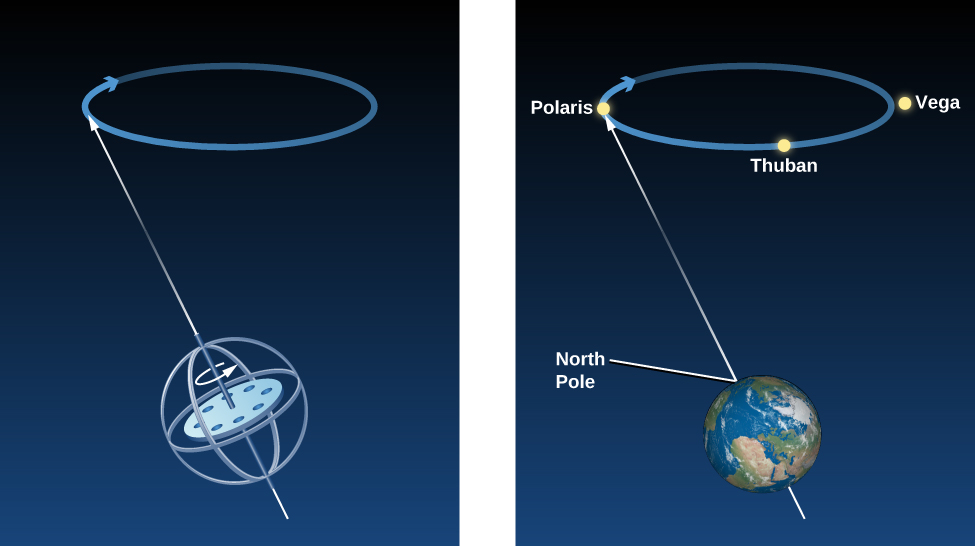
By observing the stars and comparing his data with older observations, Hipparchus made one of his most remarkable discoveries: the position in the sky of the north celestial pole had altered over the previous century and a half. Hipparchus deduced correctly that this had happened not only during the period covered by his observations, but was in fact happening all the time: the direction around which the sky appears to rotate changes slowly but continuously. Recall from the section on celestial poles and the celestial equator that the north celestial pole is just the projection of Earth’s North Pole into the sky. If the north celestial pole is wobbling around, then Earth itself must be doing the wobbling. Today, we understand that the direction in which Earth’s axis points does indeed change slowly but regularly—a motion we call precession. If you have ever watched a spinning top wobble, you observed a similar kind of motion. The top’s axis describes a path in the shape of a cone, as Earth’s gravity tries to topple it (Figure 2.12).
英語のヒント
星を観測し、以前の観測と自分のデータを比較することで、ヒッパルコスは特に注目すべき発見をした。天の北極の空での位置が、それまでの150年間に変わっていたのである。彼は、この変化が観測記録の期間だけに起きたのではなく、実際にはいつでも続いていると、正しく推論した。空がそのまわりを回るように見える方向は、ゆっくりと、しかし絶えず変わるのだ。天の極と天の赤道の節で述べたように、天の北極は、地球の北極を空へ投影したものにすぎない。天の北極が揺れ動いているなら、揺れ動いているのは地球そのものに違いない。現在では、地球の自転軸が指す方向は、実際にゆっくり、しかも規則的に変わるとわかっている。この運動を歳差という。回るこまの軸がふらつくのを見たことがあれば、似た種類の運動を観察したことになる。地球の重力がこまを倒そうとするため、その軸は円すいの形を描くように動く(図2.12)。
Precession.歳差。
OpenStax / Rice University · CC BY 4.0
Figure 2.12 Just as the axis of a rapidly spinning top wobbles slowly in a circle, so the axis of Earth wobbles in a 26,000-year cycle. Today the north celestial pole is near the star Polaris, but about 5000 years ago it was close to a star called Thuban, and in 14,000 years it will be closest to the star Vega.
図2.12 速く回るこまの軸が、ゆっくり円を描いて揺れるのと同じように、地球の軸も26,000年の周期で揺れる。現在、天の北極はポラリスの近くにあるが、約5000年前にはトゥバンという星の近くにあり、14,000年後にはベガに最も近くなる。
Because our planet is not an exact sphere, but bulges a bit at the equator, the pulls of the Sun and Moon cause it to wobble like a top. It takes about 26,000 years for Earth’s axis to complete one circle of precession. As a result of this motion, the point where our axis points in the sky changes as time goes on. While Polaris is the star closest to the north celestial pole today (it will reach its closest point around the year 2100), the star Vega in the constellation of Lyra will be the North Star in 14,000 years.
英語のヒント
地球は完全な球ではなく、赤道付近が少し膨らんでいるため、太陽と月の引く力によって、こまのように揺れる。地球の軸が歳差で一周するには、約26,000年かかる。この運動によって、時間がたつにつれて、自転軸が空で指す点も変わる。現在、天の北極に最も近い星はポラリスであり、2100年ごろに最も近づく。しかし14,000年後には、こと座のベガが北極星になる。