第1章科学と宇宙――ひとめぐりScience and the Universe: A Brief Tour
1.5 Consequences of Light Travel Time1.5 光が届くまでに時間がかかることの意味
There is another reason the speed of light is such a natural unit of distance for astronomers. Information about the universe comes to us almost exclusively through various forms of light, and all such light travels at the speed of light—that is, 1 light-year every year. This sets a limit on how quickly we can learn about events in the universe. If a star is 100 light-years away, the light we see from it tonight left that star 100 years ago and is just now arriving in our neighborhood. The soonest we can learn about any changes in that star is 100 years after the fact. For a star 500 light-years away, the light we detect tonight left 500 years ago and is carrying 500-year-old news.
英語のヒント
天文学者にとって、光の速さを距離の基準とすることが自然な理由は、もう一つある。宇宙についての情報は、ほとんどもっぱら、さまざまな形の光を通じて私たちに届く。その光はすべて光速で、つまり1年に1光年ずつ進む。このことが、宇宙の出来事をどれだけ早く知れるかに限界を設けている。ある恒星が100光年離れていれば、今夜見ているその光は100年前に恒星を出発し、たった今、私たちの近くに届いたところである。その恒星で起こる変化を知れるのは、どれほど早くても、変化が起きてから100年後になる。500光年先の恒星なら、今夜検出する光は500年前に出発し、500年前のニュースを運んでいる。
Because many of us are accustomed to instant news from the Internet, some might find this frustrating.
英語のヒント
私たちの多くは、インターネットから即座にニュースを受け取ることに慣れているため、このことをもどかしく感じる人もいるだろう。
“You mean, when I see that star up there,” you ask, “I won’t know what’s actually happening there for another 500 years?”
「つまり、あそこに見える星を見ても」とあなたは尋ねるかもしれない。「そこで実際に何が起きているのかは、あと500年たたないとわからないということ?」
But this isn’t the most helpful way to think about the situation. For astronomers, now is when the light reaches us here on Earth. There is no way for us to know anything about that star (or other object) until its light reaches us.
英語のヒント
しかし、この状況を理解するには、それが最も役に立つ捉え方とはいえない。天文学者にとっての「今」は、その光が、ここ地球にいる私たちに届くときである。光が届くまでは、その恒星やほかの天体について、私たちが何かを知る方法はない。
But what at first may seem a great frustration is actually a tremendous benefit in disguise. If astronomers really want to piece together what has happened in the universe since its beginning, they must find evidence about each epoch (or period of time) of the past. Where can we find evidence today about cosmic events that occurred billions of years ago?
英語のヒント
けれども、初めは大いにもどかしく思えることが、実は姿を隠した大きな利点でもある。宇宙の始まりから何が起きてきたのかを、本当に組み立てて理解したいなら、天文学者は過去のそれぞれの時代についての証拠を見つけなければならない。何十億年も前に起きた宇宙の出来事の証拠を、今日、どこで見つけられるのだろうか。
The delay in the arrival of light provides an answer to this question. The farther out in space we look, the longer the light has taken to get here, and the longer ago it left its place of origin. By looking billions of light-years out into space, astronomers are actually seeing billions of years into the past. In this way, we can reconstruct the history of the cosmos and get a sense of how it has evolved over time.
英語のヒント
光が届くまでの時間の遅れが、この問いに答えてくれる。宇宙の遠くを見るほど、その光がここへ届くのにかかった時間は長くなり、光が発した場所を出た時点も、いっそう遠い過去になる。宇宙の何十億光年ものかなたを見ることで、天文学者は実際に、何十億年も前の過去を見ている。このようにして、宇宙の歴史を再構成し、時間とともにどのように進化してきたかを理解できるのである。
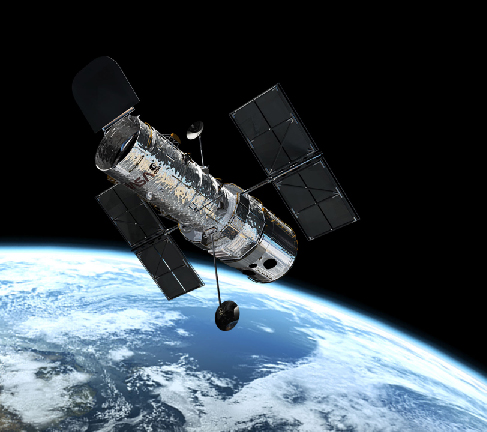
This is one reason why astronomers strive to build telescopes that can collect more and more of the faint light in the universe. The more light we collect, the fainter the objects we can observe. On average, fainter objects are farther away and can, therefore, tell us about periods of time even deeper in the past. Instruments such as the Hubble Space Telescope (Figure 1.5) and the Very Large Telescope in Chile (which you will learn about in the chapter on Astronomical Instruments), are giving astronomers views of deep space and deep time better than any we have had before.
英語のヒント
これが、天文学者が宇宙のかすかな光を少しでも多く集められる望遠鏡をつくろうと努める理由の一つである。多くの光を集めるほど、暗い天体まで観測できる。平均して、暗い天体ほど遠くにあり、それだけ遠い過去の時代を教えてくれる。ハッブル宇宙望遠鏡(図1.5)やチリにある超大型望遠鏡VLTなどの装置は、これまでにない優れた宇宙の奥深く、時間の奥深くの眺めを天文学者に届けている。これらの装置については、「天文学の観測装置」の章で学ぶ。
Telescope in Orbit.軌道上の望遠鏡。
credit: modification of work by European Space Agency · ESA educational/informational image permission
Figure 1.5 The Hubble Space Telescope, shown here in orbit around Earth, is one of many astronomical instruments in space. (credit: modification of work by European Space Agency)
図1.5 地球を周回する姿がここに写っているハッブル宇宙望遠鏡は、宇宙にある数多くの天文観測装置の一つである。(クレジット:欧州宇宙機関による作品を改変)