第21章星の誕生と太陽系外惑星の発見The Birth of Stars and the Discovery of Planets outside the Solar System
Debris Disks and Shepherd Planetsデブリ円盤と羊飼い惑星
The dust around newly formed stars is gradually either incorporated into the growing planets in the newly forming planetary system or ejected through gravitational interactions with the planets into space. The dust will disappear after about 30 million years unless the disk is continually supplied with new material. Local comets and asteroids are the most likely sources of new dust. As the planet-size bodies grow, they stir up the orbits of smaller objects in the area. These small bodies collide at high speeds, shatter, and produce tiny particles of silicate dust and ices that can keep the disk supplied with the debris from these collisions.
英語のヒント
生まれたばかりの恒星の周囲の塵は、形成中の惑星系で成長する惑星に徐々に取り込まれるか、惑星との重力相互作用で宇宙空間へ放出される。新しい物質が円盤に絶えず供給されなければ、塵は約3000万年で消える。新たな塵の最も有力な供給源は、同じ系にある彗星や小惑星である。惑星サイズの天体が成長すると、その領域の小天体の軌道をかき乱す。小天体は高速で衝突し、砕けて、ケイ酸塩の塵や氷の微粒子を作る。こうした衝突の破片によって、円盤への供給が続けられる。
Over several hundred million years, the comets and asteroids will gradually be reduced in number, the frequency of collisions will go down, and the supply of fresh dust will diminish. Remember that the heavy bombardment in the early solar system ended when the Sun was only about 500 million years old. Observations show that the dusty “debris disks” around stars also become largely undetectable by the time the stars reach an age of 400 to 500 million years. It is likely, however, that some small amount of cometary material will remain in orbit, much like our Kuiper belt, a flattened disk of comets outside the orbit of Neptune.
英語のヒント
数億年のうちに、彗星や小惑星の数は次第に減り、衝突の頻度も下がって、新しい塵の供給が少なくなる。初期の太陽系の激しい天体衝突は、太陽がまだ約5億歳のころに終わったことを思い出してほしい。観測によれば、恒星の周囲の塵を含む「デブリ円盤」も、星の年齢が4億〜5億年になるまでには、大半が検出できなくなる。それでも、海王星の軌道の外側にある、平らな彗星の円盤である太陽系のカイパーベルトのように、少量の彗星物質は軌道上に残る可能性が高いだろう。
In a young planetary system, even if we cannot see the planets directly, the planets can concentrate the dust particles into clumps and arcs that are much larger than the planets themselves and more easily imaged. This is similar to how the tiny moons of Saturn shepherd the particles in the rings and produce large arcs and structures in Saturn’s rings.
英語のヒント
若い惑星系では、惑星そのものを直接見られなくても、惑星の作用で塵の粒子が塊や弧へ集められる場合がある。こうした構造は惑星自身よりはるかに大きく、撮影しやすいものだ。土星の小さな衛星が、羊飼いのように環の粒子をまとめ、環の中に大きな弧や構造を作るのと似ている。
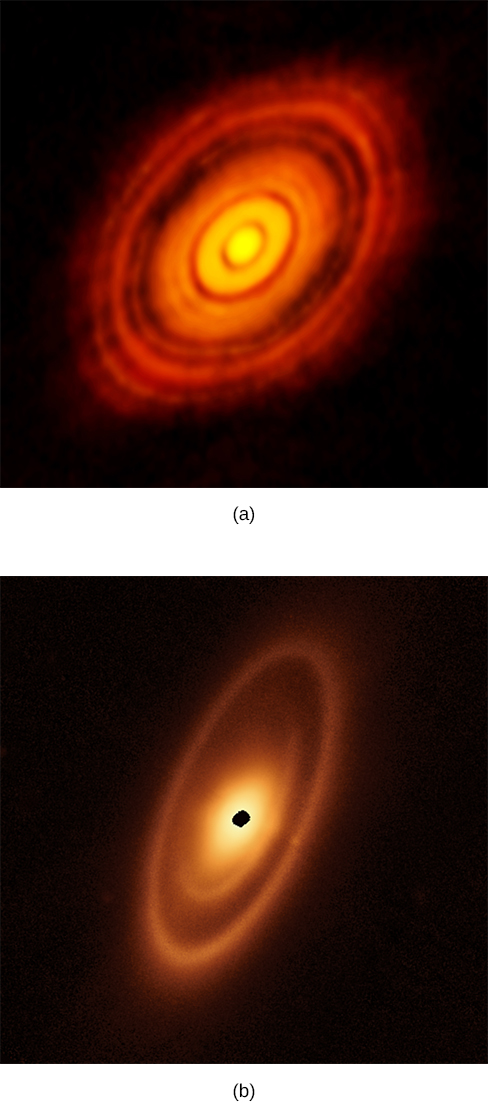
Debris disks—many with just such clumps and arcs—have now been found around many stars, such as HL Tau, located about 450 light-years from Earth in the constellation Taurus (Figure 21.15). In some stars, the brightness of the rings varies with position; around other stars, there are bright arcs and gaps in the rings. The brightness indicates the relative concentration of dust, since what we are seeing is infrared (heat radiation) from the dust particles in the rings. More dust means more radiation.
英語のヒント
今では多くの恒星の周囲にデブリ円盤が見つかり、その多くにはまさにこのような塊や弧がある。例として、おうし座の方向、地球から約450光年のHL星が挙げられる(図21.15)。環の明るさが場所によって変わる星もあれば、環の中に明るい弧や隙間がある星もある。私たちが見ているのは環の塵の粒子からの赤外線、つまり熱放射なので、明るさは塵の相対的な集中度を示す。塵が多いほど放射も多くなる。
Dust Ring around a Young Star and Three Nested Dust Belts around the Star Fomalhaut.若い恒星の塵の環と、フォーマルハウトを囲む三重の塵の帯。
credit a: modification of work by ALMA (ESO/NAOJ/NRAO); credit b: modification of work by NASA/ESA · CC BY 4.0
Figure 21.15 (a) This image was made by ALMA (the Atacama Large Millimeter/Submillimeter Array) at a wavelength of 1.3 millimeters and shows the young star HL Tau and its protoplanetary disk. It reveals multiple rings and gaps that indicate the presence of emerging planets, which are sweeping their orbits clear of dust and gas. (b) The James Webb Space Telescope took this infrared image of three belts in the debris disk of the hot, young star Fomalhaut, about 25 lightyears away. The belts extend outward for about 150 AU or 23 billion km, roughly twice the size of our own Kuiper Belt. Although the disk was discovered in 1983, the presence of the inner belts was revealed by JWST for the first time. (credit a: modification of work by ALMA (ESO/NAOJ/NRAO); credit b: modification of work by NASA/ESA)
図21.15 (a)ALMA(アタカマ大型ミリ波サブミリ波干渉計)が波長1.3ミリメートルで撮影した、若いおうし座HL星と原始惑星系円盤。複数の環と隙間が見え、軌道上の塵やガスを取り除いている、生まれつつある惑星の存在を示す。(b)ジェイムズ・ウェッブ宇宙望遠鏡による、約25光年先の高温で若い恒星フォーマルハウトのデブリ円盤の赤外線画像。三つの帯があり、外向きに約150 AU、230億キロメートルまで広がる。太陽系のカイパーベルトの約2倍の大きさである。円盤は1983年に発見されていたが、内側の帯の存在はJWSTで初めて明らかになった。(出典a:ALMA〈ESO/NAOJ/NRAO〉の作品を改変。出典b:NASA/ESAの作品を改変)
Key Concepts and Summary重要事項のまとめ
Observational evidence shows that most protostars are surrounded by disks with large-enough diameters and enough mass (as much as 10% that of the Sun) to form planets. After a few million years, the inner part of the disk is cleared of dust, and the disk is then shaped like a donut with the protostar centered in the hole—something that can be explained by the formation of planets in that inner zone. Around a few older stars, we see disks formed from the debris produced when small bodies (comets and asteroids) collide with each other. The distribution of material in the rings of debris disks is probably determined by shepherd planets, just as Saturn’s shepherd moons affect the orbits of the material in its rings. Protoplanets that grow to be 10 times the mass of Earth or bigger while there is still considerable gas in their disk can then capture more of that gas and become giant planets like Jupiter in the solar system.
観測上の証拠によれば、ほとんどの原始星は、惑星を作るのに十分な直径と質量を持つ円盤に囲まれている。円盤の質量は太陽の10%に達することもある。数百万年後には円盤の内側から塵が取り除かれ、原始星を穴の中心に置いたドーナツ状になる。これは内側での惑星形成によって説明できる。少し古い恒星のいくつかには、彗星や小惑星などの小天体が衝突して生じた破片からなる円盤が見える。デブリ円盤の環の物質の分布は、おそらく羊飼い惑星によって決まる。土星の羊飼い衛星が、環の物質の軌道に影響するのと同様である。円盤にまだ相当量のガスがあるうちに、地球の10倍以上の質量へ成長した原始惑星は、そのガスをさらに捕らえ、太陽系の木星のような巨大惑星になれる。