第21章星の誕生と太陽系外惑星の発見The Birth of Stars and the Discovery of Planets outside the Solar System
21.4 Planets beyond the Solar System: Search and Discovery21.4 太陽系の外の惑星――探査と発見
Learning Objectives学習の目標
By the end of this section, you will be able to:
この節を学ぶと、次のことができるようになる。
Describe the orbital motion of planets in our solar system using Kepler’s laws
ケプラーの法則を用いて、太陽系の惑星の軌道運動を説明する。
Compare the indirect and direct observational techniques for exoplanet detection
太陽系外惑星を検出する、間接的・直接的な観測手法を比較する。
For centuries, astronomers have dreamed of finding planets around other stars, including other planets like Earth. Direct observations of such distant planets are very difficult, however. You might compare a planet orbiting a star to a mosquito flying around one of those giant spotlights at a shopping center opening. From close up, you might spot the mosquito. But imagine viewing the scene from some distance away—say, from an airplane. You could see the spotlight just fine, but what are your chances of catching the mosquito in that light? Instead of making direct images, astronomers have relied on indirect observations and have now succeeded in detecting a multitude of planets around other stars.
英語のヒント
天文学者は何世紀もの間、ほかの恒星の周囲に惑星、とりわけ地球のような惑星を見つけることを夢見てきた。しかし、遠方の惑星を直接観測するのは非常に困難である。恒星を回る惑星は、ショッピングセンターの開店イベントで使う巨大なスポットライトの周りを飛ぶ蚊にたとえられるだろう。近くからなら蚊を見つけられるかもしれない。でも、遠く、たとえば飛行機からその場面を見るところを想像してみよう。スポットライトはよく見えても、その光の中の蚊を見つけられる見込みはどれほどあるだろうか。天文学者は直接撮影する代わりに間接観測を頼りとし、今では、ほかの恒星の周囲で多数の惑星を検出することに成功している。
In 1995, after decades of effort, we found the first such exoplanet (a planet outside our solar system) orbiting a main-sequence star, and today we know that most stars form with planets. This is an example of how persistence and new methods of observation advance the knowledge of humanity. By studying exoplanets, astronomers hope to better understand our solar system in context of the rest of the universe. For instance, how does the arrangement of our solar system compare to planetary systems in the rest of the universe? What do exoplanets tell us about the process of planet formation? And how does knowing the frequency of exoplanets influence our estimates of whether there is life elsewhere?
英語のヒント
何十年もの努力の末、1995年に、主系列星を回る最初の太陽系外惑星、つまり太陽系の外の惑星が見つかった。今日では、大半の恒星が惑星を伴って生まれるとわかっている。粘り強い努力と新たな観測法が、人類の知識を前進させる一例である。天文学者は系外惑星を研究し、宇宙全体の中で太陽系をよりよく理解したいと考えている。たとえば、太陽系の惑星の配置は、ほかの惑星系と比べてどうだろうか。系外惑星から、惑星ができる過程について何がわかるだろうか。そして、系外惑星がどれほどよく存在するかを知ることは、ほかにも生命がいるかという見積もりに、どう影響するだろうか。
Searching for Orbital Motion軌道運動を探す
Most exoplanet detections are made using techniques where we observe the effect that the planet exerts on the host star. For example, the gravitational tug of an unseen planet will cause a small wobble in the host star. Or, if its orbit is properly aligned, a planet will periodically cross in front of the star, causing the brightness of the star to dim.
英語のヒント
系外惑星の多くは、惑星が主星に及ぼす影響を観測する手法で検出されている。たとえば見えない惑星の重力は、主星に小さなふらつきを起こす。また、軌道の向きがうまくそろっていれば、惑星が周期的に星の手前を横切り、星の明るさが落ちる。
To understand how a planet can move its host star, consider a single Jupiter-like planet. Both the planet and the star actually revolve about their common center of mass. Remember that gravity is a mutual attraction. The star and the planet each exert a force on the other, and we can find a stable point, the center of mass, between them about which both objects move. The smaller the mass of a body in such a system, the larger its orbit. A massive star barely swings around the center of mass, while a low-mass planet makes a much larger “tour.”
英語のヒント
惑星が主星をどう動かすかを理解するため、木星に似た惑星が一つある場合を考えよう。実際には、惑星も恒星も共通の質量中心の周りを回っている。重力は互いに引き合う力であることを思い出してほしい。恒星と惑星はそれぞれ相手に力を及ぼしており、両者の間には、どちらもその周りを動く、安定した点である質量中心がある。このような系では、天体の質量が小さいほど軌道は大きくなる。大質量の恒星は質量中心の周りでわずかに揺れるだけであるが、軽い惑星はずっと大きな「一周の旅」をする。
Suppose the planet is like Jupiter and has a mass about one-thousandth that of its star; in this case, the size of the star’s orbit is one-thousandth the size of the planet’s. To get a sense of how difficult observing such motion might be, let’s see how hard Jupiter would be to detect in this way from the distance of a nearby star. Consider an alien astronomer trying to observe our own system from Alpha Centauri, the closest star system to our own (about 4.25 light-years away). There are two ways this astronomer could try to detect the orbital motion of the Sun. One way would be to look for changes in the Sun’s position on the sky. The second would be to use the Doppler effect to look for changes in its velocity. Let’s discuss each of these in turn.
英語のヒント
惑星が木星に似ており、質量が主星の約1000分の1だとしよう。このとき恒星の軌道の大きさは、惑星の軌道の1000分の1である。この運動の観測がどれほど難しいかをつかむため、近くの恒星の距離から、この方法で木星を検出する難しさを考えてみよう。太陽系に最も近い恒星系、約4.25光年先のケンタウルス座アルファ星から、私たちの太陽系を観測しようとする異星人の天文学者を想像してみよう。太陽の軌道運動を検出する試み方は二つある。一つは空での太陽の位置の変化を探すこと、もう一つはドップラー効果を使って速度の変化を探すことである。順に見ていこう。
The diameter of Jupiter’s apparent orbit viewed from Alpha Centauri is 10 seconds of arc, and that of the Sun’s orbit is 0.010 seconds of arc. (Remember, 1 second of arc is 1/3600 degree.) If they could measure the apparent position of the Sun (which is bright and easy to detect) to sufficient precision, they would describe an orbit of diameter 0.010 seconds of arc with a period equal to that of Jupiter, which is 12 years.
英語のヒント
ケンタウルス座アルファ星から見た木星の軌道の見かけの直径は10角秒で、太陽の軌道は0.010角秒である。1角秒は1度の3600分の1だったことを思い出してほしい。明るく検出しやすい太陽の見かけの位置を十分精密に測れれば、彼らは直径0.010角秒、周期は木星と同じ12年の軌道を描き出すだろう。
In other words, if they watched the Sun for 12 years, they would see it wiggle back and forth in the sky by this minuscule fraction of a degree. From the observed motion and the period of the “wiggle,” they could deduce the mass of Jupiter and its distance using Kepler’s laws. (To refresh your memory about these laws, see the chapter on Orbits and Gravity.)
英語のヒント
言い換えると、太陽を12年間見続ければ、1度に対してこれほど微小な角度幅で、空を行ったり来たりして揺れる様子がわかるはずである。観測した運動と「揺れ」の周期から、ケプラーの法則を使って、木星の質量と距離を推定できる。法則を思い出すには、「軌道と重力」の章を見てみよう。
Measuring positions in the sky this accurately is extremely difficult, and so far, astronomers have not made any confirmed detections of planets using this technique. However, we have been successful in using spectrometers to measure the changing velocity of stars with planets around them.
英語のヒント
空での位置をこれほど正確に測るのは非常に難しく、この方法による惑星の検出は、これまでのところ確認されていない。しかし、惑星を伴う恒星の速度の変化を分光器で測ることには成功している。
As the star and planet orbit each other, part of their motion will be in our line of sight (toward us or away from us). Such motion can be measured using the Doppler effect and the star’s spectrum. As the star moves back and forth in orbit around the system’s center of mass in response to the gravitational tug of an orbiting planet, the lines in its spectrum will shift back and forth.
英語のヒント
恒星と惑星が互いの周りを回ると、その運動の一部は私たちの視線方向、つまりこちらへ近づくか遠ざかる方向になる。この運動は、ドップラー効果と恒星のスペクトルを使って測れる。周回する惑星の重力に引かれ、恒星が系の質量中心の周りを行き来すると、そのスペクトル線も行き来してずれる。
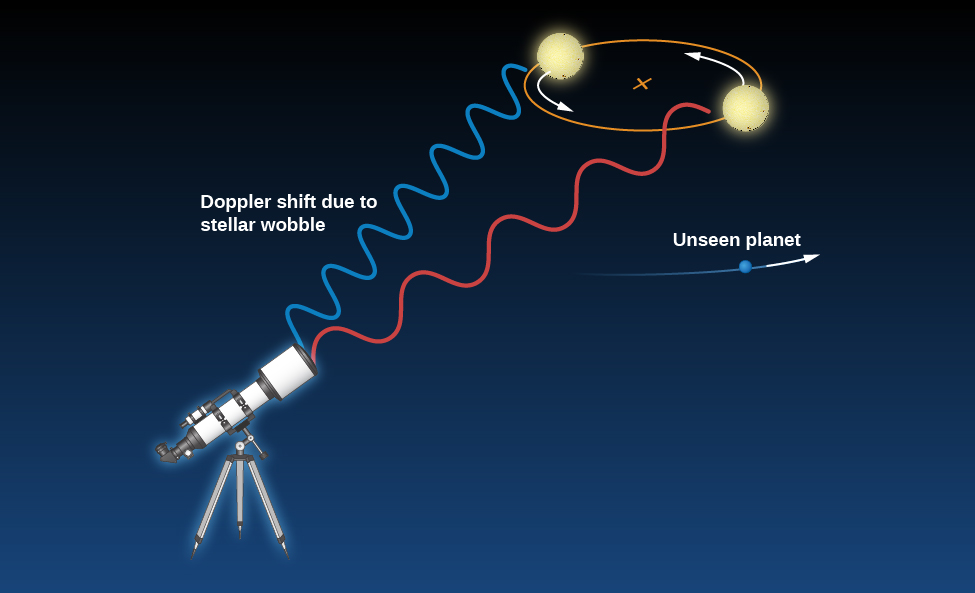
Let’s again consider the example of the Sun. Its radial velocity (motion toward or away from us) changes by about 13 meters per second with a period of 12 years because of the gravitational pull of Jupiter. This corresponds to about 30 miles per hour, roughly the speed at which many of us drive around town. Detecting motion at this level in a star’s spectrum presents an enormous technical challenge, but several groups of astronomers around the world, using specialized spectrographs designed for this purpose, have succeeded. Note that the change in speed does not depend on the distance of the star from the observer. Using the Doppler effect to detect planets will work at any distance, as long as the star is bright enough to provide a good spectrum and a large telescope is available to make the observations (Figure 21.16).
英語のヒント
再び太陽を例にしよう。木星の引力によって、太陽の視線速度、つまり観測者へ近づくか遠ざかる方向の速度は、12年周期で毎秒約13メートル変化する。これは時速約30マイルで、私たちが街中を自動車で走るくらいの速さである。恒星のスペクトルからこの程度の運動を検出することは、非常に大きな技術的課題である。それでも世界の複数の天文学者のグループが、専用に設計した分光器を使って成功している。速度の変化は、恒星から観測者までの距離によらない点に注意しよう。十分よいスペクトルが得られるほど星が明るく、観測に大きな望遠鏡を使える限り、ドップラー効果による惑星検出は、どんな距離でも機能する(図21.16)。
Doppler Method of Detecting Planets.ドップラー法による惑星検出。
OpenStax / Rice University · CC BY 4.0
Figure 21.16 The motion of a star around a common center of mass with an orbiting planet can be detected by measuring the changing speed of the star. When the star is moving away from us, the lines in its spectrum show a tiny redshift; when it is moving toward us, they show a tiny blueshift. The change in color (wavelength) has been exaggerated here for illustrative purposes. In reality, the Doppler shifts we measure are extremely small and require sophisticated equipment to be detected.
図21.16 恒星と惑星の共通の質量中心を回る恒星の運動は、恒星の速度変化を測ることで検出できる。恒星が私たちから遠ざかるとスペクトル線はわずかに赤方偏移し、近づくとわずかに青方偏移する。ここでは説明のため、色、すなわち波長の変化を誇張している。実際に測るドップラー偏移は非常に小さく、検出には高度な装置が必要である。
The first successful use of the Doppler effect to find a planet around another star was in 1995. Michel Mayor and Didier Queloz of the Geneva Observatory (Figure 21.17) used this technique to find a planet orbiting a star resembling our Sun called 51 Pegasi, about 40 light-years away. (The star can be found in the sky near the great square of Pegasus, the flying horse of Greek mythology, one of the easiest-to-find star patterns.) To everyone’s surprise, the planet takes a mere 4.2 days to orbit around the star. (Remember that Mercury, the innermost planet in our solar system, takes 88 days to go once around the Sun, so 4.2 days seems fantastically short.)
英語のヒント
ドップラー効果を使い、ほかの恒星の惑星を初めて見つけたのは1995年である。ジュネーブ天文台のミシェル・マイヨールとディディエ・ケロー(図21.17)が、約40光年先の、太陽に似たペガスス座51番星を回る惑星を発見した。この星は、ギリシャ神話の空飛ぶ馬ペガススを表す、見つけやすい星の並び「ペガススの大四辺形」の近くにある。驚いたことに、この惑星はわずか4.2日で恒星を一周する。太陽系で最も内側にある水星でも、太陽を一周するのに88日かかる。それを思えば4.2日とは、途方もなく短い周期である。
Planet Discoverers.惑星の発見者たち。
Figure 21.17 In 1995, Didier Queloz and Michel Mayor of the Geneva Observatory were the first to discover a planet around a regular star (51 Pegasi), for which they received the 2019 Nobel Prize in physics. They are seen here at an observatory in Chile where they are continuing their planet hunting. (credit: Weinstein/Ciel et Espace Photos)
図21.17 1995年、ジュネーブ天文台のディディエ・ケローとミシェル・マイヨールは、通常の恒星であるペガスス座51番星の周囲に、初めて惑星を発見した。この業績によって、2019年のノーベル物理学賞を受賞した。写真は、惑星探しを続けるチリの天文台で撮影されたもの。(出典:Weinstein/Ciel et Espace Photos)
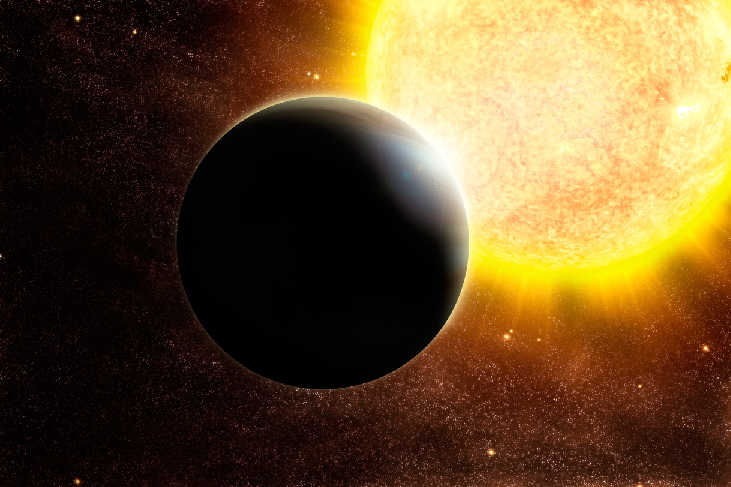
Mayor and Queloz’s findings mean the planet must be very close to 51 Pegasi, circling it about 7 million kilometers away (Figure 21.18). At that distance, the energy of the star should heat the planet’s surface to a temperature of a few thousand degrees Celsius (a bit hot for future tourism). From its motion, astronomers calculate that it has at least half the mass of JupiterThe Doppler method only allows us to find the minimum mass of a planet. To determine the exact mass using the Doppler shift and Kepler’s laws, we must also have the angle at which the planet’s orbit is oriented to our view—something we don’t have any independent way of knowing in most cases. Still, if the minimum mass is half of Jupiter’s, the actual mass can only be larger than that, and we are sure that we are dealing with a jovian planet., making it clearly a jovian and not a terrestrial-type planet.
英語のヒント
マイヨールとケローの発見によれば、惑星はペガスス座51番星に非常に近く、約700万キロメートルの距離を回っているはずである(図21.18)。その距離では恒星のエネルギーによって、惑星の表面温度は摂氏数千度になるだろう。将来の観光には少し暑すぎる。天文学者が運動から計算した惑星の質量は、少なくとも木星の半分である。したがって、地球型ではなく木星型の惑星であることが明らかである。ドップラー法だけで得られるのは、惑星の質量の最小値である。ドップラー偏移とケプラーの法則から正確な質量を求めるには、観測方向に対する惑星軌道の傾きも必要であるが、大半の場合、それを独立に知る方法はない。それでも最小質量が木星の半分なら、実際の質量はそれ以上にしかならない。木星型の惑星を見ていることは確かである。
Hot Jupiter.ホットジュピター。
credit: ESO · CC BY 4.0
Figure 21.18 Artist Greg Bacon painted this impression of a hot, Jupiter-type planet orbiting close to a sunlike star. The artist shows bands on the planet like Jupiter, but we only estimate the mass of most hot, Jupiter-type planets from the Doppler method and don’t know what conditions on the planet are like. (credit: ESO)
図21.18 画家グレッグ・ベーコンによる、太陽に似た星の近くを回る高温の木星型惑星の想像図。木星のような縞が描かれているが、高温の木星型惑星の多くでは、ドップラー法から質量を推定しているだけで、惑星の環境が実際にどのようなものかはわかっていない。(出典:ESO)
Since that initial planet discovery, the rate of progress has been breathtaking. Almost a thousand giant planets have been discovered using the Doppler technique. Many of these giant planets are orbiting close to their stars—astronomers have called these hot Jupiters.
英語のヒント
最初の惑星発見以来、進歩の速さには目を見張るものがある。ドップラー法によって、ほぼ1000個の巨大惑星が発見されている。その多くは恒星の近くを回っており、天文学者はホットジュピターと呼んでいる。
The existence of giant planets so close to their stars was a surprise, and these discoveries have forced us to rethink our ideas about how planetary systems form. But for now, bear in mind that the Doppler-shift method—which relies on the pull of a planet making its star “wiggle” back and forth around the center of mass—is most effective at finding planets that are both close to their stars and massive. These planets cause the biggest “wiggles” in the motion of their stars and the biggest Doppler shifts in the spectrum. Plus, they will be found sooner, since astronomers like to monitor the star for at least one full orbit (and perhaps more) and hot Jupiters take the shortest time to complete their orbit.
英語のヒント
恒星のこんなに近くに巨大惑星が存在するとは驚きであり、発見によって惑星系の形成についての考えを見直さざるをえなくなった。ただし今は、ドップラー偏移法が、主星に近く、しかも質量の大きい惑星を見つけるのに最も有効だと覚えておけ。この方法は、惑星の引力が恒星を質量中心の周りで行ったり来たり「揺らす」ことを利用している。そうした惑星ほど、恒星の運動に大きな「揺れ」を起こし、スペクトルに大きなドップラー偏移を生じさせる。また、より早く見つかる。天文学者は少なくとも一周、場合によってはそれ以上、恒星を監視したいと考えるが、ホットジュピターは一周にかかる時間が最も短いからである。
So if such planets exist, we would expect to be finding this type first. Scientists call this a selection effect—where our technique of discovery selects certain kinds of objects as “easy finds.” As an example of a selection effect in everyday life, imagine you decide you are ready for a new romantic relationship in your life. To begin with, you only attend social events on campus, all of which require a student ID to get in. Your selection of possible partners will then be limited to students at your college. That may not give you as diverse a group to choose from as you want. In the same way, when we first used the Doppler technique, it selected massive planets close to their stars as the most likely discoveries. As we spend longer times watching target stars and as our ability to measure smaller Doppler shifts improves, this technique can reveal more distant and less massive planets too.
英語のヒント
したがって、このような惑星が存在するなら、最初に見つかる種類になると予想できる。科学者はこれを選択効果と呼ぶ。発見に使う手法が、ある種類の天体を「見つけやすいもの」として選び出すのだ。日常の例として、新しい恋愛関係を始める気になったと想像してみよう。まず、入場に学生証が必要な学内の交流会にしか参加しないとする。すると交際相手の候補は、同じ大学の学生に限られる。それでは、望むほど多様な集団から相手を選べないかもしれない。同じように、ドップラー法を使い始めた当初は、恒星の近くにある大質量惑星が最も発見されやすいものとして選ばれた。目標の恒星をより長く観測し、小さなドップラー偏移を測る能力が向上するにつれ、この方法でも、より遠くを回る軽い惑星がわかるようになる。