第21章星の誕生と太陽系外惑星の発見The Birth of Stars and the Discovery of Planets outside the Solar System
Habitable Exoplanets生命が暮らせる系外惑星
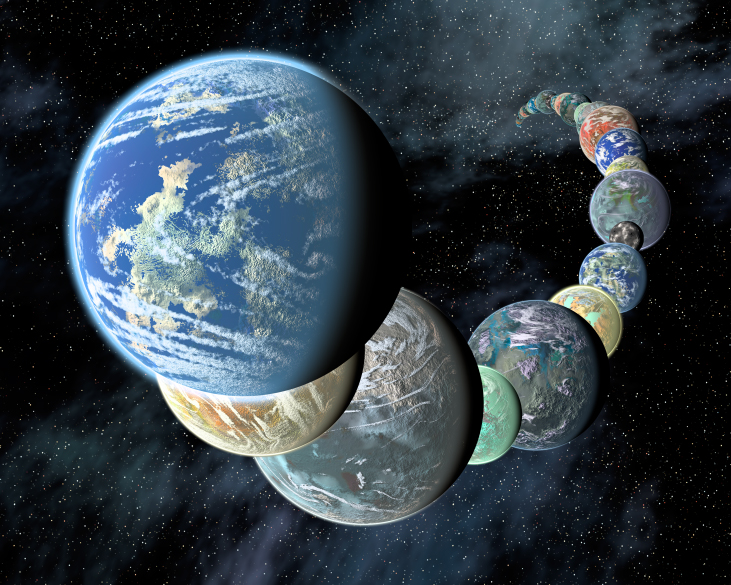
While thousands of exoplanets have been discovered in the past two decades, every observational technique has fallen short of finding more than a few candidates that resemble Earth (Figure 21.27). Astronomers are not sure exactly what properties would define another Earth. Do we need to find a planet that is exactly the same size and mass as Earth? That may be difficult and may not be important from the perspective of habitability. After all, we have no reason to think that life could not have arisen on Earth if our planet had been a little bit smaller or larger. And, remember that how habitable a planet is depends on both its distance from its star and the nature of its atmosphere. The greenhouse effect can make some planets warmer (as it did for Venus and is doing more and more for Earth).
英語のヒント
この20年で数千個の系外惑星が発見された。しかし、どの観測手法でも、地球に似た候補を数個より多く見つけるには至っていない(図21.27)。そもそも、どんな性質を持てば「もう一つの地球」と定義できるのか、天文学者にもはっきりわかっていない。大きさも質量も地球とまったく同じ惑星を見つける必要があるのだろうか。それは難しいかもしれないし、生命が暮らせるかという観点では重要でないかもしれない。結局、地球が少し小さかったり大きかったりしたら生命は生まれなかった、と考える理由はない。また、惑星の住みやすさは恒星からの距離と大気の性質の両方で決まることも思い出してほしい。温室効果は惑星を暖めることがある。金星でそうなったように、地球でもますますそうなっている。
Many Earthlike Planets.多数の地球に似た惑星。
credit: NASA/JPL-Caltech/R. Hurt (SSC-Caltech) · JPL image use policy
Figure 21.27 This painting, commissioned by NASA, conveys the idea that there may be many planets resembling Earth out there as our methods for finding them improve. (credit: NASA/JPL-Caltech/R. Hurt (SSC-Caltech))
図21.27 NASAの依頼で描かれたこの絵は、探す方法が進歩すれば、宇宙には地球に似た惑星がたくさんあるかもしれないという考えを表す。(出典:NASA/JPL-Caltech/R. Hurt〈SSC-Caltech〉)
We can ask other questions to which we don’t yet know the answers. Does this “twin” of Earth need to orbit a solar-type star, or can we consider as candidates the numerous exoplanets orbiting K- and M-class stars? (In the summer of 2016, astronomers reported the discovery of a planet with at least 1.3 times the mass of Earth around the nearest star, Proxima Centauri, which is spectral type M and located 4.2 light years from us.) We have a special interest in finding planets that could support life like ours, in which case, we need to find exoplanets within their star’s habitable zone, where surface temperatures are consistent with liquid water on the surface. This is probably the most important characteristic defining an Earth-analog exoplanet.
英語のヒント
まだ答えのない問いはほかにもある。地球の「双子」は太陽型の恒星を回る必要があるのだろうか。それとも、K型やM型の恒星を回る多数の系外惑星も候補に入れられるだろうか。2016年夏には、最も近い恒星プロキシマ・ケンタウリの周囲に、質量が少なくとも地球の1.3倍の惑星を発見したと報告された。主星はスペクトル型Mで、私たちから4.2光年の場所にある。私たちのような生命を支えられる惑星の発見には、特別な関心がある。その場合、表面温度が液体の水の存在と両立する、主星のハビタブルゾーン内の系外惑星を見つける必要がある。おそらく、これが地球に似た系外惑星を定義する最も重要な特徴である。
The search for potentially habitable worlds is one of the prime drivers for exoplanet research in the next decade. Astronomers are beginning to develop realistic plans for new instruments that can even look for signs of life on distant worlds (examining their atmospheres for gases associated with life, for example). If we require telescopes in space to find such worlds, we need to recognize that years are required to plan, build, and launch such space observatories. The discovery of exoplanets and the knowledge that most stars have planetary systems are transforming our thinking about life beyond Earth. We are closer than ever to knowing whether habitable (and inhabited) planets are common. This work lends a new spirit of optimism to the search for life elsewhere, a subject to which we will return in Life in the Universe.
英語のヒント
生命が暮らせる可能性のある世界の探査は、これからの10年間の系外惑星研究を進める主要な動機の一つである。天文学者は、遠い世界の生命の兆候まで探せる新しい装置の、現実的な計画を立て始めている。たとえば大気を調べ、生命に関連する気体を探すのだ。そのような世界の発見に宇宙望遠鏡が必要なら、計画・建造・打ち上げに何年もかかると認識する必要がある。系外惑星の発見と、大半の恒星が惑星系を持つという知識は、地球外生命についての考えを変えつつある。生命が暮らせる惑星、さらには実際に暮らしている惑星が一般的かどうかを知るまで、私たちはかつてなく近づいている。この研究は地球外生命探しに新たな楽観を与えている。この話題は「宇宙の生命」で再び取り上げる。
Key Concepts and Summary重要事項のまとめ
The ensemble of exoplanets is incredibly diverse and has led to a revision in our understanding of planet formation that includes the possibility of vigorous, chaotic interactions, with planet migration and scattering. It is possible that the solar system is unusual (and not representative) in how its planets are arranged. Many systems seem to have rocky planets farther inward than we do, for example, and some even have “hot Jupiters” very close to their star. Ambitious space experiments should make it possible to image earthlike planets outside the solar system and even to obtain information about their habitability as we search for life elsewhere.
系外惑星の集団は驚くほど多様であり、惑星形成の理解は見直された。そこには、惑星の軌道移動や散乱を伴う、激しく混沌とした相互作用の可能性も含まれる。太陽系の惑星配置は、一般的な例ではなく、珍しいものなのかもしれない。たとえば、多くの系には太陽系より内側に岩石惑星があるようで、一部には主星のごく近くにホットジュピターさえある。地球外生命を探す中で、意欲的な宇宙での実験によって、太陽系の外の地球に似た惑星を撮影し、生命が暮らせる条件についての情報まで得られるようになるはずである。
For Further Explorationさらに探究するために
Articles記事
Star Formation星形成
Ansdell, M. “Revising the Story of Planetary Formation.” Sky & Telescope (May 2020): 34. Modern theories on how a planetary system forms around a star.
Ansdell, M. “Revising the Story of Planetary Formation.” Sky & Telescope、2020年5月、34ページ。恒星の周囲で惑星系が形成される仕組みについての現代理論。
Cendes, Y. “The Sun’s Lost Siblings.” Astronomy (July 2020): 44. Trying to identify the stars that formed from the same nebula as the Sun.
Cendes, Y. “The Sun’s Lost Siblings.” Astronomy、2020年7月、44ページ。太陽と同じ星雲から生まれた星々を特定する試み。
Croswell, K. “The Story of T Tauri.” Sky & Telescope (February 2021): 12. On the star that helped us understand ongoing star formation.
Croswell, K. “The Story of T Tauri.” Sky & Telescope、2021年2月、12ページ。進行中の星形成の理解を助けた、おうし座T星について。
Kaler, J. “How Stars are Born and Die.” Astronomy (July 2020): 16. Review of stellar evolution.
Kaler, J. “How Stars are Born and Die.” Astronomy、2020年7月、16ページ。恒星進化の概説。
O’Dell, C. R. “Exploring the Orion Nebula.” Sky & Telescope (December 1994): 20. Good review with Hubble results.
O’Dell, C. R. “Exploring the Orion Nebula.” Sky & Telescope、1994年12月、20ページ。ハッブルの成果を含む、よい概説。
Redd, N. “Is Eta Corvi a Window to our Past.” Astronomy (July 2020): 50. About a younger star with two rings of material around it.
Redd, N. “Is Eta Corvi a Window to our Past.” Astronomy、2020年7月、50ページ。二つの物質の環を伴う、より若い恒星について。
Rimmer, A. “The Very Hungry Universe.” Astronomy (June 2022): 16. On the fundamental role of accretion in star formation.
Rimmer, A. “The Very Hungry Universe.” Astronomy、2022年6月、16ページ。星形成における降着の根本的な役割。
Talcott, R. “Untangling the Tarantula Nebula.” Astronomy (September 2021): 24. Understanding and observing this massive star formation region.
Talcott, R. “Untangling the Tarantula Nebula.” Astronomy、2021年9月、24ページ。大規模な星形成領域であるタランチュラ星雲の理解と観測。
Exoplanets系外惑星
Barbuzano, J. “The Real Tatooines.” Sky & Telescope (July 2022): 34. On the discovery of planets that orbit one or both stars in a binary star system.
Barbuzano, J. “The Real Tatooines.” Sky & Telescope、2022年7月、34ページ。連星系の一方、または両方の星を回る惑星の発見。
Carroll, M. “The Strange Case of the Eyeball Planets.” Astronomy (August 2022): 40. On tidally locked exoplanets orbiting close to their stars.
Carroll, M. “The Strange Case of the Eyeball Planets.” Astronomy、2022年8月、40ページ。主星の近くを回り、潮汐固定された系外惑星。
Colon, K. “Exoplanets Everywhere.” Sky & Telescope (May 2023): 34. On the work of the TESS mission finding transiting planets.
Colon, K. “Exoplanets Everywhere.” Sky & Telescope、2023年5月、34ページ。トランジット惑星を見つけるTESS計画の活動。
Dawson, R. “Toasty Jupiters: Star Huggers.” Sky & Telescope (October 2022): 28. Update on what we have learned about and from hot Jupiters.
Dawson, R. “Toasty Jupiters: Star Huggers.” Sky & Telescope、2022年10月、28ページ。ホットジュピターそのものについて、またその研究から何がわかったかの近況。
Hall, S. “The Hunt for the First Exomoons.” Sky & Telescope (September 2020): 34. Nice overview.
Hall, S. “The Hunt for the First Exomoons.” Sky & Telescope、2020年9月、34ページ。最初の系外衛星を探す研究の、わかりやすい概説。
May, B., et al. “Exoplanets: How We Discovered Other Worlds.” Astronomy (June 2022): 24. A concise history and explanation of techniques for finding exoplanets.
May, B. ほか。“Exoplanets: How We Discovered Other Worlds.” Astronomy、2022年6月、24ページ。系外惑星の発見の簡潔な歴史と、検出手法の説明。
Morley, C. “The In-Betweeners.” Sky & Telescope (March 2022): 34. On objects that could be brown dwarfs or large exoplanets.
Morley, C. “The In-Betweeners.” Sky & Telescope、2022年3月、34ページ。褐色矮星か大きな系外惑星か、どちらにもなりうる天体。
Seager, S. “Exoplanets Everywhere.” Sky & Telescope (August 2013): 18. An excellent discussion of some frequently asked questions about the nature and arrangement of planets out there.
Seager, S. “Exoplanets Everywhere.” Sky & Telescope、2013年8月、18ページ。宇宙の惑星の性質と配置について、よく寄せられる問いのいくつかを扱った優れた解説。
Stuart, C. “The Planets that Aren’t What they Seem.” Sky & Telescope (February 2022): 20. On Super-Earths and Mini-Neptunes—what they are like and how they formed.
Stuart, C. “The Planets that Aren’t What they Seem.” Sky & Telescope、2022年2月、20ページ。スーパーアースとミニネプチューンの実態、および形成過程。
Ricker, G. “Inside the Hunt for the Nearest Exoplanets.” Astronomy (August 2021): 14. On the TESS mission and its discoveries.
Ricker, G. “Inside the Hunt for the Nearest Exoplanets.” Astronomy、2021年8月、14ページ。TESS計画とその発見。