第21章星の誕生と太陽系外惑星の発見The Birth of Stars and the Discovery of Planets outside the Solar System
21.5 Exoplanets Everywhere: What We Are Learning21.5 系外惑星は至るところに――わかってきたこと
Learning Objectives学習の目標
By the end of this section, you will be able to:
この節を学ぶと、次のことができるようになる。
Explain what we have learned from our discovery of exoplanets
系外惑星の発見から何がわかったかを説明する。
Identify which kind of exoplanets appear to be the most common in the Galaxy
天の川銀河で最も一般的と考えられる系外惑星の種類を特定する。
Discuss the kinds of planetary systems we are finding around other stars
ほかの恒星の周囲で見つかっている惑星系の種類を論じる。
Before the discovery of exoplanets, most astronomers expected that other planetary systems would be much like our own—planets following roughly circular orbits, with the most massive planets several AU from their parent star. Such systems do exist in large numbers, but many exoplanets and planetary systems are very different from those in our solar system. Another surprise is the existence of whole classes of exoplanets that we simply don’t have in our solar system: planets with masses between the mass of Earth and Neptune, and planets that are several times more massive than Jupiter.
英語のヒント
系外惑星が発見される前、天文学者の多くは、ほかの惑星系も太陽系によく似ていると予想していた。惑星はほぼ円形の軌道を進み、最も重い惑星は主星から数AU離れている、という姿である。そのような系は確かに多数あるが、系外惑星や惑星系の多くは、太陽系とは大きく違う。もう一つの驚きは、太陽系にはまったくない系外惑星の種類が、丸ごと存在することである。地球と海王星の中間の質量の惑星や、木星の何倍もの質量を持つ惑星が、それに当たる。
Kepler Resultsケプラーの成果
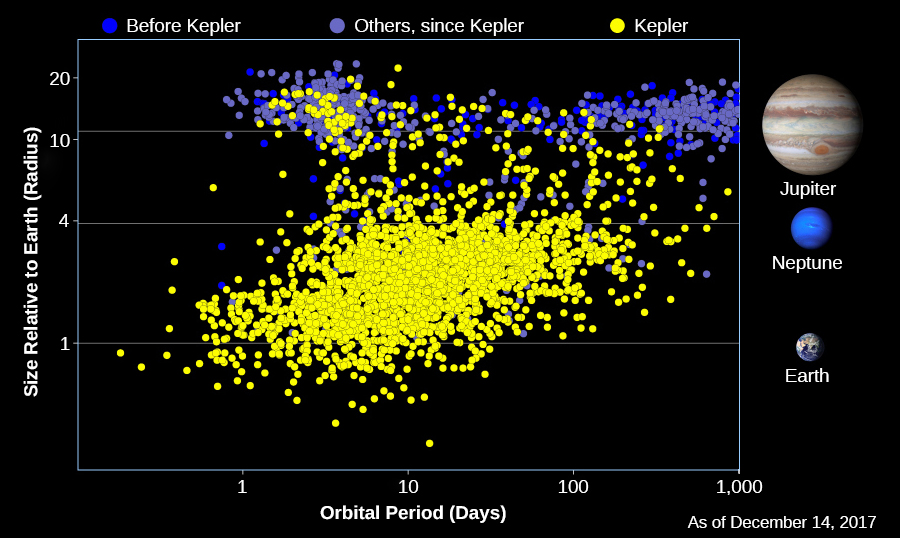
The Kepler telescope has been responsible for the discovery of most exoplanets, especially at smaller sizes, as illustrated in Figure 21.22, where the Kepler discoveries are plotted in yellow. You can see the wide range of sizes, including planets substantially larger than Jupiter and smaller than Earth. The absence of Kepler-discovered exoplanets with orbital periods longer than a few hundred days is a consequence of the 4-year lifetime of the mission. (Remember that three evenly spaced transits must be observed to register a discovery.) At the smaller sizes, the absence of planets much smaller than one earth radius is due to the difficulty of detecting transits by very small planets. In effect, the “discovery space” for Kepler was limited to planets with orbital periods less than 400 days and sizes larger than Mars.
英語のヒント
ケプラー望遠鏡は、特に小さな系外惑星を中心に、系外惑星の大半の発見を担ってきた。図21.22では、ケプラーによる発見を黄色で描いている。木星よりかなり大きな惑星から地球より小さな惑星まで、広い大きさの範囲が見て取れる。数百日より長い公転周期を持つケプラー発見惑星がないのは、ミッションの期間が4年だったためである。発見と認めるには、等間隔のトランジットを三回観測する必要があった。小さい側で地球半径を大きく下回る惑星がないのは、非常に小さな惑星のトランジットを検出するのが難しいためである。実質的に、ケプラーの「発見可能な範囲」は、公転周期が400日未満で、火星より大きい惑星に限られていた。
Exoplanet Discoveries through 2017.2017年までの系外惑星の発見。
credit: modification of work by NASA/Ames Research Center/Jessie Dotson and Wendy Stenzel · NASA media use guidelines
Figure 21.22 The vertical axis shows the radius of each planet compared to Earth. Horizontal lines show the size of Earth, Neptune, and Jupiter. The horizontal axis shows the time each planet takes to make one orbit (and is given in Earth days). Recall that Mercury takes 88 days and Earth takes a little more than 365 days to orbit the Sun. The yellow dots show planets discovered by the Kepler mission using transits, and the blue dots are the discoveries by other projects and techniques. When this graph was made, astronomers had discovered just over 3,500 exoplanets; as of the start of 2022, that number has risen to roughly 5,000. (credit: modification of work by NASA/Ames Research Center/Jessie Dotson and Wendy Stenzel)
図21.22 縦軸は各惑星の半径を地球と比べた値。横線は地球、海王星、木星の大きさを示す。横軸は各惑星が一周するのに要する時間で、地球の日を単位とする。太陽を回るのに、水星は88日、地球は365日より少し長くかかることを思い出そう。黄色の点はケプラーがトランジットで発見した惑星、青色の点はほかの計画や手法による発見である。このグラフの作成時点で、系外惑星の発見数は3500個を少し超えていた。2022年初めには、約5000個へ増えた。(出典:NASA/Ames Research Center/Jessie Dotson and Wendy Stenzelの作品を改変)
One of the primary objectives of the Kepler mission was to find out how many stars hosted planets and especially to estimate the frequency of earthlike planets. Although Kepler looked at only a very tiny fraction of the stars in the Galaxy, the sample size was large enough to draw some interesting conclusions. While the observations apply only to the stars observed by Kepler, those stars are reasonably representative, and so astronomers can extrapolate to the entire Galaxy.
英語のヒント
ケプラー計画の主要な目的の一つは、どれほどの恒星が惑星を持つかを調べ、とりわけ地球のような惑星の存在頻度を見積もることだった。調べたのは天の川銀河の星のごく一部にすぎないが、興味深い結論を引き出すには十分な標本数だった。観測結果が直接当てはまるのは、ケプラーが観測した星だけである。しかしそれらは十分に代表的な標本なので、天文学者は結果を天の川銀河全体へ広げて推定できる。
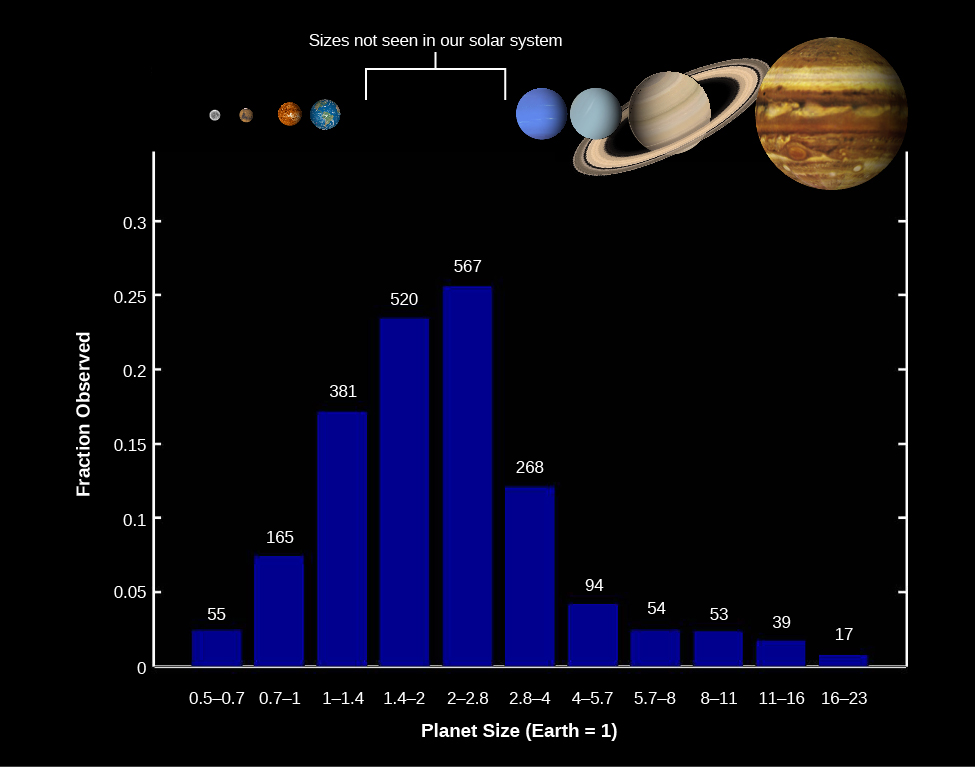
Figure 21.23 shows that the Kepler discoveries include many rocky, Earth-size planets, far more than Jupiter-size gas planets. This immediately tells us that the initial Doppler discovery of many hot Jupiters was a biased sample, in effect, finding the odd planetary systems because they were the easiest to detect. However, there is one huge difference between this observed size distribution and that of planets in our solar system. The most common planets have radii between 1.4 and 2.8 that of Earth, sizes for which we have no examples in the solar system. These have been nicknamed super-Earths, while the other large group with sizes between 2.8 and 4 that of Earth are often called mini-Neptunes.
英語のヒント
図21.23から、ケプラーの発見には岩石質の地球サイズの惑星が多数含まれ、木星サイズのガス惑星を大きく上回るとわかる。つまり初期のドップラー観測で見つかった多数のホットジュピターは、偏った標本だった。見つけやすいという理由で、実際には風変わりな惑星系を探し当てていたのだ。しかし、観測された大きさの分布と太陽系の惑星の分布との間には、大きな違いが一つある。最も多い惑星の半径は地球の1.4〜2.8倍で、太陽系にはその大きさの例がない。スーパーアースという愛称で呼ばれる。もう一つの大きな集団である、地球の2.8〜4倍の大きさの惑星は、しばしばミニネプチューンと呼ばれる。
Kepler Discoveries.ケプラーによる発見。
credit: modification of work by NASA/Kepler mission · NASA media use guidelines
Figure 21.23 This bar graph shows the number of planets of each size range found among the first 2213 Kepler planet discoveries. Sizes range from half the size of Earth to 20 times that of Earth. On the vertical axis, you can see the fraction that each size range makes up of the total. Note that planets that are between 1.4 and 4 times the size of Earth make up the largest fractions, yet this size range is not represented among the planets in our solar system. (credit: modification of work by NASA/Kepler mission)
図21.23 最初の2213個のケプラー発見惑星について、大きさの区分ごとの個数を示した棒グラフ。大きさは地球の半分から20倍までに及ぶ。縦軸では、各区分が全体に占める割合を読める。地球の1.4〜4倍の惑星が最も大きな割合を占めるのに、太陽系にはこの大きさの惑星がないことに注目しよう。(出典:NASA/Kepler missionの作品を改変)
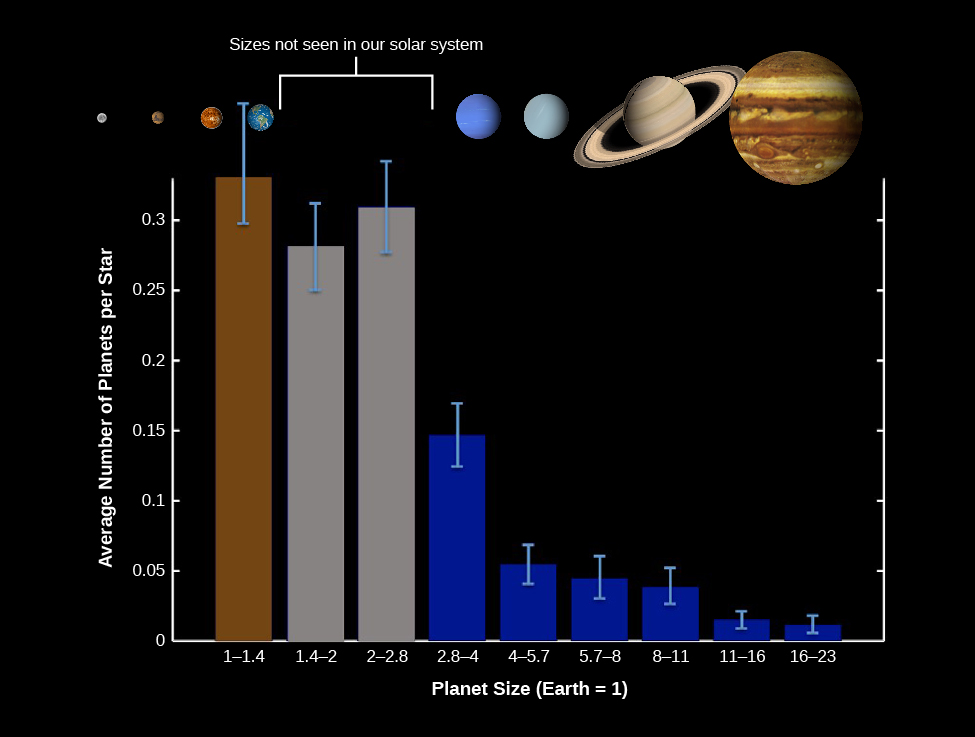
What a remarkable discovery it is that the most common types of planets in the Galaxy are completely absent from our solar system and were unknown until Kepler’s survey. However, recall that really small planets were difficult for the Kepler instruments to find. So, to estimate the frequency of Earth-size exoplanets, we need to correct for this sampling bias. The result is the corrected size distribution shown in Figure 21.24. Notice that in this graph, we have also taken the step of showing not the number of Kepler detections but the average number of planets per star for solar-type stars (spectral types F, G, and K).
英語のヒント
天の川銀河で最も一般的な種類の惑星が、太陽系にはまったくなく、ケプラーの探査まで知られていなかったとは、驚くべき発見である。ただし、とても小さな惑星はケプラーでも見つけにくかったことを思い出してほしい。地球サイズの系外惑星の存在頻度を見積もるには、この標本抽出の偏りを補正する必要がある。その結果が、図21.24の補正済みの大きさの分布である。またこのグラフでは、ケプラーの検出数ではなく、太陽型の恒星、すなわちスペクトル型F・G・Kの星について、恒星一個当たりの平均惑星数を示している。
Size Distribution of Planets for Stars Similar to the Sun.太陽に似た恒星における惑星の大きさの分布。
credit: modification of work by NASA/Kepler mission · NASA media use guidelines
Figure 21.24 We show the average number of planets per star in each planet size range. (The average is less than one because some stars will have zero planets of that size range.) This distribution, corrected for biases in the Kepler data, shows that Earth-size planets may actually be the most common type of exoplanets. (credit: modification of work by NASA/Kepler mission)
図21.24 惑星の大きさの区分ごとに、恒星一個当たりの平均惑星数を示す。平均が1より小さいのは、その区分の惑星を一つも持たない星もあるためである。ケプラーのデータの偏りを補正したこの分布は、実際には地球サイズの惑星が最も一般的な系外惑星かもしれないと示している。(出典:NASA/Kepler missionの作品を改変)
We see that the most common planet sizes of are those with radii from 1 to 3 times that of Earth—what we have called “Earths” and “super-Earths.” Each group occurs in about one-third to one-quarter of stars. In other words, if we group these sizes together, we can conclude there is nearly one such planet per star! And remember, this census includes primarily planets with orbital periods less than 2 years. We do not yet know how many undiscovered planets might exist at larger distances from their star.
英語のヒント
最も一般的なのは、半径が地球の1〜3倍の惑星、ここで「地球型の大きさの惑星」や「スーパーアース」と呼んだものだとわかる。各集団は恒星の約3分の1〜4分の1で見られる。言い換えれば、これらの大きさをまとめると、恒星一個につき、このような惑星がほぼ一個あると結論できる。しかも、この個数調査に主に含まれているのは、公転周期が2年未満の惑星である。恒星からさらに遠いところに、未発見の惑星がどれほどあるかは、まだわかっていない。
All the new observations of exoplanets allow astronomers to estimate the total number of planets in our galaxy. For solar type stars (spectral types F, G, or K), we find that while many stars have no planets, many others have multiple planets. The amazing conclusion from these observations is that there may be more planets in our galaxy than stars. Surely, this will turn out to be one of the most important results from astronomy in this century.
英語のヒント
系外惑星の新たな観測を総合すると、天文学者は天の川銀河にある惑星の総数を推定できる。太陽型の恒星、スペクトル型F・G・Kについては、惑星を持たない星が多い一方、複数の惑星を持つ星も多数あるとわかる。観測から得られる驚くべき結論は、天の川銀河には恒星より多くの惑星があるかもしれない、ということである。これはきっと、今世紀の天文学の最も重要な成果の一つとなるだろう。