第20章星と星の間――宇宙のガスと塵Between the Stars: Gas and Dust in Space
20.2 Interstellar Gas20.2 星間ガス
Learning Objectives学習の目標
By the end of this section, you will be able to:
この節を読み終えると、次のことができるようになる。
Name the major types of interstellar gas
星間ガスの主な種類を挙げる。
Discuss how we can observe each type
それぞれの種類を、どのように観測できるかを論じる。
Describe the temperature and other major properties of each type
それぞれの温度と、ほかの主な性質を説明する。
Interstellar gas, depending on where it is located, can be as cold as a few degrees above absolute zero or as hot as a million degrees or more. We will begin our voyage through the interstellar medium by exploring the different conditions under which we find gas.
英語のヒント
星間ガスの温度は、どこにあるかによって、絶対零度をわずか数度上回るほど低いものから、100万度以上の高いものまである。星間物質を巡る旅を、ガスがどのような異なる状態にあるかを調べることから始めよう。
Ionized Hydrogen (H II) Regions—Gas Near Hot Stars電離水素領域(H II領域)――高温の星の近くのガス
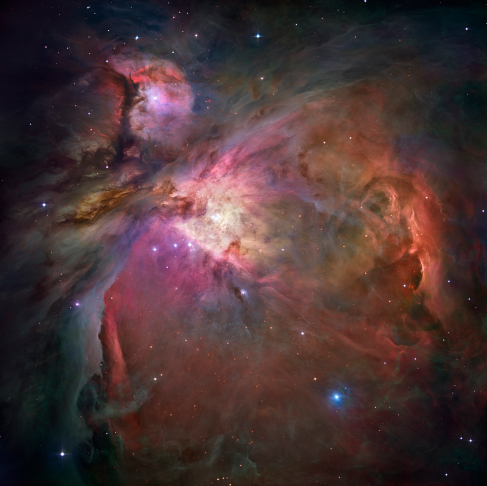
Some of the most spectacular astronomical photographs show interstellar gas located near hot stars (Figure 20.3). The strongest line in the visible region of the hydrogen spectrum is the red line in the Balmer seriesScientists also call this red Balmer line the H-alpha line, with alpha meaning it is the first spectral line in the Balmer series. (as explained in the chapter on Radiation and Spectra); this emission line accounts for the characteristic red glow in images like Figure 20.3.
英語のヒント
最も見事な天体写真の中には、高温の星の近くにある星間ガスを写したものがある(図20.3)。水素スペクトルの可視光域で最も強い線は、バルマー系列の赤い線である(「放射とスペクトル」で説明した)。この輝線が、図20.3のような画像に特徴的な赤い輝きを生む。科学者はこの赤いバルマー線をHα線とも呼ぶ。αは、バルマー系列の最初のスペクトル線であることを意味する。
Orion Nebula.オリオン大星雲
credit: NASA,ESA, M. Robberto (Space Telescope Science Institute/ESA) and the Hubble Space Telescope Orion Treasury Project Team · CC BY 4.0
Figure 20.3 The red glow that pervades the great Orion Nebula is produced by the first line in the Balmer series of hydrogen. Hydrogen emission indicates that there are hot young stars nearby that ionize these clouds of gas. When electrons then recombine with protons and move back down into lower energy orbits, emission lines are produced. The blue color seen at the edges of some of the clouds is produced by small particles of dust that scatter the light from the hot stars. Dust can also be seen silhouetted against the glowing gas. (credit: NASA,ESA, M. Robberto (Space Telescope Science Institute/ESA) and the Hubble Space Telescope Orion Treasury Project Team)
英語のヒント
図20.3 オリオン大星雲に広がる赤い輝きは、水素のバルマー系列の最初の線によって生じる。水素の放射は、近くに高温の若い星があり、そのガス雲を電離していることを示す。その後、電子が陽子と再結合し、低いエネルギーの軌道へ移ると、輝線が生じる。雲の一部の縁に見える青色は、小さな塵の粒が高温の星の光を散乱して生む。輝くガスを背景に、塵の暗い影も見える。(クレジット:NASA、ESA、M. Robberto〔宇宙望遠鏡科学研究所/ESA〕、Hubble Space Telescope Orion Treasury Project Team)
Hot stars are able to heat nearby gas to temperatures close to 10,000 K. The ultraviolet radiation from the stars also ionizes the hydrogen (remember that during ionization, the electron is stripped completely away from the proton). Such a detached proton won’t remain alone forever when attractive electrons are around; it will capture a free electron, becoming a neutral hydrogen once more. However, such a neutral atom can then absorb ultraviolet radiation again and start the cycle over. At a typical moment, most of the atoms near a hot star are in the ionized state.
英語のヒント
高温の星は、近くのガスを1万K近くまで加熱できる。星の紫外線は水素を電離もする。電離では、電子が陽子から完全にはぎ取られることを思い出そう。こうして電子を失った陽子も、引き合う電子が周りにあれば、永久に単独でいるわけではない。自由電子を捕らえ、再び中性の水素になる。しかし、その中性原子は再び紫外線を吸収し、循環を最初から繰り返しうる。典型的なある瞬間を見ると、高温の星の近くの原子の大部分は、電離した状態にある。
Since hydrogen is the main constituent of interstellar gas, we often characterize a region of space according to whether its hydrogen is neutral or ionized. A cloud of ionized hydrogen is called an H II region. (Scientists who work with spectra use the Roman numeral I to indicate that an atom is neutral; successively higher Roman numerals are used for each higher stage of ionization. H II thus refers to hydrogen that has lost its one electron; Fe III is iron with two electrons missing.)
英語のヒント
水素は星間ガスの主成分なので、ある空間領域を、そこにある水素が中性か電離しているかによって特徴づけることが多い。電離水素の雲をH II領域と呼ぶ。スペクトルを扱う科学者は、ローマ数字のIで中性原子を表し、電離段階が一つ上がるごとに、ローマ数字を一つ大きくする。したがってH IIは、唯一の電子を失った水素を指す。Fe IIIは、電子を2個失った鉄である。
The electrons that are captured by the hydrogen nuclei cascade down through the various energy levels of the hydrogen atoms on their way to the lowest level, or ground state. During each transition downward, they give up energy in the form of light. The process of converting ultraviolet radiation into visible light is called fluorescence. Interstellar gas contains other elements besides hydrogen. Many of them are also ionized in the vicinity of hot stars; they then capture electrons and emit light, just as hydrogen does, allowing them to be observed by astronomers. But generally, the red hydrogen line is the strongest, and that is why H II regions look red.
英語のヒント
水素の原子核に捕らえられた電子は、水素原子のさまざまなエネルギー準位を順に下り、最も低い準位、すなわち基底状態へ向かう。下向きの遷移のたびに、光としてエネルギーを放出する。紫外線を可視光に変えるこの過程を、蛍光と呼ぶ。星間ガスには、水素以外の元素も含まれる。その多くも高温の星の近くで電離し、水素と同じように電子を捕らえて光を出すため、天文学者が観測できる。ただし一般に、水素の赤い線が最も強く、それがH II領域が赤く見える理由である。
A fluorescent light on Earth works using the same principles as a fluorescent H II region. When you turn on the current, electrons collide with atoms of mercury vapor in the tube. The mercury is excited to a high-energy state because of these collisions. When the electrons in the mercury atoms return to lower-energy levels, some of the energy they emit is in the form of ultraviolet photons. These, in turn, strike a phosphor-coated screen on the inner wall of the light tube. The atoms in the screen absorb the ultraviolet photons and emit visible light as they cascade downward among the energy levels. (The difference is that these atoms give off a wider range of light colors, which mix to give the characteristic white glow of fluorescent lights, whereas the hydrogen atoms in an H II region give off a more limited set of colors.)
英語のヒント
地球上の蛍光灯も、蛍光を出すH II領域と同じ原理で働く。電流を流すと、管内の電子が水銀蒸気の原子に衝突する。その衝突によって、水銀は高いエネルギーの状態へ励起される。水銀原子の電子が低いエネルギー準位へ戻るとき、放出するエネルギーの一部は紫外線の光子となる。その光子が、今度は管の内壁の蛍光物質を塗った面に当たる。その面の原子は紫外線の光子を吸収し、エネルギー準位を順に下りながら、可視光を放つ。違いは、蛍光物質の原子は幅広い色の光を放ち、それが混ざって蛍光灯特有の白い光になるのに対し、H II領域の水素原子が放つ色の種類は、もっと限られていることである。
Neutral Hydrogen Clouds中性水素の雲
The very hot stars required to produce H II regions are rare, and only a small fraction of interstellar matter is close enough to such hot stars to be ionized by them. Most of the volume of the interstellar medium is filled with neutral (nonionized) hydrogen. How do we go about looking for it?
英語のヒント
H II領域を作るのに必要な非常に高温の星は、まれである。そのような星に十分近く、電離される星間物質は、全体のごく一部しかない。星間空間の体積の大部分は、中性、つまり電離していない水素で満たされている。それを探すには、どうすればよいだろうか。
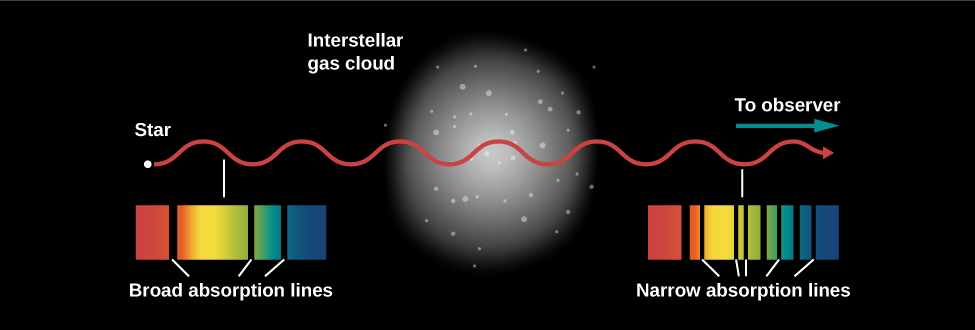
Unfortunately, neutral hydrogen atoms at temperatures typical of the gas in interstellar space neither emit nor absorb light in the visible part of the spectrum. Nor, for the most part, do the other trace elements that are mixed with the interstellar hydrogen. However, some of these other elements can absorb visible light even at typical interstellar temperatures. This means that when we observe a bright source such as a hot star or a galaxy, we can sometimes see additional lines in its spectrum produced when interstellar gas absorbs light at particular frequencies (see Figure 20.4). Some of the strongest interstellar absorption lines are produced by calcium and sodium, but many other elements can be detected as well in sufficiently sensitive observations (as discussed in Radiation and Spectra).
英語のヒント
残念ながら、星間ガスの典型的な温度にある中性水素原子は、スペクトルの可視光域では、光を放射も吸収もしない。星間水素に混ざった、ほかの微量元素も、大部分は同じである。しかし、それらの元素の一部は、典型的な星間温度でも可視光を吸収できる。したがって、高温の星や銀河のような明るい光源を観測すると、星間ガスが特定の振動数の光を吸収して生じた線が、スペクトルに加わって見えることがある(図20.4)。特に強い星間吸収線の一部は、カルシウムやナトリウムが作る。「放射とスペクトル」で述べたように、十分感度の高い観測なら、ほかの多くの元素も検出できる。
Absorption Lines though an Interstellar Dust Cloud.星間の塵の雲を通して見る吸収線
OpenStax / Rice University · CC BY 4.0
Figure 20.4 When there is a significant amount of cool interstellar matter (gas with some dust) between us and a star, we can see the absorption lines of the gas in the star’s spectrum. We can distinguish the two kinds of lines because, whereas the star’s lines are broad, the lines from the gas are narrower.
図20.4 私たちと星の間に、冷たい星間物質、つまり少量の塵を含むガスが十分あると、星のスペクトルにそのガスの吸収線が見える。星自身の線は幅広く、ガスの線は細いので、2種類の線を区別できる。
The first evidence for absorption by interstellar clouds came from the analysis of a spectroscopic binary star (see The Stars: A Celestial Census), published in 1904. While most of the lines in the spectrum of this binary shifted alternately from longer to shorter wavelengths and back again, as we would expect from the Doppler effect for stars in orbit around each other, a few lines in the spectrum remained fixed in wavelength. Since both stars are moving in a binary system, lines that showed no motion puzzled astronomers. The lines were also peculiar in that they were much, much narrower than the rest of the lines, indicating that the gas producing them was at a very low pressure. Subsequent work demonstrated that these lines were not formed in the star’s atmosphere at all, but rather in a cold cloud of gas located between Earth and the binary star.
英語のヒント
星間雲による吸収を示す最初の証拠は、1904年に発表された分光連星の分析から得られた(「恒星――星の世界の実態を調べる」を参照)。この連星のスペクトルの大部分の線は、長い波長から短い波長へ、そして再び戻る動きを繰り返した。互いの周りを回る星のドップラー効果から予想されるとおりだった。しかし、いくつかの線は波長が変わらなかった。連星系では両方の星が動いているので、動きを示さない線は天文学者を困惑させた。また、その線は、ほかの線よりずっと幅が狭いという点でも奇妙であり、線を生むガスの圧力が非常に低いことを示していた。その後の研究で、この線は星の大気でできたものではまったくなく、地球と連星の間にある冷たいガス雲で生じたと実証された。
While these and similar observations proved there was interstellar gas, they could not yet detect hydrogen, the most common element, due to its lack of spectral features in the visible part of the spectrum. (The Balmer line of hydrogen is in the visible range, but only excited hydrogen atoms produce it. In the cold interstellar medium, the hydrogen atoms are all in the ground state and no electrons are in the higher-energy levels required to produce either emission or absorption lines in the Balmer series.) Direct detection of hydrogen had to await the development of telescopes capable of seeing very-low-energy changes in hydrogen atoms in other parts of the spectrum. The first such observations were made using radio telescopes, and radio emission and absorption by interstellar hydrogen remains one of our main tools for studying the vast amounts of cold hydrogen in the universe to this day.
英語のヒント
これらや類似の観測は星間ガスの存在を証明したが、最も多い元素である水素は、可視光域にスペクトルの特徴がないため、まだ検出できなかった。水素のバルマー線は可視光域にあるが、それを生むのは励起された水素原子だけである。冷たい星間物質では、水素原子はすべて基底状態にあり、バルマー系列の輝線や吸収線に必要な、高いエネルギー準位に電子がいない。水素を直接検出するには、スペクトルのほかの領域で、水素原子の非常に低いエネルギーの変化を見られる望遠鏡の開発を待つ必要があった。最初の観測は電波望遠鏡で行われた。星間水素による電波の放射と吸収は、現在に至るまで、宇宙にある大量の冷たい水素を調べるための主要な手段の一つである。
In 1944, while he was still a student, the Dutch astronomer Hendrik van de Hulst predicted that hydrogen would produce a strong line at a wavelength of 21 centimeters. That’s quite a long wavelength, implying that the wave has such a low frequency and low energy that it cannot come from electrons jumping between energy levels (as we discussed in Radiation and Spectra). Instead, energy is emitted when the electron does a flip, something like an acrobat in a circus flipping upright after standing on his head.
英語のヒント
1944年、まだ学生だったオランダの天文学者ヘンドリク・ファン・デ・フルストは、水素が波長21 cmに強い線を作ると予測した。これはかなり長い波長であり、振動数もエネルギーも非常に低い。そのため、「放射とスペクトル」で説明した、電子がエネルギー準位の間を跳ぶ変化からは生じえないことを意味する。その代わり、電子が向きを反転するときにエネルギーが放射される。サーカスの曲芸師が、逆立ちからひっくり返って立ち上がるようなものだ。
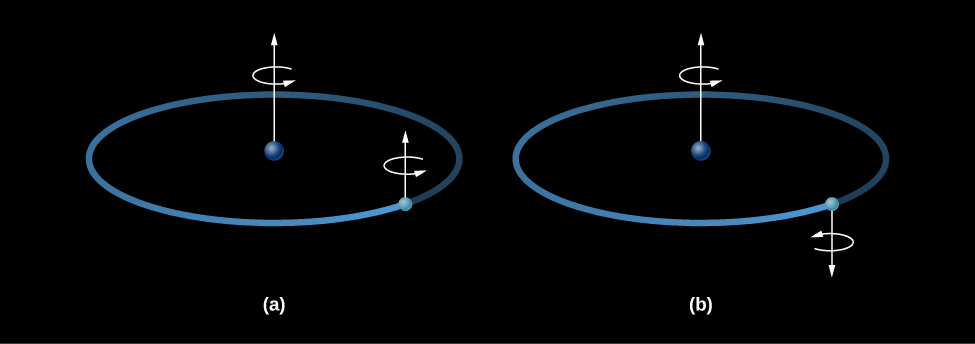
The flip works like this: a hydrogen atom consists of a proton and an electron bound together. Both the proton and the electron act is if they were spinning like tops, and spin axes of the two tops can either be pointed in the same direction (aligned) or in opposite directions (anti-aligned). If the proton and electron were spinning in opposite directions, the atom as a whole would have a very slightly lower energy than if the two spins were aligned (Figure 20.5). If an atom in the lower-energy state (spins opposed) acquired a small amount of energy, then the spins of the proton and electron could be aligned, leaving the atom in a slightly excited state. If the atom then lost that same amount of energy again, it would return to its ground state. The amount of energy involved corresponds to a wave with a wavelength of 21 centimeters; hence, it is known as the 21-centimeter line.
英語のヒント
反転は次のように起きる。水素原子は、結びついた陽子と電子からなる。陽子も電子も、こまのように自転しているかのように振る舞い、その2つのスピン軸は、同じ向き(平行)にも、反対向き(反平行)にもなれる。陽子と電子のスピンが反対向きなら、原子全体のエネルギーは、スピンが同じ向きの場合より、ごくわずかに低くなる(図20.5)。低いエネルギーの状態、つまりスピンが反対向きの原子が、わずかなエネルギーを得ると、陽子と電子のスピンを同じ向きにそろえられ、原子は少し励起された状態になる。その後、同じ量のエネルギーを再び失えば、基底状態へ戻る。関わるエネルギーの量は波長21 cmの波に対応するので、これを21 cm線と呼ぶ。
Formation of the 21-Centimeter Line.21 cm線が生じる仕組み
OpenStax / Rice University · CC BY 4.0
Figure 20.5 When the electron in a hydrogen atom is in the orbit closest to the nucleus, the proton and the electron may be spinning either (a) in the same direction or (b) in opposite directions. When the electron flips over, the atom gains or loses a tiny bit of energy by either absorbing or emitting electromagnetic energy with a wavelength of 21 centimeters.
図20.5 水素原子の電子が原子核に最も近い軌道にあるとき、陽子と電子のスピンは、(a)同じ方向にも、(b)反対方向にもなれる。電子の向きが反転すると、原子は波長21 cmの電磁波を吸収または放射し、ごくわずかなエネルギーを得たり失ったりする。
Neutral hydrogen atoms can acquire small amounts of energy through collisions with other hydrogen atoms or with free electrons. Such collisions are extremely rare in the sparse gases of interstellar space. An individual atom may wait centuries before such an encounter aligns the spins of its proton and electron. Nevertheless, over many millions of years, a significant fraction of the hydrogen atoms are excited by a collision. (Out there in cold space, that’s about as much excitement as an atom typically experiences.)
英語のヒント
中性水素原子は、ほかの水素原子や自由電子との衝突によって、少量のエネルギーを得られる。星間空間のまばらなガスでは、こうした衝突は極めてまれである。ある原子は、陽子と電子のスピンをそろえる衝突に出会うまで、何世紀も待つかもしれない。それでも数百万年という長い時間には、水素原子のかなりの割合が、衝突によって励起される。(冷たい宇宙空間では、これが原子の経験する典型的な「興奮」の程度である。)
An excited atom can later lose its excess energy either by colliding with another particle or by giving off a radio wave with a wavelength of 21 centimeters. If there are no collisions, an excited hydrogen atom will wait an average of about 10 million years before emitting a photon and returning to its state of lowest energy. Even though the probability that any single atom will emit a photon is low, there are so many hydrogen atoms in a typical gas cloud that collectively they will produce an observable line at 21 centimeters.
英語のヒント
励起された原子は後に、別の粒子と衝突するか、波長21 cmの電波を放つことで、余分なエネルギーを失える。衝突がなければ、励起された水素原子は、光子を放って最低エネルギー状態に戻るまで、平均約1000万年待つことになる。一つの原子が光子を放つ確率は低くても、典型的なガス雲には水素原子が非常に多いので、全体としては観測可能な21 cm線を作る。
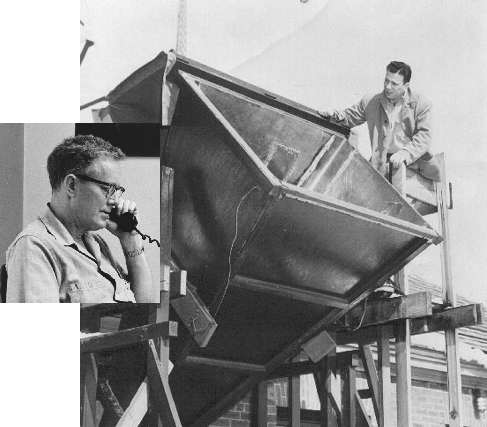
Equipment sensitive enough to detect the 21-cm line of neutral hydrogen became available in 1951. Dutch astronomers had built an instrument to detect the 21-cm waves that they had predicted, but a fire destroyed it. As a result, two Harvard physicists, Harold Ewen and Edward Purcell, made the first detection (Figure 20.6), soon followed by confirmations from the Dutch and a group in Australia. Since the detection of the 21-cm line, many other radio lines produced by both atoms and molecules have been discovered (as we will discuss in a moment), and these have allowed astronomers to map out the neutral gas throughout our home Galaxy. Astronomers have also detected neutral interstellar gas, including hydrogen, at many other wavelengths from the infrared to the ultraviolet.
英語のヒント
中性水素の21 cm線を検出できるだけの感度を持つ装置は、1951年に使えるようになった。オランダの天文学者たちも、自分たちが予測した21 cmの電波を検出する装置を作ったが、火災で失ってしまった。その結果、ハーバード大学の2人の物理学者、ハロルド・ユーエンとエドワード・パーセルが、最初の検出を行った(図20.6)。すぐ後に、オランダとオーストラリアのグループも確認した。21 cm線の検出以来、原子や分子が作るほかの多くの電波の線も発見された。これから説明するように、それらによって天文学者は、天の川銀河全体の中性ガスを地図にできるようになった。また、赤外線から紫外線までの多くの波長でも、水素を含む中性の星間ガスを検出している。
Harold Ewen (1922–2015) and Edward Purcell (1912–1997).ハロルド・ユーエン(1922〜2015)とエドワード・パーセル(1912〜1997)
credit: modification of work by NRAO · CC BY 4.0
Figure 20.6 We see Harold Ewen in 1952 working with the horn antenna (atop the physics laboratory at Harvard) that made the first detection of interstellar 21-cm radiation. The inset shows Edward Purcell, the winner of the 1952 Nobel Prize in physics, a few years later. (credit: modification of work by NRAO)
図20.6 1952年、ハーバード大学の物理学研究室の屋上にあるホーンアンテナで作業するハロルド・ユーエン。このアンテナが、星間21 cm線を最初に検出した。挿入写真は、1952年のノーベル物理学賞受賞者エドワード・パーセルの、数年後の姿である。(クレジット:NRAOの作品を改変)
Modern radio observations show that most of the neutral hydrogen in our Galaxy is confined to an extremely flat layer, less than 300 light-years thick, that extends throughout the disk of the Milky Way Galaxy. This gas has densities ranging from about 0.1 to about 100 atoms per cm3, and it exists at a wide range of temperatures, from as low as about 100 K (–173 °C) to as high as about 8000 K. These regions of warm and cold gas are interspersed with each other, and the density and temperature at any particular point in space are constantly changing.
英語のヒント
現在の電波観測によれば、天の川銀河の中性水素の大部分は、厚さ300光年未満の非常に平たい層に収まり、銀河円盤全体に広がっている。このガスの密度は1 cm3あたり約0.1〜100原子で、温度は約100 K(−173℃)という低さから約8000 Kまで、幅広い。暖かいガスと冷たいガスの領域は互いに入り交じり、どの場所でも密度と温度は絶えず変化している。