第20章星と星の間――宇宙のガスと塵Between the Stars: Gas and Dust in Space
Interstellar Reddening星間赤化
The tiny interstellar dust grains absorb some of the starlight they intercept. But at least half of the starlight that interacts with a grain is merely scattered, that is, it is redirected rather than absorbed. Since neither the absorbed nor the scattered starlight reaches us directly, both absorption and scattering make stars look dimmer. The effects of both processes are called interstellar extinction (Figure 20.14).
英語のヒント
小さな星間塵の粒は、ぶつかってきた星の光の一部を吸収する。しかし、粒と相互作用する星の光の少なくとも半分は、吸収されずに散乱されるだけだ。つまり、進む向きが変わる。吸収された光も、散乱された光も、私たちには直接届かないので、吸収と散乱は、どちらも星を暗く見せる。この二つの過程による効果を、星間減光という(図20.14)。
Astronomers first came to understand interstellar extinction around the early 1930s, as the explanation of a puzzling observation. In the early part of the twentieth century, astronomers discovered that some stars look red even though their spectral lines indicate that they must be extremely hot (and thus should look blue). The solution to this seeming contradiction turned out to be that the light from these hot stars is not only dimmed but also reddened by interstellar dust, a phenomenon known as interstellar reddening.
英語のヒント
天文学者が星間減光を理解し始めたのは、1930年代初めごろだった。ある不可解な観測を説明するものとしてである。20世紀初頭、スペクトル線からは非常に高温で、したがって青く見えるはずなのに、赤く見える星が発見された。この見かけの矛盾を解く鍵は、高温の星の光が、星間塵によって暗くなるだけでなく、赤くもなるということだった。この現象を星間赤化という。
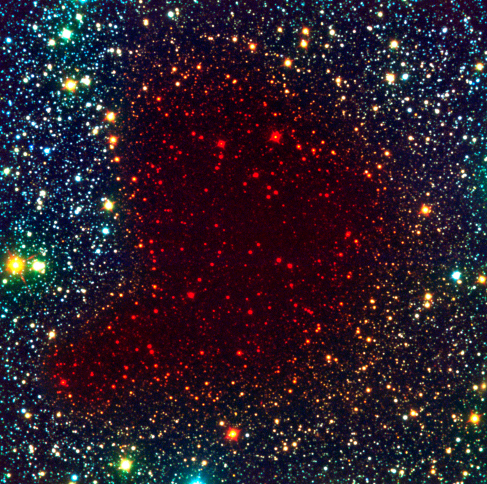
Barnard 68 in Infrared.赤外線で見るバーナード68
credit: ESO · CC BY 4.0
Figure 20.14 In this image, we see Barnard 68, the same object shown in Figure 20.9. The difference is that, in the previous image, the blue, green, and red channels showed light in the visible (or very nearly visible) part of the spectrum. In this image, the red color shows radiation emitted in the infrared at a wavelength of 2.2 microns. Interstellar extinction is much smaller at infrared than at visible wavelengths, so the stars behind the cloud become visible in the infrared channel. (credit: ESO)
英語のヒント
図20.14 図20.9と同じ天体、バーナード68を示す。違いは、前の画像では青・緑・赤の各チャンネルが、可視光、または可視光に非常に近い領域の光を表していたことだ。この画像では、赤色は波長2.2 μmの赤外線放射を表す。星間減光は、可視光より赤外線の波長でずっと小さいので、雲の背後の星が、赤外線のチャンネルでは見えるようになる。(クレジット:ESO)
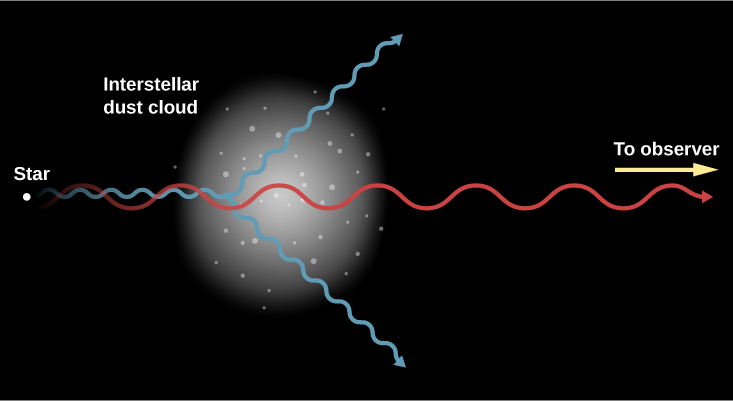
Dust does not interact with all the colors of light the same way. Much of the violet, blue, and green light from these stars has been scattered or absorbed by dust, so it does not reach Earth. Some of their orange and red light, with longer wavelengths, on the other hand, more easily penetrates the intervening dust and completes its long journey through space to enter Earth-based telescopes (Figure 20.15). Thus, the star looks redder from Earth than it would if you could see it from nearby. (Strictly speaking, reddening is not the most accurate term for this process, since no red color is added; instead, blues and related colors are subtracted, so it should more properly be called “deblueing.”) In the most extreme cases, stars can be so reddened that they are entirely undetectable at visible wavelengths and can be seen only at infrared or longer wavelengths (Figure 20.14).
英語のヒント
塵は、すべての色の光と同じように相互作用するわけではない。星からの紫・青・緑の光の多くは、塵で散乱または吸収され、地球まで届かない。それに対し、波長の長いオレンジや赤の光の一部は、途中の塵をより通り抜けやすく、宇宙の長旅を終えて、地上の望遠鏡に入る(図20.15)。そのため星は、近くで見た場合より、地球からは赤く見える。厳密には「赤化」は、最も正確な呼び方ではない。赤色が加わるわけではなく、青やそれに近い色が差し引かれるので、むしろ「脱青化」と呼ぶほうが適切だろう。極端な場合、星は非常に強く赤化し、可視光ではまったく検出できず、赤外線か、それより長い波長でしか見えなくなる(図20.14)。
Scattering of Light by Dust.塵による光の散乱
OpenStax / Rice University · CC BY 4.0
Figure 20.15 Interstellar dust scatters blue light more efficiently than red light, thereby making distant stars appear redder and giving clouds of dust near stars a bluish hue. Here, a red ray of light from a star comes straight through to the observer, whereas a blue ray is shown scattering. A similar scattering process makes Earth’s sky look blue.
英語のヒント
図20.15 星間塵は、赤い光より青い光を効率よく散乱する。そのため遠くの星を赤く見せ、星の近くの塵の雲には青みを与える。ここでは、星からの赤い光線は観測者までまっすぐ進み、青い光線は散乱する様子を示す。同様の散乱過程が、地球の空を青く見せる。
We have all seen an example of reddening on Earth. The Sun appears much redder at sunset than it does at noon. The lower the Sun is in the sky, the longer the path its light must travel through the atmosphere. Over this greater distance, there is a greater chance that sunlight will be scattered. Since red light is less likely to be scattered than blue light, the Sun appears more and more red as it approaches the horizon.
英語のヒント
地球でも、誰もが赤化の例を見たことがある。太陽は、正午より日没のときにずっと赤く見える。空の太陽の位置が低いほど、光が大気の中を進む道のりは長くなる。道のりが長い分、太陽光が散乱する機会も多くなる。赤い光は青い光より散乱しにくいため、太陽は地平線へ近づくほど、ますます赤く見える。
By the way, scattering of sunlight is also what causes our sky to look blue, even though the gases that make up Earth’s atmosphere are transparent. As sunlight comes in, it scatters from the molecules of air. The small size of the molecules means that the blue colors scatter much more efficiently than the greens, yellows, and reds. Thus, the blue in sunlight is scattered out of the beam and all over the sky. The light from the Sun that comes to your eye, on the other hand, is missing some of its blue, so the Sun looks a bit yellower, even when it is high in the sky, than it would from space.
英語のヒント
ちなみに、地球の大気を作る気体が透明なのに、空が青く見えるのも、太陽光の散乱による。太陽光は入ってくると、空気の分子によって散乱する。分子は小さいので、青い光は、緑・黄・赤の光よりずっと効率よく散乱する。そのため、太陽光の青い成分が、まっすぐ進む光の束からそれ、空全体へ散らばる。その一方で、太陽から目へ届く光は、青い成分の一部を失っている。そのため太陽は、空高くあるときでさえ、宇宙から見るより、少し黄色く見える。
The fact that starlight is reddened by interstellar dust means that long-wavelength radiation is transmitted through the Galaxy more efficiently than short-wavelength radiation. Consequently, if we wish to see farther in a direction with considerable interstellar material, we should look at long wavelengths. This simple fact provides one of the motivations for the development of infrared astronomy. In the infrared region at 2 microns (2000 nanometers), for example, the obscuration is only one-sixth as great as in the visible region (500 nanometers), and we can therefore study stars that are more than twice as distant before their light is blocked by interstellar dust. This ability to see farther by observing in the infrared portion of the spectrum represents a major gain for astronomers trying to understand the structure of our Galaxy or probing its puzzling, but distant, center (see The Milky Way Galaxy).
英語のヒント
星の光が星間塵によって赤くなるということは、波長の長い放射のほうが、短い放射より効率よく銀河内を通り抜けることを意味する。したがって、星間物質が多い方向を遠くまで見たいなら、長い波長で観測すべきである。この単純な事実は、赤外線天文学を発展させる動機の一つとなっている。例えば、波長2 μm(2000 nm)の赤外線では、可視光域の500 nmに比べて、光の遮られ方はわずか6分の1である。そのため、星間塵に光を遮られるまでに、2倍を超える距離の星まで調べられる。スペクトルの赤外線域を観測して、より遠くまで見通せることは、銀河の構造を理解しようとしたり、遠くて謎の多い中心を探ろうとしたりする天文学者にとって、大きな利点である(「天の川銀河」を参照)。
Interstellar Grains星間の粒
Before we get to the details about interstellar dust, we should perhaps get one concern out of the way. Why couldn’t it be the interstellar gas that reddens distant stars and not the dust? We already know from everyday experience that atomic or molecular gas is almost transparent. Consider Earth’s atmosphere. Despite its very high density compared with that of interstellar gas, it is so transparent as to be practically invisible. (Gas does have a few specific spectral lines, but they absorb only a tiny fraction of the light as it passes through.)The quantity of gas required to produce the observed absorption of light in interstellar space would have to be enormous. The gravitational attraction of so great a mass of gas would affect the motions of stars in ways that could easily be detected. Such motions are not observed, and thus, the interstellar absorption cannot be the result of gases.
英語のヒント
星間塵の詳しい話に入る前に、一つの疑問を片づけておこう。遠くの星を赤くするのが、塵ではなく星間ガスだとは考えられないのだろうか。原子や分子のガスがほとんど透明であることは、日常経験から分かる。地球の大気を考えよう。星間ガスに比べて、密度が非常に高いにもかかわらず、ほとんど見えないほど透明である。ガスにも特定のスペクトル線はいくつかあるが、通過する光のごく一部しか吸収しない。星間空間で観測される光の吸収を起こすには、莫大な量のガスが必要になるはずだ。それほど大きなガスの質量があれば、重力が星の運動に、容易に検出できる影響を及ぼすだろう。そのような運動は観測されない。したがって、星間吸収はガスによるものではありえない。
Although gas does not absorb much light, we know from everyday experience that tiny solid or liquid particles can be very efficient absorbers. Water vapor in the air is quite invisible. When some of that vapor condenses into tiny water droplets, however, the resulting cloud is opaque. Dust storms, smoke, and smog offer familiar examples of the efficiency with which solid particles absorb light. On the basis of arguments like these, astronomers have concluded that widely scattered solid particles in interstellar space must be responsible for the observed dimming of starlight. What are these particles made of? And how did they form?
英語のヒント
ガスはあまり光を吸収しないが、小さな固体や液体の粒が、非常に効率よく光を吸収することは、日常経験から分かる。空気中の水蒸気は、まったく見えない。しかし、その一部が凝結して小さな水滴になると、できた雲は不透明になる。砂塵嵐、煙、スモッグは、固体の粒が効率よく光を吸収する、身近な例である。こうした議論をもとに、天文学者は、観測される星の光の減光は、星間空間に広く散らばる固体粒子によるはずだと結論づけた。では、その粒は何でできていて、どのように生まれたのだろうか。
Observations like the pictures in this chapter show that a great deal of this dust exists; hence, it must be primarily composed of elements that are abundant in the universe (and in interstellar matter). After hydrogen and helium, the most abundant elements are oxygen, carbon, and nitrogen. These three elements, along with magnesium, silicon, iron—and perhaps hydrogen itself—turn out to be the most important components of interstellar dust.
英語のヒント
この章の写真のような観測から、塵が大量に存在すると分かる。したがって、主な材料は、宇宙や星間物質に豊富な元素であるはずだ。水素とヘリウムの次に多いのは、酸素・炭素・窒素である。この3元素に、マグネシウム・ケイ素・鉄、そしておそらく水素そのものが加わり、星間塵の最も重要な構成成分になっている。
Many of the dust particles can be characterized as sootlike (rich in carbon) or sandlike (containing silicon and oxygen). Grains of interstellar dust are found in meteorites and can be identified because the abundances of certain isotopes are different from what we see in other solar system material. Several different interstellar dust substances have been identified in this way in the laboratory, including graphite and diamonds. (Don’t get excited; these diamonds are only a billionth of a meter in size and would hardly make an impressive engagement ring!)
英語のヒント
塵の粒の多くは、炭素に富む、すすのようなもの、またはケイ素と酸素を含む、砂のようなものと特徴づけられる。星間塵の粒は隕石の中でも見つかる。特定の同位体の存在比が、太陽系のほかの物質と異なるため、見分けられる。この方法で、黒鉛やダイヤモンドなど、何種類もの星間塵の物質が実験室で特定されている。興奮しすぎないように。このダイヤモンドの大きさは、わずか10億分の1 mほどなので、立派な婚約指輪にはとてもならない。
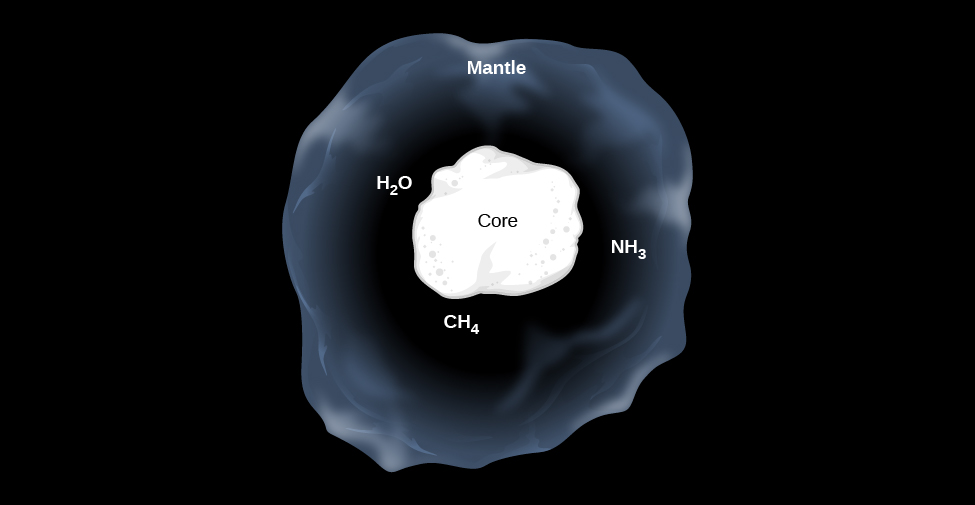
The most widely accepted model pictures the grains with rocky cores that are either like soot (rich in carbon) or like sand (rich in silicates). In the dark clouds where molecules can form, these cores are covered by icy mantles (Figure 20.16). The most common ices in the grains are water (H2O), methane (CH4), and ammonia (NH3)—all built out of atoms that are especially abundant in the realm of the stars. The ice mantles, in turn, are sites for some of the chemical reactions that produce complex organic molecules.
英語のヒント
最も広く受け入れられているモデルでは、粒には、すすのように炭素に富むか、砂のようにケイ酸塩に富む、岩石質の核がある。分子ができる暗い雲の中では、この核を氷の被膜が覆う(図20.16)。粒に含まれる氷で特に多いのは、水(H2O)・メタン(CH4)・アンモニア(NH3)であり、いずれも星の世界に特に豊富な原子でできている。さらに氷の被膜は、複雑な有機分子を生む化学反応の一部が起こる場でもある。
Model of an Interstellar Dust Grain.星間塵の粒のモデル
OpenStax / Rice University · CC BY 4.0
Figure 20.16 A typical interstellar grain is thought to consist of a core of rocky material (silicates) or graphite, surrounded by a mantle of ices. Typical grain sizes are 10–8 to 10–7 meters. (This is from 1/100 to 1/10 of a micron; by contrast, human hair is about 10–200 microns wide.)
図20.16 典型的な星間塵の粒は、岩石質の物質(ケイ酸塩)または黒鉛の核を、氷の被膜が覆うものと考えられている。典型的な粒の大きさは、10–8〜10–7 m、つまり0.01〜0.1 μmである。対照的に、人間の髪の太さは約10〜200 μmである。
Typical individual grains must be just slightly smaller than the wavelength of visible light. If the grains were a lot smaller, they would not block the light efficiently, as Figure 20.13 and other images in this chapter show that it does.
英語のヒント
典型的な一つ一つの粒は、可視光の波長より、わずかに小さいはずだ。ずっと小さければ、光を効率よく遮れないだろう。図20.13や、この章のほかの画像は、塵が実際に光を遮ることを示している。
On the other hand, if the dust grains were much larger than the wavelength of light, then starlight would not be reddened. Things that are much larger than the wavelength of light would block both blue and red light with equal efficiency. In this way we can deduce that a characteristic interstellar dust grain contains 106 to 109 atoms and has a diameter of 10–8 to 10–7 meters (10 to 100 nanometers). This is actually more like the specks of solid matter in cigarette smoke than the larger grains of dust you might find under your desk when you are too busy studying astronomy to clean properly.
英語のヒント
逆に、塵の粒が光の波長よりずっと大きければ、星の光は赤くならないだろう。波長より十分大きい物体は、青い光も赤い光も、同じ効率で遮るからだ。このようにして、典型的な星間塵の粒は、106〜109個の原子を含み、直径は10–8〜10–7 m、すなわち10〜100 nmだと推定できる。実際には、天文学の勉強に忙しくて、きちんと掃除できず、机の下にたまった大きなほこりより、たばこの煙の中の微小な固体粒子に近い。