第20章星と星の間――宇宙のガスと塵Between the Stars: Gas and Dust in Space
20.1 The Interstellar Medium20.1 星間物質
Learning Objectives学習の目標
By the end of this section, you will be able to:
この節を読み終えると、次のことができるようになる。
Explain how much interstellar matter there is in the Milky Way, and what its typical density is
天の川銀河にある星間物質の量と、その典型的な密度を説明する。
Describe how the interstellar medium is divided into gaseous and solid components
星間物質を、気体成分と固体成分にどのように分けるかを述べる。
Astronomers refer to all the material between stars as interstellar matter; the entire collection of interstellar matter is called the interstellar medium (ISM). Some interstellar material is concentrated into giant clouds, each of which is known as a nebula (plural “nebulae,” Latin for “clouds”). The best-known nebulae are the ones that we can see glowing or reflecting visible light; there are many pictures of these in this chapter.
英語のヒント
天文学者は、星と星の間にあるすべての物質をinterstellar matterと呼び、その全体をinterstellar medium(ISM)と呼ぶ。日本語では、どちらも星間物質と訳す。星間物質の一部は巨大な雲に集中し、その一つ一つを星雲(nebula、複数形nebulae。ラテン語で「雲」)と呼ぶ。よく知られた星雲は、自ら輝いたり可視光を反射したりする姿が見えるもので、この章にも多くの写真がある。
Interstellar clouds do not last for the lifetime of the universe. Instead, they are like clouds on Earth, constantly shifting, merging with each other, growing, or dispersing. Some become dense and massive enough to collapse under their own gravity, forming new stars. When stars die, they, in turn, eject some of their material into interstellar space. This material can then form new clouds and begin the cycle over again.
英語のヒント
星間雲が、宇宙の一生の間ずっと続くわけではない。むしろ地球の雲のように、絶えず移動し、互いに合わさり、大きくなったり散ったりしている。密度も質量も十分大きくなり、自分自身の重力で収縮して、新しい星を作るものもある。星が死ぬと、今度は自分の物質の一部を星間空間へ放出する。その物質から新しい雲ができ、循環が再び始まるのである。
About 99% of the material between the stars is in the form of a gas—that is, it consists of individual atoms or molecules. The most abundant elements in this gas are hydrogen and helium (which we saw are also the most abundant elements in the stars), but the gas also includes other elements. Some of the gas is in the form of molecules—combinations of atoms. The remaining 1% of the interstellar material is solid—frozen particles consisting of many atoms and molecules that are called interstellar grains or interstellar dust (Figure 20.2). A typical dust grain consists of a core of rocklike material (silicates) or graphite surrounded by a mantle of ices; water, methane, and ammonia are probably the most abundant ices.
英語のヒント
星と星の間の物質の約99%は気体であり、つまり個々の原子や分子からなる。この気体で最も多い元素は水素とヘリウムで、前に見たように、星で最も多い元素でもある。ただし、ほかの元素も含まれる。ガスの一部は、原子が結びついた分子として存在する。残り約1%の星間物質は固体で、多数の原子や分子からなる、固まった粒である。これを星間粒子、または星間塵と呼ぶ(図20.2)。典型的な塵の粒は、岩石状の物質(ケイ酸塩)か黒鉛の芯を、氷の層が包んだ構造を持つ。最も多い氷は、おそらく水、メタン、アンモニアである。
Various Types of Interstellar Matter.さまざまな種類の星間物質
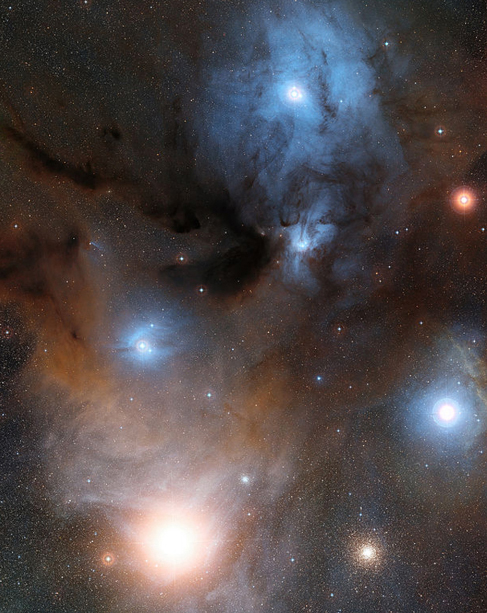
credit: modification of work by ESO/Digitized Sky Survey 2 · CC BY 4.0
Figure 20.2 The reddish nebulae in this spectacular photograph glow with light emitted by hydrogen atoms. The darkest areas are clouds of dust that block the light from stars behind them. The upper part of the picture is filled with the bluish glow of light reflected from hot stars embedded in the outskirts of a huge, cool cloud of dust and gas. The cool supergiant star Antares can be seen as a big, reddish patch in the lower-left part of the picture. The star is shedding some of its outer atmosphere and is surrounded by a cloud of its own making that reflects the red light of the star. The red nebula in the middle right partially surrounds the star Sigma Scorpii. (To the right of Antares, you can see M4, a much more distant cluster of extremely old stars.) (credit: modification of work by ESO/Digitized Sky Survey 2)
英語のヒント
図20.2 この見事な写真の赤みを帯びた星雲は、水素原子が放つ光で輝いている。最も暗い部分は、背後の星の光を遮る塵の雲である。画像の上部は、巨大で冷たい塵とガスの雲の外縁に埋もれた、高温の星の光を反射する青い輝きに満ちている。低温の超巨星アンタレスは、左下の大きな赤みを帯びた塊として見える。この星は外層大気の一部を放出し、自ら作った雲に包まれている。その雲が星の赤い光を反射する。中央右の赤い星雲は、さそり座σ星を部分的に囲んでいる。(アンタレスの右には、ずっと遠くにある、非常に古い星々の星団M4が見える。)(クレジット:ESO/Digitized Sky Survey 2の作品を改変)
If all the interstellar gas within the Galaxy were spread out smoothly, there would be only about one atom of gas per cm3 in interstellar space. (In contrast, the air in the room where you are reading this book has roughly 1019 atoms per cm3.) The dust grains are even scarcer. A km3 of space would contain only a few hundred to a few thousand tiny grains, each typically less than one ten-thousandth of a millimeter in diameter. These numbers are just averages, however, because the gas and dust are distributed in a patchy and irregular way, much as water vapor in Earth’s atmosphere is often concentrated into clouds.
英語のヒント
銀河内の星間ガスをすべて一様に広げると、星間空間の1 cm3あたりには、ガスの原子が約1個しかないことになる。(これに対して、本書を読んでいる部屋の空気には、1 cm3あたりおよそ1019個の原子がある。)塵の粒はさらに少ない。1 km3の空間に、数百〜数千個ほどの小さな粒しかなく、典型的な直径は1万分の1 mm未満である。ただし、これらはあくまで平均値である。ガスと塵は、地球大気中の水蒸気がしばしば雲に集中するのと同じように、むらが多く不規則に分布している。
In some interstellar clouds, the density of gas and dust may exceed the average by as much as a thousand times or more, but even this density is more nearly a vacuum than any we can make on Earth. To show what we mean, let’s imagine a vertical tube of air reaching from the ground to the top of Earth’s atmosphere with a cross-section of 1 square meter. Now let us extend the same-size tube from the top of the atmosphere all the way to the edge of the observable universe—over 10 billion light-years away. Long though it is, the second tube would still contain fewer atoms than the one in our planet’s atmosphere.
英語のヒント
星間雲の中には、ガスと塵の密度が平均の1000倍以上に達するものもある。それでも、地球上で作れるどんな真空よりも、真空に近い。その意味を示すため、地表から地球大気の上端まで伸びる、断面積1 m²の鉛直の空気の管を想像しよう。次に同じ断面の管を、大気の上端から、100億光年以上先にある観測可能な宇宙の端まで伸ばしてみる。2本目の管はこれほど長くても、その中の原子の数は、地球大気の中の管より少ないのである。
While the density of interstellar matter is very low, the volume of space in which such matter is found is huge, and so its total mass is substantial. To see why, we must bear in mind that stars occupy only a tiny fraction of the volume of the Milky Way Galaxy. For example, it takes light only about four seconds to travel a distance equal to the diameter of the Sun, but more than four years to travel from the Sun to the nearest star. Even though the spaces among the stars are sparsely populated, there’s a lot of space out there!
英語のヒント
星間物質の密度は非常に低いが、それが存在する空間の体積は巨大なので、総質量は相当なものになる。その理由を理解するには、星が占めるのは、天の川銀河の体積のごく小さな割合だけだと覚えておく必要がある。例えば、光が太陽の直径に等しい距離を進むには約4秒しかかからないが、太陽から最も近い別の星まで進むには4年以上かかる。星と星の間に物質がまばらでも、その空間自体が膨大にあるのだ。
Astronomers estimate that the total mass of gas and dust in the Milky Way Galaxy is equal to about 15% of the mass contained in stars. This means that the mass of the interstellar matter in our Galaxy amounts to about 10 billion times the mass of the Sun. There is plenty of raw material in the Galaxy to make generations of new stars and planets (and perhaps even astronomy students).
英語のヒント
天文学者は、天の川銀河のガスと塵の総質量を、星に含まれる質量の約15%と見積もっている。これは、天の川銀河の星間物質の質量が、太陽約100億個分に相当することを意味する。銀河には、新しい世代の星や惑星、そしておそらく天文学を学ぶ学生さえ作るだけの原材料が、十分にあるのである。
Estimating Interstellar Mass星間物質の質量を見積もる
You can make a rough estimate of how much interstellar mass our Galaxy contains and also how many new stars could be made from this interstellar matter. All you need to know is how big the Galaxy is and the average density using this formula:
英語のヒント
天の川銀河にある星間物質の質量と、そこから作れる新しい星の数を、大まかに見積もってみよう。知る必要があるのは銀河の大きさと平均密度だけで、次の式を使う。
You have to remember to use consistent units—such as meters and kilograms. We will assume that our Galaxy is shaped like a cylinder; the volume of a cylinder equals the area of its base times its height
英語のヒント
メートルとキログラムなど、整合する単位を使うことを忘れないようにしよう。銀河を円柱と仮定する。円柱の体積は、底面積に高さを掛けたものである。
where is the radius of the cylinder and is its height.
ここで、は円柱の半径、は高さである。
Suppose that the average density of hydrogen gas in our Galaxy is one atom per cm3. Each hydrogen atom has a mass of 1.7 × 10⁻²⁷ kg. If the Galaxy is a cylinder with a diameter of 100,000 light-years and a height of 300 light-years, what is the mass of this gas? How many solar-mass stars (2.0 × 1030 kg) could be produced from this mass of gas if it were all turned into stars?
銀河の水素ガスの平均密度を、1 cm3あたり1原子とする。水素原子1個の質量は1.7×10⁻²⁷ kgである。銀河が直径10万光年、高さ300光年の円柱なら、このガスの質量はいくらか。ガスの全質量が星になるとすると、太陽と同じ質量(2.0×1030 kg)の星を何個作れるだろうか。
Solution解き方
If the diameter of the Galaxy is 100,000 light-years, then the radius is 50,000 light-years. Recall that 1 light-year = 9.5 × 10¹² km = 9.5 × 1017 cm, so the volume of the Galaxy is
銀河の直径が10万光年なら、半径は5万光年である。1光年=9.5×10¹² km=9.5×1017 cmを思い出そう。したがって、銀河の体積は次のようになる。
The total mass is therefore
したがって、総質量は次のとおり。
This is sufficient to make
これだけあれば、太陽と同じ質量の星を、次の個数だけ作れる。
stars equal in mass to the Sun. That’s roughly 2 billion stars.
つまり、およそ20億個の星である。
Check Your Learning理解を確かめよう
You can use the same method to estimate the mass of interstellar gas around the Sun. The distance from the Sun to the nearest other star, Proxima Centauri, is 4.23 light-years. We will see in Interstellar Matter around the Sun that the gas in the immediate vicinity of the Sun is less dense than average, about 0.1 atoms per cm3. What is the total mass of interstellar hydrogen in a sphere centered on the Sun and extending out to Proxima Centauri? How does this compare to the mass of the Sun? It is helpful to remember that the volume of a sphere is related to its radius:
英語のヒント
同じ方法を使い、太陽の周囲の星間ガスの質量を見積もれる。太陽から最も近い別の星、プロキシマ・ケンタウリまでの距離は4.23光年である。「太陽の周囲の星間物質」で見るように、太陽のすぐ近くのガスは平均より密度が低く、1 cm3あたり約0.1原子である。太陽を中心にプロキシマ・ケンタウリまで広がる球に含まれる、星間水素の総質量はいくらか。太陽の質量と比べるとどうだろうか。球の体積と半径には、次の関係があることを思い出すとよい。