第20章星と星の間――宇宙のガスと塵Between the Stars: Gas and Dust in Space
Ultra-Hot Interstellar Gas超高温の星間ガス
While the temperatures of 10,000 K found in H II regions might seem warm, they are not the hottest phase of the interstellar medium. Some of the interstellar gas is at a temperature of a million degrees, even though there is no visible source of heat nearby. The discovery of this ultra-hot interstellar gas was a big surprise. Before the launch of astronomical observatories into space, which could see radiation in the ultraviolet and X-ray parts of the spectrum, astronomers assumed that most of the region between stars was filled with hydrogen at temperatures no warmer than those found in H II regions. But telescopes launched above Earth’s atmosphere obtained ultraviolet spectra that contained interstellar lines produced by oxygen atoms that have been ionized five times. To strip five electrons from their orbits around an oxygen nucleus requires a lot of energy. Subsequent observations with orbiting X-ray telescopes revealed that the Galaxy is filled with numerous bubbles of X-ray-emitting gas. To emit X-rays, and to contain oxygen atoms that have been ionized five times, gas must be heated to temperatures of a million degrees or more.
英語のヒント
H II領域の1万Kという温度は高温に思えるかもしれないが、星間物質の最も熱い状態ではない。星間ガスの一部は、近くに目に見える熱源がないのに、100万度の温度にある。この超高温ガスの発見は、大きな驚きだった。紫外線やX線を観測できる天文衛星が打ち上げられる前、天文学者は、星と星の間の大部分は、H II領域を超えない温度の水素で満たされていると考えていた。しかし地球大気の上へ打ち上げた望遠鏡が得た紫外線スペクトルには、5段階電離した酸素原子が作る星間の線が含まれていた。酸素原子核の周りから電子を5個はぎ取るには、大きなエネルギーが必要である。その後、軌道上のX線望遠鏡による観測で、銀河にはX線を放つガスの泡が多数あることが分かった。X線を放射し、5段階電離した酸素原子を含むには、ガスを100万度以上に加熱する必要がある。
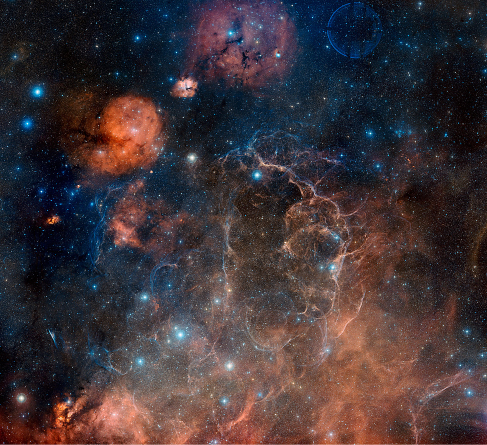
Theorists have now shown that the source of energy producing these remarkable temperatures is the explosion of massive stars at the ends of their lives (Figure 20.7). Such explosions, called supernovae, will be discussed in detail in the chapter on The Death of Stars. For now, we’ll just say that some stars, nearing the ends of their lives, become unstable and literally explode. These explosions launch gas into interstellar space at velocities of tens of thousands of kilometers per second (up to about 30% the speed of light). When this ejected gas collides with interstellar gas, it produces shocks that heat the gas to millions or tens of millions of degrees.
英語のヒント
理論家は、この著しい高温を生むエネルギー源が、大質量星の一生の最後の爆発であることを示した(図20.7)。超新星と呼ばれるこの爆発は、「恒星の死」で詳しく扱う。ここでは、星の一部は一生の終わりに近づくと不安定になり、文字どおり爆発するとだけ述べておこう。爆発はガスを毎秒数万km、最大で光速の約30%もの速度で星間空間へ放つ。放出されたガスが星間ガスに衝突すると、衝撃波が生じ、ガスを数百万〜数千万度へ加熱する。
Vela Supernova Remnant.ほ座超新星残骸
credit: Digitized Sky Survey, ESA/ESO/NASA FITS Liberator, Davide De Martin · CC BY 4.0
Figure 20.7 About 11,000 years ago, a dying star in the constellation of Vela exploded, becoming as bright as the full moon in Earth’s skies. You can see the faint rounded filaments from that explosion in the center of this colorful image. The edges of the remnant are colliding with the interstellar medium, heating the gas they plow through to temperatures of millions of K. Telescopes in space also reveal a glowing sphere of X-ray radiation from the remnant. (credit: Digitized Sky Survey, ESA/ESO/NASA FITS Liberator, Davide De Martin)
図20.7 約1万1000年前、ほ座の中で死を迎えた星が爆発し、地球の空で満月ほど明るく輝いた。その爆発が残した淡い丸みのあるフィラメントが、この色彩豊かな画像の中央に見える。残骸の縁は星間物質に衝突し、突き進む先のガスを数百万Kに加熱している。宇宙の望遠鏡からは、残骸からX線で輝く球状の領域も見える。(クレジット:Digitized Sky Survey、ESA/ESO/NASA FITS Liberator、Davide De Martin)
Astronomers estimate that one supernova explodes roughly every 100 years somewhere in the Galaxy. On average, shocks launched by supernovae sweep through any given point in the Galaxy about once every few million years. These shocks keep some interstellar space filled with gas at temperatures of millions of degrees, and they continually disturb the colder gas, keeping it in constant, turbulent motion.
英語のヒント
天文学者は、銀河のどこかで、およそ100年に1回、超新星が爆発すると見積もっている。平均すると、銀河内のある一点を、超新星が放った衝撃波が数百万年に1回ほど通過する。この衝撃波が、星間空間の一部を数百万度のガスで満たし続ける。また、より冷たいガスを絶えずかき乱し、乱流を伴う運動を持続させる。
Molecular Clouds分子雲
A few simple molecules out in space, such as CN and CH, were discovered decades ago because they produce absorption lines in the visible-light spectra of stars behind them. When more sophisticated equipment for obtaining spectra in radio and infrared wavelengths became available, astronomers—to their surprise—found much more complex molecules in interstellar clouds as well.
英語のヒント
宇宙にあるCNやCHなどの少数の単純な分子は、背後の星の可視光スペクトルに吸収線を作るため、何十年も前に発見されていた。その後、電波や赤外線のスペクトルを得る、より高度な装置が使えるようになると、天文学者は驚いたことに、星間雲の中に、はるかに複雑な分子も発見した。
Just as atoms leave their “fingerprints” in the spectrum of visible light, so the vibration and rotation of atoms within molecules can leave spectral fingerprints in radio and infrared waves. If we spread out the radiation at such longer wavelengths, we can detect emission or absorption lines in the spectra that are characteristic of specific molecules. Over the years, experiments in our laboratories have shown us the exact wavelengths associated with changes in the rotation and vibration of many common molecules, giving us a template of possible lines against which we can now compare our observations of interstellar matter.
英語のヒント
原子が可視光スペクトルに「指紋」を残すように、分子内の原子の振動や回転も、電波や赤外線にスペクトルの指紋を残しうる。そのような長い波長の放射を分光すると、特定の分子に特徴的な輝線や吸収線を検出できる。長年の実験室での実験によって、多くのよくある分子の回転や振動が変化するときの、正確な波長が分かっている。それが、星間物質の観測と比較できる、出現しうる線のひな型を与えてくれる。
The discovery of complex molecules in space came as a surprise because most of interstellar space is filled with ultraviolet light from stars, and this light is capable of dissociating molecules (breaking them apart into individual atoms). In retrospect, however, the presence of molecules is not surprising. As we will discuss further in the next section, and have already seen above, interstellar space also contains significant amounts of dust capable of blocking out starlight. When this dust accumulates in a single location, the result is a dark cloud where ultraviolet starlight is blocked and molecules can survive. The largest of these structures are created where gravity pulls interstellar gas together to form giant molecular clouds, structures as massive as a million times the mass of the Sun. Within these, most of the interstellar hydrogen has formed the molecule H2 (molecular hydrogen). Other, more complex molecules are also present in much smaller quantities.
英語のヒント
宇宙で複雑な分子が見つかったのが驚きだったのは、星間空間の大部分が、星からの紫外線で満たされているからだ。紫外線は分子を解離させ、個々の原子へばらばらにできる。しかし、振り返って考えると、分子の存在は不思議ではない。前にも見たように、また次の節でさらに説明するように、星間空間には星の光を遮れる塵も相当量ある。その塵が一か所に集まると、紫外線が遮られ、分子が生き残れる暗い雲ができる。その中でも最大のものは、重力が星間ガスを集める場所に生じる巨大分子雲で、太陽の100万倍もの質量を持つ。その内部では、水素の大部分が水素分子H2になっている。ほかの、より複雑な分子も、はるかに少ない量ながら存在する。
Giant molecular clouds have densities of hundreds to thousands of atoms per cm3, much denser than interstellar space is on average. As a result, though they account for a very small fraction of the volume of interstellar space, they contain a significant fraction—20–30%—of the total mass of the Milky Way’s gas. Because of their high density, molecular clouds block ultraviolet starlight, the main agent for heating most interstellar gas. As a result, they tend to be extremely cold, with typical temperatures near 10 K (−263 °C). Giant molecular clouds are also the sites where new stars form, as we will discuss below.
英語のヒント
巨大分子雲の密度は、1 cm3あたり数百〜数千原子で、星間空間の平均よりはるかに高い。したがって、占める体積は星間空間全体のごく一部でも、天の川銀河のガスの総質量の20〜30%という、大きな割合を含む。分子雲は密度が高いため、大部分の星間ガスの主な加熱源である、星の紫外線を遮る。その結果、非常に低温になる傾向があり、典型的には10 K(−263℃)ほどである。後で説明するように、巨大分子雲は新しい星が生まれる場所でもある。
It is in these dark regions of space, protected from starlight, that molecules can form. Chemical reactions occurring both in the gas and on the surface of dust grains lead to much more complex compounds, hundreds of which have been identified in interstellar space. Among the simplest of these are water (H2O), carbon monoxide (CO), which is produced by fires on Earth, and ammonia (NH3), whose smell you recognize in strong home cleaning products. Carbon monoxide is particularly abundant in interstellar space and is the primary tool that astronomers use to study giant molecular clouds. Unfortunately, the most abundant molecule, H2, is particularly difficult to observe directly because in most giant molecular clouds, it is too cold to emit even at radio wavelengths. CO, which tends to be present wherever H2 is found, is a much better emitter and is often used by astronomers to trace molecular hydrogen.
英語のヒント
分子ができるのは、星の光から守られた、このような暗い領域である。ガス中と塵の粒の表面の両方で起きる化学反応が、さらに複雑な化合物を生み、そのうち数百種類が星間空間で確認されている。特に単純なものには、水(H2O)、地球では燃焼で生じる一酸化炭素(CO)、そして強い家庭用洗浄剤でにおいを知っているアンモニア(NH3)がある。一酸化炭素は星間空間に特に多く、巨大分子雲を研究する天文学者の主要な手段になっている。残念ながら、最も多い分子H2は、大部分の巨大分子雲では、電波の波長でさえ放射するには低温すぎるため、直接観測しにくい。COはH2がある場所には存在する傾向があり、はるかによく放射するので、水素分子の分布をたどるためによく使われる。
The more complex molecules astronomers have found are mostly combinations of hydrogen, oxygen, carbon, nitrogen, and sulfur atoms. Many of these molecules are organic (those that contain carbon and are associated with the carbon chemistry of life on Earth.) They include formaldehyde (used to preserve living tissues), alcohol (see the feature box on Cocktails in Space), and antifreeze.
英語のヒント
天文学者が見つけた、より複雑な分子の大部分は、水素、酸素、炭素、窒素、硫黄の原子の組み合わせである。多くは、炭素を含み、地球の生命の炭素化学と関わる有機分子である。生物の組織の保存に使うホルムアルデヒド、アルコール(コラム「宇宙のカクテル」を参照)、不凍液の成分などが含まれる。
In 1996, astronomers discovered acetic acid (the prime ingredient of vinegar) in a cloud lying in the direction of the constellation of Sagittarius. To balance the sour with the sweet, a simple sugar (glycolaldehyde) has also been found. In 2025, astronomers found cyanocoronene, a remarkably complex molecule with 37 atoms in ring arrangements, that is part of a family called PAHs (polycyclic aromatic hydrocarbons). On Earth, these are produced when substances burn, like hamburgers and fossil fuels.
英語のヒント
1996年、天文学者は、いて座の方向にある雲の中に、酢の主成分である酢酸を発見した。酸っぱいものと釣り合わせるように、単純な糖であるグリコールアルデヒドも見つかっている。2025年には、37個の原子が環状に並ぶ、極めて複雑な分子シアノコロネンが発見された。これは多環芳香族炭化水素(PAH)と呼ばれる系統の分子である。地球では、ハンバーガーや化石燃料などが燃えるときに、この種の分子が生じる。
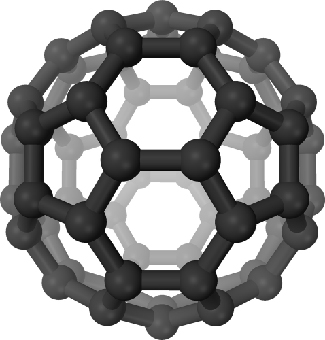
The largest compounds yet discovered in interstellar space are fullerenes, molecules in which 60 or 70 carbon atoms are arranged in a cage-like configuration (see Figure 20.8). See Table 20.1 for a list of a few of the more interesting interstellar molecules that have been found so far.
英語のヒント
星間空間でこれまでに発見された最大の化合物は、60個または70個の炭素原子が、かご状に並ぶフラーレンである(図20.8)。これまでに見つかった、興味深い星間分子の一部を表20.1に示す。
Fullerene C60.フラーレンC60
OpenStax / Rice University · CC BY 4.0
Figure 20.8 This three-dimensional perspective shows the characteristic cage-like arrangement of the 60 carbon atoms in a molecule of fullerene C60. Fullerene C60 is also known as a “buckyball,” or as its full name, buckminsterfullerene, because of its similarity to the multisided architectural domes designed by American inventor R. Buckminster Fuller.
図20.8 この立体的な図は、フラーレンC60分子の60個の炭素原子に特徴的な、かご状の並びを示す。C60は「バッキーボール」とも、正式名称のバックミンスターフラーレンとも呼ばれる。米国の発明家R・バックミンスター・フラーが設計した、多面体の建築ドームに似ていることに由来する。
Some Interesting Interstellar Molecules 興味深い星間分子の例 |
||
|---|---|---|
Name 名称 |
Chemical Formula 化学式 |
Use on Earth 地球での用途 |
Ammonia アンモニア |
NH3 | Household cleansers 家庭用洗浄剤 |
Formaldehyde ホルムアルデヒド |
H2CO | Embalming fluid 遺体の防腐処理液 |
Acetylene アセチレン |
HC2H | Fuel for a welding torch 溶接トーチの燃料 |
Acetic acid 酢酸 |
C2H4O2 C2H4O2 |
The essence of vinegar 酢の主成分 |
Ethyl alcohol エチルアルコール(エタノール) |
CH3CH2OH | End-of-semester parties 学期末のパーティー |
Ethylene glycol エチレングリコール |
HOCH2CH2OH | Antifreeze ingredient 不凍液の成分 |
Benzene ベンゼン |
C6H6 | Carbon ring, ingredient in varnishes and dyes 炭素が環状に並ぶ分子。ワニスや染料の成分。 |
The cold interstellar clouds also contain cyanoacetylene (HC3N) and acetaldehyde (CH3CHO), generally regarded as starting points for amino acid formation. These are building blocks of proteins, which are among the fundamental chemicals from which living organisms on Earth are constructed. The presence of these organic molecules does not imply that life exists in space, but it does show that the chemical building blocks of life can form under a wide range of conditions in the universe. As we learn more about how complex molecules are produced in interstellar clouds, we gain an increased understanding of the kinds of processes that preceded the beginnings of life on Earth billions of years ago.
英語のヒント
冷たい星間雲には、シアノアセチレン(HC3N)やアセトアルデヒド(CH3CHO)も含まれる。これらは一般に、アミノ酸ができる出発物質と考えられている。アミノ酸はタンパク質の構成単位であり、タンパク質は、地球の生物を作る基本的な化学物質の一つである。こうした有機分子の存在は、宇宙に生命がいることを意味しない。しかし、宇宙の幅広い条件のもとで、生命の化学的な材料が作られうることは示している。星間雲で複雑な分子がどのようにできるかを知れば知るほど、数十億年前に地球で生命が始まるのに先立って、どのような過程があったのかについても、理解が深まる。