第20章星と星の間――宇宙のガスと塵Between the Stars: Gas and Dust in Space
20.6 Interstellar Matter around the Sun20.6 太陽の周囲の星間物質
Learning Objectives学習の目標
By the end of this section, you will be able to:
この節を読み終えると、次のことができるようになる。
Describe how interstellar matter is arranged around our solar system
太陽系の周りで、星間物質がどのように分布するかを述べる。
Explain why scientists think that the Sun is located in a hot bubble
太陽が高温の泡の中にあると、科学者が考える理由を説明する。
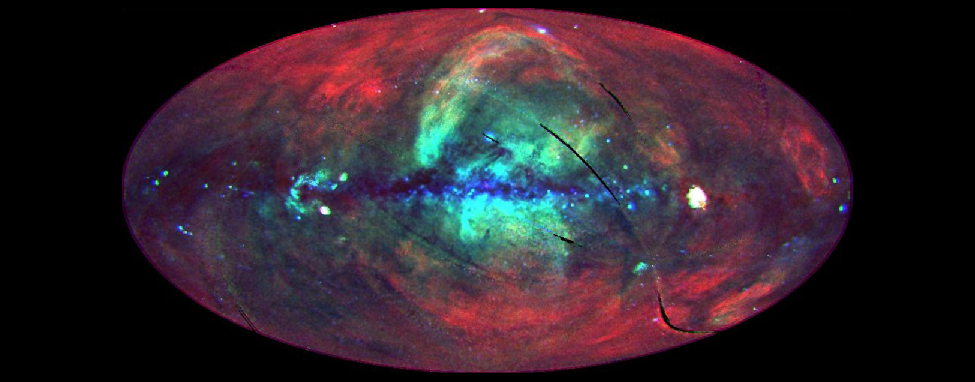
We want to conclude our discussion of interstellar matter by asking how this material is organized in our immediate neighborhood. As we discussed above, orbiting X-ray observatories have shown that the Galaxy is full of bubbles of hot, X-ray-emitting gas. They also revealed a diffuse background of X-rays that appears to fill the entire sky from our perspective (Figure 20.19). While some of this emission comes from the interaction of the solar wind with the interstellar medium, a majority of it comes from beyond the solar system. The natural explanation for why there is X-ray-emitting gas all around us is that the Sun is itself inside one of the bubbles. We therefore call our “neighborhood” the Local Hot Bubble, or Local Bubble for short. The Local Bubble is much less dense—an average of approximately 0.01 atoms per cm3—than the average interstellar density of about 1 atom per cm3. This local gas has a temperature of about a million degrees, just like the gas in the other superbubbles that spread throughout our Galaxy, but because there is so little hot material, this high temperature does not affect the stars or planets in the area in any way.
英語のヒント
星間物質の話の締めくくりに、すぐ近所で、この物質がどのように分布するかを考えよう。先ほど述べたように、軌道上のX線観測衛星によって、銀河には、高温でX線を放つガスの泡が多数あると分かった。観測衛星は、私たちから見ると全天を満たすような、広がったX線の背景放射も発見した(図20.19)。一部は太陽風と星間物質の相互作用から来るが、大部分は太陽系の外から来る。私たちの周囲のあらゆる方向に、X線を放つガスがある理由の自然な説明は、太陽自身が、その泡の一つの中にあるということだ。そこで、この「近所」を局所高温泡、略して局所泡と呼ぶ。局所泡の平均密度は、1 cm3あたり約0.01原子と、星間空間の平均的な約1原子/cm3より、ずっと低い。温度は、銀河に広がるほかの巨大な泡のガスと同じく、約100万度である。しかし高温の物質が非常に少ないので、この高温が、その地域の星や惑星に影響を与えることはない。
What caused the Local Bubble to form? Scientists are not entirely sure, but the leading candidate is winds from stars and supernova explosions. In a nearby region in the direction of the constellations Scorpius and Centaurus, a lot of star formation took place about 15 million years ago. The most massive of these stars evolved very quickly until they produced strong winds, and some ended their lives by exploding. These processes filled the region around the Sun with hot gas, driving away cooler, denser gas. The rim of this expanding superbubble reached the Sun about 7.6 million years ago and now lies more than 200 light-years past the Sun in the general direction of the constellations of Orion, Perseus, and Auriga.
英語のヒント
何が局所泡を作ったのだろうか。科学者には、まだ完全には分からないが、有力候補は、星からの風と超新星爆発である。さそり座やケンタウルス座の方向にある近くの領域では、約1500万年前、多くの星が生まれた。最も質量の大きい星は非常に速く進化し、強い風を生むようになり、その一部は爆発して一生を終えた。これらの過程が、太陽の周りを高温のガスで満たし、より冷たく密なガスを追い払った。膨張する巨大な泡の縁は、約760万年前に太陽に達した。現在は太陽を200光年以上通り越し、おおむねオリオン座・ペルセウス座・ぎょしゃ座の方向にある。
Sky in X-Rays.X線で見る空
credit: modification of work by NASA · NASA media use guidelines
Figure 20.19 This image, made by the ROSAT satellite, shows the whole sky in X-rays as seen from Earth. Different colors indicate different X-ray energies: red is 0.25 kiloelectron volts, green is 0.75 kiloelectron volts, and blue is 1.5 kiloelectron volts. The image is oriented so the plane of the Galaxy runs across the middle of the image. The ubiquitous red color, which does not disappear completely even in the galactic plane, is evidence for a source of X-rays all around the Sun. (credit: modification of work by NASA)
英語のヒント
図20.19 ROSAT衛星による、地球から見た全天のX線画像。色の違いは、X線のエネルギーの違いを示す。赤は0.25 keV、緑は0.75 keV、青は1.5 keVである。銀河面が画像の中央を横切る向きに配置している。銀河面でさえ完全には消えず、どこにでも見られる赤色は、太陽の周囲のあらゆる方向にX線源がある証拠である。(クレジット:NASAの作品を改変)
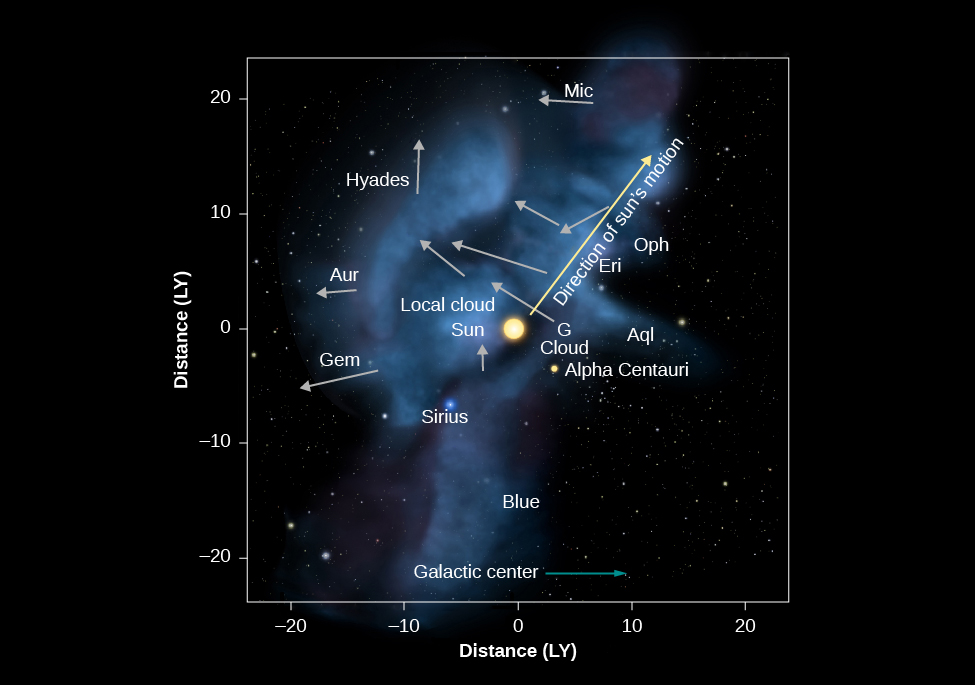
A few clouds of interstellar matter do exist within the Local Bubble. The Sun itself seems to have entered a cloud about 10,000 years ago. This cloud is warm (with a temperature of about 7000 K) and has a density of 0.3 hydrogen atom per cm3—higher than most of the Local Bubble but still so tenuous that it is also referred to as Local Fluff (Figure 20.20). (Aren’t these astronomical names fun sometimes?)
英語のヒント
局所泡の内部にも、星間物質の雲がいくつか存在する。太陽自身は、約1万年前に、その一つへ入ったようである。その雲は約7000 Kと暖かく、密度は1 cm3あたり水素原子0.3個で、局所泡の大部分より高い。それでも非常に薄いので、局所フラッフ、つまり「近所の綿ぼこり」とも呼ばれる(図20.20)。天文学の名前は、ときどき楽しい。
While this is a pretty thin cloud, we estimate that it contributes 50 to 100 times more particles than the solar wind to the diffuse material between the planets in our solar system. These interstellar particles have been detected and their numbers counted by the spacecraft traveling between the planets. Perhaps someday, scientists will devise a way to collect them without destroying them and to return them to Earth, so that we can touch—or at least study in our laboratories—these messengers from distant stars.
英語のヒント
かなり薄い雲だが、太陽系の惑星間に広がる物質へ、太陽風の50〜100倍もの粒子を供給していると見積もられる。これらの星間粒子は、惑星間を飛ぶ探査機で検出され、数えられてきた。いつの日か科学者は、粒を壊さず集め、地球へ持ち帰る方法を考え出すかもしれない。そうなれば、遠くの星から来た使者に触れることができる。少なくとも、実験室で調べられるだろう。
Local Fluff.局所フラッフ
credit: modification of work by NASA/Goddard/Adler/University Chicago/Wesleyan · NASA media use guidelines
Figure 20.20 The Sun and planets are currently moving through the Local Interstellar Cloud, which is also called the Local Fluff. Fluff is an appropriate description because the density of this cloud is only about 0.3 atom per cm3. In comparison, Earth’s atmosphere at the edge of space has around 1.2 × 10¹³ molecules per cm3. This image shows the patches of interstellar matter (mostly hydrogen gas) within about 20 light-years of the Sun. The temperature of the Local Interstellar Cloud is about 7000 K. The arrows point toward the directions that different parts of the cloud are moving. The names associated with each arrow indicate the constellations located on the sky toward which the parts of the cloud are headed. The solar system is thought to have entered the Local Interstellar Cloud, which is a small cloud located within a much larger superbubble that is expanding outward from the Scorpius-Centaurus region of the sky, at some point between 44,000 and 150,000 years ago and is expected to remain within it for another 10,000 to 20,000 years. (credit: modification of work by NASA/Goddard/Adler/University Chicago/Wesleyan)
英語のヒント
図20.20 太陽と惑星は現在、局所星間雲、別名「局所フラッフ」の中を進んでいる。密度は1 cm3あたり約0.3原子にすぎないので、綿ぼこりという表現は似つかわしい。比較すると、宇宙との境界付近の地球大気でも、1 cm3あたり約1.2 × 10¹³個の分子がある。この画像は、太陽から約20光年以内の星間物質、主に水素ガスの分布を示す。局所星間雲の温度は約7000 Kである。矢印は、雲の各部分が動く方向を示す。各矢印に添えた名前は、その方向に空で見える星座を表す。局所星間雲は、さそり座・ケンタウルス座の領域から外へ膨張する、はるかに大きな巨大泡の中にある小さな雲だ。太陽系は、4万4000〜15万年前のいずれかの時点で、この雲に入ったと考えられ、今後も1万〜2万年間、その内部に留まると予想される。(クレジット:NASA/Goddard/Adler/シカゴ大学/ウェズリアン大学の作品を改変)
Key Concepts and Summary重要事項のまとめ
The Sun is located at the edge of a low-density cloud called the Local Fluff. The Sun and this cloud are located within the Local Bubble, a region extending to at least 300 light-years from the Sun, within which the density of interstellar material is extremely low. Astronomers think this bubble was blown by some nearby stars that experienced a strong wind and some supernova explosions.
太陽は、局所フラッフと呼ばれる低密度の雲の縁にある。太陽とこの雲は、局所泡の中にある。局所泡は太陽から少なくとも300光年にわたって広がり、内部の星間物質の密度が極めて低い領域である。天文学者は、この泡は、近くのいくつかの星から吹いた強い風と、超新星爆発によって作られたと考えている。