第20章星と星の間――宇宙のガスと塵Between the Stars: Gas and Dust in Space
20.3 Cosmic Dust20.3 宇宙の塵
Learning Objectives学習の目標
By the end of this section, you will be able to:
この節を読み終えると、次のことができるようになる。
Describe how we can detect interstellar dust
星間塵をどのように検出できるかを述べる。
Understand the role and importance of infrared observations in studying dust
塵の研究で、赤外線観測が果たす役割と重要性を理解する。
Explain the terms extinction and interstellar reddening
星間減光と星間赤化という用語を説明する。
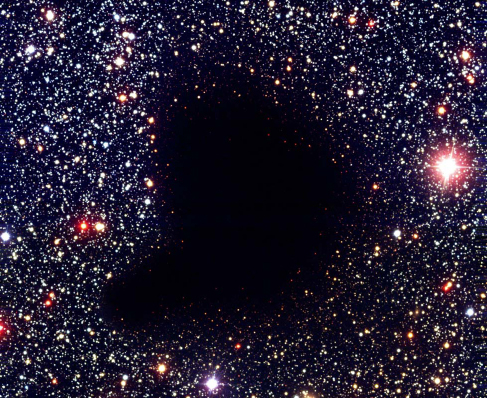
Figure 20.9 shows a striking example of what is actually a common sight through large telescopes: a dark region on the sky that appears to be nearly empty of stars. For a long time, astronomers debated whether these dark regions were empty “tunnels” through which we looked beyond the stars of the Milky Way Galaxy into intergalactic space, or clouds of some dark material that blocked the light of the stars beyond. The astronomer William Herschel (discoverer of the planet Uranus) thought it was the former, once remarking after seeing one, “Here truly is a hole in heaven!” However, American astronomer E. E. Barnard is generally credited with showing from his extensive series of nebula photographs that the latter interpretation is the correct one (see the feature box on Edward Emerson Barnard).
Figure 20.9 This object, first catalogued by E. E. Barnard, is a dark interstellar cloud. Its striking appearance is due to the fact that, since it is relatively close to Earth, there are no bright stars between us and it, and its dust obscures the light from the stars behind it. (It looks a little bit like a sideways heart; one astronomer sent a photo of this object to his sweetheart as a valentine.) (credit: modification of work by ESO)
Dusty clouds in space betray their presence in several ways: by blocking the light from distant stars, by emitting energy in the infrared part of the spectrum, by reflecting the light from nearby stars, and by making distant stars look redder than they really are.