第20章星と星の間――宇宙のガスと塵Between the Stars: Gas and Dust in Space
Detecting Dust塵を検出する
The dark cloud seen in Figure 20.9 blocks the light of the many stars that lie behind it; note how the regions in other parts of the photograph are crowded with stars. Barnard 68 is an example of a relatively dense cloud or dark nebula containing tiny, solid dust grains. Such opaque clouds are conspicuous on any photograph of the Milky Way, the galaxy in which the Sun is located (see the figures in The Milky Way Galaxy). The “dark rift,” which runs lengthwise down a long part of the Milky Way in our sky and appears to split it in two, is produced by a collection of such obscuring clouds.
英語のヒント
図20.9の暗い雲は、その背後にある多くの星の光を遮っている。写真のほかの部分には、星が密集していることに注目しよう。バーナード68は、小さな固体の塵の粒を含む、比較的密度の高い雲、すなわち暗黒星雲の一例である。このような不透明な雲は、太陽が属する天の川銀河の写真で、よく目立つ(「天の川銀河」の図を参照)。空の天の川に沿って長く延び、天の川を二つに分けるように見える「暗黒帯」は、このような光を遮る雲の集まりが作っている。
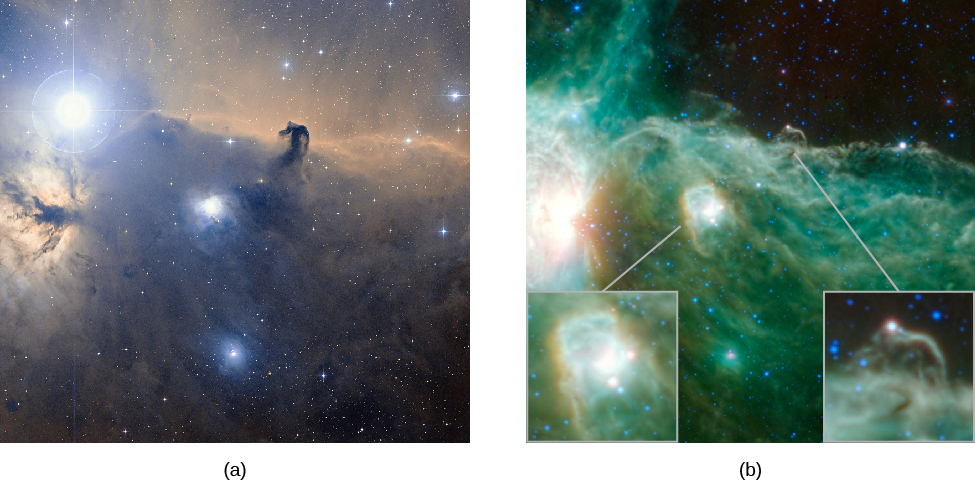
While dust clouds are too cold to radiate a measurable amount of energy in the visible part of the spectrum, they glow brightly in the infrared (Figure 20.11). The reason is that small dust grains absorb visible light and ultraviolet radiation very efficiently. The grains are heated by the absorbed radiation, typically to temperatures from 10 to about 500 K, and re-radiate this heat at infrared wavelengths.
英語のヒント
塵の雲は低温すぎて、可視光の領域では測定できるほどのエネルギーを放射しないが、赤外線では明るく輝く(図20.11)。小さな塵の粒が、可視光と紫外線を非常に効率よく吸収するためだ。吸収した放射によって、粒は典型的には10〜約500 Kに温められ、その熱を赤外線の波長で再び放射する。
Visible and Infrared Images of the Horsehead Nebula in Orion.オリオン座の馬頭星雲の可視光画像と赤外線画像
credit a: modification of work by ESO and Digitized Sky Survey; credit b: modification of work by NASA/JPL-Caltech · CC BY 4.0
Figure 20.11 This dark cloud is one of the best-known images in astronomy, probably because it really does resemble a horse’s head. The horse-head shape is an extension of a large cloud of dust that fills the lower part of the picture. (a) Seen in visible light, the dust clouds are especially easy to see against the bright background. (b) This infrared radiation image from the region of the horse head was recorded by NASA’s Wide-Field Infrared Survey Explorer. Note how the regions that appear dark in visible light appear bright in the infrared. The dust is heated by nearby stars and re-radiates this heat in the infrared. Only the top of the horse’s head is visible in the infrared image. Bright dots seen in the nebula below and to the left and at the top of the horse head are young, newly formed stars. The insets show the horse head and the bright nebula in more detail. (credit a: modification of work by ESO and Digitized Sky Survey; credit b: modification of work by NASA/JPL-Caltech)
英語のヒント
図20.11 この暗い雲は、天文学で特によく知られた姿の一つだ。本当に馬の頭に似ているためだろう。馬の頭の形は、画像の下部を満たす大きな塵の雲から突き出した部分である。(a)可視光では、明るい背景のおかげで、塵の雲が特に見つけやすい。(b)馬頭星雲付近のこの赤外線画像は、NASAの広域赤外線探査衛星WISEが撮影した。可視光では暗い領域が、赤外線では明るいことに注目しよう。塵は近くの星に温められ、その熱を赤外線として再放射する。赤外線画像で見えるのは、馬の頭の上部だけである。馬の頭の左下の星雲や、頭の上部に見える明るい点は、新しく生まれた若い星だ。挿入図は、馬の頭と明るい星雲を、より詳しく示す。(クレジットa:ESO、Digitized Sky Surveyの作品を改変。b:NASA/JPL-Caltechの作品を改変)
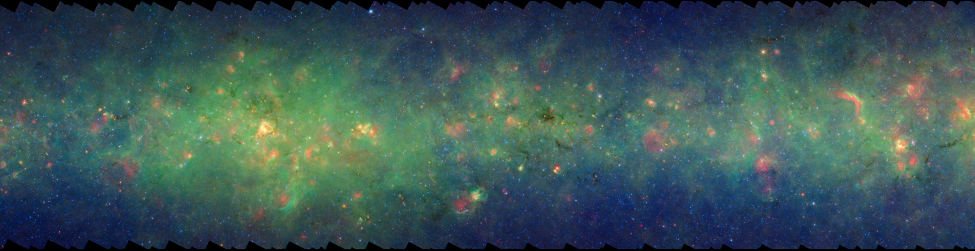
Thanks to their small sizes and low temperatures, interstellar grains radiate most of their energy at infrared to microwave frequencies, with wavelengths of tens to hundreds of microns. Earth’s atmosphere is opaque to radiation at these wavelengths, so emission by interstellar dust is best measured from space. Observations from above Earth’s atmosphere show that dust clouds are present throughout the plane of the Milky Way (Figure 20.12).
英語のヒント
星間の粒は小さく低温なので、エネルギーの大部分を、赤外線からマイクロ波にあたる振動数、波長では数十〜数百μmで放射する。地球の大気はこれらの波長の放射を通さないため、星間塵の放射は宇宙から測るのが最も適している。大気の上からの観測によると、塵の雲は天の川銀河の円盤面全体に存在する(図20.12)。
Infrared Emission from the Plane of the Milky Way.天の川銀河の円盤面からの赤外線放射
credit: modification of work by NASA/JPL-Caltech/University of Wisconsin · JPL image use policy
Figure 20.12 This infrared image taken by the Spitzer Space Telescope shows a field in the plane of the Milky Way Galaxy. (Our Galaxy is in the shape of a frisbee; the plane of the Milky Way is the flat disk of that frisbee. Since the Sun, Earth, and solar system are located in the plane of the Milky Way and at a large distance from its center, we view the Galaxy edge on, much as we might look at a glass plate from its edge.) This emission is produced by tiny dust grains, which emit at 3.6 microns (blue in this image), 8.0 microns (green), and 24 microns (red). The densest regions of dust are so cold and opaque that they appear as dark clouds even at these infrared wavelengths. The red bubbles visible throughout indicate regions where the dust has been warmed up by young stars. This heating increases the emission at 24 microns, leading to the redder color in this image. (credit: modification of work by NASA/JPL-Caltech/University of Wisconsin)
英語のヒント
図20.12 スピッツァー宇宙望遠鏡のこの赤外線画像は、天の川銀河の円盤面の一部を示す。私たちの銀河はフリスビーのような形をしており、銀河面は、その平たい円盤にあたる。太陽、地球、太陽系は銀河面の中、しかも中心から遠い場所にあるので、銀河を縁の方向から見ている。ガラスの皿を、その縁から眺めるようなものだ。この放射は、小さな塵の粒が、3.6 μm(画像では青)、8.0 μm(緑)、24 μm(赤)で放つものである。最も密な塵の領域は、非常に冷たく不透明なので、これらの赤外線の波長でも暗い雲として見える。各所に見える赤い泡は、若い星が塵を温めた領域を示す。加熱によって24 μmでの放射が増し、画像の色が赤くなる。(クレジット:NASA/JPL-Caltech/ウィスコンシン大学の作品を改変)
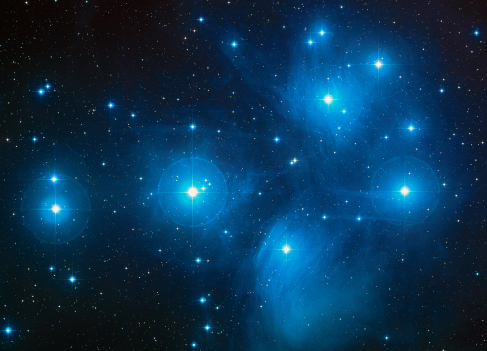
Some dense clouds of dust are close to luminous stars and scatter enough starlight to become visible. Such a cloud of dust, illuminated by starlight, is called a reflection nebula, since the light we see is starlight reflected off the grains of dust. One of the best-known examples is the nebulosity around each of the brightest stars in the Pleiades cluster (see Figure 20.13). The dust grains are small, and such small particles turn out to scatter light with blue wavelengths more efficiently than light at red wavelengths. A reflection nebula, therefore, usually appears bluer than its illuminating star (Figure 20.13).
英語のヒント
密な塵の雲の一部は、明るい星の近くにあり、十分な星の光を散乱して、見えるようになる。星の光で照らされたこのような雲を、反射星雲と呼ぶ。見えているのは、塵の粒で反射された星の光だからである。特によく知られた例の一つが、プレアデス星団の明るい星々を取り巻く星雲である(図20.13を参照)。塵の粒は小さく、このような小粒子は、赤い波長の光より、青い波長の光を効率よく散乱する。そのため反射星雲は普通、照らしている星より青く見える(図20.13)。
Pleiades Star Cluster.プレアデス星団
credit: NASA, ESA and AURA/Caltech · NASA media use guidelines
Figure 20.13 The bluish light surrounding the stars in this image is an example of a reflection nebula. Like fog around a street lamp, a reflection nebula shines only because the dust within it scatters light from a nearby bright source. The Pleiades cluster is currently passing through an interstellar cloud that contains dust grains, which scatter the light from the hot blue stars in the cluster. The Pleiades cluster is about 400 light-years from the Sun. (credit: NASA, ESA and AURA/Caltech)
英語のヒント
図20.13 画像の星々を取り巻く青みがかった光は、反射星雲の一例である。街灯の周りの霧のように、内部の塵が近くの明るい光源の光を散乱するためにだけ、反射星雲は輝く。プレアデス星団は現在、塵の粒を含む星間雲の中を通過している。その粒が、星団内の高温で青い星の光を散乱する。プレアデス星団は、太陽から約400光年の距離にある。(クレジット:NASA、ESA、AURA/Caltech)
Gas and dust are generally intermixed in space, although the proportions are not exactly the same everywhere. The presence of dust is apparent in many photographs of emission nebulae in the constellation of Sagittarius, where we see an H II region surrounded by a blue reflection nebula. Which type of nebula appears brighter depends on the kinds of stars that cause the gas and dust to glow. Stars cooler than about 25,000 K have so little ultraviolet radiation of wavelengths shorter than 91.2 nanometers—which is the wavelength required to ionize hydrogen—that the reflection nebulae around such stars outshine the emission nebulae. Stars hotter than 25,000 K emit enough ultraviolet energy that the emission nebulae produced around them generally outshine the reflection nebulae.
英語のヒント
宇宙では、ガスと塵は一般に混ざり合っているが、割合はどこでもまったく同じというわけではない。いて座の輝線星雲の写真には、塵の存在がはっきり分かるものが多い。H II領域が、青い反射星雲に囲まれているのだ。どちらの種類の星雲が明るく見えるかは、ガスと塵を輝かせる星の種類による。約2万5000 Kより低温の星は、水素を電離するのに必要な91.2 nmより短い波長の紫外線を、ほとんど出さない。そのため、そのような星の周囲では、反射星雲が輝線星雲より明るくなる。2万5000 Kより高温の星は、十分な紫外線エネルギーを放つため、その周囲にできる輝線星雲は、一般に反射星雲より明るい。