第20章星と星の間――宇宙のガスと塵Between the Stars: Gas and Dust in Space
20.5 The Life Cycle of Cosmic Material20.5 宇宙物質の循環
Learning Objectives学習の目標
By the end of this section, you will be able to:
この節を読み終えると、次のことができるようになる。
Explain how interstellar matter flows into and out of our Galaxy and transforms from one phase to another, and understand how star formation and evolution affects the properties of the interstellar medium
星間物質が銀河へ出入りし、異なる状態へ変わる仕組みを説明し、星の誕生と進化が星間物質の性質へ及ぼす影響を理解する。
Explain how the heavy elements and dust grains found in interstellar space got there and describe how dust grains help produce molecules that eventually find their way into planetary systems
星間空間の重元素や塵の粒が、どこから来たかを説明し、やがて惑星系に入る分子の生成を、塵の粒がどう助けるかを述べる。
Flows of Interstellar Gas星間ガスの流れ
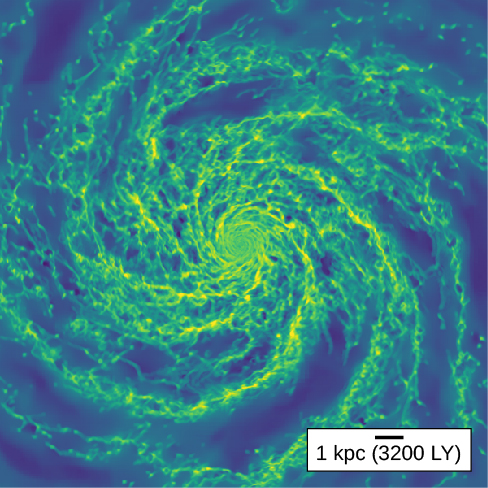
The most important thing to understand about the interstellar medium is that it is not static. Interstellar gas orbits through the Galaxy, and as it does so, it can become more or less dense, hotter and colder, and change its state of ionization. A particular parcel of gas may be neutral hydrogen at some point, then find itself near a young, hot star and become part of an H II region. The star may then explode as a supernova, heating the nearby gas up to temperatures of millions of degrees. Over millions of years, the gas may cool back down and become neutral again, before it collects into a dense region that gravity gathers into a giant molecular cloud (Figure 20.18)
英語のヒント
星間物質について最も大切なのは、静止したままでも、変わらないままでもないと理解することだ。星間ガスは銀河内を公転し、その間に、密度が高くも低くも、温度が高くも低くもなり、電離の状態も変わる。あるガスのかたまりは、ある時点では中性水素で、その後、若く高温の星の近くへ来て、H II領域の一部になるかもしれない。次にその星が超新星として爆発し、近くのガスを数百万度へ加熱するかもしれない。数百万年をかけてガスは再び冷え、中性に戻る。そして密な領域に集まり、重力によって巨大分子雲へまとめられることもある(図20.18)。
Large-Scale Distribution of Interstellar Matter.星間物質の大規模な分布
credit: modification of work by Mark Krumholz · CC BY 4.0
Figure 20.18 This image is from a computer simulation of the Milky Way Galaxy’s interstellar medium as a whole. The majority of gas, visible in greenish colors, is neutral hydrogen. In the densest regions in the spiral arms, shown in yellow, the gas is collected into giant molecular clouds. Low-density holes in the spiral arms, shown in blue, are the result of supernova explosions. (credit: modification of work by Mark Krumholz)
図20.18 天の川銀河全体の星間物質を、コンピューターでシミュレーションした画像。緑がかった色で見えるガスの大部分は、中性水素である。黄色で示す渦状腕の最も密な場所では、ガスが巨大分子雲に集まっている。青色で示す、腕の中の低密度の穴は、超新星爆発によって生じた。(クレジット:Mark Krumholzの作品を改変)
At any given time in the Milky Way, the majority of the interstellar gas by mass and volume is in the form of atomic hydrogen. The much-denser molecular clouds occupy a tiny fraction of the volume of interstellar space but add roughly 30% to the total mass of gas between the stars. Conversely, the hot gas produced by supernova explosions contributes a negligible mass but occupies a significant fraction of the volume of interstellar space. H II regions, though they are visually spectacular, constitute only a very small fraction of either the mass or volume of interstellar material.
英語のヒント
天の川銀河をどの時点で見ても、星間ガスの質量と体積の大部分は、水素原子の形で存在する。ずっと密度の高い分子雲は、星間空間の体積のごく一部しか占めないが、星々の間のガスの総質量の、およそ30%を担う。逆に、超新星爆発が作る高温ガスは、質量は無視できるほどでも、星間空間の体積のかなりの部分を占める。見た目が壮観なH II領域は、星間物質の質量でも体積でも、ごくわずかでしかない。
However, the interstellar medium is not a closed system. Gas from intergalactic space constantly falls onto the Milky Way due to its gravity, adding new gas to the interstellar medium. Conversely, in giant molecular clouds where gas collects together due to gravity, the gas can collapse to form new stars, as discussed in The Birth of Stars and the Discovery of Planets outside the Solar System. This process locks interstellar matter into stars. As the stars age, evolve, and eventually die, massive stars lose a large fraction of their mass, and low-mass stars lose very little. On average, roughly one-third of the matter incorporated into stars goes back into interstellar space. Supernova explosions have so much energy that they can drive interstellar mass out of the Galaxy and back into intergalactic space. Thus, the total amount of mass of the interstellar medium is set by a competition between the gain of mass from intergalactic space, the conversion of interstellar mass into stars, and the loss of interstellar mass back into intergalactic space due to supernovae. This entire process is known as the baryon cycle—baryon is from the Greek word for “heavy,” and the cycle has this name because it is the repeating process that the heavier components of the universe—the atoms—undergo.
英語のヒント
しかし、星間物質は閉じた系ではない。銀河間空間のガスは、天の川銀河の重力で絶えず落ち込み、星間物質に新しいガスを加える。逆に、重力でガスが集まる巨大分子雲では、ガスが収縮して新しい星を作ることがある。「星の誕生と太陽系外惑星の発見」で扱う過程であり、星間物質を星の中に閉じ込める。星が年を取り、進化し、最期を迎えると、大質量星は質量の大きな割合を失い、低質量星が失う量は、ごくわずかである。平均すると、星に取り込まれた物質のおよそ3分の1が、星間空間へ戻る。超新星爆発のエネルギーは非常に大きく、星間物質を銀河の外へ押し出し、銀河間空間へ戻すこともできる。したがって星間物質の総質量は、銀河間空間からの流入、星への変換、超新星による銀河間空間への流出の、せめぎ合いで決まる。この過程全体を、バリオン循環という。バリオンはギリシャ語の「重い」に由来する。この名前は、宇宙の重い構成成分である原子が、この過程を繰り返し経験することによる。
The Cycle of Dust and Heavy Elements塵と重元素の循環
While much of the mass of the interstellar medium is material accreted during the last few billion years from intergalactic space, this is not true of the elements heavier than hydrogen and helium, or of the dust. Instead, these components of the interstellar medium were made inside stars in the Milky Way, which returned them to the interstellar medium at the end of their lives. We will talk more about this process in later chapters, but for now just bear in mind what we learned in The Sun: A Nuclear Powerhouse. What stars “do for a living” is fuse heavier elements from lighter ones, producing energy in the process. As stars mature, they begin to lose some of the newly made elements to the reservoir of interstellar matter.
英語のヒント
星間物質の質量の多くは、この数十億年の間に銀河間空間から降着した物質だが、水素やヘリウムより重い元素と、塵には当てはまらない。これらの成分は、天の川銀河の星の内部で作られ、星が一生の終わりに、星間物質へ戻したものである。この過程は後の章で詳しく扱うが、今は「太陽――核エネルギーの源」で学んだことを思い出そう。星の「生業」は、軽い元素を融合させて重い元素を作り、その過程でエネルギーを生むことだ。星が成熟すると、新しく作った元素の一部を、星間物質の蓄えへ放出し始める。
The same is true of dust grains. Dust forms when grains can condense in regions where gas is dense and cool. One place where the right conditions are found is the winds from luminous cool stars (the red giants and supergiants we discussed in The Stars: A Celestial Census). Grains can also condense in the matter thrown off by a supernova explosion as the ejected gases begin to cool.
英語のヒント
塵の粒も同様である。ガスが高密度で低温の領域に、粒が凝結できると、塵ができる。適した条件がある場所の一つは、明るく低温の星から吹く風である。「恒星――星の世界の実態を調べる」で扱った、赤色巨星や赤色超巨星がそれにあたる。超新星爆発が放出した物質でも、ガスが冷え始めると、粒が凝結することがある。
The dust grains produced by stars may grow even further when they spend time in the dense parts of the interstellar medium, inside molecular clouds. In these environments, grains can stick together or gather additional atoms from the gas around them, growing larger. They also facilitate the production of other compounds, including some of the more complex molecules we discussed earlier.
英語のヒント
星が作った塵の粒は、分子雲の内部という、星間物質の密な場所にいる間に、さらに成長することがある。その環境では、粒どうしがくっついたり、周囲のガスから原子を取り込んだりして、大きくなる。また、先ほど扱った比較的複雑な分子など、ほかの化合物ができるのも助ける。
The surfaces of the dust grains (see Cosmic Dust)—which would seem very large if you were an atom—provide “nooks and crannies” where these atoms can stick long enough to find partners and form molecules. (Think of the dust grains as “interstellar social clubs” where lonely atoms can meet and form meaningful relationships.) Eventually, the dust grains become coated with ices. The presence of the dust shields the molecules inside the clouds from ultraviolet radiation and cosmic rays that would break them up.
英語のヒント
塵の粒の表面(「宇宙の塵」を参照)は、自分が原子なら、とても広く見えるだろう。その表面には、原子がしばらく留まり、相手を見つけて分子を作れる、「くぼみや隙間」がある。孤独な原子が出会い、意味のある関係を築ける「星間の社交クラブ」と考えてみよう。やがて塵の粒は、氷に覆われる。塵の存在は、雲の内部の分子を、分解を引き起こす紫外線や宇宙線から守る。
When stars finally begin to form within the cloud, they heat the grains and evaporate the ices. The gravitational attraction of the newly forming stars also increases the density of the surrounding cloud material. Many more chemical reactions take place on the surfaces of grains in the gas surrounding the newly forming stars, and these areas are where organic molecules are formed. These molecules can be incorporated into newly formed planetary systems, and the early Earth may have been seeded in just such a way.
英語のヒント
雲の中でついに星が生まれ始めると、星は塵の粒を温め、氷を蒸発させる。生まれつつある星の重力は、周囲の雲の物質の密度も高める。新しい星を取り巻くガスの中の粒の表面では、さらに多くの化学反応が起こる。この領域で、有機分子が作られる。これらの分子は、新しくできた惑星系に取り込まれうる。初期の地球にも、まさにこのようにして、化学的な種がまかれたのかもしれない。
Indeed, scientists speculate that some of the water on Earth may have come from interstellar grains. Recent observations from space have shown that water is abundant in dense interstellar clouds. Since stars are formed from this material, water must be present when solar systems, including our own, come into existence. The water in our oceans and lakes may have come initially from water locked into the rocky material that accreted to form Earth. Alternatively, the water may have been brought to Earth when asteroids and comets (formed from the same cloud that made the planets) later impacted it. Scientists estimate that one comet impact every thousand years during Earth’s first billion years would have been enough to account for the water we see today. Of course, both sources may have contributed to the water we now enjoy drinking and swimming in.
英語のヒント
実際、科学者は、地球の水の一部が星間の粒に由来する可能性を考えている。近年の宇宙からの観測は、密な星間雲に水が豊富にあることを示した。星はこの物質から生まれるので、私たちの太陽系を含め、惑星系が誕生するときには、水があるはずだ。海や湖の水は、もともと、地球を作るために集積した岩石質の物質に閉じ込められていた、水に由来するのかもしれない。別の可能性として、惑星を作ったのと同じ雲から生まれた小惑星や彗星が、後に地球へ衝突し、水を運んだとも考えられる。科学者の見積もりでは、地球誕生後の最初の10億年間、1000年ごとに1回、彗星が衝突すれば、現在の水を説明するには十分だったという。私たちが飲み、泳ぐことを楽しんでいる水には、両方の供給源が寄与した可能性もある。
Any interstellar grains that are incorporated into newly forming stars (instead of the colder planets and smaller bodies around them) will be destroyed by their high temperatures. But eventually, each new generation of stars will evolve to become red giants, with stellar winds of their own. Some of these stars will also become supernovae and explode. Thus, the process of recycling cosmic material can start all over again.
英語のヒント
星の周りの、より冷たい惑星や小天体ではなく、新しく生まれる星そのものへ取り込まれた星間の粒は、高温によって破壊される。しかし、やがて新しい世代の星も進化し、自らの恒星風を持つ赤色巨星になる。その一部は、超新星になって爆発する。こうして宇宙物質を再利用する過程が、再び初めから始まる。