第5章放射とスペクトルRadiation and Spectra
The Bohr Atomボーアの原子モデル
Rutherford’s model for atoms has one serious problem. Maxwell’s theory of electromagnetic radiation says that when electrons change either speed or the direction of motion, they must emit energy. Orbiting electrons constantly change their direction of motion, so they should emit a constant stream of energy. Applying Maxwell’s theory to Rutherford’s model, all electrons should spiral into the nucleus of the atom as they lose energy, and this collapse should happen very quickly—in about 10–16 seconds.
英語のヒント
ラザフォードの原子モデルには、一つ重大な問題がある。マクスウェルの電磁放射の理論によれば、電子は速さか運動方向を変えると、エネルギーを放出しなければならない。軌道を回る電子は、運動方向を絶えず変えているので、エネルギーを絶えず放出するはずである。マクスウェルの理論をラザフォードのモデルに当てはめると、すべての電子は、エネルギーを失いながら、らせんを描いて原子核へ落ち込むはずだ。そして、この崩壊は約10⁻¹⁶秒という、非常に短い時間で起こるはずである。
It was Danish physicist Niels Bohr (1885–1962) who solved the mystery of how electrons remain in orbit. He was trying to develop a model of the atom that would also explain certain regularities observed in the spectrum of hydrogen. He suggested that the spectrum of hydrogen can be understood if we assume that orbits of only certain sizes are possible for the electron. Bohr further assumed that as long as the electron moves in only one of these allowed orbits, it radiates no energy: its energy would change only if it moved from one orbit to another.
英語のヒント
電子がどうして軌道上にとどまれるのかという謎を解いたのは、デンマークの物理学者ニールス・ボーア(1885〜1962年)だった。彼は、水素のスペクトルに観測される、いくつかの規則性も説明できる原子モデルを作ろうとしていた。ボーアは、電子には特定の大きさの軌道だけが許されると仮定すれば、水素のスペクトルを理解できると提案した。さらに、電子が許された軌道のどれか一つだけを動いている限り、エネルギーを放射しないと仮定した。エネルギーが変わるのは、一つの軌道から別の軌道へ移る場合だけなのである。
This suggestion, in the words of science historian Abraham Pais, was “one of the most audacious hypotheses ever introduced in physics.” If something equivalent were at work in the everyday world, you might find that, as you went for a walk after astronomy class, nature permitted you to walk two steps per minute, five steps per minute, and 12 steps per minute, but no speeds in between. No matter how you tried to move your legs, only certain walking speeds would be permitted. To make things more bizarre, it would take no effort to walk at any one of the allowed speeds, but it would be difficult to change from one speed to another. Luckily, no such rules apply at the level of human behavior. But at the microscopic level of the atom, experiment after experiment has confirmed the validity of Bohr’s strange idea. Bohr’s suggestions became one of the foundations of the new (and much more sophisticated) model of the subatomic world called quantum mechanics.
英語のヒント
科学史家アブラハム・パイスの言葉を借りれば、この提案は「物理学に導入された中で、最も大胆な仮説の一つ」だった。日常の世界で同じようなことが起きていたなら、天文学の授業のあと散歩に出ると、自然から、毎分2歩、5歩、12歩で歩くことは許されても、その間の速さは許されない、ということになるかもしれない。どんなふうに脚を動かそうとしても、特定の歩行速度だけが許されるのだ。さらに奇妙なことに、許された速さのどれかで歩くには何の努力もいらないのに、ある速さから別の速さへ変えるのは難しいことになる。幸い、人の行動の尺度では、このような規則は当てはまらない。しかし原子という微視的な尺度では、実験を重ねるたびに、ボーアの奇妙な考えの妥当性が確かめられてきた。その提案は、量子力学と呼ばれる、原子より小さな世界の、より高度な新しいモデルの基礎の一つとなった。
In Bohr’s model, if the electron moves from one orbit to another closer to the atomic nucleus, it must give up some energy in the form of electromagnetic radiation. If the electron goes from an inner orbit to one farther from the nucleus, however, it requires some additional energy. One way to obtain the necessary energy is to absorb electromagnetic radiation that may be streaming past the atom from an outside source.
英語のヒント
ボーアのモデルでは、電子が、ある軌道から原子核に近い別の軌道へ移ると、電磁放射の形で、いくらかのエネルギーを手放さなければならない。それに対し、内側の軌道から原子核に遠い軌道へ移るには、エネルギーをいくらか追加する必要がある。必要なエネルギーを得る方法の一つは、外部の光源から来て原子のそばを流れている電磁放射を吸収することである。
A key feature of Bohr’s model is that each of the permitted electron orbits around a given atom has a certain energy value; we therefore can think of each orbit as an energy level. To move from one orbit to another (which will have its own specific energy value) requires a change in the electron’s energy—a change determined by the difference between the two energy values. If the electron goes to a lower level, the energy difference will be given off; if the electron goes to a higher level, the energy difference must be obtained from somewhere else. Each jump (or transition) to a different level has a fixed and definite energy change associated with it.
英語のヒント
ボーアのモデルの重要な特徴は、ある原子の周りで許された各電子軌道が、決まったエネルギーの値を持つことである。そのため、軌道一つ一つを「エネルギー準位」と考えられる。ある軌道から、別の固有のエネルギー値を持つ軌道へ移るには、電子のエネルギーを変える必要がある。変える量は、2つのエネルギー値の差によって決まる。低い準位へ行けば、そのエネルギー差が放出される。高い準位へ行くには、その差に当たるエネルギーをどこか別のところから得なければならない。別の準位への跳躍、すなわち「遷移」には、それぞれ固定された明確なエネルギーの変化が伴う。
A crude analogy for this situation might be life in a tower of luxury apartments where the rent is determined by the quality of the view. Such a building has certain, definite numbered levels or floors on which apartments are located. No one can live on floor 5.37 or 22.5. In addition, the rent gets higher as you go up to higher floors. If you want to exchange an apartment on the twentieth floor for one on the second floor, you will not owe as much rent. However, if you want to move from the third floor to the twenty-fifth floor, your rent will increase. In an atom, too, the “cheapest” place for an electron to live is the lowest possible level, and energy is required to move to a higher level.
英語のヒント
この状況のおおざっぱなたとえとして、眺めのよさで家賃が決まる高級マンションの塔での生活を考えられる。建物には、決まった番号の階があり、部屋はそこに置かれている。5.37階や22.5階に住むことはできない。また、高い階へ行くほど家賃が高くなる。20階の部屋を2階の部屋に替えたければ、支払う家賃はそれほど多くなくなる。しかし、3階から25階へ移りたければ、家賃は増える。原子の中でも、電子にとって最も「安い」住み場所は、可能な限り低い準位であり、高い準位へ移るにはエネルギーが必要になる。
Here we have one of the situations where it is easier to think of electromagnetic radiation as particles (photons) rather than as waves. As electrons move from one level to another, they give off or absorb little packets of energy. When an electron moves to a higher level, it absorbs a photon of just the right energy (provided one is available). When it moves to a lower level, it emits a photon with the exact amount of energy it no longer needs in its “lower-cost living situation.”
英語のヒント
ここは、電磁放射を波ではなく粒子、つまり光子として考えたほうがわかりやすい場面の一つである。電子は、ある準位から別の準位へ移るとき、エネルギーの小さなかたまりを放出したり吸収したりする。高い準位へ移るときは、利用できるものがあれば、ちょうど合うエネルギーの光子を吸収する。低い準位へ移るときは、より「生活費の安い」状態ではもう必要のない分と、ぴったり等しいエネルギーを持つ光子を放出する。
The photon and wave perspectives must be equivalent: light is light, no matter how we look at it. Thus, each photon carries a certain amount of energy that is proportional to the frequency (f) of the wave it represents. The value of its energy (E) is given by the formula
英語のヒント
光子としての見方と、波としての見方は、同じ内容でなければならない。どのように見ても、光は光だからである。したがって、各光子が運ぶ決まった量のエネルギーは、それが対応する波の振動数fに比例する。そのエネルギーEの値は、次の式で与えられる。
where the constant of proportionality, h, is called Planck’s constant.
ここで比例定数hは、プランク定数と呼ばれる。
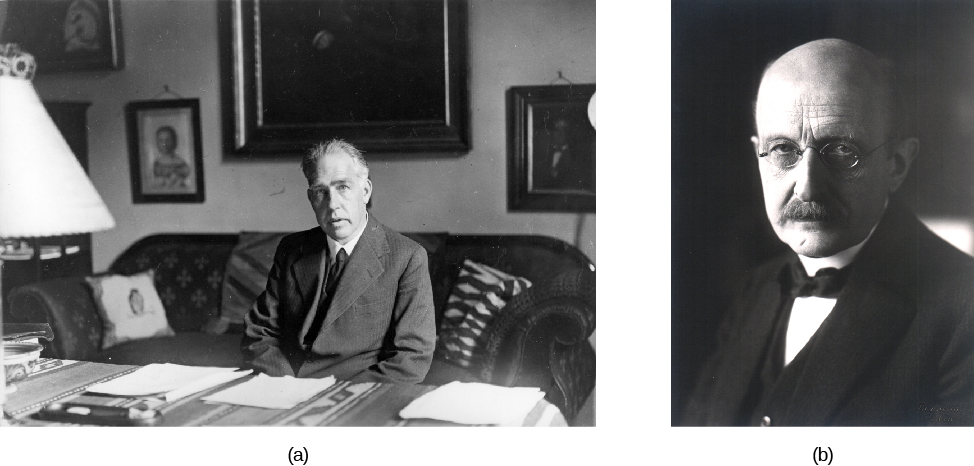
The constant is named for Max Planck, the German physicist who was one of the originators of the quantum theory (Figure 5.18). If metric units are used (that is, if energy is measured in joules and frequency in hertz), then Planck’s constant has the value h = 6.626 × 10⁻³⁴ joule-seconds (J-s). Higher-energy photons correspond to higher-frequency waves (which have a shorter wavelength); lower-energy photons are waves of lower frequency.
英語のヒント
この定数は、量子論を生み出した一人である、ドイツの物理学者マックス・プランクにちなんで名づけられた(図5.18)。メートル法の単位を使い、エネルギーをジュール、振動数をヘルツで測る場合、プランク定数の値はh = 6.626 × 10⁻³⁴ジュール秒(J-s)となる。高いエネルギーの光子は、高い振動数、つまり短い波長の波に対応する。低いエネルギーの光子は、振動数の低い波である。
Niels Bohr (1885–1962) and Max Planck (1858–1947).ニールス・ボーア(1885〜1962年)とマックス・プランク(1858〜1947年)。
OpenStax / Rice University · CC BY 4.0
Figure 5.18 (a) Bohr, shown at his desk in this 1935 photograph, and (b) Planck helped us understand the energy behavior of photons.
図5.18 (a)1935年の写真で机に向かうボーアと、(b)プランクは、光子のエネルギーの振る舞いを理解する助けを与えた。
To take a specific example, consider a calcium atom inside the Sun’s atmosphere in which an electron jumps from a lower level to a higher level. To do this, it needs about joules of energy, which it can conveniently obtain by absorbing a passing photon of that energy coming from deeper inside the Sun. This photon is equivalent to a wave of light whose frequency is about hertz and whose wavelength is about meters (393 nanometers), in the deep violet part of the visible light spectrum. Although it may seem strange at first to switch from picturing light as a photon (or energy packet) to picturing it as a wave, such switching has become second nature to astronomers and can be a handy tool for doing calculations about spectra.
英語のヒント
具体例として、太陽大気中のカルシウム原子で、電子が低い準位から高い準位へ跳び移る場合を考えよう。これには約ジュールのエネルギーが必要であり、太陽内部のより深いところから来てそばを通る、同じエネルギーの光子を吸収すると、都合よく得ることができる。この光子は、振動数が約ヘルツ、波長が約メートル、つまり393ナノメートルの光の波に相当する。可視光スペクトルの、深い紫の部分に当たる。光を光子、すなわちエネルギーのかたまりとして描く見方と、波として描く見方の切り替えは、最初は奇妙に思えるかもしれない。しかし天文学者にとって、この切り替えは自然にできることになっており、スペクトルを計算するときの便利な道具となる。
The Energy of a Photon光子のエネルギー
Now that we know how to calculate the wavelength and frequency of a photon, we can use this information, along with Planck’s constant, to determine how much energy each photon carries. How much energy does a red photon of wavelength 630 nm have?
英語のヒント
光子の波長と振動数の計算法がわかったので、この情報をプランク定数とともに使い、光子一つ一つが運ぶエネルギーの量を求められる。波長630 nmの赤い光子は、どれだけのエネルギーを持つだろうか。
Solution解き方
First, as we learned earlier, we can find the frequency of the photon:
まず、前に学んだように、光子の振動数を求められる。
Next, we can use Planck’s constant to determine the energy (remember that a Hz is the same as 1/s):
次に、プランク定数を使ってエネルギーを求める。Hzが1/sと同じであることを思い出そう。
Check Your Learning理解を確かめよう
What is the energy of a yellow photon with a frequency of Hz?
振動数が Hzの黄色い光子のエネルギーは、いくらか。