第5章放射とスペクトルRadiation and Spectra
Radiation and Temperature放射と温度
Some astronomical objects emit mostly infrared radiation, others mostly visible light, and still others mostly ultraviolet radiation. What determines the type of electromagnetic radiation emitted by the Sun, stars, and other dense astronomical objects? The answer often turns out to be their temperature.
英語のヒント
主に赤外線を放出する天体もあれば、主に可視光を放出する天体もあり、さらに主に紫外線を放出する天体もある。太陽や恒星など、密度の高い天体が放出する電磁放射の種類は、何によって決まるのだろうか。多くの場合、その答えは温度である。
At the microscopic level, everything in nature is in motion. A solid is composed of molecules and atoms in continuous vibration: they move back and forth in place, but their motion is much too small for our eyes to make out. A gas consists of atoms and/or molecules that are flying about freely at high speed, continually bumping into one another and bombarding the surrounding matter. The hotter the solid or gas, the more rapid the motion of its molecules or atoms. The temperature of something is thus a measure of the average motion energy of the particles that make it up.
英語のヒント
微視的な尺度では、自然界のあらゆるものが動いている。固体は、絶えず振動する分子や原子からできている。それらはその場で往復運動をしているが、その動きは小さすぎて目では見分けられない。気体は、自由に高速で飛び回り、互いにぶつかり続け、周囲の物質にも衝突する原子や分子からなる。固体や気体が高温であるほど、その分子や原子の運動は速い。したがって、あるものの温度は、それを構成する粒子の平均の運動エネルギーを表す尺度である。
This motion at the microscopic level is responsible for much of the electromagnetic radiation on Earth and in the universe. As atoms and molecules move about and collide, or vibrate in place, their electrons give off electromagnetic radiation. The characteristics of this radiation are determined by the temperature of those atoms and molecules. In a hot material, for example, the individual particles vibrate in place or move rapidly from collisions, so the emitted waves are, on average, more energetic. And recall that higher energy waves have a higher frequency. In very cool material, the particles have low-energy atomic and molecular motions and thus generate lower-energy waves.
英語のヒント
地球上や宇宙の電磁放射の多くは、この微視的な尺度での運動によって生じる。原子や分子が動き回って衝突したり、その場で振動したりすると、そこにある電子が電磁放射を出す。この放射の性質は、それらの原子や分子の温度によって決まる。たとえば高温の物質では、個々の粒子がその場で振動したり、衝突によって速く動いたりするため、放出される波のエネルギーは、平均すると高い。エネルギーが高い波ほど振動数が高いことを思い出そう。非常に冷たい物質では、原子や分子としての粒子の運動エネルギーが低いため、エネルギーの低い波が生じる。
Radiation Laws放射の法則
To understand, in more quantitative detail, the relationship between temperature and electromagnetic radiation, we imagine an idealized object called a blackbody. Such an object (unlike your sweater or your astronomy instructor’s head) does not reflect or scatter any radiation, but absorbs all the electromagnetic energy that falls onto it. The energy that is absorbed causes the atoms and molecules in it to vibrate or move around at increasing speeds. As it gets hotter, this object will radiate electromagnetic waves until absorption and radiation are in balance. We want to discuss such an idealized object because, as you will see, stars behave in very nearly the same way.
英語のヒント
温度と電磁放射の関係を、さらに詳しく、数量で理解するために、「黒体」と呼ばれる理想化した物体を考える。この物体は、皆さんのセーターや天文学の先生の頭とは違って、どんな放射も反射したり散乱したりせず、入射する電磁エネルギーをすべて吸収する。吸収したエネルギーによって、内部の原子や分子は、ますます速く振動したり動き回ったりする。物体は温度が上がると電磁波を放射し、やがて吸収と放射がつり合う。これから見るように、恒星はこれにほとんど同じように振る舞うため、このような理想化した物体を取り上げたいのである。
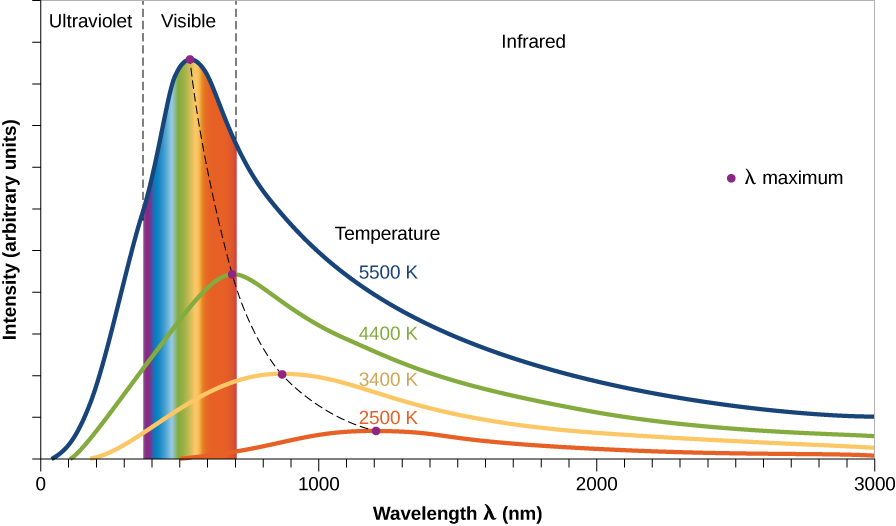
The radiation from a blackbody has several characteristics, as illustrated in Figure 5.8. The graph shows the power emitted at each wavelength by objects of different temperatures. In science, the word power means the energy coming off per second (and it is typically measured in watts, which you are probably familiar with from buying lightbulbs).
英語のヒント
黒体からの放射には、図5.8に示すようないくつかの特徴がある。グラフは、温度の異なる物体が、各波長で放出するパワーを示している。科学でいうパワーとは、1秒当たりに出ていくエネルギーのことである。通常はワットで測り、電球を買うときに、皆さんもおそらくこの単位になじんでいるだろう。
Radiation Laws Illustrated.放射の法則を図で見る。
OpenStax / Rice University · CC BY 4.0
Figure 5.8 This graph shows in arbitrary units how many photons are given off at each wavelength for objects at four different temperatures. The wavelengths corresponding to visible light are shown by the colored bands. Note that at hotter temperatures, more energy (in the form of photons) is emitted at all wavelengths. The higher the temperature, the shorter the wavelength at which the peak amount of energy is radiated (this is known as Wien’s law).
図5.8 4つの異なる温度の物体について、各波長で放出される光子の数を任意の単位で示したグラフ。可視光に対応する波長は、色の帯で示している。温度が高いほど、どの波長でも、光子という形でより多くのエネルギーが放出されることに注目しよう。温度が高いほど、放射エネルギーが最大になる波長は短くなる。これはウィーンの法則として知られる。
First of all, notice that the curves show that, at each temperature, our blackbody object emits radiation (photons) at all wavelengths (all colors). This is because in any solid or denser gas, some molecules or atoms vibrate or move between collisions slower than average and some move faster than average. So when we look at the electromagnetic waves emitted, we find a broad range, or spectrum, of energies and wavelengths. More energy is emitted at the average vibration or motion rate (the highest part of each curve), but if we have a large number of atoms or molecules, some energy will be detected at each wavelength.
英語のヒント
まず曲線を見ると、どの温度でも、黒体はすべての波長、すなわちすべての色の放射、つまり光子を出していることがわかる。これは、どの固体や密度の高い気体でも、分子や原子の中には、振動したり衝突の間を移動したりするときに、平均より遅く動くものもあれば、平均より速く動くものもあるためである。そのため、放出された電磁波を調べると、エネルギーと波長には広い範囲、つまりスペクトルが見られる。平均的な振動や運動の速さに対応するところ、すなわち各曲線の最も高い部分で、より多くのエネルギーが放出される。しかし原子や分子の数が多ければ、どの波長でもいくらかのエネルギーが検出される。
Second, note that an object at a higher temperature emits more power at all wavelengths than does a cooler one. In a hot gas (the taller curves in Figure 5.8), for example, the atoms have more collisions and give off more energy. In the real world of stars, this means that hotter stars give off more energy at every wavelength than do cooler stars.
英語のヒント
次に、温度の高い物体は、低い物体よりも、すべての波長で大きなパワーを放出することに注目しよう。たとえば高温の気体では、図5.8の高い曲線が示すように、原子の衝突がより多く、より多くのエネルギーを放出する。実際の恒星の世界に当てはめれば、高温の恒星は低温の恒星より、どの波長でも多くのエネルギーを放出することを意味する。
Third, the graph shows us that the higher the temperature, the shorter the wavelength at which the maximum power is emitted. Remember that a shorter wavelength means a higher frequency and energy. It makes sense, then, that hot objects give off a larger fraction of their energy at shorter wavelengths (higher energies) than do cool objects. You may have observed examples of this rule in everyday life. When a burner on an electric stove is turned on low, it emits only heat, which is infrared radiation, but does not glow with visible light. If the burner is set to a higher temperature, it starts to glow a dull red. At a still-higher setting, it glows a brighter orange-red (shorter wavelength). At even higher temperatures, which cannot be reached with ordinary stoves, metal can appear brilliant yellow or even blue-white.
英語のヒント
第三に、このグラフから、温度が高いほど、パワーが最大になる波長は短くなることがわかる。波長が短いほど、振動数とエネルギーが高いことを思い出そう。それなら、高温の物体が、低温の物体よりも、エネルギーの大きな割合を短波長、つまり高エネルギーの側で放出するのは、筋が通っている。この法則の例を、日常で見たことがあるかもしれない。電気コンロのヒーターを弱く入れると、赤外線である熱を出すだけで、可視光で輝くことはない。設定温度を上げると、鈍い赤色に光り始める。さらに上げると、より波長の短い、明るい橙赤色に光る。普通のコンロでは達しない、もっと高い温度では、金属は鮮やかな黄色や、さらには青白い色にも見える。
We can use these ideas to come up with a rough sort of “thermometer” for measuring the temperatures of stars. Because many stars give off most of their energy in visible light, the color of light that dominates a star’s appearance is a rough indicator of its temperature. If one star looks red and another looks blue, which one has the higher temperature? Because blue is the shorter-wavelength color, it is the sign of a hotter star. (Note that the temperatures we associate with different colors in science are not the same as the ones artists use. In art, red is often called a “hot” color and blue a “cool” color. Likewise, we commonly see red on faucet or air conditioning controls to indicate hot temperatures and blue to indicate cold temperatures. Although these are common uses to us in daily life, in nature, it’s the other way around.)
英語のヒント
この考え方を使えば、恒星の温度を測る、おおまかな「温度計」を考えられる。多くの恒星はエネルギーの大部分を可視光で放出するため、見た目で優勢な光の色が、その温度のおおまかな指標になる。ある恒星が赤く、別の恒星が青く見えるとしたら、どちらが高温だろうか。青のほうが短い波長の色なので、高温の恒星であることを示している。科学でさまざまな色に結びつける温度は、芸術家の使うものと同じではないことに注意しよう。美術では、赤を「暖色」、青を「寒色」と呼ぶことが多い。同じように、水栓や空調の操作部でも、赤で高い温度を、青で低い温度を示す表示をよく見る。日常では、このような使い方になじんでいるが、自然界では逆なのである。
We can develop a more precise star thermometer by measuring how much energy a star gives off at each wavelength and by constructing diagrams like Figure 5.8. The location of the peak (or maximum) in the power curve of each star can tell us its temperature. The average temperature at the surface of the Sun, which is where the radiation that we see is emitted, turns out to be 5800 K. (Throughout this text, we use the kelvin or absolute temperature scale. On this scale, water freezes at 273 K and boils at 373 K. All molecular motion ceases at 0 K. The various temperature scales are described in Appendix D.) There are stars cooler than the Sun and stars hotter than the Sun.
英語のヒント
各波長で恒星がどれだけのエネルギーを放出しているかを測り、図5.8のようなグラフを作れば、もっと精密な恒星の温度計にできる。それぞれの恒星のパワーの曲線で、山の頂上、つまり最大値が位置する場所から、温度がわかる。私たちに見える放射を出している場所である、太陽表面の平均温度は、5,800 Kだとわかっている。本書では一貫して、ケルビン、すなわち絶対温度の尺度を使う。この尺度では、水は273 Kで凍り、373 Kで沸騰する。0 Kでは、分子の運動がすべて止まる。さまざまな温度の尺度は、付録Dで説明している。太陽より低温の恒星もあれば、高温の恒星もある。
The wavelength at which maximum power is emitted can be calculated according to the equation
放出されるパワーが最大となる波長は、次の式に従って計算できる。
where the wavelength is in nanometers (one billionth of a meter) and the temperature is in K (the constant ). This relationship is called Wien’s law. Note that Wien's law is an inversely proportional relationship; in other words, as the temperature increases, the peak wavelength decreases. For the Sun, the wavelength at which the maximum energy is emitted is 520 nanometers, which is near the middle of that portion of the electromagnetic spectrum called visible light. Characteristic temperatures of other astronomical objects, and the wavelengths at which they emit most of their power, are listed in Table 5.1.
英語のヒント
ここで、波長の単位はナノメートル、つまり10億分の1メートルであり、温度の単位はKである。定数については、となる。この関係を「ウィーンの法則」という。ウィーンの法則は、反比例の関係であることに注意しよう。言い換えれば、温度が上がると、ピークの波長は短くなる。太陽でエネルギーが最大となる波長は520ナノメートルであり、これは電磁スペクトルのうち、可視光と呼ばれる部分のほぼ中央に位置する。ほかの天体の代表的な温度と、それぞれが最大のパワーを放出する波長は、表5.1に示している。
Calculating the Temperature of a Blackbody黒体の温度を計算する
We can use Wien’s law to calculate the temperature of a star provided we know the wavelength of peak intensity for its spectrum. If the emitted radiation from a red dwarf star has a wavelength of maximum power at 1200 nm, what is the temperature of this star, assuming it is a blackbody?
英語のヒント
恒星のスペクトルで強度が最大になる波長がわかれば、ウィーンの法則を使って、その温度を計算できる。赤色矮星が出す放射のパワーが1,200 nmで最大になるとする。この恒星を黒体と仮定すると、温度はいくらだろうか。
Solution解き方
Solving Wien’s law for temperature gives:
ウィーンの法則を温度について解くと、次のようになる。
Check Your Learning理解を確かめよう
What is the temperature of a star whose maximum light is emitted at a much shorter wavelength of 290 nm?
ずっと短い290 nmの波長で光の放出が最大になる恒星の温度は、いくらか。
We can also describe our observation that hotter objects radiate more power at all wavelengths in a mathematical form. If we sum up the contributions from all parts of the electromagnetic spectrum, we obtain the total energy emitted by a blackbody. What we usually measure from a large object like a star is the energy flux, the power emitted per square meter. The word flux means “flow” here: we are interested in the flow of power into an area (like the area of a telescope mirror). It turns out that the energy flux from a blackbody at temperature T is proportional to the fourth power of its absolute temperature. This relationship is known as the Stefan-Boltzmann law and can be written in the form of an equation as
英語のヒント
高温の物体ほど、すべての波長で大きなパワーを放射するという観測結果も、数学的に表せる。電磁スペクトルのすべての部分からの寄与を足し合わせれば、黒体が放出する総エネルギーが得られる。恒星のような大きな物体について通常測定するのは、1平方メートル当たりに放出されるパワー、すなわち「エネルギーフラックス」である。ここでfluxは「流れ」を意味する。望遠鏡の鏡の面積のような、ある面積へ流れ込むパワーに関心があるのである。温度Tの黒体からのエネルギーフラックスは、その絶対温度の4乗に比例することがわかっている。この関係は「シュテファン=ボルツマンの法則」として知られ、次の式で書ける。
where F stands for the energy flux (in units of watts per square meter), T is given in Kelvins, and σ (Greek letter sigma) is a constant number .
ここでFはエネルギーフラックスを表し、単位は1平方メートル当たりのワットである。Tはケルビンで表す。σはギリシャ文字のシグマであり、一定の数値である。
Notice how impressive this result is. Increasing the temperature of a star would have a tremendous effect on the power it radiates. If the Sun, for example, were twice as hot—that is, if it had a temperature of 11,600 K—it would radiate 24, or 16 times more power than it does now. Tripling the temperature would raise the power output 81 times. Hot stars really shine away a tremendous amount of energy.
英語のヒント
この結果がどれほど大きな意味を持つかに注目しよう。恒星の温度を上げると、放射するパワーは非常に大きな影響を受ける。たとえば太陽が2倍の温度、すなわち11,600 Kだったとすると、現在の2⁴、つまり16倍のパワーを放射することになる。温度を3倍にすれば、パワーの出力は81倍になる。高温の恒星は、実に膨大なエネルギーを光として放出している。
Calculating the Power of a Star恒星のパワーを計算する
While energy flux tells us how much power a star emits per square meter, we would often like to know how much total power is emitted by the star. We can determine that by multiplying the energy flux by the number of square meters on the surface of the star. Stars are mostly spherical, so we can use the formula for the surface area, where R is the radius of the star. The total power emitted by the star (which we call the star’s “absolute luminosity”) can be found by multiplying the formula for energy flux and the formula for the surface area:
英語のヒント
エネルギーフラックスからは、恒星が1平方メートル当たりにどれだけのパワーを放出するかがわかる。しかし、恒星全体から放出される総パワーを知りたいことも多い。それには、エネルギーフラックスに、恒星の表面が何平方メートルあるかを掛ければよい。恒星はおおむね球形なので、表面積にはという式を使える。Rは恒星の半径である。恒星から放出される総パワーを、その恒星の「絶対光度」と呼ぶ。これは、エネルギーフラックスの式と表面積の式を掛け合わせることで求められる。
Two stars have the same size and are the same distance from us. Star A has a surface temperature of 6000 K, and star B has a surface temperature twice as high, 12,000 K. How much more luminous is star B compared to star A?
英語のヒント
2個の恒星が同じ大きさで、私たちから同じ距離にある。恒星Aの表面温度は6,000 Kで、恒星Bはその2倍の12,000 Kである。恒星Bの光度は、恒星Aの何倍だろうか。
Solution解き方
Take the ratio of the luminosity of Star A to Star B:
恒星Aの光度と恒星Bの光度の比を取る。
Because the two stars are the same size, RA = RB, leaving
2個の恒星は同じ大きさなので、R_A = R_Bであり、次が残る。
Check Your Learning理解を確かめよう
Two stars with identical diameters are the same distance away. One has a temperature of 8700 K and the other has a temperature of 2900 K. Which is brighter? How much brighter is it?
直径が同じ2個の恒星が、同じ距離にある。一方の温度は8,700 Kで、もう一方は2,900 Kである。どちらが明るいか。また、何倍明るいか。